


Antique Wood Jewelry Box: A Buyer’s & Owner’s Guide

A small wooden box often starts as a mystery. It may appear at an estate sale with a worn velvet lining, turn up in a family attic with no note attached, or sit in an antique mall waiting for someone to notice the fine grain, the old hinge, or the faint smell of aged wood. To a beginner, it can feel hard to tell whether it's a treasure, a reproduction, or a pretty storage piece.
That uncertainty is exactly what makes an antique wood jewelry box so appealing. It combines craftsmanship, history, and everyday usefulness in one object. A careful buyer can learn to read its clues. A thoughtful owner can protect it. And a design-minded homeowner can turn it into a standout accent that adds warmth and personality to a bedroom, dressing area, or living space.
For homeowners in West Texas and New Mexico, there's an added layer to the story. Dry air, strong sun, and indoor temperature swings can be hard on old wood. A beautiful box deserves more than admiration. It needs the right placement, the right care, and a little informed judgment.
Table of Contents
- The Story Locked Inside Every Antique Jewelry Box
- How to Identify Your Jewelry Box Style and Origin
- Authenticity Checklist What to Inspect Before You Buy
- Understanding the Value of Your Antique Box
- Essential Care and Restoration Best Practices
- Styling Your Jewelry Box in a Modern Home
- Your Next Step from Collector to Curator
The Story Locked Inside Every Antique Jewelry Box
A shopper at a flea market in Lubbock lifts the lid of a small wooden box and notices two things right away. The brass catch has been touched by hundreds of hands, and beneath the top tray sits a hidden compartment meant for something private. In a dry West Texas or New Mexico home, a piece like that can feel both delicate and alive, carrying its history into a very modern room.
That is the appeal of an antique wood jewelry box. It is storage, craftsmanship, and social history gathered into one object small enough to place on a nightstand. The wear matters. A softened edge, a slightly uneven carving, or a faded lining works like a handwritten note in the margin of a book. Those details show that the box was used, valued, and kept close.
Jewelry and keepsake boxes have a very long history. Museum collections and historical overviews trace decorated personal containers back to ancient civilizations, where people used them to protect ornaments, cosmetics, seals, and small valuables. Over time, boxes in wood became more elaborate, especially in later European decorative arts, with fitted interiors, metal mounts, and concealed spaces that reflected both taste and practical concerns.
Practical rule: Start by asking, “What does this box show about daily life, craftsmanship, and storage habits?” That question usually teaches more than a price tag does.
Beginners often assume the story is hidden in one dramatic feature, such as a secret drawer or ornate lock. More often, the story is built from smaller clues working together. The way the lid closes, the scale of the compartments, the choice of wood, and the signs of repair can reveal whether the box was made for travel, display, or regular bedside use.
This matters if you want to do more than collect. A good antique box can also anchor a room. In a clean-lined contemporary bedroom, one warm wooden piece adds age and texture without making the space feel heavy. In arid climates like West Texas and New Mexico, that same box also asks for thoughtful placement away from intense sun, heating vents, and sharp swings in humidity. Old wood behaves a bit like old leather. It stays beautiful longer when conditions remain steady.
That blend of story and function is what draws many new collectors in. An antique jewelry box gives you something to study, something to use, and something to style well in a present-day home. It turns a small decorative object into a piece of lived history.
How to Identify Your Jewelry Box Style and Origin
You spot a wood jewelry box at an estate sale. The lid has a graceful curve, the brass keyhole looks promising, and the seller says it is "very old." Before you decide what it is, slow down and read it the way an appraiser would read a room. Start with the broad style, then confirm that first impression with wood, hardware, and interior details.
Start with the overall silhouette
Shape is your first clue because style usually announces itself from across the table. A simple rectangular box with restrained lines often points toward a more practical or understated tradition. A box with a domed lid, carved borders, bracket feet, or layered moldings usually belongs to a more decorative design language.
This broad read matters because antique boxes were shaped by the taste of their era. Decorative European boxes became more elaborate over time, especially in periods that favored display furniture and ornament. The exact date still needs proof, but the silhouette gives you a sensible starting range.
Use a quick visual sequence:
- Study the outline. Plain geometry often suggests restraint. Curves, swelling forms, and stacked trim suggest a more formal style.
- Look at the lid. Flat lids are common on simpler boxes. Domed, stepped, or framed lids often signal a box meant to be noticed.
- Check the base. Feet, aprons, and edge profiles can place a box closer to a regional or period taste.
- Open it. Trays, ring slots, small drawers, mirrors, and hidden compartments reveal how the box was meant to be used, and sometimes how late or early it is.
A useful rule is stylistic consistency. The outside, inside, and hardware should feel like members of the same family. If the exterior suggests age but the insert looks recently machine-made, pause and inspect more carefully.
Read the wood like a material clue
Wood works like fabric in clothing. Even before you know the label, the material changes the whole impression.
Mahogany often looks refined and even-grained. Oak usually shows a bolder pattern and a sturdier character. Walnut tends to have a softer, warm depth that many collectors and decorators love. Boxes can also be veneered, which confuses many beginners at first. Veneer does not mean inferior. Fine makers often used thin decorative wood over a secondary wood to create a richer surface, bookmatched patterns, or contrasting borders, a practice widely described in museum and decorative arts guidance such as the wood identification notes from the Victoria and Albert Museum.
That said, condition matters. Veneer lifting at the corners, bubbling, shrinkage lines, or obvious replacement patches affect both value and appearance. In dry climates like West Texas and New Mexico, these issues can become more noticeable because old glue, finish, and wood fibers react badly to intense sun and low humidity. A box that looks stable in a shaded shop can dry out quickly on a bright dresser near a window.
Common Woods in Antique Jewelry Boxes
| Wood Type | Color & Grain | Common Eras & Notes |
|---|---|---|
| Mahogany | Often rich brown with a finer, elegant grain | Frequently associated with higher-value wooden examples and formal styles |
| Teak | Warm brown tones, often with attractive figuring | Generally commands strong interest among buyers |
| Walnut | Medium to dark brown, softer visual movement than oak | Common in many older boxes and often appreciated for warmth |
| Oak | More pronounced grain, often a sturdy and traditional look | Found in many practical and decorative boxes, usually less prized than mahogany or teak |
Let the hardware support the story
Hardware should confirm the style, not fight it. Hinges, escutcheons, locks, side handles, and drawer pulls need to make visual sense with the rest of the box. Crisp modern screws, bright replacement brass, or fittings that sit awkwardly in older recesses often point to later repairs or part swaps.
The interior can be just as revealing. Silk, velvet, paper linings, and fitted trays change over time, and they age in recognizable ways. Faded fabric, worn ring rolls, and slight compression can be perfectly normal. A freshly relined interior is not a deal breaker, but it should fit the age and style of the piece rather than looking like a craft-store update.
Beginners often want an exact decade right away. A better goal is a reliable category. "Late 19th-century style, likely decorative and veneered, with later interior work" is far more useful than a shaky claim based on one pretty lock plate. Once you can sort a box by style, materials, and consistency, you are already collecting with a sharper eye and decorating with more confidence. A well-identified box is easier to place in a modern home too, whether you want it to warm up a clean-lined bedroom or add a note of history to a Southwest interior without making the room feel heavy.
Authenticity Checklist What to Inspect Before You Buy
A strong antique jewelry box usually feels believable before it feels impressive. You lift the lid, turn it over, and the whole piece tells one consistent story. The wood, hardware, lining, and wear should agree with each other, much like the parts of an old house should match its age instead of looking patched together from different decades.
Construction usually gives the clearest answer
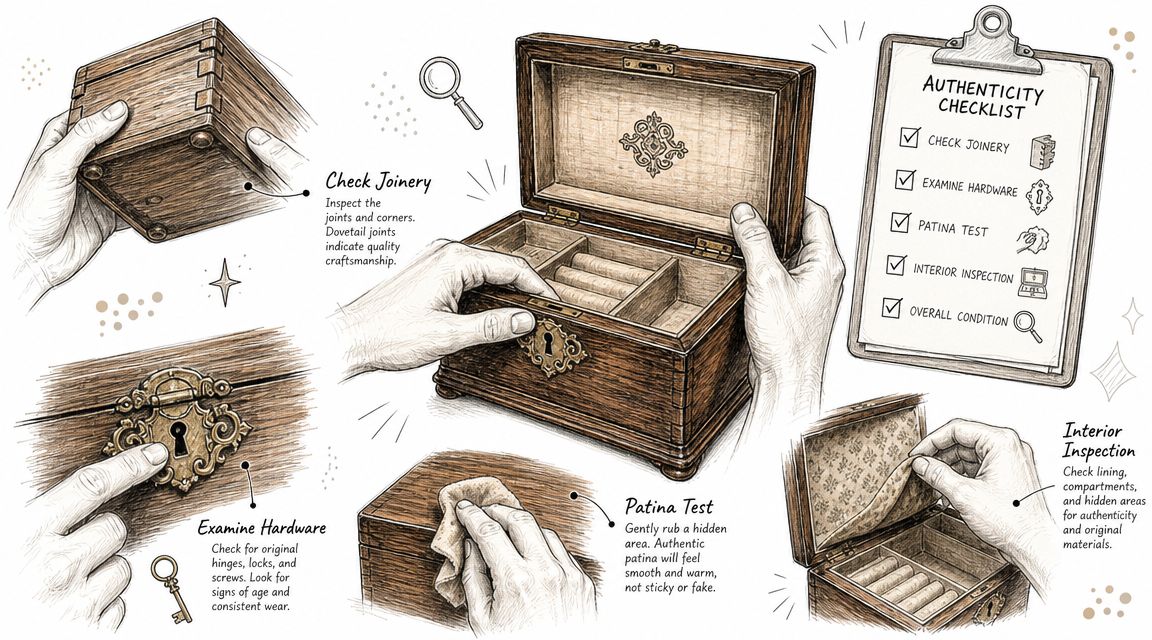
Start with the places a seller is least likely to polish for display. The underside, drawer bottoms, interior corners, hinge recesses, and back edges often reveal more than the lid or front panel. Old glue residue, uneven handwork, and honest wear are difficult to fake in a convincing way across the whole box.
Small irregularities can be reassuring. A hand-fitted lid may sit slightly differently from one side to the other. Carved details may vary in depth. Tiny inconsistencies often point to age and hand craftsmanship, while perfectly repeated distress marks can suggest a newer piece made to look old.
Climate matters here too. In West Texas and New Mexico, dry air can shrink wood, widen joints, and make old veneers lift at the edges. That kind of movement does not automatically mean a box is fake. It means you need to decide whether you are seeing natural aging in an arid home or a more serious structural problem that affects long-term use and display.
The fast inspection points that matter most
At a market stall or estate sale, you rarely get ideal lighting or unlimited time. A short checklist helps you stay calm and look past surface charm.
- Check lid fit. A lid should open and close with reasonable alignment. Severe binding, twisting, or a noticeably uneven gap can point to wood movement, warping, or old repair work.
- Inspect hinges and screws. Wear should look consistent with the rest of the box. Bright replacement screws, mismatched metals, or fresh cuts around the hinge area often signal later alterations.
- Study the lining. Original silk, velvet, or paper interiors usually age softly, with fading, compression, and wear where jewelry once rested. A replacement lining is not disqualifying, but it should suit the box rather than look newly crafted.
- Look for insect damage. Small exit holes, weakened wood, and powdery residue deserve close attention, especially if the box will live in a warm, dry room.
- Watch for heavy sanding or stripping. Rounded corners, blurred moldings, and flattened carving can erase the details collectors use to judge age and quality.
Conservation guidance from a major museum's furniture care resources notes that wood, veneer, joints, and surface finishes should be examined together because damage and repair often show up as a pattern rather than a single flaw, as explained in this furniture care guidance from the Smithsonian Museum Conservation Institute.
One more useful habit. Open the box and smell it. Fresh stain, modern glue, or a sharp chemical odor can suggest recent work, while an older interior often has the softer scent of aged wood, fabric, and time.
If wear appears only in one spot, pause. Genuine age usually shows up across several surfaces at once.
The goal is coherence. A box can have a replaced lining, a repaired hinge, or a small veneer crack and still be worth buying if the piece remains honest about what it is. That mindset also helps when you bring antiques into a modern home. A box with stable structure and visible history often adds more character to a clean-lined bedroom or Southwest interior than one polished into looking almost new.
If you are drawn to pieces made with lasting workmanship, the idea behind the sovereignty of quality in furniture and decor applies here too. Materials, craftsmanship, and integrity tend to reveal themselves over time.
For higher-value purchases, especially if the box includes precious metal fittings or if you are building insurance documentation alongside a collection, it helps to find a trusted watch appraiser or a similarly qualified decorative-arts specialist who can assess related components and provenance with care.
An authentic piece does not need to be perfect. It needs to make sense.
Understanding the Value of Your Antique Box
A beautiful old box can be inexpensive. A modest-looking one can be surprisingly valuable. That's why value should never be guessed from decoration alone. Buyers pay for a combination of age, material, condition, craftsmanship, and confidence in what the piece is.
Why age alone doesn't decide price
The strongest dividing line in this category is the difference between vintage and antique. Jewelry boxes under 100 years old are typically considered vintage, while those older than 100 years are antiques. That threshold has a real effect on pricing and buyer interest. Market summaries note that common vintage examples can sell for under $100, broader vintage pieces can range from about $10 to $1,000+, and antique jewelry boxes from the 16th, 17th, and 18th centuries can sell for a few hundred dollars apiece, while rare pieces can reach over $1,000, according to this pricing guide for rare and antique jewelry boxes.
Age still isn't enough on its own. A damaged antique with major loss can be less desirable than a well-kept vintage piece. Buyers want a box that still looks right, functions reasonably well, and retains the features that make it collectible.
The factors that shape market value
Some value drivers are visible immediately. Others require a little homework.
- Material quality matters. Mahogany and teak generally command more than walnut or oak in wooden examples.
- Condition shapes confidence. Clean structure, stable veneer, usable hinges, and an interior that feels appropriate all support stronger pricing.
- Rarity helps, but only with clarity. Unusual design can add interest, but only if the box still makes sense stylistically and structurally.
- Provenance adds trust. A documented family history, maker's mark, or traceable origin can make a piece easier to assess.
Collectors who also own fine watches or jewelry often find that the same mindset applies across categories. When questions about documentation, insurance, or formal valuation come up, it helps to find a trusted watch appraiser who explains condition, comparables, and recordkeeping clearly.
A buyer should also separate resale value from personal value. A box inherited from a grandparent may matter more emotionally than it would at auction. That doesn't reduce its importance in a home. It changes the reason for keeping it.
For homeowners who appreciate the role of craftsmanship in lasting furnishings, The Sovereignty of Quality offers a useful perspective on why materials and construction deserve close attention. The same principle applies here. Quality isn't a vague idea. It shows up in joinery, wood selection, fit, finish, and how gracefully an object ages.
Essential Care and Restoration Best Practices
Set an antique wood jewelry box on a sunny dresser in Midland or Santa Fe, leave it there through one heating season, and you may notice the lid fit change before you notice anything else. Old wood responds to its surroundings much like a wood floor or a vintage door. It swells a little, shrinks a little, and shows stress first at joints, veneer edges, and thin panels.
Protecting old wood in dry climates
That matters in any home. It matters even more in West Texas and New Mexico, where dry air, strong light, and indoor heating can pull moisture from old wood and glue lines faster than new collectors expect. The National Park Service explains in its guidance on museum collection preservation and environmental control that fluctuations in temperature, relative humidity, and light exposure can damage organic materials such as wood, veneers, and finishes.
A jewelry box often gives small warnings before serious damage appears. A lid that starts rubbing at one corner may point to wood movement. A veneer bubble may signal dryness or failing adhesive. Brass hardware that suddenly feels misaligned can mean the wood around it has shifted, not that the metal itself has failed.
Start with placement. In design terms, treat the box like a small wood furnishing rather than a trinket. It should look beautiful in the room, but it also needs a steady microclimate.
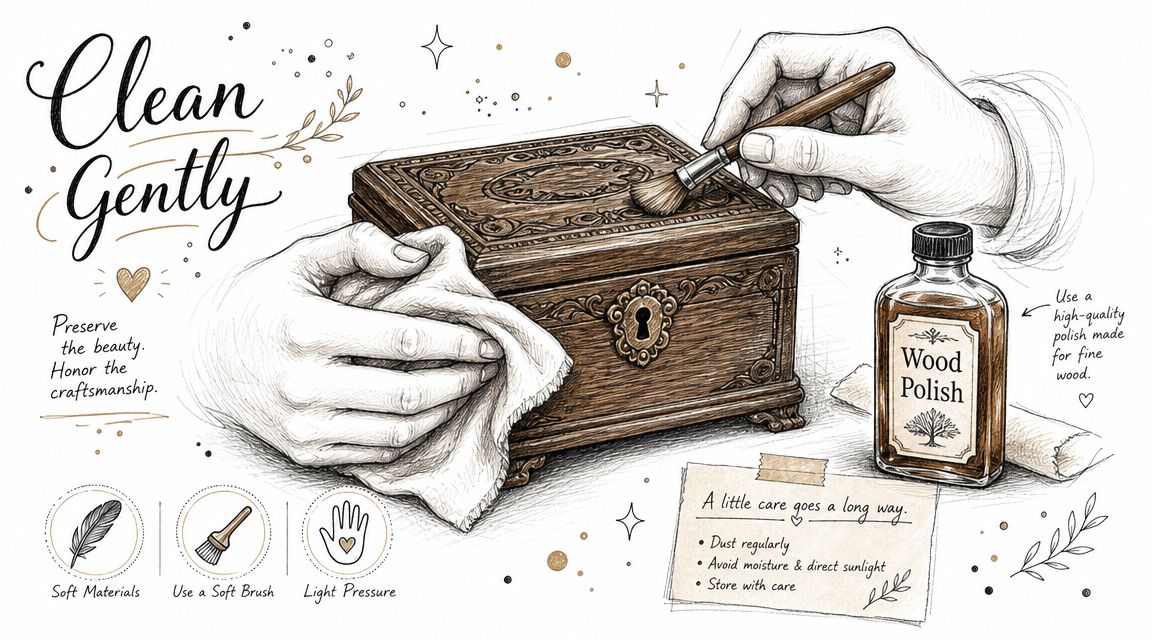
- Choose filtered light: Bright Southwestern sun can fade finish and dry wood quickly, even across a room.
- Keep it away from vents and radiators: Fast heat changes stress old joinery and glue.
- Avoid bathrooms and window ledges: Steam, sun, and temperature swings create repeated expansion and shrinkage.
- Dust with a soft dry cloth: Rough cloths and spray polishes can scratch or leave buildup in carved details.
- Open locks and clasps gently: Resistance is a signal to pause and inspect, not force.
Small changes matter.
Owners who want a broader refresher on household wood maintenance may also appreciate this practical guide on how to properly care for wood furniture. The same calm approach works well here. Gentle handling and stable placement usually do more good than frequent product use.
When to preserve and when to restore
Beginners often assume every worn surface needs repair. In antiques, that instinct can remove the very signs that make a piece appealing. A softened finish, slight darkening around the lid pull, or faded interior lining may be part of the box's history rather than a defect that needs correction.
A simple question helps. Is the problem structural, or is it mostly visual?
Structural problems deserve prompt attention. Loose hinges, active insect damage, separated joints, lifting veneer, and a lid that strains the carcass can worsen with normal use. Visual issues call for more restraint. Surface scratches, mellow brass, and age-related finish wear often belong to the piece and can sit comfortably in a modern interior where contrast and texture are part of the appeal.
A practical framework looks like this:
- Preserve as found if the box is stable, attractive, and still reads clearly as its original style.
- Repair selectively if one failing part threatens function, such as detached trim, a loose foot, or a hinge pulling free.
- Refinish only with caution if the original surface is already badly compromised and the box is being used mainly as a decorative home object rather than a collector piece.
This is the point where many owners get stuck, especially if they want the box to work in a polished contemporary room. Perfection is not the goal. Stability is. A carefully aged surface can look richer on a modern nightstand than a stripped and overly glossy finish that erases the box's character.
For day-to-day habits that support both preservation and attractive display, wood furniture care tips for placement, cleaning, and humidity awareness are useful, especially in homes where dry indoor air affects wood over time.
Styling Your Jewelry Box in a Modern Home
An antique box doesn't need an antique room. In fact, it often looks better when the setting gives it contrast. A carved wood box on a clean-lined dresser stands out because the surrounding shapes are calm. The age of the piece becomes the point.
Using contrast to make the box stand out
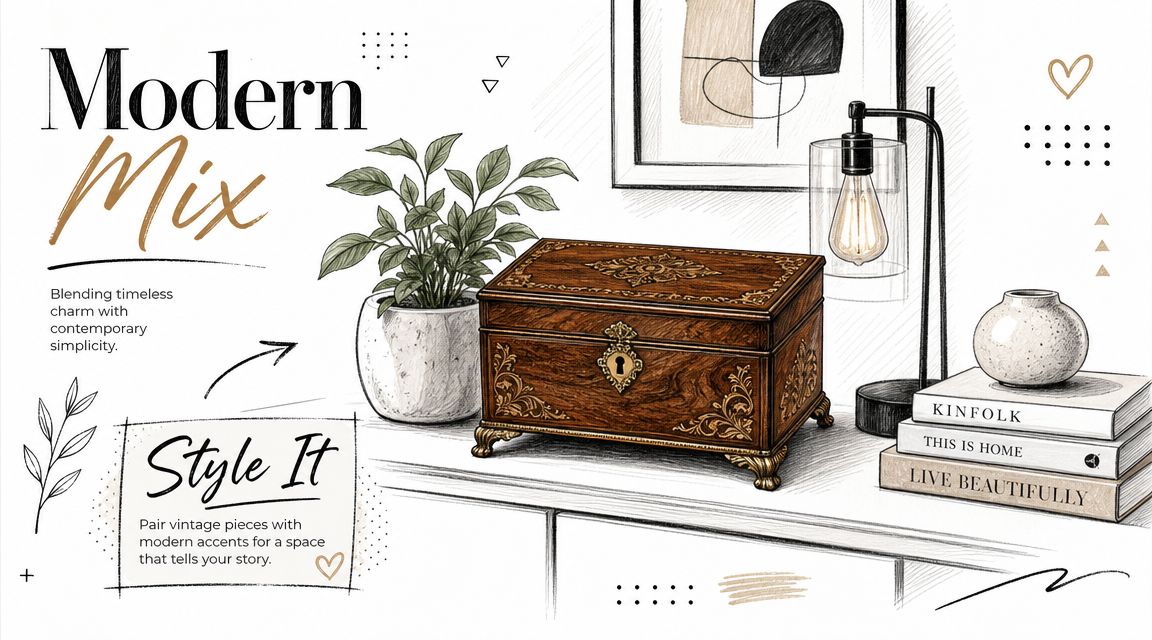
A darker antique wood jewelry box works especially well against pale painted furniture, stone tops, or lightly textured textiles. The grain adds depth. The small scale keeps the look personal rather than heavy. A simple lamp, a framed photo, and one natural element such as a plant or branch are often enough to create a balanced arrangement.
The box doesn't need to be centered to feel important. Off-center placement often looks more relaxed and intentional. A stack of books beneath it can raise its profile, while an open tray nearby can hold modern daily jewelry so the antique piece stays reserved for special items or visual impact.
A small antique reads best when the surrounding decor gives it breathing room.
A formal box with ornate hardware can also soften a room that feels too sharp or new. In a modern bedroom, it adds history. In a transitional living room, it contributes texture. In a home office, it can even hold keepsakes, cuff links, or letters while making the desk feel less impersonal.
Rooms where an antique box works beautifully
Different rooms create different moods for display.
- Bedroom dresser: The most natural fit. The box supports daily routine and adds intimacy.
- Accent chest in a hallway or guest room: A great place for a decorative vignette with books and a lamp.
- Bookshelf styling: Ideal for a box that's more collectible than functional. It breaks up rows of vertical lines with a horizontal form.
- Vanity or dressing area: Best for boxes that still open smoothly and have a useful interior.
A well-chosen surface makes a difference too. A piece such as the Hooker Furniture Beaumont Accent Chest would give an antique box enough presence without overwhelming it. The pairing works because both pieces rely on material character rather than trend-heavy styling.
The key is restraint. One antique box with room around it usually looks more elegant than several clustered together. The goal isn't to turn the room into a museum. It's to let one meaningful object tell part of the home's story.
Your Next Step from Collector to Curator
Once a person can identify the clues of style, notice authenticity signals, judge value sensibly, and protect old wood from environmental stress, ownership changes. The box is no longer just “old.” It becomes a chosen object with context. That shift is what turns a casual owner into a curator of personal history.
Curating doesn't mean filling a house with antiques. It means selecting pieces with intention and giving them the right role. One antique wood jewelry box on the right chest, dresser, or shelf can bring more character to a room than a dozen generic accessories. It can also serve as a bridge between generations, especially when it holds inherited pieces, letters, or mementos that deserve better than a drawer.
For owners who may eventually sell inherited contents rather than keep them, it helps to understand how to get the best price for your jewelry before making a decision. A box and its contents often carry separate value, and clear thinking protects both.
Practical home care still matters after styling does. If the chosen display surface has ever shown moisture marks, guidance on removing water rings from wood can help protect the furniture beneath a treasured box. Preservation works best when the object and the surface under it are both treated with care.
The most satisfying homes rarely look assembled in one afternoon. They look layered. An antique box contributes exactly that kind of depth. It adds craft, memory, and texture in a form that's easy to live with every day.
Miller Waldrop Furniture & Decor gives homeowners in West Texas and Southeastern New Mexico the tools to make special pieces look at home. Whether a room needs the right dresser, accent chest, bedside surface, or design guidance to balance old and new, Miller Waldrop Furniture & Decor offers curated furnishings, personalized help, and a stress-free shopping experience that helps treasured finds shine.