


A Practical Guide to Bed Sheet Measurements

A great mattress is only half the story. The real secret to a bed you can't wait to sink into is finding sheets that actually fit. A perfect fit means you can finally stop wrestling with that one corner that keeps popping off or waking up tangled in a bunch of loose fabric.
This guide will empower you to get that flawless fit, every single time.
Finding the Perfect Fit Starts With a Tape Measure
Have you ever played that frustrating game of tug-of-war with your fitted sheet? You pull it over one corner, and another one snaps free. It’s a nightly battle that usually comes down to one simple thing: a mismatch between your sheet size and your mattress dimensions.
But you can end that struggle for good. The fix isn't about buying more expensive sheets; it's about ditching the guesswork. Think of this guide as your cheat sheet to measuring your bed like a pro and finally understanding what those bedding labels are trying to tell you.
Why Getting it Right Matters
A proper fit goes way beyond just looking neat. It's about your comfort. Sheets that are stretched too tight can squash the cushy loft of your mattress topper, making it feel less comfortable. On the other hand, loose sheets that bunch up create annoying wrinkles that you can feel all night. A snug, secure fit is the tool you need to turn a good bed into a great one.
Here’s what you'll be able to accomplish:
- No More Guessing: You'll learn a simple, foolproof way to get your mattress's exact dimensions.
- Decode the Lingo: You'll master terms like "pocket depth" so you know exactly what you're buying.
- Shop Like a Pro: You'll walk into any store with the confidence to choose sheets that feel custom-made for your bed.
The most overlooked detail? Mattress depth. Many standard sheet sets were made for the thinner mattresses of yesterday, leaving them totally unprepared for today's plush pillow-tops and thick toppers.
Once you master a few simple measurements, you can handle any bedding situation. Whether you have an extra-deep mattress, just added a new foam topper, or are simply ready for an upgrade, you'll have the know-how to make the right choice.
Ready to find sheets that feel tailored just for you? Explore our hand-picked collection of high-quality Sheets & Pillowcases and discover the difference a perfect fit can make.
How to Measure Your Mattress for a Flawless Fit
We’ve all been there: wrestling with a fitted sheet that just won't stay put. The journey from that tangled mess to a perfectly made bed starts with a simple measuring tape. Taking a few minutes to get your bed’s true dimensions is the single best action you can take to win the nightly battle against slipping corners.
Sure, standard sizes like "Queen" or "King" are a good starting point, but they don't tell the whole story—especially with today's deep pillow-tops and plush mattress toppers. Think of this as creating a custom blueprint for your bed. With the right numbers in hand, you can finally choose sheets that hug every corner for that crisp, hotel-like finish you've been dreaming of.
The Three Essential Measurements
First things first, strip the bed. You need to measure the mattress itself, so take off all the pillows, comforters, and sheets. But here’s a key tip: leave any mattress protectors or toppers right where they are. Their height is a crucial part of the final measurement.
Grab a flexible tape measure and let’s find your three magic numbers.
-
Width: Measure straight across the mattress from the left edge to the right. To get an accurate reading, do this at the widest point, usually right in the middle. Keep the tape pulled taut.
-
Length: Now, measure from the head of the mattress all the way down to the foot. Just like with the width, make sure the tape is lying flat against the surface for the most precise number.
These first two numbers will confirm whether you have a standard Twin, Full, Queen, or King. But it's the third measurement that truly makes all the difference.
The Game Changer: Mattress Depth
Mattress depth (or height) is your secret weapon in the quest for the perfect fit. This single dimension is the #1 reason why fitted sheets fail. Many standard sheets are designed for older, thinner mattresses around 8 to 12 inches deep. But modern pillow-top, hybrid, and memory foam mattresses can easily be 15 inches or even more.
Here’s how you can find your mattress depth:
- Place something firm and straight, like a ruler or yardstick, on top of the mattress so it hangs just over the side.
- Using your tape measure, measure from the bottom edge of the mattress up to the bottom of the ruler.
- Crucially, you must include any mattress toppers or pads in this measurement. If you have a 12-inch mattress and a 3-inch topper, your total depth is 15 inches.
One of the most common mistakes people make is measuring only the mattress and forgetting about the topper. That extra few inches makes a huge difference and is often why sheets keep popping off.
Once you have this number, you’re ready to shop with confidence. Look for the "pocket depth" listed on the sheet packaging. A great rule of thumb is to choose a pocket depth that is at least 2 inches deeper than your mattress height. For a 15-inch mattress, you’d want sheets with a pocket depth of 17 inches or more. That extra fabric is what allows the elastic to tuck securely under the mattress, creating a snug fit that won't budge.
With these three simple numbers—width, length, and depth—you have everything you need. You're no longer just buying a "Queen" sheet set; you're selecting one with the exact measurements to fit your unique bed.
Ready to put your new expertise to the test? Explore our collection of high-quality Sheets & Pillowcases, where you can find beautiful options designed for every mattress depth.
Decoding Bed Sheet Sizes and Dimension Charts
Alright, you've got your mattress measurements. That’s the hard part done. Now, let's turn those numbers into the perfect set of sheets. This is where you go from guessing with size names like "Queen" or "King" to knowing with certainty. Think of it as having the secret code to bedding—it lets you shop with complete confidence, whether you're here with us in the store or browsing online.
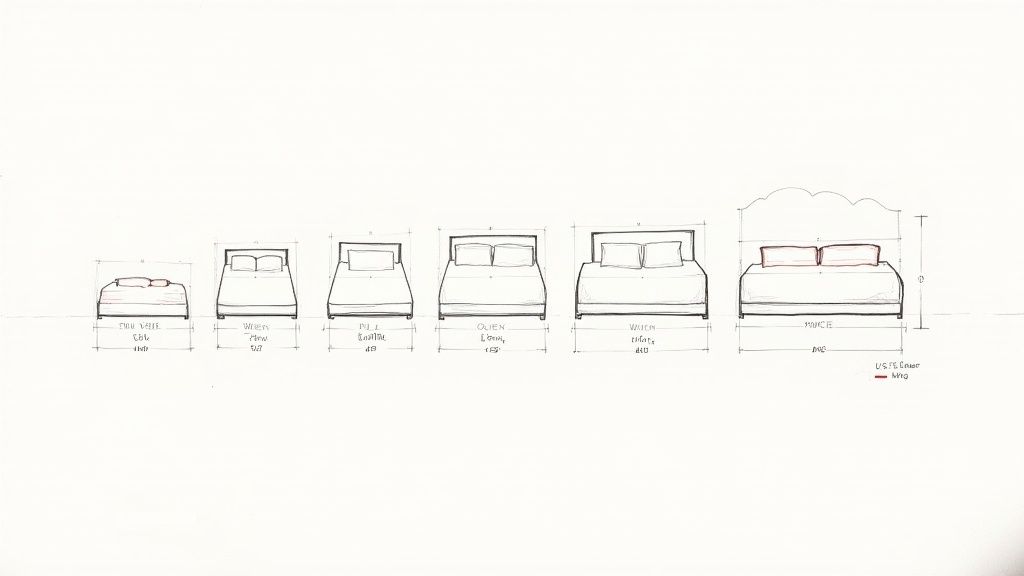
The standard size charts are a fantastic starting point, a reliable guide. But it’s your personal measurements that will ultimately confirm a perfect, hotel-quality fit. This chart will be your new best friend, helping you quickly spot the right sheets for any bed in your house.
Standard US Bed and Sheet Size Dimensions (Inches)
Navigating bed sheet measurements can feel a little overwhelming at first, but this simple chart breaks down all the common US sizes. Use it as your quick reference to match your mattress dimensions to the fitted and flat sheets you'll see on the packaging.
| Mattress Size | Mattress Dimensions (Width x Length) | Standard Fitted Sheet (Width x Length) | Standard Flat Sheet (Width x Length) |
|---|---|---|---|
| Twin | 38" x 75" | 39" x 75" | 66" x 96" |
| Twin XL | 38" x 80" | 39" x 80" | 66" x 102" |
| Full (Double) | 54" x 75" | 54" x 75" | 81" x 96" |
| Queen | 60" x 80" | 60" x 80" | 90" x 102" |
| King | 76" x 80" | 76" x 80" | 108" x 102" |
| California King | 72" x 84" | 72" x 84" | 102" x 110" |
Just one important thing to remember: the fitted sheet dimensions in this table don't include the pocket depth. That's the crucial third measurement you took earlier. Always, always check the packaging for that pocket depth to make sure it can handle your mattress height.
Beyond the Label: What Sizes Really Mean
While the chart gives you a solid foundation, the real world of bedding isn't always so cut and dried. Ever wonder why a "King" sheet from one brand fits differently than another? Or why one from overseas doesn't fit at all? Understanding these little differences is the key to avoiding those frustrating and costly buying mistakes.
It all comes down to the fact that sheet sizes are based on regional mattress standards, and those vary wildly around the globe. For example, a standard US Queen is 60 by 80 inches, so the sheets are made to fit that, plus a pocket depth of anywhere from 7.5 to 16 inches to accommodate different mattress thicknesses. A European King, on the other hand, is actually narrower and a bit shorter.
By understanding both US and international sizing, you empower yourself to shop anywhere. This knowledge transforms you from a hopeful buyer into a confident expert who knows exactly what to look for, no matter the brand or origin.
This is exactly why your own measurements are your superpower. They are your ground truth. No matter what a package says—"King," "Super King," or "Euro King"—you can check it against your numbers and know if it will actually fit your bed back home. To see just how different things can be, you can explore the different mattress sizes in Australia.
Putting Your Knowledge into Action
So now, you’re in the driver's seat. You have the measurements and the charts to make sense of any label you come across. The next time you're shopping for sheets, you can confidently walk right past the ones that won't work and zero in on the set that will give you that perfect, snug fit you’re looking for.
Here are a few final tips to keep in mind:
- Trust Your Tape Measure: If you have a non-standard mattress, your measurements are gospel. Always trust them over the size name on the package.
- Don't Forget the Topper: Your mattress depth measurement absolutely must include any mattress toppers or pads you use.
- Read the Fine Print: Get in the habit of looking for the specific dimensions and pocket depth listed on the sheet set's packaging.
Of course, getting the right sheets starts with having the right mattress. If you're not sure which bed size is best for your room and your life, here's how you can determine what size mattress you might need. When you have the right foundation and the perfect sheets, you're well on your way to creating your dream sleep sanctuary.
Solving the Most Common Sheet Fitting Problems
You’ve measured your mattress and you’ve stared at the size charts, but somehow, that perfect, snug fit still feels out of reach. This is where you tackle the most common—and frankly, most frustrating—sheet-fitting problems you’ll run into. From that dreaded middle-of-the-night corner pop to a flat sheet that refuses to tuck, these issues can turn a beautiful bed into a nightly battle.
The good news? Every single one of these problems has a straightforward solution. It’s not about finding some magical, one-size-fits-all sheet set. It’s about understanding why these things happen and knowing exactly what to look for. With a few simple adjustments to how you shop, you can conquer any bedding challenge and get that crisp, secure fit you’re after.
Why Does My Fitted Sheet Keep Popping Off?
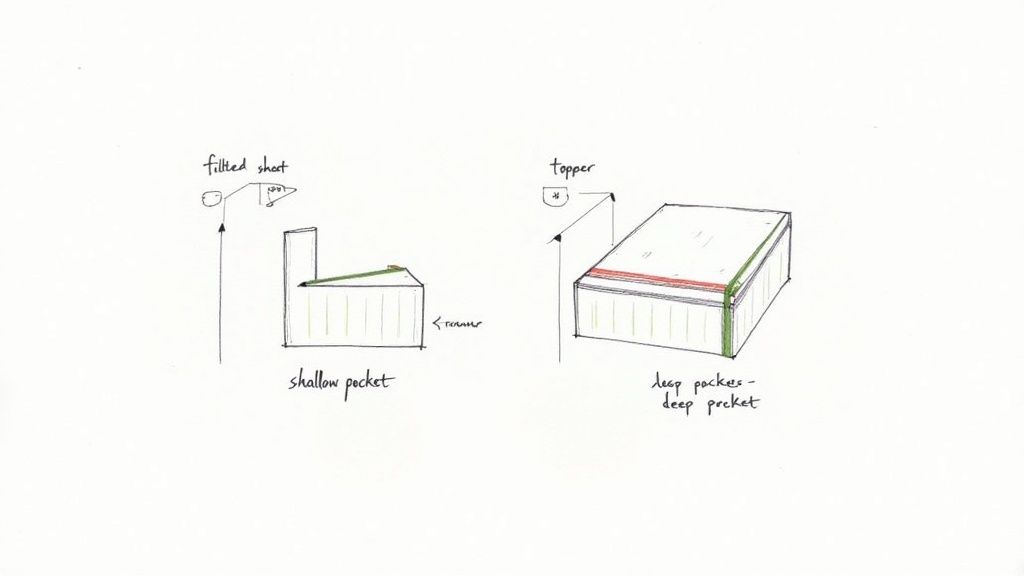
This is, without a doubt, the number one complaint about bedding. You meticulously tuck it in, smooth it all out, and by morning, one corner has snapped loose and is halfway up the mattress. The culprit is almost always the same: incorrect pocket depth.
When a fitted sheet's pocket is too shallow for your mattress, the elastic simply can't get a proper grip underneath. Every time you move, you're pulling the fabric up and over the corner until it finally gives way. This has become a huge issue as modern mattresses have gotten so much thicker with plush pillow tops and layers of memory foam.
Your Solution:
- Measure Again: Don't guess! Re-measure your mattress depth, and be sure to include any toppers or pads in that measurement.
- Shop Smarter: Keep an eye out for sheets specifically labeled as "deep pocket" or "extra-deep pocket."
- The 2-Inch Rule: Always choose a pocket depth that is at least 2 inches deeper than your total mattress height. If you have a 14-inch mattress, you need a sheet with a minimum 16-inch pocket.
Think of those extra 2 inches as your insurance policy. It provides just enough fabric to wrap fully under the mattress, giving the elastic something to hold onto, no matter how much you toss and turn.
The bedding industry has been playing catch-up with mattress trends for a while. For example, in Europe, mattress lengths started growing from 190 cm to 200 cm or more after the 1980s to better fit taller people. This shift forced sheet manufacturers to adjust their sizes, including offering deeper pockets for modern mattresses. You can see more about how bedding sizes have evolved to keep up with today’s beds.
My Flat Sheet Is Too Short to Tuck In
Here’s another classic frustration: you get the fitted sheet on perfectly, but the flat sheet barely grazes the bottom of the mattress. There’s nothing to tuck in, which means you’re left with a messy look and tangled feet by sunrise. This is especially common with extra-deep mattresses; the fitted sheet in the set might have deep pockets, but the manufacturer forgot to make the flat sheet bigger, too.
A flat sheet needs enough length and width to not only cover the top but also have several inches of extra fabric on the sides and foot to get a secure tuck.
Your Solution:
- Size Up: Don't be afraid to buy a flat sheet that’s one size larger than your mattress. Using a King flat sheet on a Queen bed gives you plenty of fabric for a deep, satisfying tuck that will stay put.
- Check the Dimensions: Look past the size name (Queen, King, etc.) on the package and find the actual dimensions, like 90" x 102". That’s the real number that tells you if it will be long enough.
What About Mattress Toppers?
A mattress topper can be a game-changer for comfort, but it’s also a leading cause of sheet-fitting headaches. That 3-inch foam topper you added instantly turns your standard 12-inch mattress into a 15-inch deep one. Forgetting to account for that extra height is an incredibly common pitfall.
Your bed sheet measurements must always be taken with the topper on the bed. That total height is the number you need to use when you're shopping for pocket depth.
Now that you’re equipped to solve these common problems, you can find sheets that not only fit but make your bed a true sanctuary. The final step is choosing a set that feels as good as it looks. Find the perfect foundation for your sleep in our curated collection of Sheets & Pillowcases, all designed for a flawless fit.
Your Expert Guide to Choosing the Perfect Sheets
With your measurements in hand, you’re ready for the fun part—choosing sheets that feel absolutely incredible. You’ve done the practical work, so now you can focus on finding the quality and comfort that will turn your bed into a personal retreat.
This is about more than just picking a color. It's about understanding why one set of sheets feels crisp and cool while another feels silky and smooth against your skin. Your measurements are the key that unlocks the door, and now you can discover the perfect materials to create your ideal sleep sanctuary.
Beyond the Numbers: Material and Feel
A perfect fit is non-negotiable, but the right fabric is what creates that "ahhh" moment when you slide into bed. The material is what determines how a sheet breathes, how it drapes, and how it feels. Here's how you can personalize your sleep experience.
Here are a few popular choices and what you can expect from them:
- Cotton Percale: If you love the cool, crisp feel of classic hotel sheets, percale is for you. It's wonderfully lightweight, breathable, and actually gets softer with every wash.
- Cotton Sateen: For those who crave a silky-smooth, almost buttery texture, sateen is the ideal choice. It has a subtle luster and drapes beautifully, offering a cozier, slightly warmer feel.
The fabric's weave doesn’t just affect comfort; it can also play a small role in fit. For instance, the smoother finish of sateen might feel a bit more forgiving over a thick mattress topper compared to a more rigid percale. Knowing these little differences helps you zero in on sheets that truly match your sleep style.
Your bed is more than just a piece of furniture; it’s the foundation for your well-being. Investing in high-quality sheets that fit perfectly and feel wonderful is an investment in better rest and, ultimately, better days.
Decoding Thread Count: The Real Story
We’ve all seen the impressive numbers—800, 1000, or even higher—marketed as the pinnacle of luxury. But here's the inside scoop: a higher thread count doesn't automatically mean a better sheet. Thread count is simply the number of threads woven into one square inch of fabric.
While a solid thread count (think in the 200-500 range) is a good sign of quality, the type of fiber and the quality of the weave are far more important. In fact, a sky-high thread count can sometimes be a red flag, achieved by using thinner, lower-quality threads. This can result in a sheet that is less durable and doesn't breathe well.
So, instead of getting hung up on that one number, look for clues about the material itself. Is it made from long-staple cotton? What kind of weave is it? These details give you a much more honest picture of how the sheets will perform night after night. Our complete guide to bedding will help you dive even deeper into selecting the right materials for every layer of your bed.
Putting It All Together for the Perfect Bed
You now have all the tools you need to win the day—or in this case, the night. You know how to measure your mattress, read the sizing charts, troubleshoot common fit problems, and now, choose the materials that will bring you a new level of comfort.
You can walk up to any bedding package and know exactly what you’re looking at. Just find the three key pieces of information: the size (e.g., Queen), the pocket depth (e.g., 18 inches), and the material (e.g., 100% long-staple cotton). With that knowledge, you can confidently pick a high-quality sheet set that will feel like it was made just for you.
Your journey to a better night’s sleep is complete. Find the perfect final piece for your sleep sanctuary by exploring our curated collection of premium Sheets & Pillowcases today.
Answering Your Top Bed Sheet Measurement Questions
Even after you've measured everything perfectly, a few "what if" questions can still pop up. That’s perfectly normal. We’re here to clear up that last bit of confusion so you can buy your next set of sheets with total confidence.
Think of this as the final piece of the puzzle. You’ve done the hard work, and now you’re ready to handle any curveball, ensuring nothing gets in the way of a perfectly made bed.
What Happens If My Sheets Have a Pocket Depth That Is Too Deep?
It’s a common thought: "I'll just buy the deepest pockets I can find to be safe." But that well-intentioned idea can backfire. While sheets that are too shallow will constantly pop off the corners, sheets that are way too deep create their own set of frustrations.
All that extra fabric has to go somewhere, and it usually ends up bunched uncomfortably beneath you. The elastic hem won't be pulled taut around the mattress base, so instead of a snug fit, you get a baggy sheet that shifts and slides around just as much as one that’s too small.
For that crisp, secure fit that feels as good as it looks, you want to hit the sweet spot: a pocket depth that’s 2 to 3 inches deeper than your mattress. That gives you just enough fabric to tuck securely without leaving loose material to wrinkle up.
Can I Use Queen Sheets on a Full Mattress?
We've all been tempted to make do, but trust us on this one—using the wrong size sheets just doesn't work. A Queen mattress is 6 inches wider and 5 inches longer than a Full. If you try to put a Queen fitted sheet on a Full bed, you'll end up with a saggy, wrinkled mess because the elastic has nothing to grip.
Going the other way is even worse; a Full sheet simply won't stretch over a Queen mattress. As for the flat sheet, a Queen-sized one will drape too long on a Full bed, looking sloppy and getting tangled. A Full flat sheet on a Queen bed? You'll be lucky if you can tuck it in at all. Always match your sheet size to your mattress size for the best look and feel.
How Does a Mattress Topper Change the Sheet Size I Need?
Ah, the mattress topper—the number one reason perfectly good sheets suddenly stop fitting. People often forget that a topper adds real height to the mattress, and that new total is what really counts.
When you measure your mattress depth, you must include the topper's thickness in your calculation.
- For example: If you have a 12-inch mattress and add a 3-inch memory foam topper, your new total mattress depth is 15 inches.
- Your new mission: You should now be looking for sheets with a pocket depth of at least 17-18 inches. This ensures the pocket is deep enough to cover both your mattress and the topper without a struggle.
Should I Wash New Sheets Before Using Them?
Yes, absolutely. Washing new sheets before you sleep on them is a non-negotiable for two main reasons. First, it rinses away any starches or residues left over from the manufacturing process. This step alone makes them feel much softer and more comfortable against your skin.
Second, it's about getting the right fit. Manufacturers, especially those using natural fibers like cotton, often cut the fabric a tiny bit large to account for the slight shrinkage that happens in the first wash. By washing them right away, you're letting the sheets settle into their true, final size. It’s a simple trick that guarantees a better fit from night one and is a great first step in a healthy sleep routine.
You're now ready to pick out sheets that will fit your bed like a glove. The final step is finding a set that not only fits perfectly but also gives you the comfort you’ve been dreaming of. At Miller Waldrop, we believe the right bedding is the final touch that turns a bedroom into a true sleep sanctuary.
Come explore our collection and find the perfect foundation for a great night’s sleep. Discover your ideal Sheets & Pillowcases today.