


How to Choose a Cervical Pillow for Neck Pain & Finally Sleep Better


If you’re starting your day with that familiar, nagging ache in your neck, your pillow is the first place you should look for answers. It's a problem many of us just learn to live with, but you don't have to. The key to waking up refreshed often comes down to finding a pillow that truly supports you, specifically one that matches the way you sleep.
The right cervical pillow for neck pain can completely change how you feel in the morning by keeping your spine properly aligned. Let's walk through how you can find the perfect one and finally get some real, restorative sleep.

Your Guide to Waking Up Without Neck Pain
A sore, tight neck in the morning can ruin your whole day before it even begins. It's easy to blame a bad night's sleep, but the real culprit is often the very thing meant to provide comfort: your pillow. A pillow’s job is much more than just being a soft cushion; it’s a critical piece of sleep equipment. Its primary function is to support the natural C-shaped curve of your neck, keeping your head in a straight, neutral line with the rest of your spine.
When a pillow is too high, too low, or lacks the right support, it forces your neck into an awkward angle for hours on end. This constant strain on your muscles and vertebrae is exactly why you wake up feeling stiff and sore instead of rested.
Why Your Pillow Is Your Best Defense
Think of a cervical pillow as a specialized tool built for one purpose: to provide the ergonomic support standard pillows just can't offer. It’s designed to perfectly fill the gap between your head, neck, and the mattress. By cradling your neck correctly, it allows those hard-working muscles to finally relax and recover overnight.
This isn't just a niche idea anymore. As more people connect the dots between sleep posture and overall wellness, the global cervical pillow market has grown to an estimated USD 1.055 billion in 2024. With modern problems like "tech neck" on the rise from spending hours hunched over screens, people are rightly looking for ways to improve their posture, even while they sleep.
Choosing the Right Pillow for Your Sleep Style
The single most important factor in choosing a pillow is how you sleep. Your dominant sleep position determines the amount of space between your head and the mattress, and your pillow needs to fill that space just right.
A good starting point is to match your sleep habit with the pillow type best suited for it.
Quick Guide to Pillow Types by Sleep Position
| Sleep Position | Recommended Pillow Shape | Ideal Firmness |
|---|---|---|
| Side Sleepers | Higher-loft, often with a contoured dip for the head or a gusseted side panel. | Medium-Firm to Firm to prevent the head from drooping. |
| Back Sleepers | Lower-loft with a raised, rounded edge to support the curve of the neck. | Medium to cradle the head without pushing it forward. |
| Stomach Sleepers | Very thin and flat, almost like no pillow at all. | Soft to minimize the upward bend of the neck. |
| Combination Sleepers | Contoured with varied heights or a softer, moldable material like shredded memory foam. | Medium to adapt to different positions. |
This table provides a great snapshot, but remember that personal comfort is also a huge part of the equation.
A quality neck pain pillow is an investment in your daily comfort and long-term health. At Miller Waldrop, we know that finding the right solution can feel overwhelming. That's why our in-store sleep experts are here to help you get properly fitted. You can use their expertise to select the perfect tool for the job, like a supportive Serta pillow, so you can finally win back your mornings.
The Science of Spinal Alignment During Sleep
Think of your spine as a busy highway. All day long, it’s dealing with the traffic of daily life—gravity, your posture at a desk, the stress you hold in your shoulders. Sleep is supposed to be the time when the overnight road crew comes out to make repairs. But that crew can't do its job if the highway is bent into a detour.
If your pillow is forcing your neck into an awkward angle, that’s exactly what's happening. You're creating a nightly detour that strains muscles, pinches nerves, and leads to that all-too-familiar morning neck pain. Once you grasp this, you'll stop seeing pillows as just soft things for your head and start seeing them as essential tools for your health.
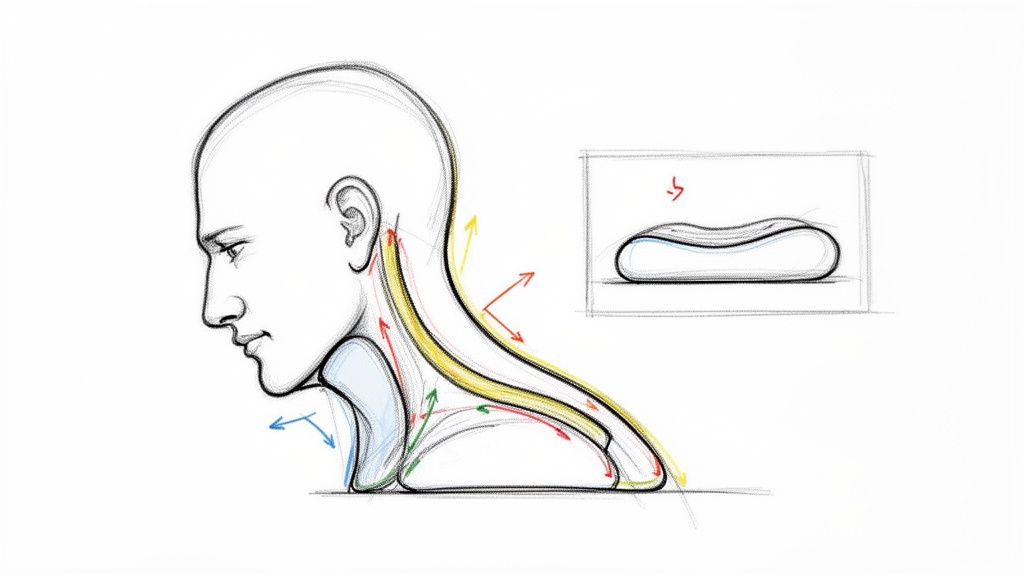
What Is the Cervical Curve?
Here’s something that surprises a lot of people: your neck isn't supposed to be perfectly straight. It has a natural, gentle C-shaped curve, known as the cervical curve. This curve is an incredible piece of engineering, acting like a spring to support the weight of your head—which is a hefty 10-12 pounds—and absorb shock as you move.
The whole goal of a good night's sleep is to maintain that natural curve. If your pillow is too high, it shoves your head forward and flattens the C-shape. Too low, and your head lolls backward, overextending it. Either way, you're creating a bottleneck where your muscles and nerves are put under pressure all night long.
The Problem with Traditional Pillows
For years, we were sold on the idea that the best pillow was the fluffiest one you could find. While that sounds cozy, those soft, squishy pillows are often the culprits behind chronic neck pain. They simply fail where it counts most.
- They Collapse Under Pressure: Pillows filled with down or basic polyester feel great at first, but they compress overnight. As they flatten, your head sinks, your alignment is lost, and the support you started with is gone.
- They Offer One-Size-Fits-All Support: A standard rectangular pillow is just a flat surface. It doesn't account for the gap between your neck and the mattress, leaving the crucial cervical curve completely unsupported.
- They Can Trap Heat: Many traditional materials don't breathe well, causing you to get hot and reposition yourself constantly. All that tossing and turning just means more disruption to your spinal alignment, preventing you from ever reaching deep, restorative sleep.
A pillow that doesn't maintain neutral spinal alignment forces your neck muscles to work all night long instead of rest. It's like trying to repair a highway while traffic is still moving—the work is inefficient and the results are poor.
This is exactly where a cervical pillow for neck pain changes the game. It's not just a pillow; it's a specialized tool designed to do what a standard pillow can't: hold your spine in proper alignment. It fills that empty space under your neck, cradles your head, and keeps your cervical spine in its ideal, neutral position.
When that happens, your muscles can finally relax. The pressure on your nerves subsides. Your body gets the all-clear to begin its essential overnight recovery work. The result is waking up feeling mobile and refreshed, not stiff and sore.
Finding the right tool for the job is key. For instance, a quality Beautyrest pillow is built with specific shapes and responsive materials engineered to provide this exact kind of structural support. You can leverage the expertise of our Sleep Experts at Miller Waldrop to walk through these differences in person, helping you find the pillow that finally puts an end to your morning neck pain.
Finding Your Perfect Pillow Material and Design
Walking into the pillow aisle or browsing online can feel completely overwhelming. With so many options, how do you even begin to choose? The good news is that all this variety is your greatest advantage in the fight against neck pain. It’s not about finding one single "best" pillow—it's about finding the right material and shape that works for your body.
Think of it like finding the right tool for a specific job. Each pillow material has its own unique strengths. Your task is to match those strengths to what your neck and sleep style truly need. Let's dig into the most common materials to help you find that perfect fit for a night of deep, restorative sleep.
Memory Foam: The Pressure-Relief Champion
There's a reason memory foam is a titan in the world of ergonomic sleep. This material uses your own body heat and weight to soften and mold perfectly to the contours of your head and neck. The result is a custom-fit cradle that distributes your weight evenly, taking the pressure off those sore, sensitive spots.
If you’re someone who wakes up with that familiar ache or stiffness, a solid memory foam pillow can be a revelation. It provides consistent, firm support that doesn't flatten out or shift around as you sleep. This stability is key to keeping your spine in a healthy, neutral line all night long, which is exactly what you need for reliable relief.
Memory foam dominates the cervical pillow market, holding a 45% share because it's incredibly durable and excels at relieving pressure. Higher-end options, like high-density foams (5.0 lb/ft³), can hold their supportive shape for up to 36 months. For comparison, standard foams might start breaking down in just 6-12 months. This long-lasting, consistent support makes it a go-to for people dealing with chronic issues like cervical spondylosis or daily tension headaches.
Shredded Memory Foam: The Adaptable Ally
What if you love the contouring feel of memory foam but want something a bit more plush and customizable? Enter shredded memory foam. These pillows are filled with thousands of tiny pieces of foam, giving you the freedom to fluff, scrunch, and shape the pillow to your heart's content.
This makes them a fantastic option for combination sleepers who are constantly changing positions. You can easily bunch it up for more height when you roll onto your side or flatten it out when you move to your back. Many even let you add or remove the filling yourself, giving you total control over the pillow's loft and firmness.
- Adjustable Loft: You can fine-tune the height to perfectly match your shoulder width and sleeping position.
- Improved Airflow: All those individual pieces create air pockets, allowing for much better ventilation than a solid block of foam. This means a cooler night's sleep.
- Moldable Comfort: It gives you the pressure-relieving benefits of memory foam but with the cozy, scrunchable feel of a traditional down pillow.
Latex: The Responsive and Cool Contender
If memory foam’s slow-sinking feeling isn't for you, latex might be your perfect match. Latex offers a more buoyant, responsive support. Instead of slowly contouring, it provides an immediate, gentle push-back that cradles your head without letting it sink too far.
One of the biggest perks of latex is its natural breathability. The material has an open-cell structure that promotes constant airflow, making it one of the coolest, most refreshing pillow materials you can find. On top of that, it's naturally hypoallergenic and resistant to dust mites and mold, which is a huge win for anyone with allergies.
Ultimately, choosing a pillow is a deeply personal decision. Our comprehensive guide on how to choose the perfect pillow offers even more advice to help you narrow down the options. A quality cervical pillow for neck pain is an investment in your daily well-being, and having the right tools—like the expertly designed Beautyrest Harmony Lux Carbon Pillow—can finally help you win the battle against pain.
How to Match Your Pillow to Your Sleep System
Your pillow is just one half of the equation. For it to truly work its magic against neck pain, it needs to be perfectly in sync with the other major player: your mattress. Think of them as a team. When they work together, they keep your spine perfectly aligned. When they're mismatched, your neck and back are the ones that suffer.
This is where you can start thinking like a sleep expert. By understanding how your pillow and mattress interact, you can look at your own setup and see exactly what needs to change for a night of truly restorative sleep.
Aligning Your Pillow with Your Sleep Position
We’ve talked about how important your primary sleep position is, and it really is the number one factor in choosing a pillow. The whole point is to achieve a neutral spine, where your head, neck, and back form a relatively straight line. Here’s what that looks like in practice.
For Side Sleepers: Your main challenge is filling that big gap between your ear and your mattress. To do that, you'll need a pillow with a higher loft (meaning it's thicker) and a medium to firm feel. This support prevents your head from sagging down, which is a classic recipe for neck strain and shoulder pain. A firm, substantial pillow is your best friend here.
For Back Sleepers: The goal is to support the natural curve of your neck without shoving your head too far forward. A pillow with a lower loft is usually the answer, especially one with a contoured shape that has a little bump designed to cradle your neck. This lets your head rest comfortably while preventing your chin from tucking into your chest—a position that puts a lot of stress on your neck muscles.
For Stomach Sleepers: This is, hands down, the toughest position for neck health because it forces your neck to twist at a sharp angle all night. If you can’t break the habit, the best you can do is minimize the strain. Use an extremely thin, soft pillow, or even no pillow at all, to keep your head and neck as close to a flat, neutral position as possible.
The Mattress Factor: How Firmness Changes Everything
This is the detail most people miss. Your pillow's loft and firmness needs aren't set in stone; they change based on how firm your mattress is. Your mattress dictates how much your body sinks, and that directly changes the distance your pillow needs to fill.
Think of it like this: If you're lying on a soft mattress, your shoulders sink in, closing the gap between your head and the bed. You'll need a thinner pillow. But on a firm mattress, your shoulders stay on top, creating a bigger gap that requires a thicker pillow to fill.
Let’s break it down.
If You Have a Soft Mattress: When you lie on a plush, cloud-like bed, your torso and shoulders naturally sink deeper. This actually shrinks the space between your head and the mattress. Because of this, you’ll need a thinner, lower-loft pillow to keep your spine straight. A thick pillow on a soft bed would crank your head upwards, creating a painful angle.
If You Have a Firm Mattress: On a firm bed, your body rests right on top with very little sinkage. This creates a much larger gap that the pillow needs to fill, especially for side sleepers. To bridge that space, you’ll need a thicker, higher-loft pillow. Using a thin pillow on a firm mattress would let your head drop, causing immediate strain.
Picking the right foundation is the first step. If you think your mattress might be the real culprit, our guide on finding the right mattress can help you get started on building a better sleep system from the ground up.
To help you put it all together, this table cross-references your sleep style and mattress type to give you a solid starting point for your ideal pillow loft and firmness.
Pillow Loft and Firmness Based on Sleep Style and Mattress Type
| Sleep Position | Mattress Firmness (Soft/Medium/Firm) | Recommended Pillow Loft (Low/Medium/High) | Recommended Pillow Firmness (Soft/Medium/Firm) |
|---|---|---|---|
| Side Sleeper | Soft | Medium Loft | Medium |
| Side Sleeper | Medium | Medium-High Loft | Medium-Firm |
| Side Sleeper | Firm | High Loft | Firm |
| Back Sleeper | Soft | Low Loft | Soft-Medium |
| Back Sleeper | Medium | Low-Medium Loft | Medium |
| Back Sleeper | Firm | Medium Loft | Medium-Firm |
| Stomach Sleeper | Any | Low Loft (or none) | Soft |
Remember, these are expert recommendations, but your personal comfort is what matters most. Use this as your guide, then fine-tune based on what feels best for your body.
This decision guide can also help you visualize which pillow materials are best suited for different needs, like pressure relief versus adjustability.
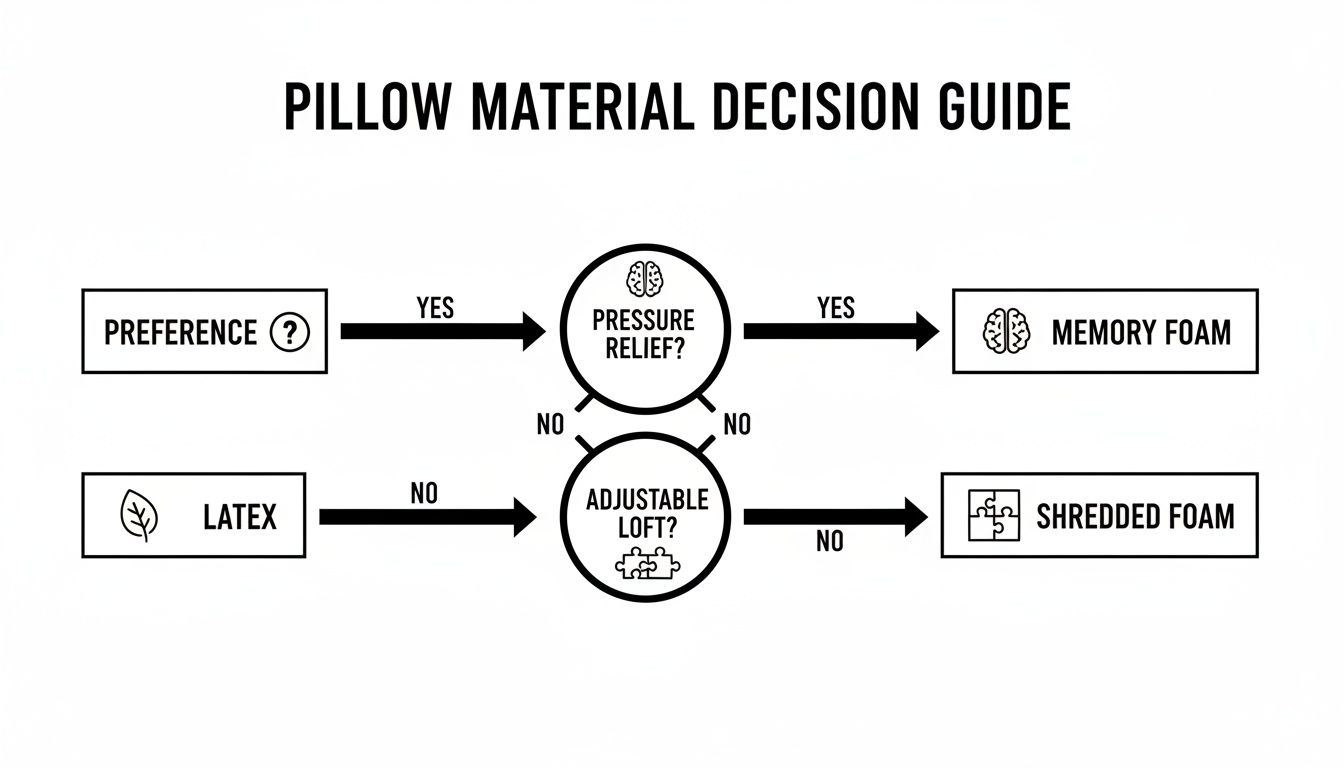
As the chart shows, a material like solid memory foam is fantastic for consistent, contouring support, whereas something like shredded foam gives you the freedom to adjust the pillow to your exact liking. By carefully considering your sleep position and mattress, you’re well on your way to building the perfect sleep setup for a pain-free morning.
Build Your Ultimate Sleep Solution at Miller Waldrop
Choosing the right cervical pillow for neck pain can feel like a daunting task, but you don't have to go it alone. Think of us at Miller Waldrop as your personal sleep guides. We’re here to give you the expert knowledge and hands-on help you need to finally put neck pain to rest.
We’re deeply rooted in the communities of Lubbock, Texas, and Hobbs, New Mexico, with a 70-year legacy of helping families sleep better. As a store voted best in both Lea and Lincoln Counties, we've built our reputation by empowering homeowners and renters to find their perfect sleep setup with personalized service. It's a commitment that's reflected in everything we do, even in how the broader industry, as noted in reports on barchart.com, analyzes solutions for neck pain.
Your Partners in Pain-Free Sleep
Finding the right pillow shouldn't be a shot in the dark. That's why our showrooms in Lubbock, Hobbs, and Ruidoso Downs are staffed with dedicated Sleep Experts who become your partners in this process. Their entire goal is to listen and understand your specific challenges—from morning stiffness to shoulder aches—and guide you to a solution that genuinely works.
We don't just rely on guesswork. You can use our high-tech bed matching system to get a clear, data-driven picture of your body. This system creates a digital map of your unique pressure points, showing us exactly how your body interacts with a sleep surface. It’s a scientific approach that reveals precisely where you need more support and where you need a bit more cushion.
This pressure point analysis is the key to building your perfect sleep system. It allows our experts to recommend not only the right mattress but also the ideal Serta or Beautyrest pillow that completes the setup, ensuring your spine stays in that crucial neutral alignment all night long.
Tools to Build Your Complete Sleep System
A great pillow is a powerful tool, but its real magic happens when it’s part of a complete, customized sleep system. At Miller Waldrop, you can find all the pieces you need to build that foundation for truly restorative rest.
- Expert Pillow Fittings: Forget buying a pillow out of a box and just hoping for the best. Our Sleep Experts will have you test different pillow materials and lofts right here in our showroom, making sure the one you choose is a perfect match for your mattress and the way you sleep.
- Curated Pillow Selection: We've done the homework for you. You'll find a carefully chosen selection of top-tier pillows, including options like the Serta Arctic Memory Foam Pillow, which is engineered with advanced cooling and contouring tech for lasting relief.
- Adjustable Bed Bases: To take your comfort to the next level, nothing beats an adjustable base. It allows you to elevate your head and feet to find the perfect position, which can dramatically reduce pressure on your cervical spine and even open up your airways. You can learn more in our guide on the benefits of an adjustable bed.
With over seven decades of experience, we know how to help you assemble a sleep solution that gets to the root cause of your neck pain. It’s time to stop just enduring restless nights and painful mornings. Visit a Miller Waldrop showroom today, and let our team help you win back your sleep.
Frequently Asked Questions About Cervical Pillows
Switching to a cervical pillow for neck pain is a big step, and it’s completely normal to have some questions before you commit. You’re trying to solve a real problem, and you want to feel confident you’re making the right choice. Let's walk through some of the most common questions we hear from customers, with some honest, expert-backed answers.
How Long Does It Take to Get Used to a Cervical Pillow?
Don't be surprised if your new pillow feels a little strange for the first few nights. In fact, you should expect an adjustment period that can last anywhere from a few days to about two weeks. Think of it this way: your neck and spine have become accustomed to sleeping in a less-than-ideal position, and now you're retraining them to hold a proper alignment.
A great way to ease into it is to start by using the new pillow for just an hour or two each night. When you're ready to sleep, swap it out for your old pillow. Over the next several days, gradually increase the time you spend on the cervical pillow until you can make it through the whole night comfortably.
If you’re still feeling discomfort after two weeks, that's a red flag. It’s a strong sign that the pillow’s loft or firmness isn't the right fit for your body. This is exactly why getting a professional fitting can save you a lot of time and frustration—it helps you get it right from the start.
Can a Cervical Pillow Make My Neck Pain Worse?
It’s a fair question, and the answer is yes, the wrong cervical pillow absolutely can make your neck pain worse. While they are designed to help, they aren't a one-size-fits-all solution.
For instance, if you're a back sleeper and your pillow is too high, it will shove your chin toward your chest and strain your neck. On the flip side, if you're a side sleeper and your pillow is too thin, your head will sag downwards, knocking your spine out of alignment.
This is why matching the pillow to your sleep position, body type, and even your mattress firmness isn’t just a recommendation—it’s crucial. A little initial soreness as your muscles adapt is one thing, but if the pain gets worse or doesn't go away, you need to re-evaluate your pillow.
How Should I Clean and Care for My Cervical Pillow?
Taking proper care of your pillow will make sure it lasts and continues to give you the support you paid for. The cleaning method really depends on the material.
- Memory Foam & Latex: These materials should never go in a washing machine. The intense spinning and water will break down their supportive structure for good.
- Cleaning Process: Most foam pillows have a removable cover that you can toss right in the wash. To clean the pillow core itself, just spot-clean any stains with a mild detergent on a damp cloth. Then, let it air dry completely before putting the cover back on.
- Pillow Protectors: We always suggest using a pillow protector. It’s an essential barrier against moisture, allergens, and dust mites that keeps your pillow fresh and hygienic, helping it last much longer.
When Is It Time to Replace My Cervical Pillow?
Even the best pillows have a finite lifespan. Over time, the materials just naturally start to break down and lose their ability to support your head and neck correctly. A good rule of thumb is to plan on replacing a memory foam or latex pillow every 3-5 years.
You'll know it's time when you start seeing the tell-tale signs of wear. The pillow might feel lumpy or have dents that don't bounce back. Maybe it just feels flat and doesn't spring back to its original shape like it used to. The most obvious sign, though, is when the neck pain you bought the pillow to fix starts creeping back. An old, worn-out pillow simply can’t do its job anymore.
At Miller Waldrop, our goal is simple: to help you find real relief from neck pain. Our Sleep Experts can walk you through our collection and give you a personalized fitting to find your perfect match. A pillow like the expertly designed Serta iComfort Memory Foam Pillow might just be the final piece of the puzzle you need for a great night's sleep.