

Finding the Right Mattress for a Perfect Night’s Sleep

Feeling like you're drowning in a sea of mattress options? You're not the only one. The honest truth is that finding the right mattress is one of the most important things you can do for your health, but the whole process can feel completely overwhelming.
Your Journey to Better Sleep Starts Here
Think about it: you spend about a third of your life in bed. That adds up to nearly 26 years over a lifetime. It’s wild, then, that most of us put more research into our next phone than the surface we sleep on every single night. This guide is your personal roadmap, designed to help you cut through the marketing hype and equip you with real, practical knowledge.
This isn't about finding some mythical "best" mattress for everyone—because it just doesn't exist. The perfect mattress is incredibly personal. What feels like a cloud to your friend might feel like a rock to you, leaving you tossing and turning all night. The real win is finding the mattress that’s a perfect match for you.
Decoding Your Unique Needs
Here, you'll move past the generic advice and focus on what actually matters: your specific body, your sleep style, and your personal preferences. Forget the one-size-fits-all approach. Here’s what you’ll learn to master so you can finally get the rest you deserve:
- Decode Mattress Types: Get a real feel for the differences between memory foam, innerspring, and hybrid mattresses—what they actually do for you, not just what the label says.
- Master the Science of Support: Understand why your go-to sleep position is the single biggest factor in determining the support you need for a healthy, aligned spine.
- Identify Crucial Features: Pinpoint the extras that can turn restless nights into deep, restorative sleep, whether it’s cooling technology for hot sleepers or motion isolation for couples.
This guide provides you with the same insider knowledge our non-commissioned Sleep Experts use every single day. Our goal is to empower you to turn a confusing chore into a confident and successful journey.
Ready to take control and find the mattress that will genuinely support your well-being? Your best self starts with great sleep, and it all begins with understanding what you truly need. You can explore our extensive mattress collection online to see what's out there, or even better, visit a Miller Waldrop showroom in Lubbock, Hobbs, or Ruidoso Downs to start your journey with an expert guide right by your side.
Building Your Personal Sleep Profile
Before you even think about browsing mattresses online or stepping into a showroom, the most important work happens right at home. It starts with a little self-reflection. Think of yourself as a sleep detective—you need to understand your own habits and needs before you can find the mattress that will solve the mystery of a good night's rest.
We call this creating your personal sleep profile. It’s essentially a blueprint of what your body requires for deep, restorative sleep, and it’s built on two key things: how you sleep and your body type. Nailing this down first is a game-changer. It immediately narrows the field, letting you filter out dozens of mattresses that were never going to be right for you in the first place.
This chart gives you a bird's-eye view of how these initial questions guide you toward the perfect sleep setup. When you start with your personal needs, you create a much clearer path to finding the right mattress.
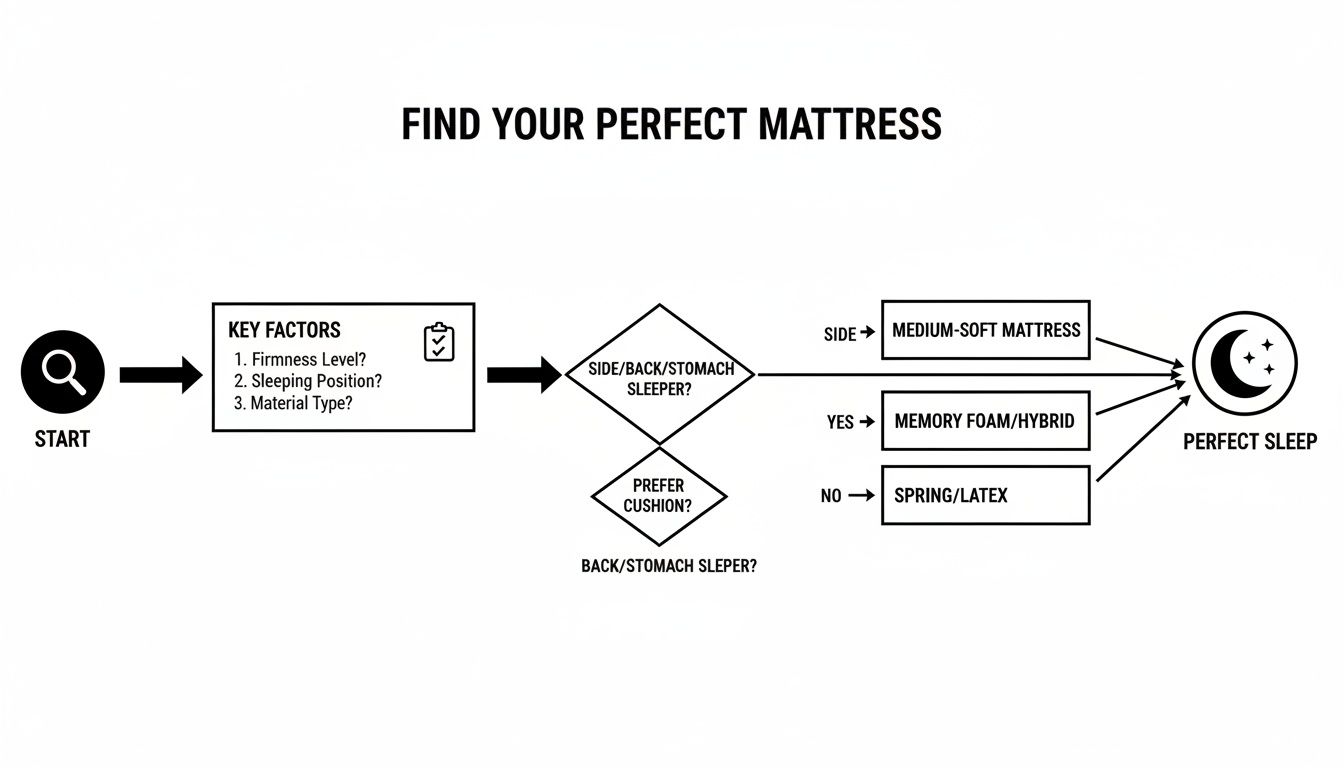
This visual roadmap simplifies the whole process, showing why understanding your sleep profile is the essential first step toward finally getting that perfect night's sleep.
How Your Sleep Position Shapes Your Choice
Think about it: which position do you settle into most nights? Your answer is probably the single biggest clue in your mattress search. Each sleeping style creates unique pressure points and spinal alignment challenges that the right mattress has to solve.
Side Sleepers: Most people are side sleepers, and if you're one of them, you need a mattress with enough give to contour to your body's curves. If it's too firm, you'll wake up with sore shoulders and hips. Too soft, and your spine will sag out of alignment. The sweet spot is a perfect balance of pressure-relieving cushion and solid underlying support.
Back Sleepers: Sleeping on your back can be fantastic for spinal health, but only if your mattress is doing its job. You need consistent, even support from your head down to your heels. The main goal is to keep your hips from sinking in too deeply, which can put a painful arch in your lower back. A medium-firm to firm feel usually hits the mark.
Stomach Sleepers: This position can be tough on the neck and spine. To avoid waking up with aches and pains, you absolutely need a firm, supportive surface. A firmer mattress will keep your hips from dipping, maintaining a straight line with your shoulders and preventing that all-too-common lower-back strain.
Combination Sleepers: If you toss and turn all night, you need a bed that can keep up. A responsive mattress is key here—something that adapts quickly as you change positions, so you never feel like you're fighting against the bed to get comfortable.
The Impact of Body Type on Mattress Feel
Your weight and build play a huge role in how a mattress actually feels to you. A mattress that one person describes as "plush and cloud-like" might feel completely unsupportive to someone else. It's all relative.
For instance, sleepers over 230 lbs generally need a firmer, more durable mattress. This provides the necessary support to keep the spine aligned and prevents the mattress from breaking down prematurely. On the other hand, lighter sleepers under 130 lbs often find firm mattresses too hard, getting much better pressure relief from softer, more contouring options.
If you’re currently dealing with a bed that’s too firm, some well-chosen mattress topper solutions for hard mattresses can offer temporary relief while you search for the right long-term solution.
The mattress industry is booming as technology gets better at meeting these diverse needs. In fact, the market is projected to grow from USD 39.77 billion to USD 66.11 billion by 2033, all driven by innovations designed to give everyone better spinal alignment and a better night's sleep.
Mattress Firmness Guide by Sleep Position and Body Weight
Use this table as a starting point to determine the ideal firmness range for your specific sleep profile. Remember, personal preference is key, so this is a guide, not a rule.
| Sleep Position | Lightweight Sleepers (<130 lbs) | Average Weight Sleepers (130-230 lbs) | Heavier Sleepers (>230 lbs) |
|---|---|---|---|
| Side Sleepers | Soft to Medium-Soft (3-5) | Medium to Medium-Firm (5-7) | Medium-Firm to Firm (6-8) |
| Back Sleepers | Medium (5-6) | Medium-Firm (6-7) | Firm (7-8) |
| Stomach Sleepers | Medium-Firm (6) | Firm (7) | Firm to Extra-Firm (7-9) |
Now that you have your sleep profile in hand, you’re ready to start exploring your options with real confidence. To get even more specific, check out our complete guide on how to choose mattress firmness.
Decoding the Main Mattress Types
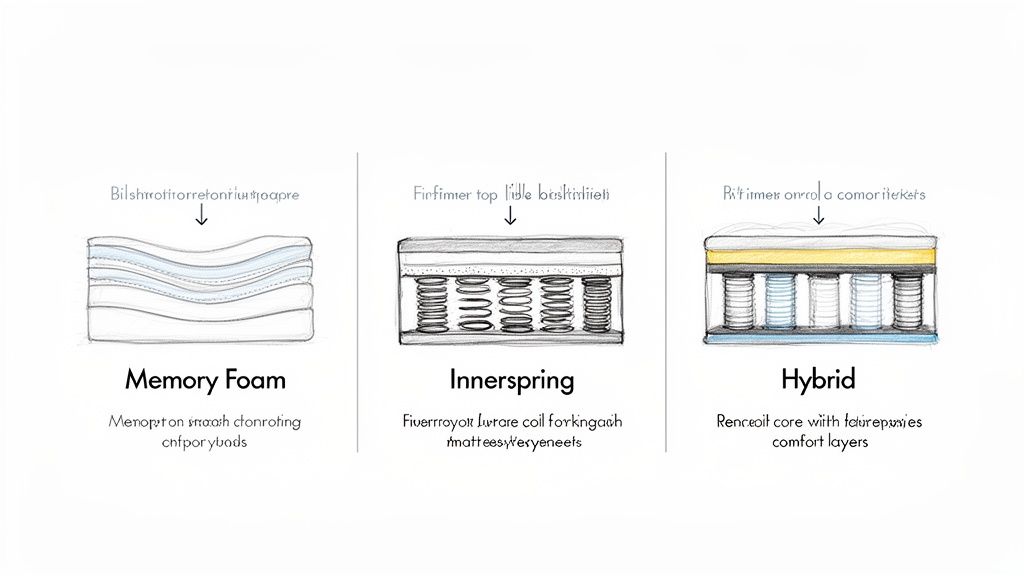
Alright, you've got your Sleep Profile. Now for the fun part: matching that profile to the right mattress technology. It might seem like there are a million options out there, but most mattresses boil down to one of three core types: innerspring, memory foam, or a hybrid of the two.
Think of it this way: each type offers a completely different feel and set of benefits. One isn't inherently "better" than another—it's all about finding the one that's engineered to give your body exactly what it needs for a great night's sleep. Let's break them down.
The Deep Contouring of Memory Foam
You’ve probably heard of memory foam for its signature "hugging" sensation. This material, originally developed by NASA back in the 1960s, is designed to respond to your body heat and pressure, softening and molding to your exact shape. This creates the feeling of being cradled in the mattress, not just lying on it.
That deep contouring is what delivers exceptional pressure relief. For side sleepers, this is a total game-changer. The foam allows your shoulders and hips to sink in just the right amount, keeping your spine perfectly aligned and preventing those nagging morning aches.
Key Takeaway: Memory foam is incredible at isolating motion. If you share a bed with someone who tosses and turns, their movements get absorbed by the foam instead of being transferred to your side of the bed.
Now, I know what you might be thinking: "Doesn't memory foam sleep hot?" That used to be a common complaint, but today’s foams are much more advanced. Look for cooling gel infusions, open-cell structures, and other modern materials that are specifically designed to pull heat away from your body.
The Classic Bounce of Innerspring
Innerspring is the mattress most of us grew up with. Built on a core of steel coils, it provides that familiar bouncy, responsive feel and a traditionally firmer surface.
Unlike the "sinking in" feeling you get from foam, an innerspring mattress keeps you elevated "on" the bed. This makes it much easier to change positions throughout the night—a big plus for combination sleepers. The open coil structure is also a huge advantage for airflow, making innerspring a naturally cooler sleep surface.
Who is it best for?
- Stomach and Back Sleepers: The firm, even support is great for keeping the spine aligned without letting your hips sag.
- Anyone Needing Sturdy Edges: Quality innerspring models have reinforced perimeters, which provides excellent edge support for sitting or getting in and out of bed.
- Budget-Conscious Shoppers: Generally, innerspring mattresses are available at a more accessible price point.
If you're still torn between these two, our detailed comparison can help. We dive even deeper into the pros and cons in our guide to innerspring vs. memory foam mattresses.
The Best of Both Worlds with Hybrid Mattresses
What if you love the pressure relief of foam but miss the responsive support of coils? That's exactly why hybrid mattresses were created. They truly offer the best of both worlds by combining a supportive base of pocketed innerspring coils with top comfort layers of memory foam, latex, or other premium materials.
The result is a perfectly balanced sleep experience. The coils give you that durable support and breathability, while the foam layers provide the contouring comfort and pressure point relief that make memory foam so popular. It’s an incredibly versatile solution that works for a huge range of sleep styles.
For instance, a hot sleeper who also needs deep pressure relief for their shoulders would be a perfect candidate for a hybrid like the Serta iComfort Hybrid. The coils keep air moving while the specialized foam layers target comfort. This adaptability is a key reason the mattress market is projected to grow from USD 46.5 billion to USD 67.5 billion by 2030, with hybrid technology driving much of that innovation.
Of course, while you're focused on your own comfort, remember that the right materials and construction are vital for everyone in the family. For the little ones, for example, understanding specific crib mattress safety standards is absolutely critical and highlights just how important quality construction is for sleepers of all ages.
Now that you have a handle on the main mattress types, you’re ready to match your Sleep Profile to the right technology. Next up, we’ll talk about how to really put them to the test.
How to Test a Mattress Like an Expert
Online reviews and spec sheets are great starting points, but they can't answer the most important question: how will this mattress actually feel to you? This is where a trip to the showroom becomes so important. It’s your chance to move beyond the theory and find out what your body really needs for a great night's sleep.
You’ve done the homework—you know your sleep style and the basic mattress types. Now, let’s put that knowledge to the test. This is how you gain that gut feeling, that unshakeable confidence that you’re making the right choice for the long haul.
Go Beyond the "Edge Sit"
I see it all the time: someone walks in, sits on the edge of a mattress, gives it a quick bounce, and thinks they've tested it. That tells you almost nothing about how it will feel at 2 a.m. The real test only begins when you lie down.
Think of it like test-driving a car. You wouldn't just sit in the driver's seat; you'd take it out on the road. The same principle applies here.
- Dress comfortably. Wear something you can move around in easily.
- Take your shoes off. Get a real feel for the surface.
- Lie down in your usual sleep position. Don't be shy! If you're a side sleeper, get on your side. Back sleeper? Same thing.
- Stay put for at least 10-15 minutes. This is the most important step. It takes time for your body to relax and settle into the mattress. This is when you'll notice if a pressure point starts to develop or if your lower back isn't getting the support it needs.
A mattress can feel fantastic for the first minute. But true comfort and support only reveal themselves after you’ve given your body time to fully relax. This is the only way to know if it will still feel good hours into the night.
The Science of a Perfect Match
While your own comfort is the ultimate judge, we can bring some hard data into the conversation to confirm what you're feeling. At Miller Waldrop, we use a high-tech bed matching system to take the guesswork out of the process.
This system creates a digital pressure map of your body, showing us exactly where you carry the most tension. It pinpoints where you need more contouring comfort and where you need robust support. Our non-commissioned Sleep Experts use this data to guide you toward mattresses built for your specific body type. It’s an incredible tool for validating that what feels good is also doing good for your body.
Questions to Ask a Sleep Expert
Testing the feel is one thing, but a good conversation with an expert can uncover details about a mattress's durability and long-term performance. This is a major investment in your health, so don't hesitate to ask detailed questions.
Here are a few I always recommend asking:
- What are the main materials in the top layers, and how do they handle heat? This helps you figure out if a mattress has modern cooling features or if it’s likely to sleep hot.
- Can you tell me more about the coil system? For innerspring or hybrid models, ask about the coil gauge and whether they are pocketed. This has a huge impact on both support and motion isolation.
- What’s the density of the memory foam? For foam or hybrid beds, look for higher-density foams—typically 4-5 lbs per cubic foot—as they are far more durable and supportive over time.
- What kind of base or foundation does this mattress need to keep the warranty intact? Using the wrong foundation can ruin a great mattress and void your warranty. A quality hybrid like the Serta iComfort Hybrid, for example, needs a solid platform or an adjustable base to perform its best.
By pairing your own "test drive" with the data from our bed matching system and the insights from our experts, you’ll have everything you need to make a truly informed decision. You’re not just guessing anymore; you’re building your perfect sleep setup.
Ready to feel the difference for yourself? Stop by one of our showrooms in Lubbock, Hobbs, or Ruidoso Downs and let us give you a personalized sleep analysis.
Building Your Complete Sleep System
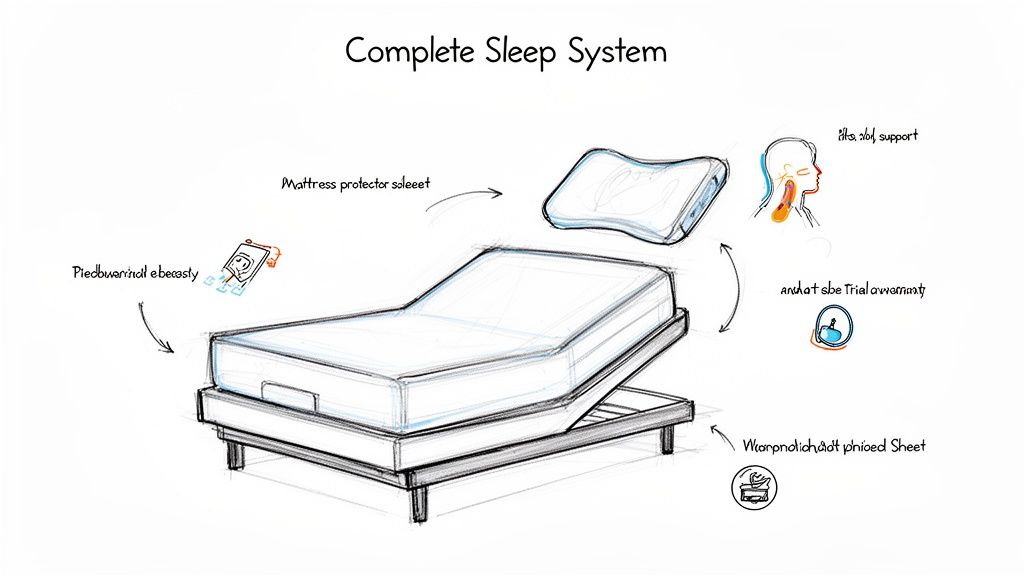
Finding the perfect mattress is a huge win, but it's really just the first step. Think of your mattress as the star of the show; it still needs a solid supporting cast to deliver a truly great night's sleep. Building a complete sleep system means looking at the whole picture—the foundation, pillows, and even protectors—to create an environment that’s perfectly tuned for you.
This holistic approach is what separates a good night's sleep from a great one. It ensures every single piece, from the base that holds your mattress up to the pillow that cradles your head, is working together.
Elevate Your Comfort with an Adjustable Base
Sure, a flat foundation provides solid support. But an adjustable base can completely transform your bed from just a place to sleep into your own personal hub for comfort and wellness. With the touch of a button, you can raise your head to read a book or lift your legs to improve circulation after a long day on your feet.
But it’s about more than just convenience. An adjustable base can be a game-changer for addressing common health issues:
- Alleviating Snoring: Raising your head just slightly can open up your airways, leading to a quieter night for everyone.
- Easing Acid Reflux: By keeping your upper body elevated, you can help prevent discomfort from acid reflux.
- Reducing Back Pain: Finding that perfect zero-gravity angle can take immense pressure off your lower back in a way a flat surface simply can't.
Most modern mattresses, especially foam and hybrid models, are designed to work perfectly with these bases. If you’re curious how it could work for you, you can discover the benefits of an adjustable base and see how it truly enhances your entire sleep system.
The Critical Role of the Right Pillow
You could have the best mattress in the world, but with the wrong pillow, you'll still wake up with a sore, stiff neck. A pillow’s main job is to keep your head, neck, and shoulders in proper alignment by bridging the gap between you and the mattress.
The right pillow for you comes down almost entirely to how you sleep:
- Side Sleepers: You'll need a thicker, firmer pillow to properly fill that space between your ear and shoulder.
- Back Sleepers: Look for a medium-height pillow that supports the natural curve of your neck without pushing your head too far forward.
- Stomach Sleepers: A very thin, soft pillow is best—or even no pillow at all—to prevent your neck from being strained at an unnatural angle.
Your pillow and mattress have to work as a team. A new mattress changes the dynamics of your bed, which means the pillow that was perfect for your old mattress might be completely wrong for your new one.
Protecting Your Investment
A new mattress is a significant investment in your well-being, and a high-quality mattress protector is the single best way to safeguard it. It’s an absolute must-have that shields your bed from spills, allergens, and dust mites, keeping it fresh and hygienic for years to come.
Forget those crinkly plastic sheets from the past. Today’s protectors are breathable, waterproof, and completely silent—you won’t even know it’s there. More importantly, most mattress warranties require a protector to remain valid, making it an essential final touch for your new bed.
The global mattress market is a big deal, valued at around USD 47 billion and expected to grow to over USD 80 billion by 2032. With a quality mattress lasting 7-10 years, making an informed choice is key to avoiding an expensive mistake. At a family-owned store like Miller Waldrop, with over 70 years of experience serving West Texas and New Mexico, our Sleep Experts use bed-matching technology to map your pressure points and find the perfect fit from top brands like the Serta iComfort Hybrid. Protecting that investment from day one just makes sense.
It’s Time to Find Your Perfect Mattress
You've done the research. You know what to look for in a mattress, how to match it to your body, and even how to test one out like an expert. Now comes the best part: putting it all into practice. And you don’t have to go it alone.
Our Sleep Experts in Lubbock, Hobbs, and Ruidoso Downs are ready to help you take this final, crucial step. The best part? They’re non-commissioned, so their only goal is to find the right fit for you.
Your best self starts with great sleep, and that journey begins with the right mattress. We have the expertise and technology to help you win back your rest.
Let our team show you how our bed-matching technology works in person. We'll walk you through options from trusted brands like Serta and Beautyrest, making sure everything aligns with your personal needs and budget.
Don't spend another night tossing and turning. Your energy, your health, and your happiness are too important. We’re here to help you get the quality rest you deserve.
Ready to find your match? Take a look at our curated mattress collection online or, even better, stop by a Miller Waldrop showroom near you to put your newfound knowledge to the test.
Common Questions We Hear in Our Showrooms
Even with all the research in the world, you're bound to have a few lingering questions when you're standing in front of a wall of mattresses. That's completely normal. Getting those last few answers is what builds the confidence to make a final decision you'll be happy with for years to come.
Here are a few of the most common questions our Sleep Experts get asked every day, along with the straightforward answers we give our customers.
How Long Should a Mattress Really Last?
You’ll often hear the number 7-10 years, but honestly, that’s just a ballpark figure. The true lifespan of your mattress really comes down to what it's made of, how much use it gets, and the people sleeping on it every night. A high-quality mattress in a guest room might last much longer, while one used every night by a couple might be on the shorter end of that range.
Instead of just marking a date on the calendar, listen to your body.
- Are you waking up with new aches and pains?
- Do you see a permanent body-shaped valley in your side of the bed?
- Are you sleeping better in a hotel bed than your own?
Those are the real tell-tale signs that your mattress has given its all and it’s time for a replacement.
What Is the Point of a Mattress Trial Period?
Think of a trial period as your "get out of jail free" card. It’s a safety net that lets you actually sleep on a mattress in your own home, which is the only place it really matters. These trials usually run anywhere from 30 to 120 nights, giving your body plenty of time to get used to a brand new sleep surface.
It's a crucial step because it can take a few weeks for your spine and muscles to fully relax and adapt to a different kind of support. A trial period takes the pressure off, so you can be absolutely certain that the bed that felt amazing for ten minutes in the showroom still feels just as good after ten nights at home.
Lying on a mattress in the store is like a first impression. The in-home trial is the real test of compatibility. It's the final confirmation that you've made the right choice.
Do I Need a Box Spring with My New Mattress?
Probably not, but you do need a proper foundation. The days when every mattress automatically came with a box spring are long gone. While a traditional innerspring mattress might still need one, most of today's memory foam and hybrid models are designed for something more solid and stable.
Here’s a common mistake we see: people put a brand new, high-tech mattress on their old, sagging box spring. This not only ruins the support of the new mattress but can actually void your warranty. For a modern bed like the Serta iComfort Hybrid, you’re much better off with a solid platform base, a sturdy slatted foundation, or an adjustable base to get the most out of it. Always check the manufacturer's guidelines—it's the best way to protect your investment.
With this knowledge, you're ready to make a great decision. Here at Miller Waldrop Furniture & Decor, our non-commissioned Sleep Experts are genuinely here to help you connect the dots. Stop by one of our showrooms in Lubbock, Hobbs, or Ruidoso Downs and let us show you how our bed-matching technology can take the guesswork out of the process.
You can also browse our hand-picked mattress collection online to see what's in store. A better night's sleep is waiting for you.