


Dining Room Furniture with Storage: A Complete Buyer’s Guide

The dining room is the easiest place to fall in love with a piece of furniture online and the hardest place to forgive a bad fit at home. A sideboard can look perfect on screen, then block the walkway, swallow chair space, and turn every family meal into a shuffle. That's why dining room furniture with storage needs to be judged by real-life clearance first, storage second.
A good purchase solves a mess. A bad one creates a new one. If the room has to work for weeknight dinners, holiday overflow, homework, and the odd stack of paperwork, the furniture has to stay useful when drawers are open, chairs are pulled back, and people are moving around the table at the same time.
Why Storage Dining Furniture Is the Hardest Buy
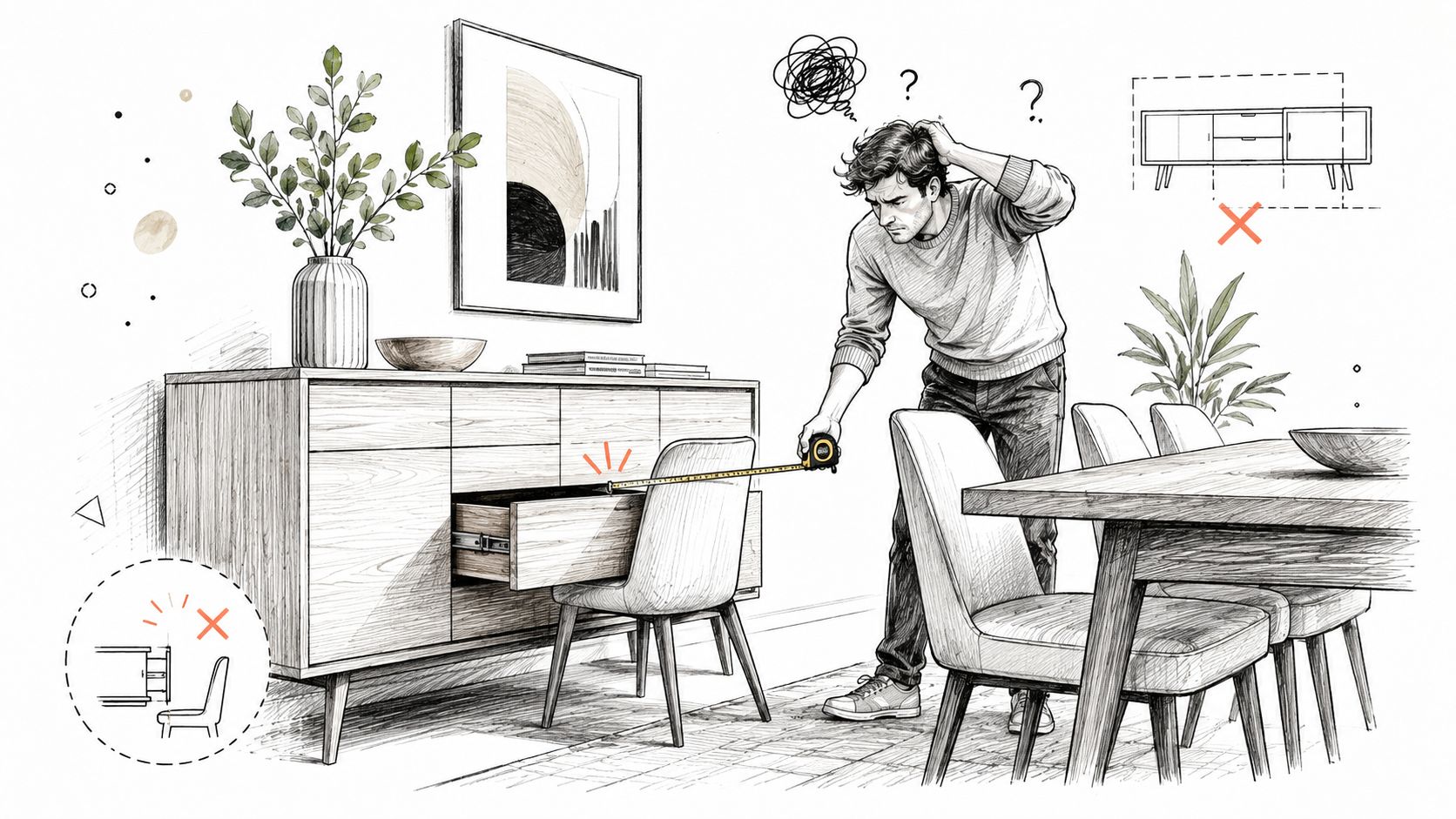
A homeowner can measure a beautiful hutch in the showroom, get it home, and realize the side drawers clash with the chairs the moment anyone sits down. That's the trap with this category. Storage furniture doesn't just occupy floor space, it demands open space to function, and that's what shoppers often miss.
The dining room market is large because this problem is common, not niche. The global living and dining room market reached USD 183.09 billion in 2025 and is projected to reach USD 241.61 billion by 2033, with storage-focused cabinets and storage leading at 56.2% of the category in 2025 (Grand View Research). That tells a simple story, cabinets, buffets, and related pieces are mainstream because homes need dining spaces to do more than one job.
The real conflict is not storage, it's movement
The buyer's mistake is chasing capacity without asking what happens when the room is in use. A table that looks compact on paper can still feel cramped once people sit down, because chairs need pull-back room and walkers need a path behind them.
Practical rule: if storage furniture steals knee room or blocks traffic, it's not saving space. It's consuming it.
U.S. dining room furniture sales also show why households keep investing here. Sales climbed from USD 11.44 billion in 2019 to USD 12.62 billion in 2020 and then to USD 14.96 billion in 2021, a rebound of about 30.9% over two years (Furniture Today). Families did not suddenly start loving formal dining rooms again, they started wanting pieces that support daily life.
The better question is not “How much can this store?” It's “Can it still work when everyone is using the room?” That's the lens that separates a smart buy from an expensive obstruction.
The Main Types of Storage Dining Furniture
A dining room can look like it has plenty of storage and still fail the test. If a cabinet crowds the table, blocks the walkway, or makes holiday seating awkward, it is the wrong piece for the room. That is why the main types of storage dining furniture deserve a closer look before anyone buys.
Know the names before you shop
A hutch is a two-part piece, with a lower cabinet base and an upper display section. That makes it the right choice when a household wants visible heirlooms, glassware, or decorative objects up high, plus concealed storage below. A buffet is usually a long, low cabinet used for serving and storage, and standard design guidance places it at about 34 to 36 inches high for comfortable standing service.
A sideboard is similar, but often a bit taller, with typical heights of about 34 to 40 inches. That slightly taller profile works when more surface area matters than display. A credenza sits lower and cleaner in profile, which makes it easier to place in open-plan rooms where the goal is visual calm, not a heavy furniture statement. A good overview of hutch and credenza options helps separate those shapes before you commit to one.
A china cabinet is the most display-forward option. It is the piece to buy when formal dinnerware, collections, or glass-front presentation matter more than broad serving surface. In a room that only gets used for holidays, it can make sense. In an everyday room, it can feel fussy unless the household needs the display function.
The names matter because shoppers often ask for one category when they need another. The same logic applies if the dining room also has to function as a play area, office, or storage overflow zone, because the piece has to fit the room's real job, not just its style.
Match the form to the task
- Hutch: Best when display is part of the plan.
- Buffet: Best when serving and concealed storage need to share one low profile.
- Sideboard: Best when the room needs a wider surface and a slightly stronger visual presence.
- Credenza: Best when the room is open, modern, or already visually busy.
- China cabinet: Best when formal presentation is the point.
Skip the piece that looks impressive but blocks traffic. Buy the one that lets people move, sit, and serve without working around it. That rule holds up in dining rooms, and it shows up in other small-space planning too, including space-saving tips for tiny nurseries, where circulation matters just as much as storage.
Measuring for Real-Life Clearance
A dining table with storage is not just a piece of furniture, it is a moving system. Chairs slide out, drawers open, cabinet doors swing, and people still need a clean path through the room while food sits on the table. If the room cannot handle all of that at once, the design has failed.
Measure the whole storage envelope
Independent dining-layout guidance recommends leaving 3 to 4 feet of clearance around the table. Practical buying advice also recommends at least 36 inches of open area for primary walkways, with 30 inches only as a low-traffic exception (Miller Waldrop). For storage tables, that open space has to account for drawer pull space and room for a seated person to move without hitting the furniture behind them.
A useful way to judge the room is by the storage envelope, not just the footprint. The footprint is the rectangle the piece occupies. The storage envelope includes every drawer, door, lift-top, or pull-out leaf when it is fully open, plus the chair pull-back space around the table.
Clearance beats capacity every time. A smaller piece that opens cleanly is more useful than a bigger one that turns the room into a maze.
A simple planning example
A six-seat table needs more than tabletop dimensions alone. If a sideboard sits behind one side of the table, the room still has to allow the recommended 3 to 4 feet of clearance around the dining zone, which is the standard rule in independent dining-layout guidance. That means the usable room width and length both need to be larger than the table area by enough room for chairs, walking lanes, and storage access.
The practical buy is the one that preserves the room when people are seated, not the one that wins a storage-capacity contest on a product page. A table that works at breakfast and still works on Thanksgiving is the goal.
A detailed dining table size guide helps turn those numbers into a layout the household can live with. That matters because a dining room is not measured by square footage alone, it is measured by how comfortably people can move inside it.
Storage Tables and Benches With Hidden Storage
Built-in storage changes the buying decision because the furniture itself becomes part of the storage plan. That sounds efficient, and sometimes it is. The trade-off is clear. Any storage built into the table or seating has to earn its place by staying easy to reach without ruining comfort or circulation.
A first-time buyer should judge these pieces by how they behave in a real dining room, not by how much they claim to hold. A table or bench that looks tidy in a product photo can still be a poor choice if drawers hit chair backs, lids need too much pull-back room, or the storage steals knee space from the people who sit there.
Tables with drawers are useful, but only in the right homes
Under-table systems usually provide enough room for placemats, napkins, cutlery, coasters, tablecloths, board games, and other small household items, according to furniture guides. That storage is useful when the room handles daily meals, homework, or quick cleanups. It is less useful when the table is meant to stay open and flexible for guests.
The question is not whether the table stores things. It is whether that storage stays usable when the room is busy. A family that eats in the room every night may appreciate drawers for everyday clutter and serving pieces. A formal dining room used only for occasional meals usually does better with a separate sideboard, because the table itself should stay uncluttered and easy to seat. A good guide to what a buffet table is used for helps make that distinction clear.
Benches and built-in seating solve a different problem
Hidden-storage benches work best in small rooms and multiuse spaces. They reduce the number of individual chairs the room has to support and can hide overflow items without adding another tall cabinet. That makes them practical in rooms that need storage but cannot give up more wall space.
The downside is comfort. If the bench is too deep, too high, or awkward to open, the room starts feeling like a compromise instead of a solution. That is where reclaimed wood building materials can make a difference for a custom build, because a solid, well-planned bench matters more than a flashy one with storage that is hard to use.
| Storage Dining Formats Compared by Use Case | Best For | Typical Storage Volume | Key Trade-Off |
|---|---|---|---|
| Storage table | Everyday family meals, small households, multiuse rooms | Qualitative, depends on design | Can reduce knee room or access space |
| Hidden-storage bench | Small spaces, banquette-style seating, homework zones | Qualitative, depends on build | Comfort and access can limit usefulness |
| Sideboard | Serving, concealed storage, holiday support | Qualitative, varies by size | Needs extra wall space and clearance |
| Hutch | Display plus storage | Qualitative, varies by build | Tall profile can overwhelm smaller rooms |
A well-built table with storage can be the right answer when the room has to do double duty. The same goes for built-in seating when the household wants a clean look and hidden volume in one footprint. Skip storage in the table itself if the room already feels tight. Buy it when the room needs hidden utility and the seating still stays comfortable.
Materials Finishes and Construction That Last
Storage furniture in the dining room takes more abuse than people expect. It holds dishes, gets bumped by chair backs, catches spills, and usually sits close to food and drink. Cheap construction shows up fast in this category, usually as wobble, sagging drawers, or a finish that looks tired long before the piece should.
Start with the load path, not the look
One modern storage sideboard is rated for 200 lb distributed load, while another modern dining storage unit specifies 300 lb total weight capacity and uses even weight distribution plus food-safe, formaldehyde-free glue. Those specs matter because dining storage is not just decorative. It has to carry heavy plates, serving pieces, and glassware without sagging or stressing the frame.
Look for solid wood where it counts, stable veneered panels where the design allows, and joinery that does not rely on shortcuts. Dovetail joints, well-fitted drawer boxes, and smooth glides beat flimsy hardware every time. The room may look finished, but the construction decides whether the piece survives family life.
Finish choice should match the household
Sealed surfaces are easier to wipe after spills, which is a real advantage in food-adjacent furniture. In homes with children, that matters more than a perfect catalog sheen. Strong finishes also protect edges, corners, and drawer fronts from the scuffs that come from constant use.
For households drawn to natural character, reclaimed materials can be a smart way to get warmth without making the room feel precious. A resource on reclaimed wood building materials is useful when the goal is a more textured, lived-in look that still needs to stand up to daily meals.
What to check in person: open every drawer, press on the top corners, inspect the back panel, and ask how the surface handles spills.
Hardware should move smoothly. Doors should close without rubbing. If the frame twists in the showroom, it will not improve at home. The best-looking storage piece is useless if the drawers bind after a few months.
How Showroom Design Services Remove the Guesswork
Online listings can show dimensions, but they can't walk the room with the customer and spot the bad decisions before money is spent. A curated showroom solves that problem by translating measurements and daily habits into actual furniture choices. That's where expert guidance earns its keep.
Good design help turns measurements into a real plan
Miller Waldrop Furniture & Decor has served West Texas and Southeastern New Mexico for more than 70 years, with showrooms in Lubbock, Hobbs, and Ruidoso Downs and brands that include Hooker and Ashley. That matters because storage dining pieces are one of those categories where fit is everything, and a trained staff can help a shopper decide whether the room needs a hutch, a buffet, or a lower-profile storage piece that won't crowd the chairs.
Custom-order options for fabrics, finishes, and configurations solve a lot of problems that off-the-shelf pieces can't. A household may need a different drawer layout, a finish that works with existing flooring, or a cabinet height that matches the room's scale. That kind of adjustment is practical, not indulgent.
The best showroom visit feels like a fit check, not a sales pitch
The right advisor asks where the room gets blocked, which items need daily access, and how often the table has to seat extra people. That changes the recommendation immediately. A piece that looks impressive in a vacuum can be the wrong answer once the room is measured.
A showroom also reduces the risk of buying the wrong style name. Many shoppers walk in asking for a sideboard when they really need a buffet, or wanting a hutch when a lower, cleaner piece would protect circulation. That's why the conversation matters more than the catalog image.
When the room needs to function without guesswork, a showroom visit beats random browsing. The furniture should fit the room, not the other way around.
Budgeting Financing and Long-Term Care
A storage dining piece should be treated like a long-term household tool, not a weekend accessory. That means the budget should cover the furniture, the delivery plan, and the maintenance that keeps doors aligned and finishes looking clean. Skipping those details usually costs more later.
Spend where the stress points are
The money belongs in the frame, the hardware, and the finish. A piece that gets handled daily needs sturdy joints, reliable glides, and a surface that can handle regular wipe-downs. Decorative extras are fine, but they shouldn't come at the expense of structure.
For households stretching a project budget, payment flexibility can make the right piece possible without downgrading quality. A resource to explore payment options for your remodel can help frame that decision in practical terms, especially when the room needs both function and durability.
Keep the piece in shape after delivery
Wood pieces need occasional conditioning, hardware needs tightening, and finishes need protection from hot platters, wet glasses, and abrasive cleaners. Those aren't optional habits. They're what keep a dining room piece from looking worn out before it's old.
A short showroom checklist keeps the purchase honest:
- Room measurements: Bring wall lengths, walkway widths, and the space behind chairs.
- Must-have storage: Decide what needs to stay hidden and what needs quick access.
- Daily use test: Confirm drawers, doors, and chair pull-back all work together.
- Finish concerns: Ask how the surface handles spills, heat, and cleaning.
- Delivery fit: Verify that the piece will clear doorways, corners, and stairs before it's ordered.
The smartest buyer doesn't chase the biggest cabinet. The smartest buyer chooses the piece that still works when the room is full, the chairs are out, and the table is being used the way real homes use it.
Miller Waldrop Furniture & Decor helps shoppers turn dining room measurements into a practical plan, with curated dining room pieces, design guidance, and custom-order options that can solve fit and function problems before delivery. Visit Miller Waldrop Furniture & Decor to review dining room storage options and talk through the room that needs to work better every day.