


Adjustable Base vs Box Spring: Which Foundation Wins?


The popular advice is simple: buy a box spring with a new mattress and move on. That advice is also incomplete. A box spring can be the right answer for a traditional innerspring mattress and a straightforward bedroom, but it can't raise a sleeper's head for snoring, change the angle of the torso for reflux, support a preferred position for lower-back discomfort, or help someone move from lying down to standing.
The better question isn't “Which foundation costs less?” It's which foundation solves the actual sleep problem without creating a compatibility problem later. The comparison below treats the adjustable base vs box spring decision as a practical showroom choice, not a luxury contest.
Why the Default Foundation May Not Be Your Best Choice
A box spring remains useful, but it shouldn't be treated as the automatic companion for every mattress. It provides a fixed sleeping surface, which works well for people who want a traditional setup and already own a compatible innerspring mattress. It doesn't provide positioning, however, so sleepers who spend their nights fighting snoring, acid reflux, back discomfort, or difficult bed entry may be paying for a solution that never addresses the source of the frustration.
An adjustable base changes that conversation. It lets the sleeper alter the head and foot sections instead of relying on stacked pillows or accepting one flat position. Guidance on adjustable bases identifies positioning as relevant to concerns such as reflux, snoring, back pain, circulation, and easier bed entry and exit, while also emphasizing that the right choice depends on the sleeper's specific needs, not on a universal definition of “better”.
Start with the problem, not the product
A household with no positional needs may have no reason to add motors, controls, or a more involved setup. A guest room often rewards the box spring's simplicity, particularly when the mattress is designed for it. A couple dealing with nighttime movement or a sleeper who reads in bed may get far more daily use from an adjustable base.
The hidden cost appears when a mismatched foundation affects the mattress above it. Foam and flexible hybrid mattresses generally need consistent support, while a traditional box spring may not provide the structure their manufacturer requires. A cheap foundation that reduces mattress performance or voids warranty protection isn't necessarily a cheap purchase.
Practical rule: Choose a fixed foundation for a fixed need. Choose an adjustable base when positioning, mobility, or shared-bed comfort is the problem to solve.
Before choosing, shoppers can review box spring and foundation guidance and compare compatible options in a curated foundation collection at Comfort Pure. The important step is matching the foundation to the mattress and the sleeper, rather than assuming the oldest setup is automatically the safest.
How Adjustable Bases and Box Springs Actually Work
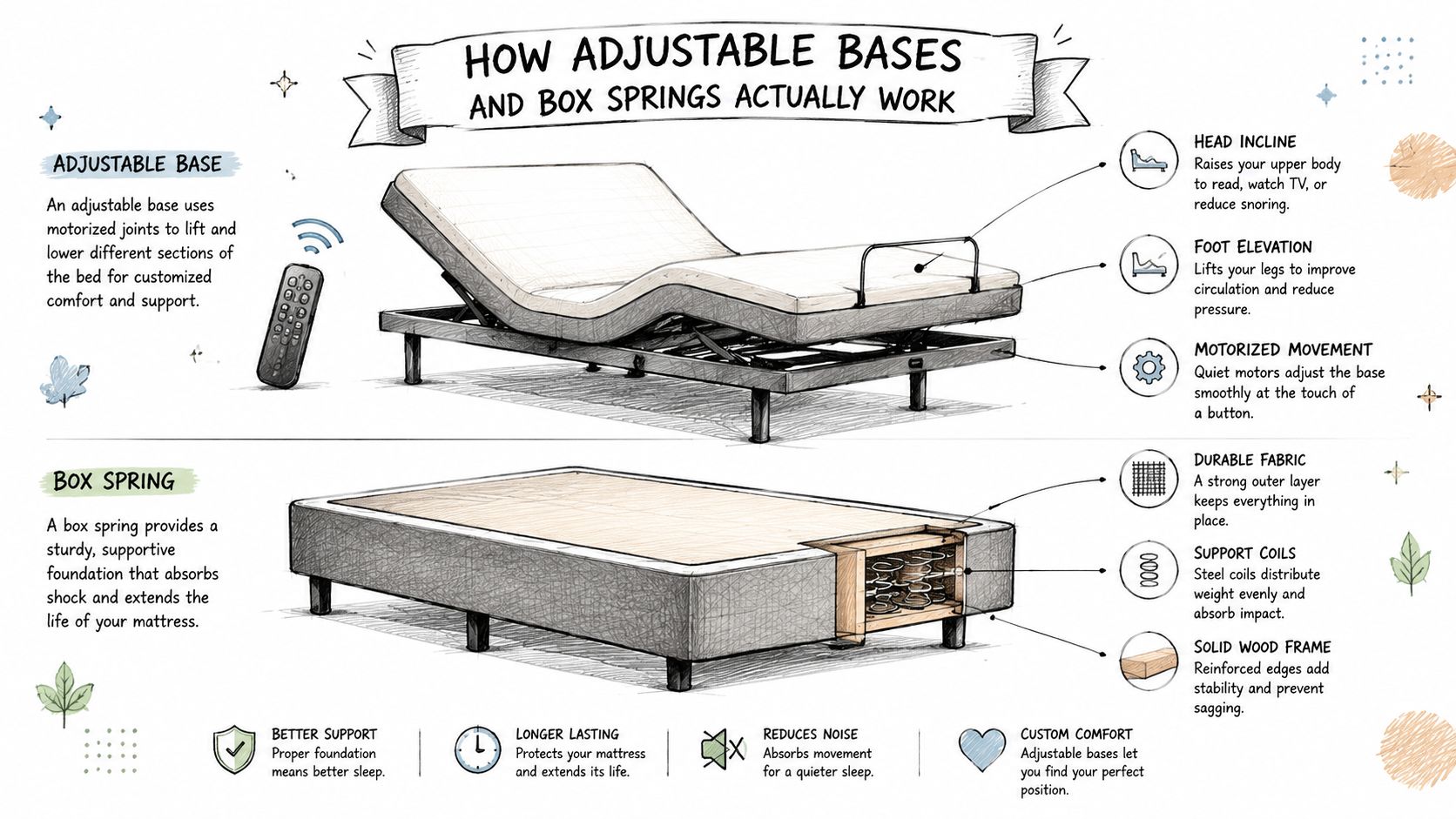
A box spring is a traditional foundation built to sit between a mattress and its supporting frame. Depending on the design, it uses a rigid frame with coils or slats, adds height, and absorbs some of the movement transferred through an innerspring mattress. The surface stays flat, so the mattress receives stable support without hinges, motors, or a remote.
An adjustable base is a different machine altogether. Its segmented platform uses hinged sections and motors to raise the head, foot, or both portions of the mattress. Some models use a wired remote, while others use wireless controls and may include features such as preset positions, charging ports, lighting, or massage. The base supports the mattress directly, which means a box spring shouldn't sit between the adjustable mechanism and the mattress.
The mechanics explain the compatibility rules
An adjustable base bends the sleep system at the head and foot sections. Some models can raise the head up to 70 degrees and the foot up to 45 degrees, according to compatibility guidance on articulated foundations (adjustable base movement and mattress compatibility). That repeated movement demands a mattress that can flex smoothly without collapsing, bridging, creasing, or losing support.
The box spring transfers weight through a fixed support structure. That can complement a traditional innerspring mattress, but it doesn't follow an articulated platform. Adding a box spring to an adjustable base defeats the base's movement and can place stress on both components.
The market has moved toward movement
Adjustable bases are no longer a niche showroom curiosity. In the United States mattress bases market, adjustable bases were estimated to hold 41.00% of the market in 2025, while the overall market was sized at USD 2.18 billion in 2026 and projected to reach USD 3.01 billion by 2031 at a 6.67% CAGR, according to United States mattress bases market data. Wood-based foundations still accounted for 60.74% of the market in 2025, so traditional foundations remain substantial, but adjustable technology has clearly entered mainstream demand.
That shift has a practical explanation. A static foundation only supports the mattress. An adjustable base supports the mattress while also changing the sleeper's posture, which makes the foundation part of the comfort system rather than a hidden platform underneath it.
Comfort and Daily Use Compared Side by Side
The adjustable base wins whenever the bed needs to do more than remain flat. Raising the head can create a more comfortable reading or television position, while lifting the legs can help a sleeper settle after a long day. Preset positions, including zero-gravity-style settings, reduce the need to experiment with pillows and body positioning.
A box spring offers a familiar feel with almost no learning curve. It doesn't need an outlet, remote, or motor, and it's easier to move during cleaning or relocation. That simplicity matters in a guest room, a rental, or a child's bedroom where advanced positioning may never be used.
The daily-use comparison
| Feature | Adjustable Base | Box Spring |
|---|---|---|
| Sleeping position | Raises the head and foot sections for customized angles | Keeps the mattress flat |
| Reading and television | Supports an upright position without a pillow stack | Requires pillows or a separate chair |
| Partner comfort | Split configurations can let each sleeper choose a position | Both sleepers share the same flat surface |
| Bed entry and exit | Can assist with a raised position for getting up or settling down | Provides fixed height only |
| Motion experience | Can offer more individual control in a split setup | Preserves a traditional, shared feel |
| Convenience | Requires power and remote control | Needs no power and has fewer components |
| Best fit | Sleepers who use positioning regularly | Sleepers seeking simple support with a compatible mattress |
Partner disruption deserves special attention. In a split configuration, each side can be positioned independently, so one sleeper can raise the head while the other remains flatter. That doesn't eliminate every disturbance, but it gives couples more control than a single fixed foundation.
Where the box spring still makes sense
A box spring remains the sensible choice when the mattress manufacturer approves it and the household values a traditional feel over positioning. It also makes sense when the room has a strict budget, the mattress is used occasionally, or the sleeper moves frequently and needs a lighter, less complicated foundation.
The adjustable base earns its space through use. If a sleeper raises the head every night, uses the foot lift after work, or relies on the base to make bed entry easier, those features are functional tools. If the remote stays untouched after the first week, the extra complexity probably wasn't justified.
Mattress Compatibility Rules You Cannot Ignore
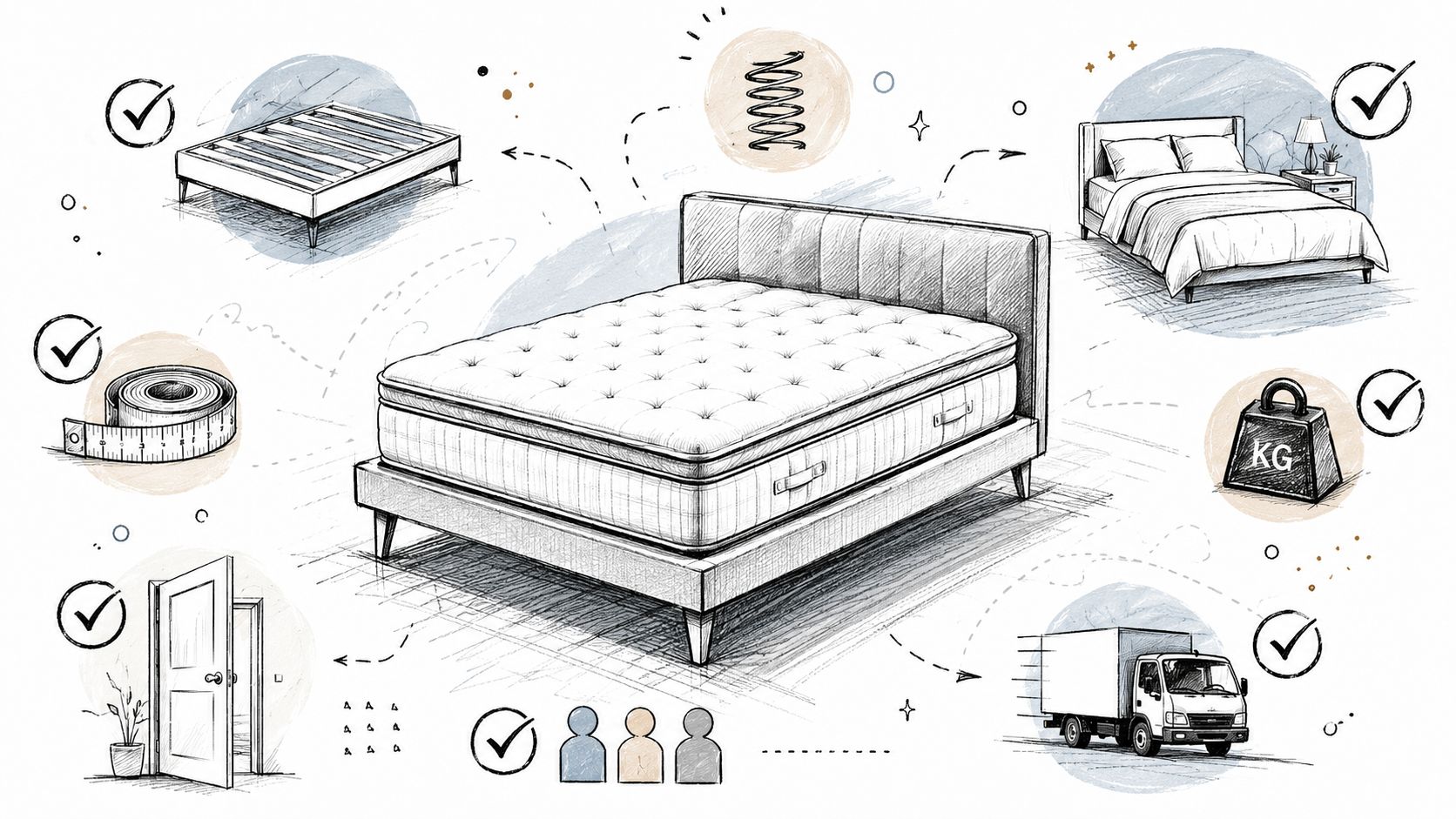
Compatibility is the part shoppers most often discover too late. A mattress can match the base dimensions perfectly and still fail as a long-term pairing if it bridges over a hinge, develops a hump or crease, slides during movement, or lacks warranty approval for repeated articulation. The foundation and mattress must work as one system.
Adjustable bases generally suit all-foam and all-latex mattresses, along with innerspring mattresses that use a wrapped coil system. Guidance specifically identifies Bonnell coil and Verticoil systems as incompatible because they aren't designed to flex properly on an articulating base.
Match the foundation to the construction
Traditional innerspring mattresses can work naturally with a box spring when the manufacturer recommends that combination. Foam mattresses need even, stable support, and many hybrid mattresses also require a solid or specifically approved foundation rather than a conventional spring foundation.
A rigid edge-support system can limit bending. Thickness also matters, and shoppers should follow the adjustable-base manufacturer's stated limits instead of assuming every tall mattress will articulate safely. The safest answer comes from the written warranty and compatibility documentation, not from a salesperson's guess or a mattress label alone.
Use this verification checklist
- Read the mattress warranty. Look for approved foundations and any language addressing adjustable-base use.
- Identify the internal construction. Confirm whether the mattress uses foam, latex, pocketed coils, or a rigid coil system.
- Test flexibility carefully. If the mattress is already owned, check whether its corners and body flex without sharp resistance or structural distortion.
- Confirm the base capacity. Match the combined weight of the sleepers and mattress to the manufacturer's stated capacity.
- Check the return terms. A return policy matters if the existing mattress doesn't articulate comfortably after setup.
A shopper who buys a premium adjustable base before checking the existing mattress may face an unplanned mattress replacement. Conversely, placing a foam or incompatible hybrid mattress on the wrong box spring can create uneven support, premature sagging, and warranty trouble. The mattress guide for adjustable beds can help shoppers narrow the pairing before money changes hands.
Cost Versus Long-Term Sleep Value
The box spring usually wins the sticker-price argument. It also wins for a guest room, a temporary apartment setup, or a sleeper who has no need for elevation and owns a compatible traditional innerspring mattress. That doesn't make it the universal value winner. Value depends on whether the foundation protects the mattress, supports daily comfort, and solves a problem the sleeper has.
An adjustable base costs more because it includes moving sections, motors, controls, and additional hardware. It can make sense for a sleeper who uses head or foot elevation every night, a couple who needs more independent positioning, or someone who wants easier bed entry and exit. It makes less sense for a healthy sleeper who prefers a flat surface and expects to move the bed often.
Compare the ownership question
| Foundation Type | Initial Cost | Lifespan | 5-Year Total Cost | Health Benefits |
|---|---|---|---|---|
| Adjustable base | Higher upfront investment | Depends on construction, use, and maintenance | Must be calculated from the selected model's price and coverage | Positioning may support comfort related to snoring, reflux, circulation, pain, or mobility |
| Box spring | Lower upfront investment | Depends on construction and use | Must be calculated from the selected foundation's price and condition | Provides fixed support and height, but no active positioning |
The table avoids fake precision because prices, warranty terms, construction, and service coverage vary by product. The right financial comparison uses the actual foundation being considered, the mattress warranty requirements, and how often the household expects to use the features.
A box spring that fails to support the mattress correctly can turn into a false economy. A base that makes nightly movement easier can deliver value even when it doesn't reduce the cost of the mattress itself. Shoppers comparing a specific queen setup can also review queen box spring pricing guidance before comparing fixed and motorized options.
The cheapest foundation is only the best value when it supports the mattress and solves the sleeper's needs.
For chronic discomfort or mobility limitations, daily positioning may justify the adjustable base. For a rarely used guest bed, the box spring's low-maintenance design is usually the cleaner decision. Health concerns deserve professional guidance, but the foundation choice should still account for whether a change in position could improve the sleeper's comfort routine.
Which Foundation Fits Your Household
A couple with different sleep habits provides the clearest adjustable-base example. One partner may snore or prefer a raised reading position, while the other wants a flatter sleep surface. A split adjustable configuration gives each side independent control, which is a functional reason to choose it. The decision isn't about owning a premium feature. It's about reducing a nightly conflict that a shared, flat box spring can't address.
A college student in a rental has a different calculation. The student may need a simple setup that is easy to move, doesn't require a nearby outlet, and keeps spending under control. If the mattress is designed for a box spring, a basic fixed foundation can serve the room without adding weight, controls, or moving parts.

Match the choice to the household
An aging homeowner who struggles to sit up or stand may benefit from an adjustable base that brings the upper body into a more manageable position. The base can support independence during ordinary bed routines, though the sleeper should verify that the mattress and base are compatible before purchase.
A family furnishing a guest room usually has different priorities. Guests may appreciate a comfortable mattress and appropriate height, but they rarely need customized positioning. A compatible box spring keeps the room straightforward and preserves budget for the mattress and other furnishings.
Common objections deserve practical answers
“Adjustable bases are too complicated.” Modern controls are designed around simple raise and lower functions, along with presets. A showroom test quickly reveals whether the remote feels intuitive.
“They look medical.” Upholstered designs and coordinated bedroom furniture can make an adjustable setup look like part of the room rather than a clinical device.
“A healthy sleeper doesn't need one.” That sleeper may not need one. Preventive comfort isn't a guarantee, but a base can provide useful flexibility before a household faces mobility or positioning concerns.
The right household assessment asks four questions:
- What interrupts sleep? Snoring, reflux, pain, partner movement, or difficulty getting up point toward different features.
- What mattress is already owned? Construction and warranty rules may narrow the choices immediately.
- How often will the bed move? Frequent relocation favors simplicity.
- What does the room need? A guest room and a primary bedroom don't have the same job.
Shop With Confidence and Expert Guidance
The adjustable base vs box spring decision becomes easier when shoppers stop treating the foundation as an afterthought. The mattress, foundation, sleeper, room layout, and daily routine all need to agree. A correct match should feel stable when flat, articulate smoothly when raised, and remain covered by the applicable warranty.
A showroom test can answer questions that product pages often leave vague. Shoppers should raise and lower the base, listen for motor noise, test the remote, assess the final bed height, and ask how the foundation pairs with the specific mattress under consideration. Weight capacity, warranty coverage, delivery, setup, and return terms deserve clear answers before the purchase is finalized.
Ask questions that protect the investment
- Will this mattress articulate safely? The answer should refer to written manufacturer guidance.
- What happens if the motor needs service? Ask about coverage and the process for resolving a problem.
- Can both partners control their sides? This matters for split configurations.
- Will the finished bed fit the room? Account for height, outlet access, and surrounding furniture.
- Who handles setup? Correct assembly protects both the base and mattress.
Sleep concerns can also involve room temperature, hormonal changes, and nighttime comfort. Readers looking for additional context can find help for hot flashes and sleep, while keeping the foundation decision focused on support and positioning.
Miller Waldrop Furniture & Decor offers mattresses, adjustable bases, box springs, and foundation guidance through its sleep-focused selection, with staff available to help customers compare compatible combinations. That hands-on process gives shoppers a way to test both foundation types instead of guessing from a product description.
Visit Miller Waldrop Furniture & Decor to test adjustable bases and fixed foundations, compare compatible mattresses, and ask sleep experts about positioning, warranty requirements, delivery, and setup. A showroom consultation can help each household choose the foundation that fits its body, budget, bedroom, and everyday sleep routine.


