

Your Guide to Finding the Best Mattress for Side Sleepers


If you're searching for the best mattress as a side sleeper, your quest will likely lead you to the medium-soft to medium-firm range. Memory foam and hybrid mattresses are often the heroes of this story. This sweet spot provides the perfect balance of deep pressure relief for your shoulders and hips while keeping your spine perfectly aligned—the secret to waking up without those familiar aches and pains.
Your Path to Pain-Free Mornings
Do you find yourself curling up on your side every night? If so, you're in good company. It's the most common way people sleep, but it comes with its own set of challenges—namely, finding a mattress that doesn't leave your shoulders and hips screaming for relief by morning.
This guide is your roadmap to unlocking refreshed, revitalized mornings. We're not just going to list a bunch of products; we're going to arm you with the knowledge to choose the features that actually matter for your body and your sleep style.
Think of it this way: choosing the right bed is the single most important step you can take to reclaim your energy. When your mattress isn't right for you, your body spends the whole night fighting for a comfortable position instead of truly resting and repairing itself. Those aches are your body's way of telling you it's time for a change. You can learn more about these warning signs in our guide on when to replace your mattress.
Understanding Your Unique Needs
Side sleeping isn't just common; it's the go-to position for the majority of adults. In fact, research shows about 54% of people spend most of the night on their side. This reality has pushed mattress designers to create beds specifically for this sleeping style. When you sleep on your side, you're putting a ton of your body weight onto your shoulders and hips, creating major pressure points.
Without a mattress that can properly cushion these areas, you're setting yourself up for:
- Nagging shoulder pain and stiffness
- Hip discomfort that can even travel down your leg
- Lower back strain from your spine being out of alignment
- Constant tossing and turning as you search for a comfortable spot
Your mattress shouldn't be something your body has to fight against all night. It should be your greatest ally in getting deep, restorative rest. The goal is simple: find a surface that hugs your curves, cradles your pressure points, and keeps your spine in a healthy, straight line.
Of course, a great mattress is just one piece of the puzzle. Building better sleep habits is just as important. For a broader look at improving your nightly routine, check out these practical tips for better sleep. Armed with the right knowledge, you can confidently find a mattress that will deliver incredible sleep, night after night. Your journey to better mornings starts right now.
Why Spinal Alignment Is Your Top Priority
When you lie on your side, your body presents a unique challenge for your mattress. The mission, though, is simple: keep your spine in a perfectly straight, neutral line from your neck all the way down to your tailbone. Picture your spine as a delicate chain—if one link is out of place, the entire structure is compromised.
If your mattress is too firm, it's like sleeping on a board. Your shoulders and hips, the widest parts of your body, can't sink in at all. This forces your spine to curve upwards, creating painful pressure on those very spots.
On the flip side, a mattress that’s too soft is just as bad. Your heavier hips and midsection will sink in way too far, pulling your spine down into an uncomfortable hammock shape. Either way, you're waking up stiff, sore, and wondering why you even bothered going to sleep.
This is where the right mattress proves its worth. It’s not about a simple choice between soft and firm; it’s about finding a mattress that’s smart enough to understand the unique contours of a side sleeper.
The Balancing Act of Pressure Relief and Support
To nail that perfect alignment, a mattress has to do two things at once, and do them well. It must cushion your pressure points while simultaneously supporting the rest of your body. This delicate balance is what separates a truly great mattress from a merely good one.
This infographic breaks down how these crucial elements—pressure relief, spinal support, and cushioning—work in harmony.
As you can see, they’re all connected. Proper cushioning lets your shoulder and hip sink in just enough to relieve pressure, which then allows the supportive core of the mattress to do its job and keep your spine straight.
When a mattress gets this right, it feels like it was made just for you. It actively cradles your body instead of fighting against it, preventing the strain that builds up into chronic aches and pains. This is exactly why materials that contour to your shape, like memory foam or the plush top layers in a hybrid, are such a game-changer for side sleepers.
A great mattress doesn't force your body to adapt to it. Instead, it intelligently adapts to you, filling the gaps under your waist and contouring around your hips and shoulders to maintain a neutral spine all night long.
Building a Foundation for Long-Term Health
Of course, a healthy spine isn't just about what happens at night. Your daily posture and core strength are just as important for how you feel when you wake up. Think of your mattress as your nighttime support system, while strong, flexible muscles are your daytime defense against pain.
Activities like Pilates can work wonders for your core and flexibility, which directly contributes to better spinal alignment 24/7. You can explore how these exercises help through resources covering Pilates for spinal alignment and core strength. By pairing the right sleep surface with healthy physical habits, you create a powerful formula for long-term spinal health.
Finding that perfect mattress is a personal journey, but it all starts with understanding these core principles. Our Sleep Experts are here to guide you through it. Using our advanced bed matching system, we can pinpoint your body's unique pressure points and help you find a mattress like the Serta iComfortECO, which is engineered to deliver that precise balance of cushioning and support you need to wake up ready for anything.
How to Find Your Perfect Firmness Level
Mattress firmness is more than just a preference—it’s the single most important factor for a pain-free morning. For side sleepers, the perfect firmness is a tricky balancing act. You need a mattress soft enough to cushion your body's curves but still supportive enough to keep your spine straight. Think of it as a good hug: too tight is uncomfortable, but too loose offers no support at all.
Trying to make sense of mattress firmness can feel overwhelming, but thankfully, there’s a simple 1-10 scale to cut through the confusion. On this scale, 1 is the softest you can imagine (like a fluffy cloud), and 10 is the firmest (think sleeping on a carpeted floor). While everyone's different, the sweet spot for the best mattress for side sleepers usually lands right in the middle.
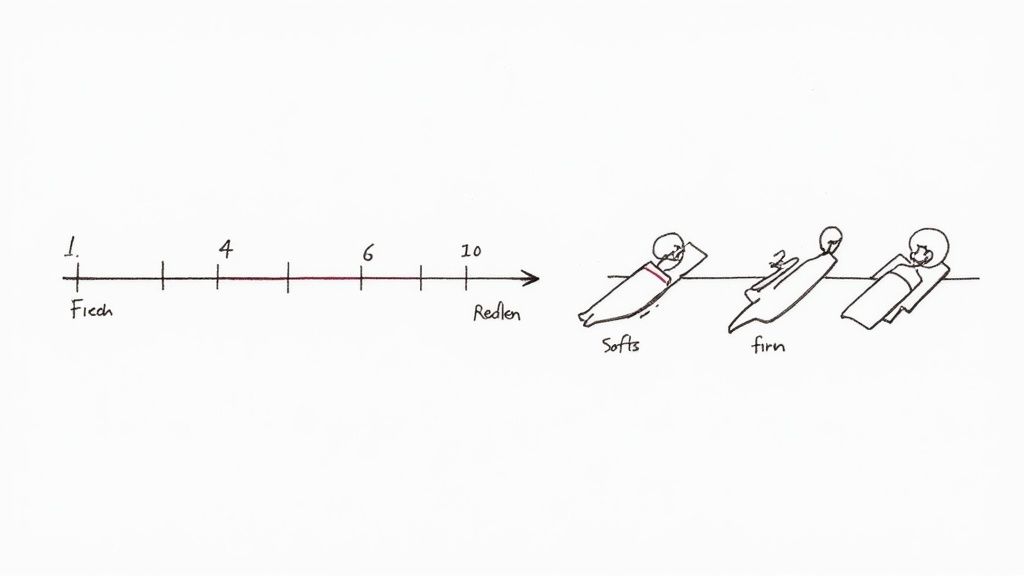
Most side sleepers discover their ideal match in the 4 to 6 range, what we call medium-soft to medium. This level delivers that "just right" Goldilocks feel, letting your hips and shoulders sink in just enough to take the pressure off, without letting your waist and lower back sag.
How Your Body Weight Changes the Game
That perfect firmness level isn't a one-size-fits-all number. Your body weight plays a huge role in how a mattress actually feels underneath you. What one person calls a supportive medium, a heavier person might feel they’re sinking into quicksand. Understanding this is the key to finding truly personalized comfort.
Here’s how you can find the right tool for the job based on your body type:
- Lighter Sleepers (Under 130 lbs): If you're on the lighter side, you don't compress a mattress very much. A firm mattress won't give at all, creating pressure points instead of relieving them. That's why a softer mattress (a 4-5 on the scale) is often the way to go, as it provides the gentle contouring needed for proper spinal alignment.
- Average Weight Sleepers (130-230 lbs): This group has the most options and typically does best in that classic medium-soft to medium range (5-6). This firmness offers an ideal blend of pressure relief and support, preventing the hips from sinking too far while still cradling the shoulders.
- Heavier Sleepers (Over 230 lbs): Heavier individuals naturally put more pressure on a mattress, causing them to sink deeper. If the mattress is too soft, they'll "bottom out," which throws the spine out of alignment. A medium-firm to firm mattress (6.5-7) provides the robust support needed to keep the spine level while still having enough cushioning for pressure points.
Think of it this way: your body weight determines how much "work" the mattress has to do. The goal is to find one built to handle your specific needs, ensuring it can provide consistent support and comfort, night after night.
The Dangers of Getting It Wrong
Choosing the wrong firmness is more than a small mistake; it can seriously impact your sleep and even your overall health. The wrong mattress can leave you with persistent aches and pains that follow you all day long.
If a mattress is too firm for you, it will actively push against your shoulders and hips. This doesn't just create sore spots—it also forces your spine into an unnatural upward curve, leading to a strained lower back.
On the flip side, a mattress that’s too soft lets your heavier midsection sink way too far down. This creates a "hammock effect" that pulls your spine out of its natural alignment, causing major discomfort, especially in your lumbar region. Finding that ideal balance isn't just about feeling cozy; it’s about protecting your spinal health for the long haul.
Finding the right mattress is a journey of empowerment. You're not just buying a bed; you're investing in your well-being. At Miller Waldrop, our Sleep Experts are here to be your trusted guides. With our advanced bed matching system, we can analyze your unique pressure points and help you find the perfect mattress firmness, ensuring you wake up feeling refreshed and ready to win the day. Explore our collection of premium mattresses and discover the difference a personalized fit can make.
How to Choose the Right Mattress Material for You
Once you’ve settled on the right firmness level, it's time to pick your mattress’s core material. Think of it like choosing the right tires for your car—what they're made of completely changes the ride. Memory foam, latex, and hybrid mattresses all get you to a great night's sleep, but they take very different roads to get there.
Your choice here is a big deal. The material dictates everything from pressure relief and support to how warm you sleep at night. It's time to look past the marketing buzz and discover what each one actually feels like so you can make the right choice.
The Deep Cradling Comfort of Memory Foam
When people talk about pressure relief, memory foam is almost always the first thing that comes to mind—and for good reason. Originally developed by NASA, this unique viscoelastic foam softens and molds in response to your body heat and weight. For side sleepers, this is a game-changer. The foam literally contours around the distinct curves of your shoulders and hips, giving you a deep, cradling hug.
This contouring action is the secret sauce. It spreads your body weight out evenly, which is exactly what you need to stop those sharp pressure points that leave you sore and stiff in the morning.
- Exceptional Pressure Relief: Its ability to conform is second to none, making it a top contender for the best mattress for side sleepers, especially if you deal with nagging shoulder or hip pain.
- Superb Motion Isolation: Memory foam is incredible at absorbing movement. If you share a bed, your partner’s tossing and turning is far less likely to wake you up.
Now, you might have heard that old memory foam trapped a lot of heat. Thankfully, those days are mostly behind us. Modern foams often include cooling gel infusions, open-cell structures, or perforated designs to keep air flowing, so you don't have to worry about overheating.
The Buoyant and Responsive Feel of Latex
If you love the idea of pressure relief but hate the feeling of sinking too far into your mattress, latex could be your perfect match. Sourced from the sap of rubber trees, latex foam has a much more buoyant and responsive feel. Instead of slowly melting around you like memory foam, it provides an almost instantaneous lift.
That springiness makes it so much easier to switch positions without feeling like you’re stuck in quicksand. It creates the feeling of sleeping on your bed, not in it—a sensation many side sleepers find more comfortable.
Latex offers a really unique blend of gentle cushioning and uplifting support. It compresses just enough under your shoulders and hips for relief but pushes back enough to keep your spine in a perfectly straight line.
On top of that, latex is naturally durable and breathes incredibly well. Its open-cell structure promotes constant airflow, making it a fantastic pick if you tend to sleep hot. It’s also naturally hypoallergenic and resistant to dust mites, which is a nice bonus for a cleaner sleep space.
Hybrid Mattresses: The Best of Both Worlds
Stuck between the contouring hug of foam and the classic bounce of an innerspring? You don't have to choose. A hybrid mattress is designed to give you both. This modern construction pairs a supportive core of individually pocketed coils with thick comfort layers of memory foam, latex, or sometimes both. A fantastic example is the Serta Perfect Sleeper Luminous Sleep Plush Pillow Top Mattress, which combines advanced coils with plush, pressure-relieving foams.
The coils provide that robust, durable support and fantastic edge-to-edge stability, so you never feel like you're about to roll off the side. Up top, the foam layers deliver the critical pressure relief that side sleepers absolutely need. It's a balanced approach that has made hybrids incredibly popular.
As the mattress industry evolves, sleepers are demanding more personalized solutions. The North American mattress market was valued at $15.3 billion in 2024, with memory foam and hybrid models leading the charge. This growth is driven by people just like you, who are looking for better alignment and serious pressure relief. You can learn more about these market trends and their impact on mattress design.
Hybrids really do offer a "best-of-both-worlds" sleep experience. To dig deeper into this popular design, check out our guide on what a hybrid mattress is and see if it's the right fit for you.
Mattress Material Matchup for Side Sleepers
To make things a little clearer, let's put these materials head-to-head. Here’s a quick breakdown of how memory foam, latex, and hybrids stack up on the features that matter most to side sleepers.
| Material Type | Pressure Relief | Spinal Support | Responsiveness | Best For |
|---|---|---|---|---|
| Memory Foam | Excellent (deep contouring) | Good to Excellent (conforms to curves) | Low (slow-moving feel) | Side sleepers with sharp pain points who don't move around much at night. |
| Latex | Very Good (gentle cushioning) | Excellent (buoyant and uplifting) | High (bouncy feel) | Hot sleepers and those who prefer to feel like they're sleeping "on" the bed. |
| Hybrid | Excellent (combines foam relief with coil support) | Excellent (strong coil core) | Medium to High (balanced bounce and contour) | Sleepers who want a bit of everything: deep relief, sturdy support, and bounce. |
Ultimately, choosing the right material is a personal call. The goal is to find a mattress that understands your body’s unique needs. By knowing the distinct advantages of memory foam, latex, and hybrids, you're in a much better position to pick a winner that will transform your sleep for years to come.
The Little Details That Make a Huge Difference
Once you’ve got a handle on mattress types and firmness levels, it’s time to look at the finer details. These are the features that can take a mattress from "good enough" to "perfect for you." Think of it this way: the mattress type is the car's engine, and the firmness is its suspension. These next features are the high-tech extras—the heated seats and premium sound system that make the whole experience so much better.
Getting these details right is how you can solve those annoying sleep problems that can ruin an otherwise comfortable night.
Master the Art of Undisturbed Sleep
Is there anything worse than being jolted awake just as you’re drifting off because your partner rolled over? That’s where motion isolation comes in. A mattress with good motion isolation absorbs movement on one side of the bed, so it doesn't send a shockwave over to your side.
Memory foam is the undisputed champion here; it just deadens movement on the spot. But hybrid mattresses with individually pocketed coils are also fantastic, since each spring compresses on its own without affecting its neighbors. If you share a bed, this isn't a luxury—it's a must-have for staying asleep.
Maximize Your Space with Edge Support
Another feature that people often forget about until it's too late is edge support. This is all about how sturdy the perimeter of the mattress is. A bed with weak edges will sag and collapse when you sit on it to put on your shoes, and it can make you feel like you’re about to roll off if you sleep close to the side.
Strong edge support, typically found in hybrids with a reinforced perimeter of coils, gives you more usable real estate on your bed. You can sleep right up to the edge and still feel completely secure. It’s a small thing, but it makes a big difference in how you use your mattress day-to-day.
A mattress with superior edge support and motion isolation creates a stable, personal sleep zone. It’s the tool you need to ensure that your rest is protected from outside disturbances, whether from a restless partner or your own movements.
Stay Cool and Comfortable All Night Long
Waking up in a sweat is a surefire way to kill a great night's sleep. Your body temperature naturally needs to drop to initiate and maintain deep sleep, and a mattress that traps heat works against that biological process. This is why temperature regulation has become a huge focus in mattress design.
Luckily, manufacturers have gotten pretty clever about solving this problem:
- Gel-Infused Foams: Gel beads are swirled into the foam to help pull heat away from your body.
- Open-Cell Construction: Think of this as making the foam more like a sponge than a brick, allowing air to move through it freely.
- Perforated Layers: Some brands literally punch small holes through the foam layers to let heat escape.
- Breathable Covers: High-tech fabrics like Tencel or good old-fashioned cotton help wick away moisture and stay cool.
Hybrid mattresses have a natural advantage here because air can flow freely between the coils. In fact, these kinds of innovations are a big reason why hybrids have become so popular. According to a recent in-depth mattress market analysis, the U.S. residential market—where most of us are shopping—accounted for a massive 79% of total mattress revenue in 2024, with demand for these advanced features continuing to climb.
Here’s a look at how some of these features come together in a modern mattress design.
As you can see, it's all about how the different layers work in concert to both support you and keep you from overheating.
By paying attention to motion isolation, edge support, and cooling, you’re no longer just buying a mattress—you’re investing in a complete sleep system tailored to your life. You’re almost there! If you want a hand putting it all together, visit us at Miller Waldrop and let one of our Sleep Experts help you find a mattress with all the features you need to win the night.
Your Checklist for Choosing with Confidence
You’ve got the theory down—from spinal alignment to the pros and cons of memory foam versus latex. Now, let’s put all that knowledge into practice. This isn't just a checklist; it's your game plan for walking into a store (or browsing online) and making a choice you'll be happy with for years.
Think of it as the final step in your mission. You're about to find the mattress that finally lets you wake up feeling recharged and free from those nagging aches and pains.
The Final Steps to Your Best Sleep
A mattress is a major investment in your health, so getting the practical details right is crucial. Before you pull the trigger, walk through these final checkpoints. They’re your safety net, ensuring you’ve found the perfect match and your investment is protected.
-
Read Reviews with a Critical Eye: Don't just scan the star ratings. Actively hunt for reviews from people who identify as side sleepers. Pay special attention to any mentions of shoulder and hip comfort—that’s where the real proof is for someone who sleeps like you.
-
Prioritize the Sleep Trial: This is non-negotiable. It takes your body at least 30 nights to truly adapt to a new mattress. Look for a trial period of 90 nights or more. This gives you a genuine, risk-free chance to know if the mattress is right for you in your own home.
-
Understand the Warranty: A warranty is your protection against things going wrong with the mattress itself, like sagging or other manufacturing defects. It's not for when you change your mind. A solid warranty of 10 years or more shows that the company truly stands behind the quality and durability of its product.
A great mattress company doesn't just sell you a product; they provide a service. The sleep trial and warranty are your assurance that they stand behind their promise of better sleep, giving you the peace of mind you deserve.
Finally, double-check the simple stuff. Even the world's best mattress won't feel right if it's crammed into your bedroom. Before you make the final call, our guide on what size mattress you might need can help you confirm the perfect fit.
You now have everything you need to make a smart, informed decision. You're ready.
Got a Few More Questions?
Even after digging through all the details, it's normal to have a few last-minute questions before you make a final decision. Buying a mattress is a big deal! Let's tackle some of the most common things we hear from side sleepers to clear up any lingering doubts.
What's the Best Firmness for a Heavier Side Sleeper?
If you weigh over 230 lbs, you'll likely feel most comfortable on a medium-firm mattress—think a 6.5 or 7 on that 1-10 firmness scale. This level gives you the robust support needed to keep your hips from sinking too far, which is absolutely essential for keeping your spine straight.
But support is only half the battle. That medium-firm feel still needs to have a generous comfort layer on top to cushion your shoulders and prevent that painful, jammed-up feeling. The secret is looking for mattresses built with high-density foams or strong, reinforced coils that can stand up to pressure night after night.
Can a Firm Mattress Ever Work for a Side Sleeper?
Generally, an extra-firm mattress is a one-way ticket to soreness for a side sleeper. However, a standard "firm" or "luxury firm" model can work, but only if one crucial condition is met: it must have a thick, plush comfort layer right on top.
Think of it this way: the firm core provides the deep-down support, while the top layer is there to let your shoulders and hips sink in just enough to relieve pressure. Without that initial give, you might as well be sleeping on the floor. You'll wake up sore, and your spine will be completely out of whack.
Just How Important Is My Pillow?
Your pillow is every bit as important as your mattress. Seriously. As a side sleeper, the entire job of your pillow is to fill the gap between your head and the mattress, holding your neck in a perfectly straight line with the rest of your spine.
A pillow that’s too thin lets your head droop, creating a nasty strain. One that's too thick forces your head upward at an uncomfortable angle. Your best bet is usually a loftier, more substantial pillow—contoured memory foam or responsive latex are fantastic options here.
How Long Should I Test Drive a New Mattress?
Give it at least 30 nights. It might sound like a long time, but your body needs a chance to get used to a new feel and support system. Plus, the mattress itself has what’s called a "break-in period," where the materials will soften up just a little bit and conform to you.
This is exactly why almost any brand worth its salt offers a sleep trial of 90 nights or more. They want you to have ample, real-world time to know for sure that you've made the right choice for your long-term health and comfort.
Finding the right mattress is a personal journey, and now you’re equipped with the expert knowledge to make a great decision. Here at Miller Waldrop Furniture & Decor, our Sleep Experts are ready to be your final guide, using advanced bed matching technology to pinpoint the exact mattress your body needs.
Explore our collection and find your perfect mattress today.