

Best Mattress for Combination Sleepers Buying Guide

You probably know the routine. You fall asleep on your side, wake up on your back, then spend the last hour of the night half-twisted on your stomach trying to get comfortable. By morning, your shoulder aches, your lower back feels tight, and the mattress that felt fine in the showroom suddenly feels like the problem.
That’s what makes shopping for the best mattress for combination sleepers different. You’re not buying for one position. You’re buying for constant movement, shifting pressure points, and a sleep surface that has to keep up without fighting you.
For shoppers in West Texas and Southeastern New Mexico, there’s another layer. Heat matters. Breathability matters. Edge support matters when you stretch out across the bed to find the cooler spot. A mattress that traps warmth or makes you feel stuck can turn ordinary position changes into a long night.
The right mattress fixes that. It gives you enough cushion for your side, enough support for your back, and enough lift to keep your hips from dropping when you roll to your stomach. That balance is what separates a mattress that feels nice for five minutes from one that helps you sleep better.
Why Combination Sleepers Need a Specialized Mattress
A standard mattress usually works well for one main sleep style. That’s the problem.
If you’re a combination sleeper, your body asks for something different at different points in the night. Your shoulders want pressure relief when you’re on your side. Your lower back wants steady support when you’re flat on your back. Your hips need to stay lifted when you rotate onto your stomach. One mattress has to handle all of that.
What goes wrong on the wrong bed
On slow, soft foam, you can feel trapped when you try to move. The comfort layer hugs your body a little too much, and every turn takes effort.
On a basic firm innerspring, the opposite happens. You can move easily, but your shoulders and hips may press too hard into the surface when you land on your side.
Neither setup is ideal. Combination sleepers need a mattress that responds quickly and supports multiple positions without forcing the body to compensate.
The mattress shouldn’t make you work to change position. It should reset fast and stay supportive every time you move.
Why soreness shows up in the morning
Most restless sleepers blame themselves first. They think they toss because they’re stressed, hot, or light sleepers. Sometimes that’s true. But often the mattress is creating the problem.
When the mattress doesn’t keep your spine in a neutral position, your body keeps searching for relief. That’s when you wake up with stiffness through the shoulders, lower back, or hips. If that sounds familiar, this guide on why your back hurts after sleeping is worth reading because it connects mattress support to the pain many people wake up with.
Specialized support changes the whole night
The best mattress for combination sleepers does three things well. It cushions pressure points, stays supportive through the midsection, and lets you turn without resistance.
That combination matters more than flashy marketing terms. If a bed can’t handle repeated movement without sagging, trapping heat, or collapsing at the edge, it’s not built for the way you sleep.
Understanding Combination Sleeper Requirements
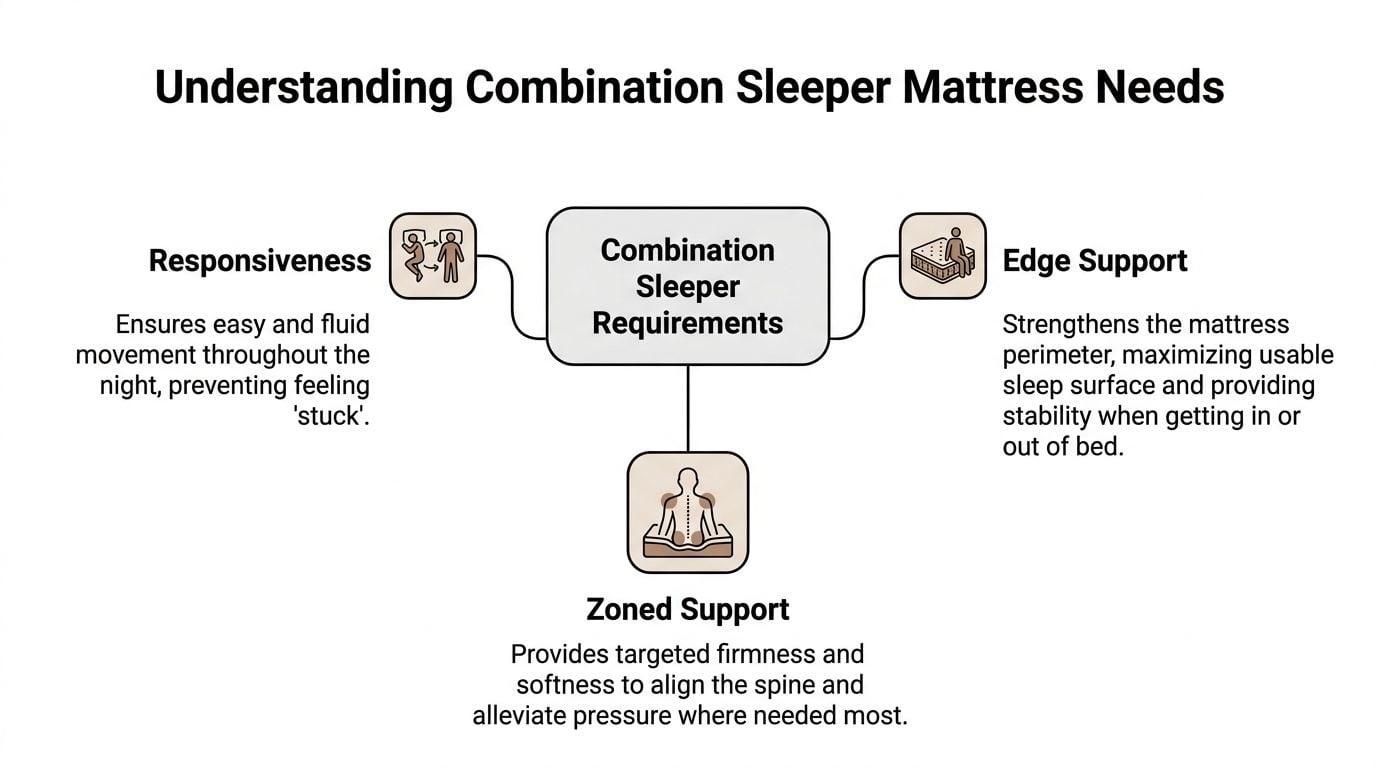
Combination sleepers need a mattress that acts like a multi-gear bike. It has to adapt quickly when the terrain changes. You don’t want one fixed response from the bed. You want a surface that shifts with you without losing control.
Research cited in expert mattress reviews notes that combination sleepers, who shift between side, back, and stomach positions multiple times nightly, benefit most from hybrid mattresses featuring zoned support systems, which reduce tossing and turning by up to 23% compared to traditional memory foam options. The same source notes that about 60-70% of adults are combination sleepers (expert review citing Sleep Foundation research).
Responsiveness matters first
If you change positions often, responsiveness is essential.
A responsive mattress springs back quickly after pressure is removed. That keeps you from feeling stuck when you roll from your side to your back. It also helps the bed feel consistent instead of lumpy or delayed.
At this point, many older memory foam beds fail combination sleepers. They can feel comfortable at first, but once your body settles in, movement gets harder.
Zoned support keeps your spine from fighting the bed
Not every part of your body needs the same level of pushback. Your shoulders usually need more give. Your hips and lower back usually need firmer support.
That’s why zoned support works so well for combination sleepers. It allows different areas of the mattress to respond differently, which helps the bed stay comfortable across more than one sleep position.
If you want extra context on the body mechanics behind this, surprising ways your sleep position affects your health is a useful read. It connects sleep posture with the kinds of strain people often dismiss as “just sleeping wrong.”
Edge support is more important than most shoppers think
Combination sleepers don’t stay planted in the center of the mattress.
You drift. You stretch out. You use more of the sleep surface. Weak edges make the bed feel smaller than it is and can create that rolling-off sensation when you end up near the perimeter.
Strong edges also matter when you sit down to put on shoes, stand up in the morning, or share the bed with a partner and need every inch of space.
Breathability matters more in this region
West Texas heat and Southeastern New Mexico conditions can make a warm mattress feel even warmer. If the bed holds heat, each position change can turn into a search for the cool side.
Breathable covers, coil systems, and less heat-trapping comfort materials usually feel better here than dense, slow foams. That doesn’t mean foam is off the table. It means you need to pay attention to how the mattress releases heat, not just how it feels in the first minute.
What to test in person
When you’re on a showroom floor, focus on these points:
- Ease of movement: Roll from side to back and back to stomach. The bed should help you move, not resist you.
- Midsection support: Notice whether your hips dip too far when you lie on your stomach or back.
- Shoulder pressure relief: Stay on your side long enough to feel whether the top layer gives enough.
- Perimeter stability: Move toward the edge while lying down. A good mattress still feels usable there.
Practical rule: If a bed only feels good in your favorite position, it probably isn’t the best mattress for combination sleepers.
Evaluating Mattress Constructions and Firmness
Construction decides feel. Marketing doesn’t.
If you’re a combination sleeper, the question is simple. Does the mattress let you move easily while still keeping your body aligned in every position you use? The answer usually comes down to what’s inside the bed and how firm it feels.
For a broader primer, this overview of different types of mattresses is helpful. It gives shoppers a clean comparison before they narrow in on what works for active sleepers.
All-foam mattresses
All-foam beds can work well for combination sleepers when they use more responsive comfort layers and land in the medium-firm range.
Their biggest strength is pressure relief and motion control. If you sleep with a partner and one of you moves a lot, foam often reduces disturbance better than coil-heavy builds.
Their biggest weakness is mobility. Some all-foam beds contour so much that they slow you down. If you already feel like you fight your mattress at night, a dense, slow-responding foam bed probably won’t help.
Innerspring mattresses
Traditional innerspring mattresses are easy to move on. That’s their appeal.
They usually feel lifted and supportive rather than contouring. If you spend a lot of time on your back or stomach and dislike any sink at all, innerspring can feel straightforward and clean.
The downside is pressure relief. Pure coil constructions can feel too rigid for people who spend a meaningful part of the night on their side. If your shoulder or hip pain is the main complaint, a basic innerspring often isn’t the best answer.
If you’re weighing these trade-offs closely, this guide on innerspring vs memory foam mattress lays out the comfort and support differences clearly.
Hybrids usually win this category
Many find a hybrid mattress to be a good starting point, moving away only for a specific reason.
Hybrid mattresses combine foam comfort layers with a coil support core, which gives you more bounce, better airflow, and stronger edge support than most all-foam models. They also tend to handle mixed sleep positions better than traditional innersprings because the top layers add pressure relief where you need it.
Expert mattress reviews note that hybrid mattresses with dual coil systems and zoned support, such as the Saatva Classic and Helix Midnight Luxe, excel for combination sleepers by providing responsive bounce with responsiveness scores of 4-4.5/5 and targeted lumbar reinforcement that maintains spinal alignment across positions (Sleep Advisor review).
That’s exactly what combination sleepers need. Not softness alone. Not firmness alone. Controlled adaptability.
Firmness for combination sleepers
Most combination sleepers do best in the middle. Too soft and your hips drop when you roll onto your stomach or back. Too firm and your shoulder gets punished when you spend time on your side.
A useful range is usually 5 to 8 on a 10-point firmness scale, with the sweet spot for many shoppers sitting near medium-firm. That range gives you enough pushback to stay aligned and enough surface comfort to avoid pressure buildup.
Softer end of the range
This can work if you spend most of the night on your side and only occasionally rotate onto your back.
The risk is that it may feel great at first, then start to feel unstable once you move into a less forgiving position.
Firmer end of the range
This makes more sense if you rotate between back and stomach often, or if you strongly prefer sleeping on top of the bed rather than in it.
The trade-off is reduced pressure relief. If your shoulder or hip gets sore easily, don’t go firm just because it feels “supportive” for thirty seconds in the store.
What matters more than the label
Ignore names like plush, luxury, or ultra support. Focus on these questions instead:
- Does the mattress recover quickly after you move?
- Does your lower back stay supported on your back and stomach?
- Does your shoulder sink enough on your side?
- Does the edge stay stable when you drift outward?
A mattress can feel soft on top and still be supportive underneath. It can also feel firm for one minute and become uncomfortable after ten. Stay on it long enough to find out which one you’re actually buying.
How to Test Mattresses for Combination Sleepers
A quick sit on the edge and a ten-second lie-down won’t tell you anything useful. Combination sleepers need to test mattresses like they sleep, which means movement, time, and honest comparison.
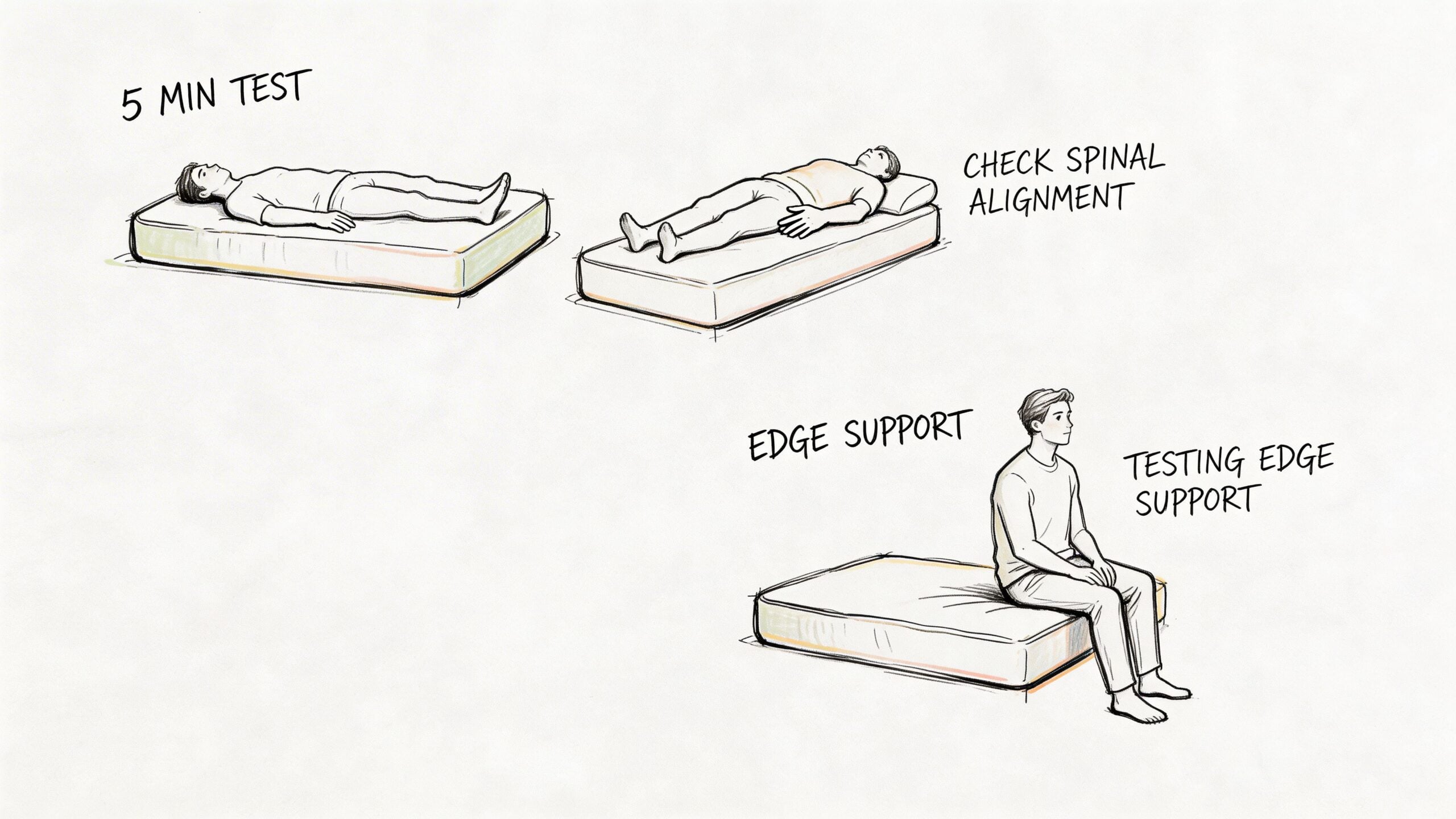
Start with your real sleep pattern
Don’t test the bed in one ideal pose. Test the positions you use at home.
If you usually fall asleep on your side and wake up on your back, start there. If you rotate onto your stomach late in the night, include that too. Give each position enough time for your body to settle.
A good showroom routine looks like this:
- Lie on your side first. Stay there long enough to notice shoulder and hip pressure.
- Roll onto your back. Check whether your lower back feels supported or hollow.
- Turn onto your stomach if you use it. Pay attention to whether your hips sink too far.
- Repeat the transitions. The bed should feel easy to move on each time.
Pay attention to movement, not just comfort
Many mattresses feel comfortable when you’re still. That’s not the challenge for a combination sleeper.
The challenge is what happens during transition. If the mattress grips your body, you’ll notice it when you try to roll. If the surface is too springy, you’ll feel your body overshoot and settle awkwardly.
You want a bed that resets quickly but doesn’t throw you around.
Use a simple alignment check
Ask the salesperson to look at your posture from the side while you lie in your usual positions. A good bed keeps your body looking level rather than bent at the waist or dropped at the shoulders.
You can also do a quick self-check:
- On your back: Notice whether there’s a huge gap under your lower back or if your hips sink lower than your chest.
- On your side: Pay attention to whether your spine feels straight or bowed.
- On your stomach: Check for lower-back compression or that “hammock” feeling.
Test the edge on purpose
Combination sleepers use the full width of the mattress.
Sit on the side first. Then lie down near the perimeter. If the edge collapses, the bed will feel smaller at home than it looked in the store. Strong edge support gives you confidence to move freely without feeling unstable.
If you share a bed, edge support isn’t a luxury. It’s what keeps the whole mattress usable.
Ask better showroom questions
The right questions get better answers than “Is this one popular?”
Ask things like:
- How easy is this mattress to move on compared with the others I tried?
- Does this model have zoned support through the center?
- How does the edge feel when people sleep near the side?
- Is this mattress better for side-to-back sleepers or back-to-stomach sleepers?
- What does the pressure-mapping system show under my shoulders and hips?
That last one matters. Pressure-mapping can help you see whether your body is getting support in the right places instead of guessing based on initial softness.
Compare only a few serious contenders
Don’t test fifteen beds. Narrow it to three that fit your movement style, sleep temperature, and comfort preference.
Then repeat the same routine on each. Same positions. Same amount of time. Same transition checks. That’s how you separate a bed that feels impressive from one that fits.
Top Mattress Features for Seamless Position Changes
If you want the best mattress for combination sleepers, stop focusing on the broad category first and start looking at the parts that create the feel. Features decide whether a mattress helps you turn smoothly or leaves you fighting for a better position.
Zoned support systems
This is one of the most useful features for mixed-position sleepers.
A zoned design gives the mattress different support levels across the body. Softer areas let the shoulders and hips settle when you’re on your side. Firmer reinforcement through the center helps keep your lower back and hips from dropping when you rotate onto your back or stomach.
That’s why zoned hybrids tend to feel more controlled than flat, uniform builds.
Adaptive transition layers
The transition layer sits between the plush top and the main support core. On a good mattress, this layer does a lot of work.
It prevents the dramatic sink that makes some beds feel slow and swampy. It also smooths out movement, so when you change positions you don’t hit the support core too abruptly.
If you’ve ever tried a mattress that felt nice at first but awkward once you moved, the transition layer was probably the issue.
Quick-rebound comfort materials
Slow-response foam can be comfortable, but quick-rebound materials are usually better for active sleepers.
Expert reviews note that advanced memory foam or hybrid constructions like the Bear Elite Hybrid and Nectar Premier offer combination sleepers pressure redistribution with scores of 4-4.5/5 through multi-density foam layering, while also delivering 5/5 motion isolation. The same review states these constructions can reduce pressure points at the hips and shoulders by 25-30% versus innerspring alone (Mattress Clarity review).
That’s the sweet spot. Enough contouring to ease pressure, but not so much that the bed traps you.
Reinforced edges
Strong edges do more than make sitting easier.
They widen the useful sleep surface, which matters if you sprawl, rotate toward the perimeter, or share the bed. Reinforced edges also make the mattress feel more stable during transitions because the whole surface stays consistent.
Cooling-focused materials
Heat changes how a mattress feels over the course of the night. In a warm bedroom, foams can feel softer and less responsive as heat builds up.
For West Texas and Southeastern New Mexico shoppers, prioritize features that help the bed stay breathable:
- Coil support cores: They allow more airflow than solid foam cores.
- Open, less-dense comfort materials: These tend to feel less heat-retentive.
- Cooling covers or gel-infused foams: These can help moderate surface warmth.
A simple feature checklist
Use this when comparing mattresses:
| Feature | Why it matters for combination sleepers |
|---|---|
| Zoned support | Keeps shoulders cushioned and hips supported |
| Responsive comfort layer | Makes turning easier |
| Transition foam | Prevents deep sink and awkward movement |
| Reinforced edge | Gives you more usable mattress space |
| Breathable build | Helps the bed stay comfortable through repeated movement |
The best feature mix isn’t the most complicated one. It’s the one that lets your body change positions without losing alignment.
Recommended Mattresses for Combination Sleepers
You go to sleep on your side, wake up on your back, then end up half-turned toward the edge by 4 a.m. In West Texas and Southeastern New Mexico, that pattern gets harder to manage on a mattress that holds heat or slows you down during position changes. Start with a medium-firm hybrid unless you have a clear reason not to. It is the safest choice for active sleepers because it balances pushback, airflow, and enough pressure relief for side sleeping.
Foam can still work. I only recommend it when motion isolation is a top priority and the feel is supportive enough to keep you from sinking too far. If you want help comparing in-store feel with what your body will tolerate over a full night, review this guide on how to shop for mattress before you head into a showroom.
Top Mattresses for Combination Sleepers
| Model | Type | Firmness | Best For |
|---|---|---|---|
| Nectar Premier | All-foam | Medium-firm | Couples who want motion control without an overly soft feel |
| Saatva Classic | Hybrid / innerspring-style | Medium-firm to firm options | Shoppers who want lift, edge stability, and easier movement |
| Helix Midnight Luxe | Hybrid | Medium-firm | Back-to-side sleepers who need pressure relief and support |
| WinkBed Luxury Firm | Hybrid | Luxury Firm, medium-firm feel | Sleepers who want a stable surface and stronger edges |
| Nolah Evolution 15 | Hybrid | Medium-firm | Side-combination sleepers who want more cushioning |
| Birch Luxe Natural | Latex hybrid | Medium-firm | Sleepers who want fast response and a buoyant surface |
Nectar Premier for foam shoppers who share a bed
The Nectar Premier is one of the few foam beds I would confidently put in front of a true combination sleeper.
Expert testing at Sleepopolis rated it at a medium-firm 6/10 and gave it strong marks for back support, side support, cooling, and motion isolation. That combination matters if your partner moves around or wakes easily, but you still need enough surface support to turn without effort.
For hot, dry West Texas bedrooms or warmer homes in Hobbs and Carlsbad, this would not be my first cooling pick. It is a better fit for couples who care more about motion control than maximum airflow.
Saatva Classic for shoppers who want lift instead of sink
The Saatva Classic works well for people who hate the hugged, slow-moving feel of dense foam.
It has the traditional lifted sensation many shoppers still prefer in local showrooms. That matters because a mattress can feel comfortable for five minutes and still become a problem if your hips settle too far after an hour. The Saatva is a strong choice if you rotate between your back, side, and stomach, or if you use the perimeter of the bed heavily.
It is also a smart showroom test in this region because you can quickly tell whether the more buoyant, coil-forward feel helps or irritates your joints.
Helix Midnight Luxe for back-to-side sleepers
The Helix Midnight Luxe is a practical middle-ground option.
It gives side sleepers enough pressure relief at the shoulder without letting the torso sag when the body rolls onto the back. That is the profile I would point to for someone who wakes up with stiffness but does not want an especially firm mattress. In a local showroom, spend extra time on this one in your side position first, then rotate to your back without getting up. If the transition feels easy and your midsection stays supported, it is doing its job.
WinkBed Luxury Firm for a more stable, hotel-style feel
The WinkBed Luxury Firm is the mattress I would show to shoppers who say support comes first.
The queen price is listed at $1,799, and The Spruce named the WinkBed their best mattress for combination sleepers. That tracks with the feel. It has a stable surface, good edge integrity, and enough give for side sleeping without turning soft or sluggish.
For West Texas and SE New Mexico shoppers, this is one of the easier models to judge in person because the support shows up fast. Sit on the edge, lie on your side, then roll to your back. If the bed stays level and does not fight your movement, it is a serious contender.
Nolah Evolution 15 for shoppers who want more cushioning
The Nolah Evolution 15 makes sense for combination sleepers who spend a lot of the night on their side and still need better support than a plush bed usually gives.
The trade-off is clear. It has a thicker, more cushioned feel than a simpler hybrid, so some sleepers will love the pressure relief and others will find it a little less quick to move across. If you sleep warm, pay close attention during an in-store test. A mattress that feels plush and comfortable in a cool showroom can feel much heavier after a hot night in Midland, Odessa, or Roswell.
Birch Luxe Natural for fast bounce-back
If quick response is your top priority, the Birch Luxe Natural deserves a spot near the top of your list.
Testing from Mattress Clarity's Birch Luxe Natural review gave it high scores for responsiveness and edge support. That lines up with what latex hybrids usually do best. They bounce back fast, stay easier to move on, and avoid the stuck feeling that frustrates active sleepers.
This type of mattress also makes sense in hotter regional climates because latex hybrids tend to feel less heat-trapping than dense memory foam models.
How to narrow the field
Do not leave yourself with six finalists. Cut it to two or three based on the trade-off you care about.
- Choose Nectar Premier if motion isolation matters most.
- Choose Saatva Classic or WinkBed Luxury Firm if you want easier movement and stronger edge support.
- Choose Helix Midnight Luxe if your night is mostly back-to-side rotation.
- Choose Nolah Evolution 15 if you want more cushioning without going overly plush.
- Choose Birch Luxe Natural if you want the fastest response and a more buoyant feel.
Miller Waldrop Furniture & Decor is also worth a practical in-person stop for regional shoppers. Their mattress selection includes brands such as Serta, Beautyrest, and Mattress 1st, along with adjustable bases and in-store bed matching technology that can help compare pressure points across models.
Finding Mattresses Locally in West Texas and SE New Mexico
Online research helps. It doesn’t replace lying on the bed.
If you’re shopping in Lubbock, Hobbs, or Ruidoso Downs, the smart move is to test mattresses in person and use the climate to your advantage. A mattress that feels fine in a cool room can feel completely different after a warm West Texas night.
What to look for in a local showroom visit
Bring your real priorities with you. Don’t walk in asking for the most popular mattress. Ask for the best match for a combination sleeper who changes positions often, sleeps warm, or shares the bed.
A pressure-mapping session can help show where you’re getting pushback and where you’re not. That matters because many shoppers confuse softness with support. They aren’t the same thing.
Adjustable bases are worth a serious look
This category is getting more relevant for combination sleepers, especially people who wake up during repositioning.
A sleep industry source notes an emerging trend toward smart adjustable bases with combination-sleeper setups, citing 35% sales growth in smart sleep tech, and reports that zero-gravity presets reduced toss-turns by 25% in user trials (Sleep Foundation review). That’s useful for shoppers who want to reduce manual repositioning or fine-tune comfort at night.
If you deal with back tension, swelling, or just struggle to settle into a comfortable angle, pairing the right mattress with an adjustable base can make more difference than switching mattress materials alone.
Regional conditions should shape your choice
In this part of the country, cooling isn’t a luxury add-on. It’s a practical buying criterion.
Beds with better airflow and quicker response usually feel more comfortable in warm conditions. Humidity swings also make build quality matter. Materials that hold shape and recover well tend to stay more consistent through seasonal changes than beds that rely on deep, slow contouring.
Test the mattress the way you’ll use it at home. Stretch out, roll, move toward the edge, and ask how it performs when the room isn’t perfectly cool.
Conclusion and Next Steps
The best mattress for combination sleepers isn’t the softest bed or the firmest bed. It’s the one that keeps up with you.
For most shoppers, that means prioritizing responsiveness, zoned support, usable edge support, and cooling-friendly construction. If you move through side, back, and stomach positions in the same night, your mattress has to handle every one of those transitions without creating pressure, sag, or resistance.
The clearest starting point is a medium-firm hybrid. That’s the most reliable match for the widest range of combination sleepers. If you want stronger motion isolation, look hard at responsive foam models like the Nectar Premier. If you want easier movement and a more lifted feel, focus on hybrids like the Saatva Classic, Helix Midnight Luxe, WinkBed Luxury Firm, or a responsive latex hybrid.
Keep the process simple.
Your buying checklist
- Start with movement: Can you roll easily without feeling trapped?
- Check alignment: Do your hips stay supported on your back and stomach?
- Test side comfort: Do your shoulders and hips get enough relief?
- Use the full surface: Does the edge still feel stable?
- Factor in climate: Will this mattress sleep comfortably in your bedroom, not just the showroom?
One final step matters most. Test before you decide. A mattress can look perfect on paper and still be wrong for your body. When you compare a few serious options side by side, the right choice gets obvious fast.
If you’re ready to shop, browse the mattress collection, compare adjustable bases, and look for financing and value details directly on the retailer site before you commit.
Visit Miller Waldrop Furniture & Decor to explore mattresses and adjustable bases online, then take the next step in person in Lubbock, Hobbs, or Ruidoso Downs. You can compare trusted brands, use guided bed-matching tools, ask better questions in the showroom, and shop with financing options and a Low Price Promise that help you move forward with confidence.