


Your Guide to a Barn Door Room Divider

A barn door can be a game-changer for an open-concept layout, empowering you to create privacy without the hassle and expense of building a permanent wall. Because they slide along a track instead of swinging out, they save valuable floor space while adding a compelling architectural feature to a room. They’re much more than a passing trend; they're a genuinely clever tool for modern living.
Reimagine Your Space with a Barn Door Room Divider
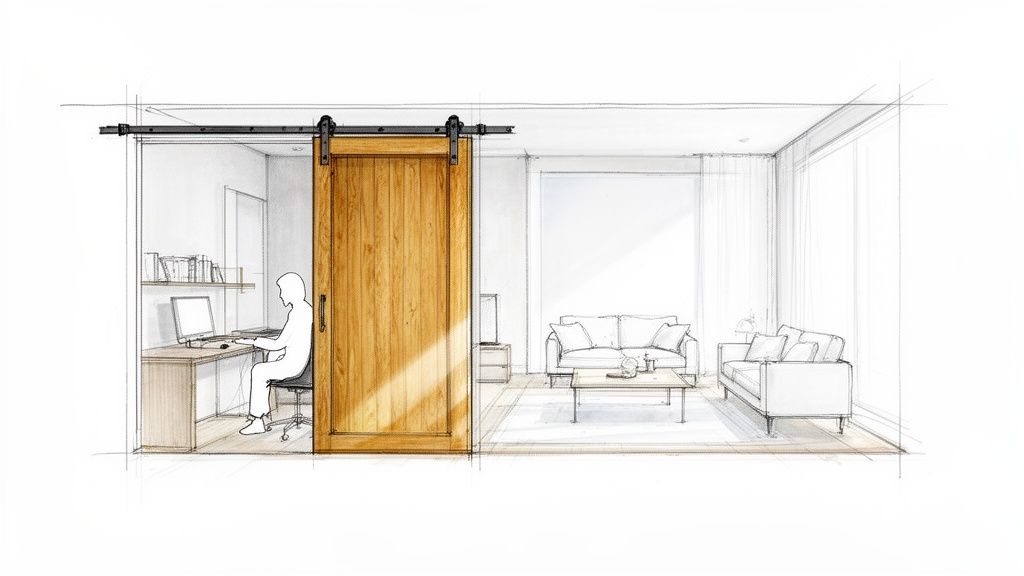
Don't just think of a barn door as a way to close something off. Instead, see it as the key to unlocking new possibilities for how you use your home. With a single sliding motion, you can instantly transform a large, undefined area into a series of distinct, functional zones.
This is what makes them such a fantastic tool, especially when you're looking for smart furniture and design ideas for small spaces.
Define Your Home on Your Terms
The real power of a barn door is its flexibility. It gives you separation when you need it and an open, airy feel when you don't. That’s how you can shape a home that truly works for you, not against you.
Here are just a few ways you can use a barn door to conquer everyday layout problems:
- Carve out a Home Office. In an open living area, sliding a barn door shut instantly creates a quiet, focused workspace. You get the privacy you need for video calls and deep work, without permanently closing off your floor plan.
- Separate a Playroom. You can section off a kids' play area from the main family room, which brilliantly contains the joyful chaos while still letting you keep an eye on things. A door with glass panels works great here, as it maintains that visual connection and lets light through.
- Add Drama to a Master Suite. Using a double barn door to create an entry between a master bedroom and an en-suite bathroom or walk-in closet is a showstopper. It adds a stunning feature that feels both custom and luxurious.
A Nod to Practical History
While they look fantastic in modern homes, today's sliding doors actually have deep roots in practicality. Their design traces back centuries to farms and barns where space was always tight. Farmers needed sturdy doors that could close off stalls or storage areas without swinging into narrow corridors, and the simple sliding mechanism was the perfect answer. You can learn more about the fascinating history of sliding barn doors and see how this workhorse design evolved.
This history of pure function is exactly what makes the barn door such an intelligent choice for today’s homes. It’s a design born from a need to maximize utility, now repurposed to solve our own contemporary challenges.
This guide will walk you through everything you need to know to decide if a barn door is the right solution for your home. Our design services can equip you with the perfect ready-to-ship or custom-order door to bring your vision to life.
Why a Sliding Barn Door is More Than Just a Pretty Face
It’s easy to fall in love with the look of a barn door. They bring a certain character and architectural interest to a room that’s hard to ignore. But the real magic is in the problems they solve. A barn door room divider is one of the smartest design moves you can make, especially when it comes to saving space.
Think about any traditional swinging door in your home. It needs a huge, empty arc of floor space just to open and close. This "swing space" dictates where you can put furniture and carves out a chunk of your room that you can't really use for anything else.
A sliding barn door completely changes the game. By gliding along the wall, it gives all of that dead space back to you. Suddenly, you have a spot for that armchair you’ve always wanted, room for a bigger bookshelf, or the freedom to arrange your furniture exactly how you like. It empowers you to make any room feel bigger and work harder.
Win Back Your Square Footage
This isn't just a feeling; it’s a measurable gain. We often forget that hinged doors can hog 30-50 square feet of clearance. In smaller homes or open-concept apartments where every inch counts, that’s a massive sacrifice.
Barn doors slide on wall-mounted tracks, giving that valuable real estate right back to you. Some 2022 design studies even noted that in a 400-square-foot open-plan apartment, adding a barn door can free up roughly 12% more usable space. You can read more about the benefits of installing a barn door room divider.
This recovered area is a game-changer. It allows you to choose larger, more comfortable furniture without making the room feel cramped. It's a key strategy for anyone interested in maximizing small spaces with furniture solutions.
Create Flexible and Adaptable Rooms
The other huge win is versatility. A barn door gives you the power to create a truly adaptable home that can shift with your needs from one moment to the next.
Imagine how you can master your space with these real-world scenarios:
- From Open to Intimate: Keep the door open between your living and dining areas for a big, connected space when you’re entertaining. Then, slide it closed to create a cozy dining room for a quiet family meal or to hide the post-dinner kitchen mess.
- Pop-Up Privacy: Instantly turn a home office or a den into a private guest room. It offers a solid, real-door feel that a curtain or screen just can't match.
This kind of on-demand flexibility lets your home serve multiple purposes without needing expensive or permanent renovations.
A barn door doesn't just divide a room; it multiplies its potential. You get the structure of a wall with the fluid adaptability of an open floor plan.
Finally, installation and upkeep are surprisingly simple. For anyone comfortable with a weekend project, installing a barn door is a totally manageable job with a huge payoff. And since there are no hinges to squeak or frames to get knocked out of alignment, maintenance is a breeze. Just a quick wipe of the track now and then is all it takes to keep it gliding smoothly for years.
Ready to see how a barn door could redefine your space? Our design experts at Miller Waldrop can help you find a beautiful, functional barn door that fits your home perfectly.
How to Measure for Your Barn Door Project
Before you fall in love with a specific door style, your project really begins with a tape measure and a little bit of planning. Getting your measurements right is hands-down the most critical part of the process. It's what separates a flawless, smoothly sliding door from a frustrating installation headache.
Think about it—you wouldn't order a custom sofa without first making sure it fits through the front door and into your living room. A barn door is no different. You’re not just hanging a piece of wood; you're installing a piece of functional architecture. Let’s walk through how you can measure to get it perfect on the first try.
Getting the Right Fit: Sizing Your Door and Track
First things first: your barn door must always be larger than the opening it covers. This overlap is what gives you complete visual privacy and blocks light from seeping through the gaps. Don't fall into the common trap of ordering a door the exact same width as the opening, only to end up with awkward gaps on both sides.
Here’s how you can nail the dimensions:
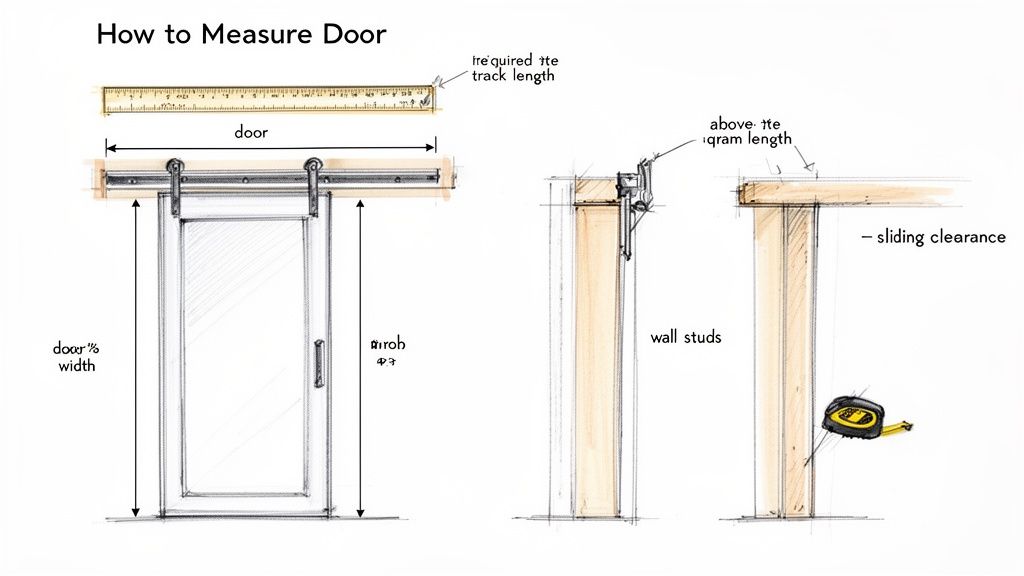
- Measure the Opening: Grab your tape measure and get the width of your doorway. Measure at the top, middle, and bottom, then use the widest of the three numbers.
- Calculate Door Width: A single barn door needs to overlap the opening. Add 2 to 4 inches to the widest measurement you took. This gives you a clean 1 to 2-inch overlap on each side. So, for a 36-inch opening, you’ll want a door that’s 38 to 40 inches wide.
- Determine Door Height: Measure from the floor to the very top of the door trim or opening. To ensure full coverage with no gaps, add at least 1 inch to this height.
- Figure Out Track Length: This is a big one. The track must be at least twice the width of your door—not the opening. For that 40-inch-wide door, you'll need a track that is at least 80 inches long. This guarantees the door can slide completely out of the way, giving you full access to the opening.
Remember these three things: The door must be wider than the opening. The door must be taller than the opening. The track must be twice the width of the door itself. Get those right, and you're well on your way.
Checking Your Wall for Clearance and Support
Once you know the size of your door and track, it’s time to inspect the wall where everything will be mounted. A barn door needs a completely clear path to travel, and this is where you can avoid common surprises.
You need to check the wall space on the side (or sides, for double doors) where the door will rest when it's open. This section of the wall needs to be at least as wide as the door itself and totally free of obstructions.
Be on the lookout for common obstacles like:
- Light switches and electrical outlets
- Thermostats
- Windows or protruding trim
- Air vents
- Wall art or shelves
If you find anything in the way, you'll either have to move it or rethink which direction the door slides. You also need to look up. Make sure you have enough "headroom"—at least 6-8 inches of clear wall space between the top of the doorway and the ceiling. This space is necessary for mounting the track hardware, though some low-profile kits might require less. Always double-check the manufacturer's specs.
Finally, barn doors are heavy. The track cannot just be mounted into drywall; it needs a solid anchor. Use a stud finder to locate the wall studs above your opening. If they aren’t perfectly aligned where your track needs to go (and they rarely are), you'll need to install a header board. This is simply a sturdy plank of wood mounted horizontally across the studs, providing a secure foundation for your track.
Taking these steps gives you a complete blueprint for your project. For more great tips, our guide on how to measure furniture has some helpful principles that apply here, too. And of course, if you run into questions, our design team is always ready to help you plan your project and find the perfect door.
Choosing Your Perfect Barn Door and Hardware
You've done the prep work and have your measurements ready. This is where the project really starts to take shape—equipping yourself with the actual door and hardware that will define your new space. The options can feel overwhelming, but the goal is simple: find a door that complements your home's style and meets your needs for privacy and light.
Think of this as more than just a door; it's a major architectural feature. What you choose will set the tone for the entire room.
Finding the Right Door Style for Your Home
A barn door makes a big statement, so it needs to feel like it belongs. A heavily distressed, Z-brace door might look fantastic in a modern farmhouse but could feel jarring in a sleek, minimalist condo. Here's how you can choose a door that matches your room's existing personality.
Before you fall in love with a specific barn door, it’s worth exploring all the different types of interior doors for renovation to get a feel for how various designs can change a room’s atmosphere.
Here are a few popular styles to get you started:
- Classic Brace: This is the look most people picture—the quintessential farmhouse style with a "Z," "X," or even a "K" brace. These doors bring a ton of warmth and rustic character, making them a great fit for traditional, country, or industrial spaces.
- Modern Panel: Defined by clean, simple lines, these doors might feature vertical planks (like shiplap) or a completely flat surface. They’re incredibly versatile and blend seamlessly into contemporary, Scandinavian, or transitional homes.
- Glass and Metal: If you want to divide a space without making it feel closed off, a door with glass panels is a fantastic choice. It lets light flow between rooms, which is perfect for maintaining an open, airy feel. Frosted or reeded glass is a great compromise, offering privacy while still keeping things bright.
- Chalkboard or Mirrored: Why not make your door do double duty? A chalkboard surface is a fun, practical addition to a kitchen, office, or playroom. A mirrored door is a classic designer trick to make a small space feel much larger and brighter.
Choosing the right material and style can be tricky. This table breaks down some common options to help you decide what's best for your project.
Barn Door Material and Style Comparison
| Material | Common Styles | Privacy Level | Best For |
|---|---|---|---|
| Solid Wood | Classic Brace, Modern Panel, Reclaimed | High | Bedrooms, bathrooms, or anywhere sound-dampening and total privacy are key. |
| Glass Panel | Metal Frame, Wood Frame | Low to Medium | Dividing living and dining areas where light flow is more important than privacy. Frosted glass works for offices. |
| Hollow Core | Modern Panel, Lightweight Designs | Medium | Budget-conscious projects and areas with low traffic. Not ideal for soundproofing. |
| Composite/MDF | All styles (can be painted/molded) | High | Achieving a specific painted look; offers a smooth, stable surface that resists warping. |
Ultimately, the material you choose has just as much impact as the design. Think carefully about how the door's weight, look, and privacy level will function in your home day-to-day.
Selecting the Right Hardware
The hardware is the engine of your barn door. It’s what makes it slide, and it's a huge part of the overall look. High-quality hardware is the tool you need to avoid a wobbly, noisy, or perpetually stuck door.
You'll mainly choose between two types of hangers:
- Top-Mount Hangers: These have a wheel that rolls along the track, with the strap attaching to the top edge of the door. This hides most of the hardware, creating a clean, modern look where the door seems to float just below the track.
- Face-Mount Hangers: This is the more traditional style. The strap (often J-shaped) wraps over the wheel and bolts directly onto the front of the door. The hardware is highly visible, becoming a major design statement.
When you buy a hardware kit, make sure it includes a sturdy track, hangers, stops, and a floor guide. The track has to support your door’s full weight without bending. The stops keep it from flying off the end of the track, and the floor guide is crucial for preventing the door from swinging out from the wall.
The final touch is the handle or pull. It should be easy to grab and match the style of your track system. Think of it like coordinating your home’s other finishes—the same logic you’d use when you learn how to choose window treatments that complement your decor applies here, too.
Feeling inspired but a little lost in the details? Our design experts are here to help you sort through the options. We can help you place a fully custom-order door with the right style, finish, and hardware to bring your vision to life.
A Homeowner's Guide to Installing Your Barn Door
You’ve done the hard part—measuring your space and picking out the perfect door and hardware. Now comes the rewarding part: installation. While it might look like a job for a pro, installing a barn door is a surprisingly straightforward project for any reasonably confident DIYer.
Think of it as a few key steps. Get these right, and you'll have a beautiful, functional room divider. We'll walk you through the entire process, so you can tackle this project with confidence.
Prepare Your Space and Header Board
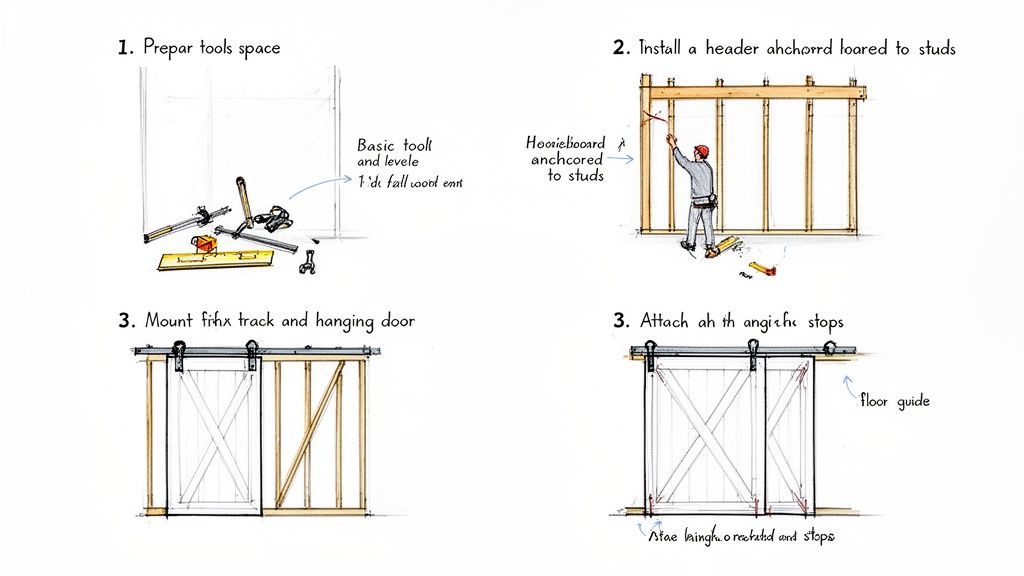
First things first, you need to prep the wall. This all starts with a header board. A header is simply a flat piece of wood (a 1×4 or 1×6 is common) that you’ll mount horizontally above the door opening. This is where your track will attach.
Why is this so critical? Your wall studs almost never line up with the pre-drilled holes on a barn door track. If you try to mount the track directly to the drywall, it will eventually pull right out of the wall. The header board bridges the gap between studs, creating a rock-solid foundation for the entire system.
Use a stud finder to locate every stud along the wall above your opening and mark them. Secure the header board directly into those studs using long, heavy-duty screws. Grab a level—making sure the header is perfectly straight is non-negotiable for a door that glides smoothly.
Securely Install the Track
With the header board solidly in place, it’s time to mount the track. This is where precision really counts. A track that's even slightly off-kilter will cause the door to drift open or closed on its own.
Hold the track up against the header and use your level one last time to double-check that it’s perfectly horizontal. Mark where the pilot holes need to go, then set the track aside and drill. From there, you can fasten the track to the header with the lag bolts that came with your kit.
Pro Tip: Don't crank down on the bolts one by one. Instead, get all of them started in their holes first. Then, go back and tighten each one a little at a time until they are all snug. This prevents the track from warping and ensures it sits perfectly flush.
This quick visual breaks down all the decisions you've made to get to this point.
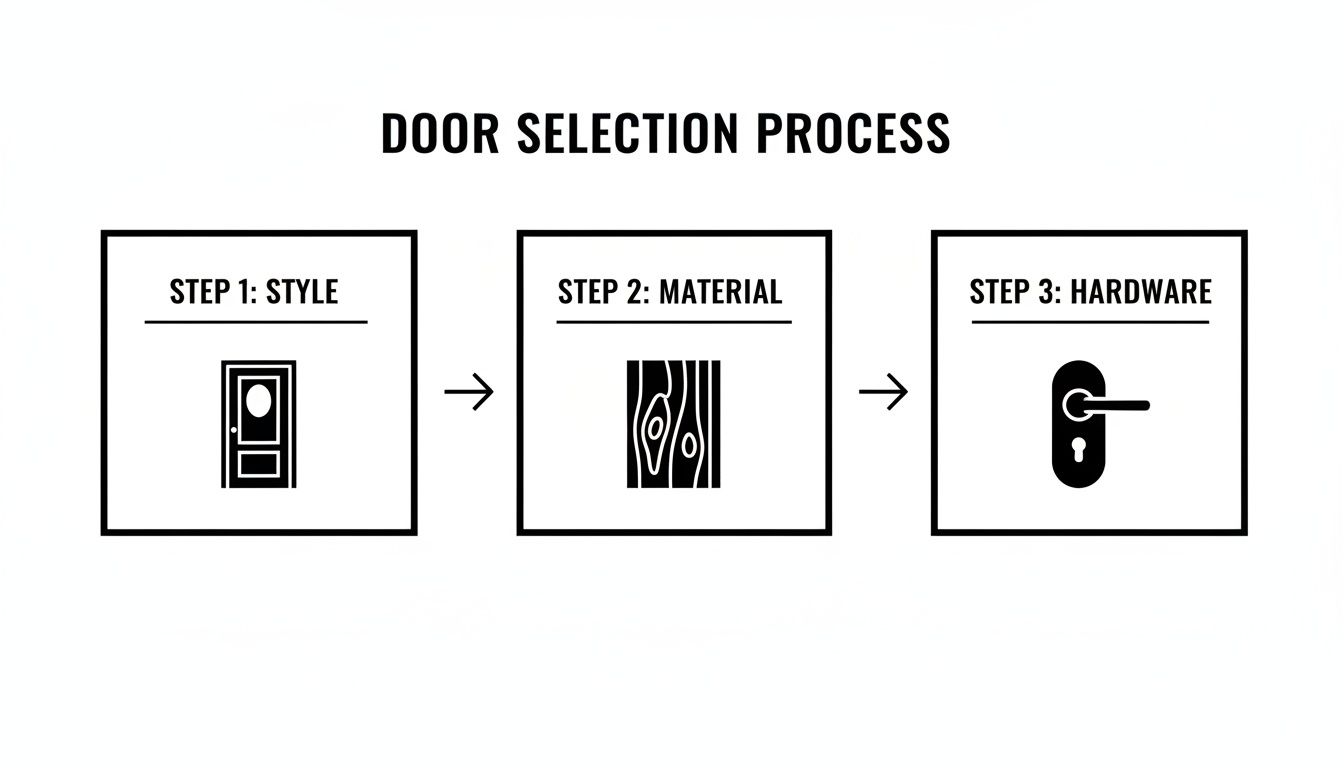
It’s a great reminder of how your choices in style, material, and hardware all come together to create the final look you're about to install.
Hang the Door and Set the Stops
Here’s the most satisfying moment—actually hanging the door. Following the instructions from your hardware kit, attach the hangers (the rollers) to the top of the door. Be meticulous with your measurements here to make sure the door itself will hang plumb.
Now, grab a helper. Seriously, don't try this alone. Barn doors are heavier and more awkward than they look. Together, carefully lift the door and place the wheels onto the track. Give it a gentle slide back and forth to feel the motion. It should be quiet and smooth.
With the door up, you can now install the stops. These little brackets attach to the ends of the track and keep the door from rolling right off. Slide the door to its fully closed and fully open positions to figure out exactly where to place them.
Add the Finishing Touches
The last component is the floor guide. This small bracket gets installed on the floor or baseboard and fits into a pre-cut groove on the bottom edge of the door. Its only job is to keep the door from swinging in and out, so it always slides straight.
Line it up so the door hangs perfectly vertical, then screw it into place. And that’s it—your installation is complete. You just transformed your room with a custom barn door room divider.
Of course, if a DIY project isn't your cup of tea, we get it. We are happy to coordinate a seamless professional installation for you. From helping you find the perfect custom-order barn door to making sure it’s installed perfectly, we're here to help you win the day.
Common Questions About Barn Door Room Dividers
Even with a solid plan, a few lingering questions are totally normal. Adding a barn door divider is a big move, and you want to be sure it's the right one for your home. Let's tackle some of the most common questions you might have.
Can I Install a Barn Door If I'm Renting?
Yes, you absolutely can! While drilling into the walls for a permanent track is usually a no-go in a rental, there are clever tools that empower you to get the look without damage.
Freestanding track systems are a game-changer here. These kits use tension-mounted vertical posts that press securely between the floor and ceiling. This creates a sturdy frame to hang your door from without leaving a single hole behind. Another fantastic option is a large, stylish folding screen designed to look like a barn door—all the aesthetic, none of the installation.
Of course, for the simplest temporary solution, you can always turn to stylish curtains or other DIY room dividers. They're a great way to define a space when you're just looking for a visual, non-structural separation.
Will a Barn Door Actually Block Out Sound?
This is a big one, and the honest answer is that a barn door won't give you the same soundproofing as a traditional hinged door. Because they slide along the wall, there will always be a slight gap between the door and the wall, and another at the floor.
That said, you can absolutely improve its sound-dampening abilities:
- Go solid. Always choose a solid-core door over a hollow-core one. The sheer mass of solid wood makes a huge difference in blocking noise.
- Seal the gaps. Add adhesive foam or rubber weatherstripping around the door frame. This can close up most of the gap and muffle a surprising amount of sound.
- Soften the room. Sound loves to bounce off hard surfaces. Plush area rugs, heavy curtains, and upholstered furniture will absorb sound waves and reduce echo.
For most situations, like creating privacy for a home office, a well-chosen barn door provides more than enough quiet.
What Kind of Maintenance is Involved?
Good news—barn doors are incredibly low-maintenance. A few quick checks every few months will keep your door gliding like new for years.
Simply wipe down the track with a dry cloth to clear away any dust that could gum up the rollers. While you're at it, give the bolts on the hangers and track a quick check to make sure they’re snug. If you ever hear a squeak, a quick shot of silicone lubricant into the wheel axles will almost always silence it instantly.
It's no surprise these doors have become so popular. Driven by home design shows and their open-plan-friendly nature, Google searches for 'barn door room divider' exploded with a 400% surge between 2015 and 2023. You can discover more insights about the modern history of barn doors to see how they took over the design world. Thanks to this trend, high-quality hardware is easy to find, making upkeep a breeze.
Your home should be a perfect reflection of your style and meet your family's needs. At Miller Waldrop, we believe in giving you the tools and expertise to bring that vision to life. Whether you have more questions or you're ready to find the perfect piece, our design team is here to help.
Explore our curated selection of quality home furnishings and let us help you transform your space.

