

Quality & Service: Family Owned Furniture Store


You walk into a giant showroom because you need one simple thing. Maybe it is a sofa that can survive movie nights, pets, and weekend naps. Maybe it is a mattress because nobody in the house is sleeping well. Maybe you just moved and every room feels unfinished.
Then the shopping trip gets hard fast.
Rows of furniture blur together. Price tags tell you almost nothing about how a piece will hold up. One sectional looks like the next until you sit down and realize the cushions feel completely different. A salesperson asks, “Can I help you?” but the question feels more like a checkpoint than real guidance.
That frustration is common. It does not mean you are bad at shopping. It means furniture is a bigger decision than most stores treat it.
A family owned furniture store offers a different kind of experience. Instead of pushing you through a warehouse, it helps you slow down, compare wisely, and choose pieces that fit your home, your routine, and your budget. That difference shows up in the quality of the furniture, the kind of advice you receive, and the confidence you feel when the furniture finally arrives at your door.
The Overwhelming Furniture Quest
A lot of shoppers start the same way. They head to the biggest place in town because it seems efficient. More square footage should mean more options. More options should mean a better chance of finding the right piece.
But furniture rarely works that way.
A young family may spend hours comparing sectionals, only to get home and realize they never asked the questions that mattered. Will this fabric handle daily use? Are the seat cushions supportive or just soft for the first five minutes? Is the scale right for a modest living room, or will it swallow the space?
That is where many big-box experiences fall short. They offer inventory. They do not always offer interpretation.
Why shoppers feel stuck
The problem is not only too many choices. It is too little context.
You are often expected to decide all of this on your own:
- Room fit: Will the piece leave enough walking space?
- Daily function: Does your household need deep lounging seats or upright support?
- Longevity: Is the frame and upholstery built for years of use?
- Style direction: Will this still feel right after the excitement of the purchase fades?
A good shopping experience should make your choices clearer, not more confusing.
A local store changes the pace. Instead of starting with “What is on sale,” the conversation often starts with “How do you live in the room?” That one question can save you from buying the wrong size, wrong fabric, or wrong comfort level.
If you are comparing local options, this guide to best furniture stores near me can help you think beyond square footage and start looking at service, selection, and support.
What a different path looks like
At a family store, the goal is not to impress you with endless rows. It is to narrow the field to pieces that make sense for your life.
That means fewer random choices and more useful ones. It means someone helps you separate a “looks nice under showroom lights” purchase from a “works in our house every day” decision.
For shoppers, that is often the first real relief.
What Defines a Family-Owned Store
A family-owned store is not just a business with relatives in the building. It is a business shaped by memory, accountability, and local knowledge.
When a store has served the same region for decades, it learns things a national chain often misses. It learns what fabrics hold up in busy households. It learns the styles local homeowners come back to. It learns that one town may shop differently from the next, even when they are only a short drive apart.

The broader market shows there is room for this model. The U.S. furniture retail sector is projected to reach 56,620 stores by 2026, with an average annual growth rate of 3.9% from 2020 to 2025, and businesses such as fourth-generation retailer Miller Waldrop Furniture & Mattress, established in 1952, continue to hold a strong local presence in a fragmented market where the largest players hold minimal dominance, according to IBISWorld’s furniture store business data.
Legacy shows up in practical ways
“Family-owned” matters most when it changes your outcome as a shopper.
Consider what legacy can mean at store level:
- Long memory: Staff often know which product lines have held up well over time.
- Local judgment: Buyers can select styles that fit regional homes and lifestyles.
- Repeat relationships: A store may help furnish your first apartment, then your house, then a guest room years later.
- Community accountability: Reputation is built neighbor by neighbor, not market by market.
That kind of continuity creates a different standard. If a store expects to see you again, it has a strong reason to guide you carefully the first time.
How to recognize genuine characteristics
Not every store that feels friendly operates with the same depth. Look for signals that the values are built into the business.
A useful checklist:
| Sign | What it tells you |
|---|---|
| Multi-generational history | The store has experience beyond current trends |
| Curated brand selection | Someone is filtering for quality, not just quantity |
| Staff with product knowledge | You can ask better questions and get better answers |
| Design help and custom options | The store is solving for your home, not just moving inventory |
| Ongoing service after delivery | The relationship does not end at checkout |
If you want a closer look at what those values look like in practice, review our advantage.
A family owned furniture store earns trust slowly. That is the point. Furniture is a long-term purchase, so the business guiding you should think long term too.
The Power of a Personalized Partnership
The biggest difference between a chain transaction and a family-store experience is not the greeting at the door. It is what happens after you say, “I’m not sure where to start.”
In a transactional setting, you may get pointed toward a section of the showroom. In a partnership setting, someone starts asking useful questions. How many people use the room every day? Do you host often? Are you replacing a piece that wore out too quickly? Do you need easy-clean upholstery? Is support more important than sink-in softness?

Those questions change the outcome.
Good help is specific
The furniture and home furnishings industry supported around 390,000 workers in early 2026, including 263,130 retail salespersons and 44,660 first-line supervisors, according to the BLS industry profile for furniture and home furnishings stores. In a strong family-store setting, those roles translate into hands-on guidance rather than generic assistance.
That guidance can sound like this:
- “This sofa has a lower profile, so it works in a room with a big window.”
- “This sectional looks comfortable, but the chaise may block your walkway.”
- “You said your kids sprawl across the whole couch. Let’s sit in a few with deeper seats.”
- “If you want cleaner lines but still need durability, this fabric direction makes more sense.”
Shoppers often feel a shift at this point. They realize they do not need to become furniture experts overnight. They need someone to help them ask the right questions.
A design conversation prevents expensive mistakes
A sofa can look perfect in the store and feel wrong at home for several reasons:
- Scale was off and the room feels crowded.
- Comfort was mismatched and nobody enjoys sitting in it.
- Fabric choice ignored real life such as pets, kids, or heavy daily use.
- The style fought the room instead of pulling it together.
A knowledgeable guide can catch those issues early.
The right salesperson does more than help you buy furniture. They help you avoid regret.
That is why design help matters. It is not about making your home look formal or complicated. It is about translating your daily habits into smart furniture choices.
One practical option for shoppers who want that kind of support is Miller Waldrop Furniture & Decor, which offers in-store guidance, curated brands, and custom-order choices for fabrics, finishes, and configurations.
What partnership feels like
It feels calmer.
You stop asking, “What should I buy?” and start asking, “Which option fits us best?” That is a much better question, and it usually leads to a much better room.
Choosing Furniture That Lasts
Many shoppers focus on the first test. They ask, “Do I like how this looks?”
That matters, but it is not enough.
A sofa, recliner, dining table, or bed should also pass the second test. “Will this hold up in the way we live?” A family owned furniture store often earns its value by helping you answer that second question with more confidence.
What to inspect before you buy
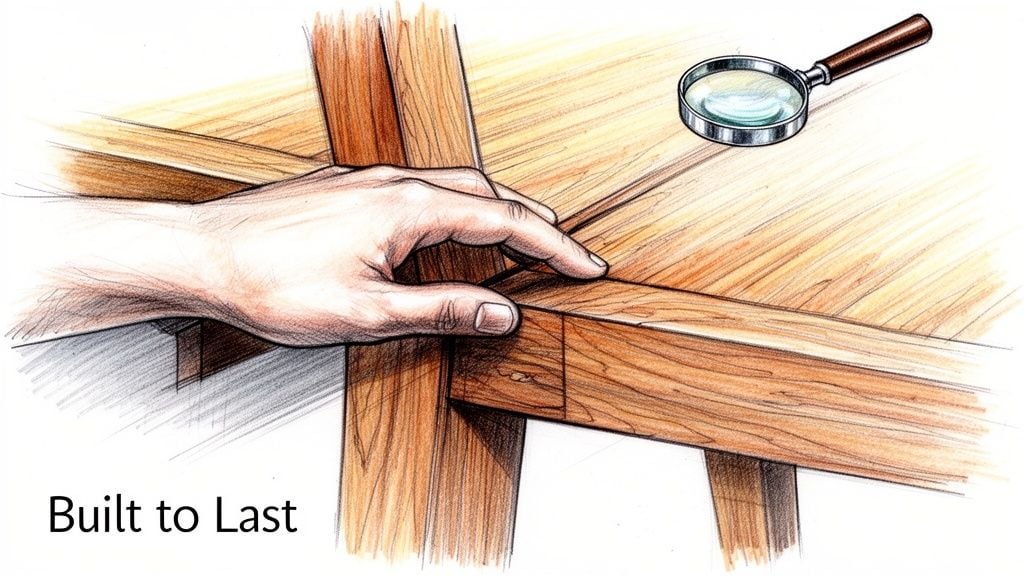
You do not need trade-school knowledge to spot quality. You just need a few points of focus.
Start with the frame. Ask what supports the piece beneath the cushions and upholstery. A well-made frame gives furniture its staying power.
Then move to the seating experience:
- Seat support: Sit normally, then sit how you relax at home.
- Cushion recovery: Stand up and see how the cushion responds.
- Arm height: Good-looking arms can still be awkward for everyday use.
- Fabric hand and texture: Touch matters because you will live with it daily.
If you are shopping living room furniture, browsing a Flexsteel sectional is a useful way to compare construction, style direction, and comfort priorities in one product category.
Curated beats crowded
A giant assortment can create the illusion of value. A curated assortment creates clarity.
Stores that carry trusted lines such as Flexsteel, La-Z-Boy, Hooker, and Ashley are making a statement through selection. They are saying, in effect, “We have already filtered through broad market noise and brought in pieces people can realistically live with.”
That matters because furniture buying is rarely about chasing the most options. It is about narrowing to the right options.
Here is a simple comparison:
| If you focus on this | You may miss this |
|---|---|
| Lowest ticket price | How quickly the piece shows wear |
| Trendy silhouette | Whether it fits your room and routine |
| Softness on first sit | Long-term support |
| Color alone | Cleaning, texture, and durability |
How to think like a savvy buyer
Ask yourself three questions before you commit.
First, where will this piece work hardest? A formal room and an everyday family room need different answers.
Second, who will use it most? Adults, kids, guests, pets, and older family members all place different demands on furniture.
Third, what kind of wear bothers you most? Some families hate visible lint. Others dislike sagging cushions. Others care most about wipeable surfaces.
A smart furniture purchase is not the piece that looks best for five minutes. It is the one that serves your household well for years.
That mindset changes everything. You stop chasing novelty and start buying with purpose.
Unlock Better Sleep With a Mattress Expert
Mattress shopping confuses people for a simple reason. You are trying to solve a body problem with a product label.
“Firm,” “plush,” and “hybrid” are useful starting words, but they do not tell the whole story. Two people can lie on the same mattress and have completely different experiences based on body type, sleep position, pressure points, and support needs.
That is why mattress expertise matters.
Family retailers often stand out by offering advanced sleep technology, including high-tech bed-matching systems that map pressure points. This expert-led approach can reduce tossing and turning and help address the concerns of the 70% of consumers who prioritize durability and support, according to Statista’s overview of U.S. furniture retail.
What a mattress expert helps you sort out
A good sleep consultation moves past brand slogans and gets practical.
You may need help identifying whether your problem is:
- Pressure relief for shoulders and hips
- Spinal support for back comfort
- Motion response for couples
- Ease of movement if you change positions often
- Adjustable-base compatibility for reading, recovery, or comfort
That is a much better process than lying on three beds for a minute each and guessing.
A simple way to shop smarter
Use this sequence when you test mattresses:
- Start with your sleep position, not your current mattress label.
- Describe any pain points clearly.
- Spend enough time on the mattress to notice pressure and alignment.
- Compare support, not just softness.
- Ask whether an adjustable base changes the feel or function you need.
If you want more guidance before visiting a showroom, this resource on finding the right mattress walks through the decision process in plain language.
A mattress is one of the most personal purchases in your home. A family store with Sleep Experts and pressure-mapping tools can turn the process from guesswork into a better-informed fit.
Create a Home That Is Uniquely Yours
Many shoppers think customization is only for designers or people furnishing luxury homes. It is not. In many cases, custom order options help regular households get a better fit.
Maybe you love a sofa shape but need a different fabric because of pets. Maybe the wood finish on a dining table feels too dark for your kitchen. Maybe a sectional needs a different configuration so the room keeps an open path.
That is where a family owned furniture store becomes less like a retail stop and more like a design tool.
Custom does not have to feel complicated
The process usually becomes easier when you break it into separate decisions.
Think about your room in layers:
- Shape: Start with the right silhouette and size.
- Function: Decide how the piece needs to perform every day.
- Surface choices: Compare fabrics, finishes, and textures.
- Coordination: Make sure the piece works with flooring, wall color, rugs, and lighting.
Shoppers often get tangled up because they try to decide all of that at once. A good design conversation separates the choices so each one becomes manageable.
Digital tools can increase confidence
Many retailers are blending showroom service with digital support. According to IBISWorld’s furniture store industry analysis, 59% of businesses use 3D product visualization tools, and those tools can increase customer confidence in custom decisions and lift conversion rates by up to 25%.
For shoppers, the takeaway is simple. You no longer have to rely on imagination alone.
You can use online browsing to narrow styles, save favorites, and compare options before you visit. Then, in the store, you can sit, touch, test, and refine the details with help from a knowledgeable team.
The goal of customization is not to make your home look expensive. It is to make it feel like yours.
That can mean a sectional that fits your room better. It can mean a recliner in a leather or fabric that suits your lifestyle. It can mean choosing a finish that works with the architecture you already have.
A custom home is rarely built from random choices. It is built from a series of well-guided small decisions.
Voices from West Texas and New Mexico
Trust feels different when it is local.
In West Texas and Southeastern New Mexico, people pay attention to which businesses stay involved, remember their customers, and handle problems face to face. That matters in furniture because the purchase does not end when the receipt prints. Delivery, setup, follow-up questions, and future purchases all become part of the relationship.
A family store with deep local roots becomes familiar in a way a national brand often does not. Realtors notice it. Property managers notice it. Families furnishing a first home notice it. People remember who helped them choose a dependable mattress, who found the right recliner for a parent, or who helped furnish a room that finally felt finished.
That kind of connection is part of the reason family-owned stores often become woven into community life. Local reputation, including awards in places such as Lea County and Lincoln County, helps build trust with the people and businesses invested in those communities, as noted in Flourish Furniture Bank’s impact discussion.
What neighbors tend to value
The praise local shoppers give is usually practical, not flashy:
- They felt heard
- They got help narrowing choices
- They found pieces suited to their home
- They knew where to go back when they needed another room furnished
That is the quiet strength of a family business. It becomes part of the rhythm of local life.
In places like Lubbock, Hobbs, and Ruidoso Downs, that kind of trust still matters. It tells shoppers they are not walking into an anonymous sales floor. They are walking into a place that knows the region and expects to keep serving it.
Begin Your Journey to a Beautiful Home
A good furniture purchase should solve a problem, not create a new one. It should make your home more comfortable, more functional, and more like you. That is why choosing a family owned furniture store can make such a difference. You gain guidance, a more thoughtful selection, and help matching each piece to real life.
Walk in with questions. Sit on everything. Ask about construction, fit, fabric, support, and customization. The more clearly you shop, the better your home will serve you.
If you want help turning ideas into a room that works, connect with Miller Waldrop Furniture & Decor. Their team can help you compare furniture styles, explore mattresses, and sort through custom options so you can choose with confidence.