


Adjustable Bed Brands Worth Comparing in 2026


Shopping for an adjustable base usually starts with a simple question, then turns messy fast. A couple walks into the showroom thinking they're comparing two price tags, and ten minutes later they're asking about motors, delivery, remote pairing, and what happens when a part quits in year six. That's the right way to shop, because an adjustable base is an electromechanical product first and a bedroom piece second.
The brands worth comparing are the ones that make ownership easier, not just the ones that look polished on a spec card. Warranty length, delivery terms, lift mechanics, and mattress compatibility matter more than a shiny brochure. If a base is going to live under your mattress for years, the brand that built the service plan matters as much as the one that built the frame.
| Brand / Model | What stands out | Ownership signal |
|---|---|---|
| Sleep Number | Strong U.S. share position | Brand reach and mainstream recognition |
| Tempur-Sealy | Premium-segment strength | Premium positioning with broad retail presence |
| Reverie | Smart-base presence | Electronics-heavy feature set |
| Beautyrest | Large unit volume | Scales beyond niche retail |
| Nectar | Shorter warranty in the comparison set | Value-focused, but service terms matter |
| Saatva | Long warranty and included white-glove delivery | Ownership terms are a major selling point |
| Helix | Longer warranty tier in review roundups | Balanced service positioning |
| Brooklyn Bedding | Longer warranty tier in review roundups | Coverage becomes part of the value equation |
Why the Sticker Price Doesn't Tell You the Whole Story
A couple can stand in front of two adjustable bases that look almost identical and still buy the wrong one if they only compare the tag. One frame may seem cheaper on day one, then the cost shows up later when a motor slows, a control box misfires, or the remote loses pairing. That is where ownership gets expensive.
The smarter shopper stops treating the base like furniture and starts treating it like a machine. Motors, actuators, wireless controls, and power delivery are the parts that fail, so warranty terms, delivery terms, and service response matter far more than the fabric or finish. If a salesperson only talks about padding and features, keep your wallet closed.
Practical rule: if the base uses electronics to move the bed, the service plan is part of the product, not an extra.
That shift also changes what counts as useful research before buying. A resource like adjustable base health benefits earns its place because it connects the mechanical purchase to real use cases, like relief positioning, reading, or easier bed entry. The long-term question still comes first, who stands behind the product after the novelty wears off.
Shoppers who chase the lowest sticker price often end up with the least patient brand in the category. The better move is to ask what happens when the base is still in the home and no longer working perfectly, because that is when warranty language, parts support, and delivery follow-through separate a serious brand from marketing fluff.
That is also why ownership terms deserve the same attention as lift range or massage settings. A base with strong mechanics but weak support can become a headache fast, while a more expensive model with clear service coverage can save money and frustration over time.
The Adjustable Bed Market at a Glance
A shopper standing in the showroom can see the shift immediately. Adjustable bases are no longer a niche add-on hiding behind mattresses. Analyst coverage from Consumer Reports reference summary shows the market is built around powered bases, not manual frames, and the broader category continues to move like a real furniture-and-mechanics business, not a novelty aisle.
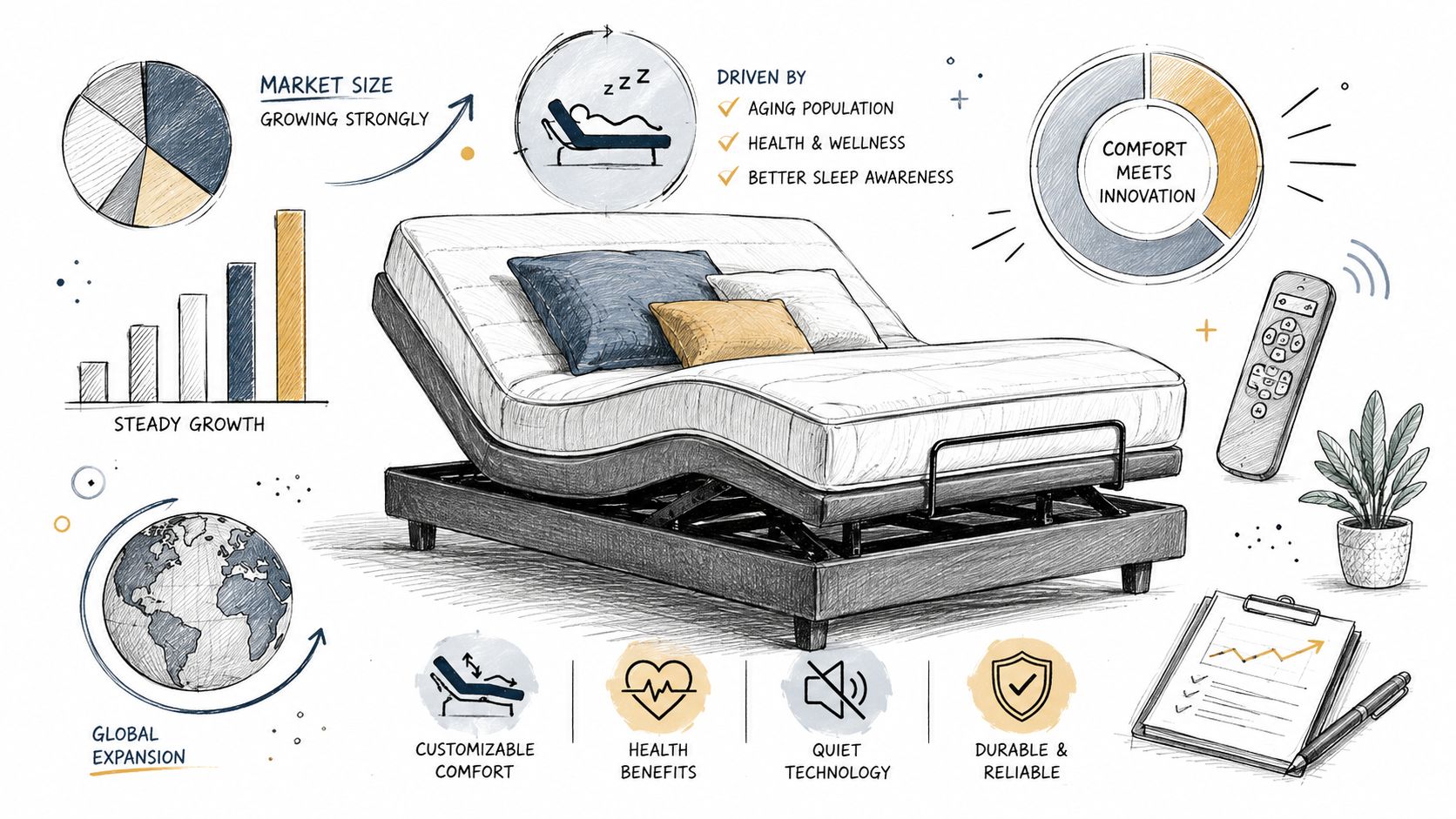
The brand field reflects that shift. Legacy bedding names sit beside specialty base makers, but the better brands treat motion hardware as the main product, not a bolt-on feature. That difference matters because service, parts support, and delivery follow-through separate a dependable base from a polished sales pitch.
Market concentration is another sign buyers should not ignore. Gitnux adjustable bed industry statistics points to a category where a market leader, a premium legacy name, and a smart-base specialist already control meaningful attention in the U.S. and premium segments. That tells shoppers something useful. They are not comparing fringe labels. They are choosing between brands that already know how to build, ship, and support powered furniture at scale.
The broader market behaves like a serious retail category, too. Retirement Living says the adjustable bed and mattress market was valued at $10.5 billion in 2023, and that in 2021 more than 54% of revenue came from bed sales rather than mattresses alone (Retirement Living market summary). That is the takeaway. Adjustable bases are a standalone purchase, and the name on the motor matters as much as the name on the mattress.
Engineering Specs That Separate the Brands
The spec sheet is where marketing gets exposed. A base can sound “heavy-duty” all day long, but if the listed capacity is weak or the motion range is limited, the label does not matter. Buyers should read the numbers, not the slogans.
Load capacity and motion range are not the same thing
A model can carry a lot of weight and still move poorly. It can also articulate well and still feel underbuilt if the frame, motor system, or actuator setup is thin. Capacity is about whether the platform can handle the mattress and sleeper combination without strain. Motion range is about whether the base can create the position the buyer wants.
That split is exactly why the hardware spec deserves more attention than the sales copy. For buyers comparing options, a strong frame rating helps with heavier mattresses and split-King layouts. Bigger articulation angles matter when the goal is elevation for reflux, snoring, or pressure relief. For a practical example of how people use a zero-gravity position in real bedrooms, see this guide to adjustable bed zero-gravity setups.
A higher capacity rating helps with heavier mattresses and split-King layouts. Bigger articulation angles matter when the goal is elevation for reflux, snoring, or pressure relief.
Presets and massage modes are features, not proof of quality
Presets sound nice on a showroom floor. They do not tell you whether the base is built around solid motion hardware or just dressed up with comfort features. Some models add zero-gravity and anti-snore presets, others focus on head-only motion, and some include dual-zone motion or full-body-wave massage modes. The smart move is to start with the motion architecture, then look at the extras.
| Brand / Model | Load Capacity | Head / Foot Articulation | Massage Modes | Notable Presets |
|---|---|---|---|---|
| A top-tier brand model | 1,000 lb | Not listed in the verified data | Not listed in the verified data | Not listed in the verified data |
| A value-tier frame | 850 lb | Not listed in the verified data | Not listed in the verified data | Not listed in the verified data |
| A premium split-base model | Not listed in the verified data | 75° head, 45° foot | Full-body-wave massage on some models in the comparison set | Zero-gravity and anti-snore presets appear in the comparison set |
The useful habit is simple. Ask what the base moves, how far it moves, and what it is built to carry. That is the engineering check. Everything else is showroom noise.
Price Ranges and the True Cost of Ownership
Sticker price only tells part of the story. The cost that hurts later is service, and adjustable bases are full of parts that can age out, motors, actuators, control electronics, and remote systems. That is why the warranty line matters more than most shoppers think.
The review comparisons make the gap obvious. In NCOA's comparison, a value-tier frame is listed with a short warranty, a trial period, and white-glove delivery starting at a stated fee, while a premium base shows a much longer warranty and free white-glove delivery but no trial period. Those differences are not cosmetic, they change how expensive ownership feels over time.

A short warranty works if the buyer expects a short holding period and wants lower upfront risk. A long warranty makes more sense for households that plan to keep the base for years and do not want to gamble on future service costs. That is the decision.
A helpful planning habit is to think in ownership bands. Short-term buyers can put more weight on trial and delivery convenience. Long-term buyers should prioritize the brand that offers the longest coverage and the cleanest service path, because the wrong base gets expensive exactly when the sleeper starts relying on it most.
For a practical reference on replacement timing and broader bed planning, the SleepHabits 2026 bed guide is a useful companion read. The key takeaway stays the same, value is not the lowest price, it is the least painful ownership.
Mattress Compatibility and Configuration Choices
An adjustable base fails fast with the wrong mattress. If the mattress fights the hinge points, the whole setup feels awkward, wears unevenly, and never settles in the way it should. Flexible constructions are the safest bet, especially memory foam, latex, and many hybrid designs. A rigid mattress creates stress right where the base needs to bend.
Match the mattress to the motion, not the other way around
Start with the mattress, because the base can only work with what it is given. If the mattress resists flexing, the motor still moves, but the sleep surface does not cooperate. Shoppers should treat the mattress and base as one decision, not two separate purchases.
For a deeper shopping checklist on fit, the internal guide on choosing a mattress for an adjustable bed is worth using before a final purchase. Stability matters as much as comfort. The mattress needs to stay in place and keep its shape as the base shifts position.
Pick the configuration that matches the household
Split-King makes sense when two sleepers want different positions and different timing. Single King works when one user wants a unified surface and a simpler setup. Dual-zone control matters more for couples with mismatched sleep preferences than for anyone chasing gadget features.
Keep this straight: head-only motion works for some users, but people managing reflux, snoring, or leg elevation usually get more out of broader articulation.
Configuration choices should stay practical. Under-bed lighting and USB ports can be handy, but they do nothing for poor motion geometry or a mattress that will not bend. Treat those extras as convenience add-ons, not reasons to buy.
The filter is simple. Check mattress compatibility first, then decide whether the household needs split control, stronger articulation, or a simpler single-user setup. Once those three calls are made, the rest of the feature list gets much easier to ignore.
Which Brand Fits Which Buyer
A shopper who needs head and foot elevation for reflux, snoring, or leg relief should ignore brand hype and inspect the motion first. The base has to hold position cleanly, move without strain, and keep working after repeated use. If the lift feels shaky in the showroom, it will feel worse at home.
Sleep-health buyers should give the highest weight to articulation and preset behavior. A strong preset is only useful if the frame and actuators can support it without hesitation. A brand that talks a lot about comfort but gives little detail about motion range is selling presentation, not performance.
Couples have a different problem. One person wants one angle, the other wants another, and shared comfort falls apart fast if the base cannot split the bed properly. Split-King support and dependable dual-zone control matter more than decorative lighting, massage presets, or app tricks. The household that needs separate settings should choose the base that makes compromise unnecessary.
Mobility-focused shoppers need the easiest system to live with every night. Smooth movement, clear remote controls, and simple logic matter more than a long feature list. A base that takes effort to understand becomes a nuisance after the first week. The right call is the one that keeps bed entry, exit, and repositioning straightforward.
Here is the blunt filter. Sleep-health buyers should spend their attention on articulation and preset behavior. Couples should focus on split configuration and control that stays independent. Mobility-focused shoppers should skip the flashy extras and choose the simplest system with stable motion.
One type of brand deserves extra skepticism. If the pitch leads with luxury language and stays vague about motors, actuators, and service terms, the money is going toward marketing fluff. Warranty and service details are not footnotes here. They are the test, because those are the terms that matter when moving parts fail.
Buying Locally and Why the Showroom Matters
Online research can narrow the list, but a showroom finishes the job. An adjustable base has to be felt in motion, not just read about on a spec card, because the test is how the head lift, foot lift, and remote behavior feel under an actual mattress. That's where a local retailer earns its keep.
Miller Waldrop's Sleep Experts use a bed-matching system to identify pressure points and connect shoppers to a mattress and adjustable base combination that fits the body, not just the budget. That matters because the wrong pairing can make a well-built base feel awkward, while the right pairing makes the same motion feel natural. Shoppers in Lubbock, Hobbs, and Ruidoso Downs also get the practical side of the purchase handled, including delivery support, financing options, and a Low Price Promise.

A smart showroom visit should include at least two or three base-and-mattress combinations. One should be the shopper's first choice, one should be the safer service-heavy option, and one should test whether a different configuration feels better in motion. That side-by-side comparison does more in ten minutes than a week of scrolling.
If delivery and setup matter, the science-backed equipment delivery model is a useful reference point for what careful handling should look like. A big mechanical purchase deserves careful placement, not a rushed drop-off.
For shoppers trying to find a local place that can stage and explain a purchase like this, the internal guide on the best furniture stores near me is a practical starting point. Miller Waldrop Furniture & Decor offers adjustable bases, mattress matching, and showroom guidance, so the purchase can be tested before it leaves the store.
Visit Miller Waldrop Furniture & Decor to compare adjustable bases in person, test how the motion feels with a real mattress, and get help matching the right setup to the way the bed will be used. The right showroom visit turns a complicated purchase into a clear decision, and that's the fastest way to avoid buying the wrong base.