


Are All Crib Mattresses the Same Size? A Parent’s Guide to Choosing with Confidence

When you're getting ready for a new baby, the last thing you want is more confusion. So let’s cut right to the chase: No, not all crib mattresses are the same size.
While there is a federally regulated standard size in the United States, you'll find several other options out there. Understanding the differences is your first and most important step in creating a safe nursery. This guide will empower you to make the perfect choice for your family.
Your Guide to Crib Mattress Sizes
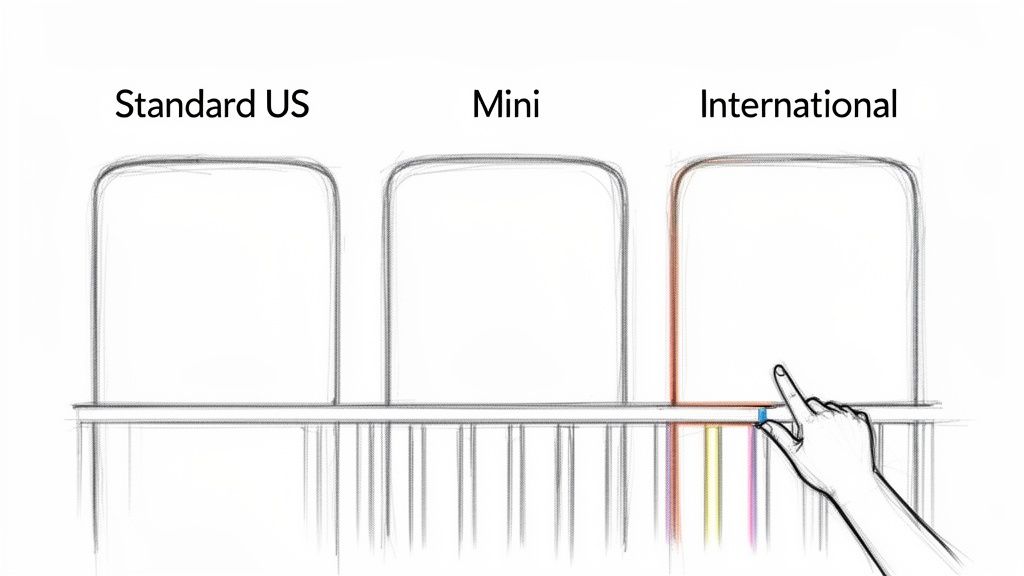
Choosing a crib mattress can feel like a huge decision, but you can master it. The secret is knowing that different cribs are built for different mattress sizes, and the fit between them must be absolutely perfect. A poor fit can create dangerous gaps, which is a serious safety hazard for your baby.
Think of it like finding the right key for a lock—only one size will work safely. Your role here is to be the safety hero, ensuring every part of your baby’s sleep space fits together flawlessly. This guide is your toolkit, equipping you with the know-how to choose with confidence.
Why a Snug Fit Is Your Top Priority
The most critical thing you can provide is a snug, gap-free fit between the mattress and the inside of the crib. This is non-negotiable. It prevents your baby from getting trapped in any spaces along the edges, which could lead to injury or even suffocation.
There's a simple tool for this called the "two-finger test."
Once you place the mattress inside the crib, try to slide your fingers between the mattress edge and the crib frame. You should not be able to fit more than two fingers. If you can, the mattress is too small and unsafe.
By getting familiar with the basic size categories, you can quickly narrow down your choices and find the perfect match for your crib. Here are the main types you’ll come across:
- Standard U.S. Crib Mattresses: This is the most common size you'll find, and its dimensions are mandated by the federal government for safety.
- Mini Crib Mattresses: These are made for smaller, portable, or space-saving cribs.
- International Sizes: Mattresses sold outside the U.S., particularly in Europe, often have different dimensions and are not compatible with American cribs.
With this foundation, you're not just shopping anymore—you're actively building a secure haven for your baby. To find a mattress that meets the highest safety standards, here’s how you can explore our curated selection of safe and comfortable crib mattresses.
Understanding Standard US Crib Mattress Dimensions
When you see the term "standard size" on a crib or mattress here in the United States, it’s not just a casual label. It's a legally mandated safety measure, and it's one of your most powerful tools for creating a safe sleep space for your little one.
This uniformity was put in place to take the guesswork out of the equation for parents like you. Think of it as a nationwide safety pact between manufacturers and families. Every crib sold as "full-size" or "standard" is built to hold a mattress with very specific dimensions, all to guarantee a snug and secure fit.
The CPSC Safety Standard: Your Built-In Guardian
The federal agency behind these critical rules is the U.S. Consumer Product Safety Commission (CPSC). Their guidelines aren't just random numbers; they’re the result of years of research into keeping infants safe while they sleep.
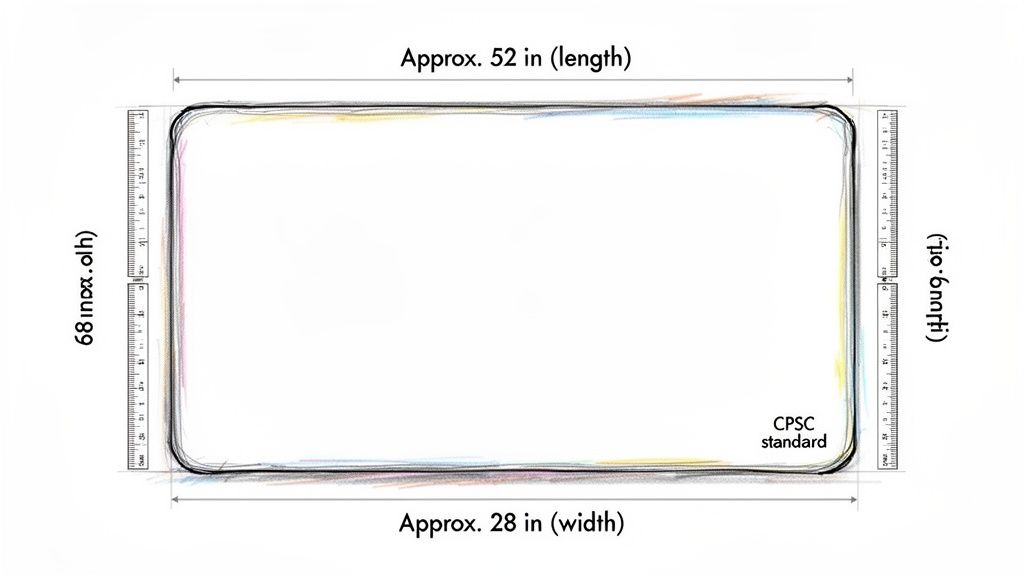
The CPSC dictates that a standard crib mattress in the U.S. must be at least 27¼ inches wide and 51¼ inches long. It also can't be more than 6 inches thick. This exact sizing is designed to eliminate dangerous gaps between the mattress and the crib frame—a crucial detail for preventing the risk of entrapment or suffocation.
This means that when you buy a standard U.S. crib and a standard U.S. mattress, you can rest assured they are made to work together safely. This standardization is a huge relief, helping you build a nursery that meets the highest safety protocols without needing a tape measure at every turn.
Why Thickness and Firmness Empower You
You might wonder why the CPSC is so specific about thickness. A mattress thicker than 6 inches could actually reduce the depth of the crib, creating a potential fall hazard once your baby is old enough to start pulling themselves up. Every detail is connected to your child's safety.
Here are the key numbers to remember for a standard US crib mattress:
- Length: At least 51¼ inches.
- Width: At least 27¼ inches.
- Thickness: No more than 6 inches.
Your goal is to create a sleep surface that is both snug and firm. A firm mattress provides the stable support a baby needs for healthy development and reduces the risks associated with overly soft surfaces.
Getting these dimensions right is the first step, but it’s part of a bigger picture of nursery safety. As you plan your space, you might also be thinking about how different bed sizes work in other rooms. To figure out the best fit for your home, our guide on what size mattress you need can be a huge help. Having this knowledge empowers you to make confident choices that contribute to your baby’s well-being.
What If I Don’t Have Room for a Standard Crib?
Let’s be realistic—not everyone has the space for a full-sized crib. And that's perfectly fine! Your living space is your own, and your nursery setup should be a tool that works for you, not the other way around.
If you’re setting up a nursery in a cozy apartment, a smaller home, or just need a safe sleeping spot at the grandparents' house, a mini crib can be a lifesaver. They offer the same safety and security as their larger counterparts, just with a much smaller footprint.
Cracking the Code on Mini Crib Dimensions
Here's where things get a little different. Unlike standard cribs, there’s no single, federally mandated size for mini cribs. That said, the industry has mostly rallied around a common set of dimensions to make finding a mattress easier for you.
You'll find that most mini crib mattresses are about 24 inches wide and 38 inches long.
Because these sizes aren't set in stone by law, it's incredibly important to be diligent. Your safest bet is to buy the exact mattress made for your specific mini crib model. Even better, look for a mini crib that comes bundled with its own mattress. This takes all the guesswork out of the equation and ensures that snug, gap-free fit that’s so crucial for safety. And yes, the two-finger test is just as important here.
Mini cribs have really carved out their own niche in the market, becoming a popular choice for families dealing with space constraints since the 2000s. While they're not as common as standard cribs, they're a significant and growing option. You can dig into more crib mattress trends on polysleep.com to see how the market has shifted.
A Quick Word on Specialty Crib Shapes
You've probably seen them online or in magazines—those beautiful round, oval, or even hexagonal cribs. They can be a stunning focal point in a nursery, but they come with one non-negotiable rule.
For any crib that isn't a standard rectangle, you must use the mattress that comes from the manufacturer. No exceptions. These mattresses are custom-shaped to fit the crib's unique frame perfectly, and trying to use any other mattress creates a serious safety hazard.
At the end of the day, it's all about creating a sleep space that's safe, comfortable, and works for your family. Whether you go with a standard crib, a compact mini crib, or a show-stopping oval design, the secret is always a perfect mattress fit. Now you have the knowledge to build a nursery that’s just right for you and your little one.
Why You Can't Mix and Match International Crib Mattresses
When you’re setting up a nursery, it’s tempting to think a crib is just a crib, no matter where you buy it from. This is one of the most dangerous assumptions a parent can make. Using a mattress from one country with a crib from another creates a serious safety hazard because the dimensions simply don't match up.
Think of it like trying to fit a square peg in a round hole—or, more accurately, trying to use a European plug in an American outlet. They just weren't made for each other. Even a small difference of an inch can create a gap along the edge of the crib that's large enough for an infant to become trapped. This is why sticking to products designed for your specific region is one of the most important things you can do for your baby's safety.
US vs. European Dimensions: A Tale of Two Standards
The size differences aren't just a tiny variation; they're completely different standards that make international products incompatible. The United States has its own federally regulated sizes, while European countries follow an entirely different set of measurements, usually in centimeters.
For example, in Europe, a common standard crib size is 60 by 120 centimeters (which is about 23.6 by 47.2 inches), and their mattresses are made to fit that. This dimensional mismatch means that manufacturers have completely separate product lines for North America and Europe. You can discover more insights about these global differences on assemblysmart.com.
This is critical information for you to have, especially for families who have moved internationally or are eyeing a stylish crib from an overseas website.
A mattress bought from a European retailer will be noticeably narrower and shorter than a standard U.S. crib mattress. When you place it inside an American crib, you'll see an immediate and dangerous gap.
Your Safest Bet: Keep It Local
To keep your little one safe, the golden rule is to make sure both your crib and mattress were manufactured to meet the same country's safety regulations. This is the only way to guarantee they were designed to be a matched set, giving you the snug, secure fit your baby needs.
Here’s how you can achieve that perfect, safe fit and have total peace of mind:
- Buy Local: Stick to purchasing your crib and mattress from a trusted U.S. retailer.
- Check the Labels: Always look for labels on both products confirming they meet U.S. CPSC safety standards.
- Don't Mix and Match: Never, ever use a European mattress in a U.S. crib, or the other way around.
By choosing products designed to work together, you aren't just buying furniture—you're building a safe sleep environment from the ground up. If you're searching for a mattress that meets all U.S. safety requirements, here’s how to explore our curated selection of safe and comfortable crib mattresses. Our Sleep Experts are always here to help you confirm you have the right fit for your crib.
Getting the Fit Just Right: Your Step-by-Step Safety Guide
Alright, now that you’re equipped with the standards, it’s time to get hands-on. Think of yourself as the lead safety inspector for your nursery. This is where you put all that knowledge into practice to make sure your baby’s sleep space is as secure as possible. With just a tape measure and a couple of simple checks, you can be absolutely confident that your crib and mattress are a perfect match.
Your best tool for this job is a standard tape measure. To get an accurate reading, you need to measure the interior dimensions of your crib. That means measuring from the inside panel on one side to the inside panel on the other, for both the length and width. Don't make the common mistake of measuring from the outside edges of the frame; what counts is the actual space the mattress will fill. If you're new to this, our guide on how to measure furniture will have you measuring like a pro in no time.
This isn't about second-guessing the labels; it's about taking that extra step to personally confirm your baby's safety.
The Two-Finger Test: Your Non-Negotiable Check
Once the mattress is in the crib, it’s time for the most critical safety check of all: the two-finger test. This is a simple, must-do step for every single parent.
Push the mattress firmly against one corner of the crib. Then, check the gaps on the opposite side and end. Can you fit more than two fingers between the mattress and the crib frame? If so, the mattress is too small and presents a serious entrapment risk.
A safe fit is a snug fit. There should be virtually no gap along any side of the crib. This simple action provides immediate peace of mind, confirming your baby won't be at risk.
Of course, the right fit is just one piece of the puzzle. It’s also important to know how to choose a crib mattress based on other key factors like materials and breathability.
Don't Forget Thickness and Firmness
A safe fit isn’t just about length and width—thickness and firmness are just as crucial for safety. The CPSC mandates that a full-size crib mattress must be no thicker than 6 inches. Anything thicker can actually lower the effective height of the crib rails, creating a dangerous climbing hazard as your baby gets older and more mobile.
Firmness is equally important. To an adult, a proper baby mattress should feel surprisingly firm. When you press down on it with your hand, it should snap right back without leaving an indentation. This ultra-firm surface is vital for reducing the risk of SIDS and suffocation.
This flowchart shows exactly why you can't mix and match cribs and mattresses from different countries.
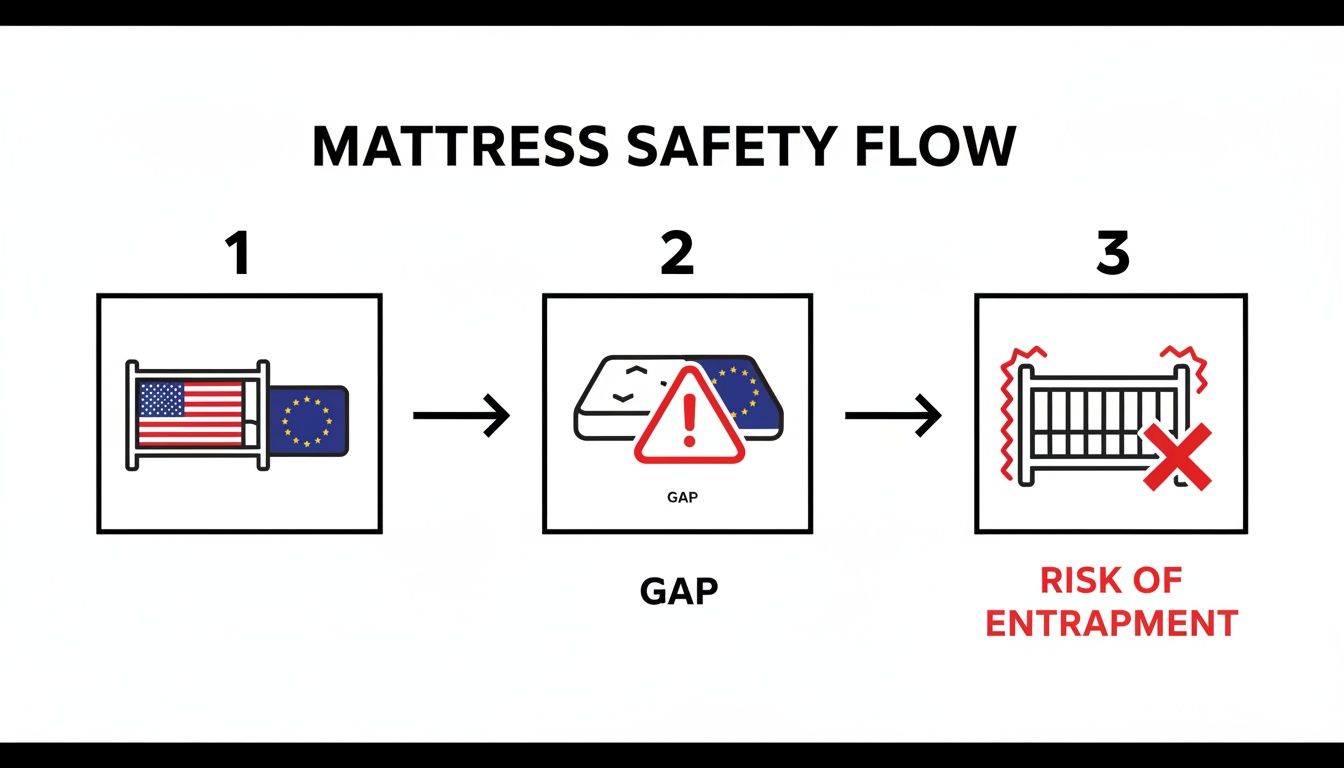
As you can see, pairing a U.S. crib with a slightly smaller European mattress creates a dangerous gap. It’s a perfect visual reminder of why sticking to local standards is so critical.
Here’s your quick-reference checklist for a perfectly safe fit:
- Measure First: Always check the crib’s interior dimensions before buying a mattress.
- Do the Two-Finger Test: Make sure the gap is no wider than two fingers.
- Check the Thickness: Confirm the mattress is 6 inches thick or less.
- Test for Firmness: The surface should be firm and bounce back immediately.
Following these steps means you’re not just hoping for a safe sleep setup—you’re actively creating one.
Let Our Experts Help You Build the Perfect Nursery
You now have all the insider info on how to pick a safe, snug-fitting crib mattress. That’s a huge step. But going from knowing the rules to actually putting them into practice in your own nursery is where the real confidence comes from. You’re the hero in this story, making sure every little detail of your baby’s sleep space is just right, and we’re here to be your trusted guide.
Creating a safe and beautiful nursery shouldn't feel like a solo mission. Our Sleep Experts in Lubbock, Hobbs, and Ruidoso Downs are on hand to be your local partners in this project. We can help you double-check dimensions, compare different mattress types, and find the perfect match for whatever crib you’ve chosen. Think of us as your personal guides, here to make sure every choice you make is a safe one.
Your Partners in Peace of Mind
Let's be honest, the world of baby gear can feel pretty overwhelming. A good newborn essentials shopping list can help you keep track of everything, but for foundational items like the crib and mattress, a little professional guidance goes a long way.
Choosing the right mattress is more than just another purchase. It’s a foundational decision for your baby’s safety and comfort. Our goal is to give you the expertise and tools to make that choice with complete peace of mind.
There’s a real advantage to coming into our showroom. You can actually see the products, feel the quality, and measure things for yourself—goodbye, online shopping guesswork! Our team can walk you through the "two-finger test" with a real crib and mattress so you can see firsthand what a truly safe fit looks and feels like. And if you're looking for help designing the whole space, here's how you can learn about our dedicated design services.
We'd love for you to stop by. Bring your questions, and let our team help you build the safest, coziest nursery for your new arrival.
Answering Your Final Crib Mattress Questions
Even with all the measurements and safety checks down, a few nagging questions can pop up. Let's tackle some of the most common ones we hear from parents, so you can feel completely at ease with your choice.
Is It Okay to Use a Second-Hand Crib Mattress?
While a gently used crib frame can sometimes be a great find (after a thorough safety inspection, of course), the mattress is a different story. We strongly recommend buying a new mattress for each baby.
An old mattress can be a hidden home for mold and germs you can't see. Even more critically, it loses its firmness over time, creating a softer, less safe sleeping surface. Starting fresh guarantees a clean, firm foundation that you know meets the very latest CPSC safety standards.
Do Convertible Cribs Take a Special Mattress?
Nope, and that’s part of their magic! The vast majority of standard convertible cribs are built to use a standard U.S. crib mattress—one that's at least 27¼ inches wide by 51¼ inches long.
This means the same mattress your baby uses in their crib will fit perfectly when you convert it into a toddler bed. It's always smart to double-check the crib's manual for the exact required dimensions, but you generally won't need to hunt for a special size.
Remember, the most important thing is that the mattress remains firm and fits snugly, with no gaps, at every stage. The core safety rules don't change just because your child is getting bigger.
Exactly How Firm Does a Crib Mattress Need to Be?
When we say firm, we mean it. A safe crib mattress should feel uncomfortably firm to an adult. If you press your hand down into the center, it should pop right back up without leaving a significant impression.
This isn’t about what feels cozy to you; it's a critical safety measure. A rock-solid surface prevents your baby from sinking in, which significantly reduces the risk of suffocation and SIDS. If your baby happens to roll onto their stomach, a firm mattress ensures they can easily lift and turn their head to breathe clearly. It provides the stable ground they need to push up safely.
At Miller Waldrop Furniture & Decor, we believe you have what it takes to build a nursery that's not only beautiful but, most importantly, safe. Our Sleep Experts are always on hand to answer your questions and provide the tools you need to find the perfect mattress for your little one.
You can start your journey right now. Explore our curated selection of safe and comfortable crib mattresses.