

Bunk Bed Dimensions: Find the Perfect Fit for Your Space


Picking out a bunk bed is a fantastic way to open up a room, but nailing the dimensions is what makes it all work. It's the difference between a functional, safe space and a cramped, frustrating one. A standard Twin-over-Twin bunk bed, for example, usually measures around 80 inches long by 43 inches wide, and stands somewhere between 65 and 70 inches tall. Mastering these core numbers is your first step to making sure your new bed is a perfect fit.
Your Guide to Essential Bunk Bed Dimensions
Choosing a bunk bed isn't just about picking a cool style—it’s about equipping yourself to make every square inch of your room count. This requires you to think like an interior designer. Before you can choose the right furniture, you need the exact blueprint of your space. The length, width, and height of a bunk bed are the most critical parts of that blueprint. These numbers will determine how the bed settles into the room, how much floor space you have left over, and ultimately, whether the room feels spacious or squeezed.
Think of this guide as your go-to tool, empowering you to measure your room with total confidence. We'll walk through the basics first, so you can start visualizing exactly how different bunk bed sizes will look and feel in your home.
Why Every Inch Matters
Knowing the standard measurements upfront helps you answer some pretty important questions before you fall in love with a particular model. This knowledge empowers you to:
- See the Possibilities: You can quickly figure out if a standard Twin, a wider Full, or a different setup is even realistic for your room’s layout.
- Dodge Common Headaches: You can avoid that sinking feeling when the bed you ordered is too tall for your ceilings or an inch too long for the wall you picked out.
- Map Out the Flow: You can ensure there’s still enough space to walk around, open closet doors, and pull out dresser drawers without everything bumping into each other.
Getting the dimensions right isn't just about squeezing a bed into a room. It's about designing a space where your family can actually live and grow—safely and comfortably. This is your key to a layout that works for everything from playtime to storytime.
Starting with the Basics
Before we get into all the different configurations, let's lock down the three main measurements. The length runs from the headboard to the footboard, the width is the side-to-side measurement, and the height is the total distance from the floor to the very top of the guardrail. These three numbers are the foundation for every other decision you'll make.
With this knowledge, you're in the driver's seat. Once you master these fundamentals, you can confidently explore powerful options like the versatile Youth Full Over Full Bunk Bed and know exactly how it will transform your kid's room. When you have your measurements ready, bring them into a Miller Waldrop showroom, and our team will help you find the perfect match for your family's needs.
A Field Guide to Bunk Bed Types and Sizes
Now that you've got the basics of measurement down, you’re ready to start thinking like a space planner. It's time to dive into the different types of bunk beds out there. Each design is a unique solution to a specific design problem, whether you're trying to fit two kids in one room or create a multi-purpose zone in a tiny apartment.
Think of this as your guide to the most popular configurations. We'll break down their typical dimensions and show you how each one can be the hero of your room's layout.
This flowchart gives you a quick visual of how a bunk bed's length, width, and height all work together.

Getting a feel for how these three measurements interact is the first step toward finding the perfect style for your space.
The Classic: Twin-Over-Twin
The Twin-over-Twin is what most of us picture when we hear "bunk bed." It's the classic, go-to solution for shared kids' rooms and has been for generations. Why? Because it’s the most efficient way to sleep two people while using the least amount of floor space.
- Typical Footprint: Approximately 80 inches long x 43 inches wide.
- Best For: Younger kids sharing a room, a cozy guest nook, or any spot where floor space is a hot commodity. Its slim profile leaves much more room for playing, desks, and dressers.
The beauty of this design is its simplicity. You're stacking two twin beds, instantly doubling your sleep capacity without eating up precious square footage. It's a powerhouse of room optimization.
The Flexible Choice: Twin-Over-Full
Kids grow, and their needs change fast. The Twin-over-Full configuration is the perfect answer for this phase, offering a smart blend of space-saving design and extra comfort.
This setup features a standard twin bed up top with a more spacious full-size bed on the bottom. It's an ideal choice for siblings with an age gap or for kids who love having friends over for sleepovers.
- Typical Footprint: Around 80 inches long x 58 inches wide.
- Best For: Growing families, a child who needs more room to stretch out, or for creating a comfortable reading spot on the lower bunk.
The wider base of the full mattress gives the entire structure a more substantial feel, making it a great long-term investment that can adapt as your family evolves.
The Roomy Option: Full-Over-Full
For older kids, teenagers, or even the guest room at a vacation home, the Full-over-Full bunk bed brings maximum comfort to the table. This symmetrical design stacks two roomy full-size beds, creating a robust solution for any shared sleeping situation.
A Full-over-Full is a savvy long-term investment. It offers plenty of space that teenagers won't outgrow and provides genuinely comfortable sleeping quarters for adult guests, making that spare room incredibly versatile.
A perfect example is the Youth Full Over Full Bunk Bed, which combines a sturdy, stylish frame with this incredibly spacious setup.
- Typical Footprint: Approximately 80 inches long x 58 inches wide.
- Best For: Teenagers, college dorms, guest rooms, and cabins where you need to comfortably sleep up to four people.
The Space Creator: The Loft Bed
A loft bed isn't just about adding more sleeping spots—it’s about empowering you to completely rethink how a room can be used. Think of it as creating a brand-new functional zone out of thin air.
By lifting a single bed (usually a Twin or Full) up toward the ceiling, you unlock a huge amount of usable floor space underneath. This new area is a blank canvas.
- Create a study zone: Slide a desk and chair underneath for a dedicated homework station.
- Build a lounge area: Add a beanbag chair or a small futon to create a cozy hangout spot.
- Expand your storage: Fit a dresser or shelving units below to keep the room organized and clutter-free.
The length and width of a loft bed are similar to standard beds, but the real magic is in the vertical space it frees up. A loft bed turns you into the architect of your own room, giving you the power to design a space that’s perfectly suited to your lifestyle.
Ready to find the perfect setup? Bring your room measurements and ideas into a Miller Waldrop showroom. Our team is here to walk you through the options and help you find the ideal bunk bed that will serve your family for years to come.
Calculating Ceiling Height and Safe Clearance
It’s easy to focus on how much floor space a bunk bed takes up, but the most important measurement is actually vertical. This is the one detail people often forget until they're trying to assemble the bed, only to discover the top bunk is dangerously close to the ceiling. A little bit of measuring upfront saves you from a world of bumped heads and a cramped, claustrophobic feel for whoever gets the top bunk.
Think of the space above the top bunk as its own living area. Just like you need room to walk around a bed, the person sleeping up top needs space to sit up, read, and climb in and out comfortably. Getting this vertical dimension right is what makes a bunk bed a powerful design tool instead of just a hazard.
The Golden Rule of Bunk Bed Clearance
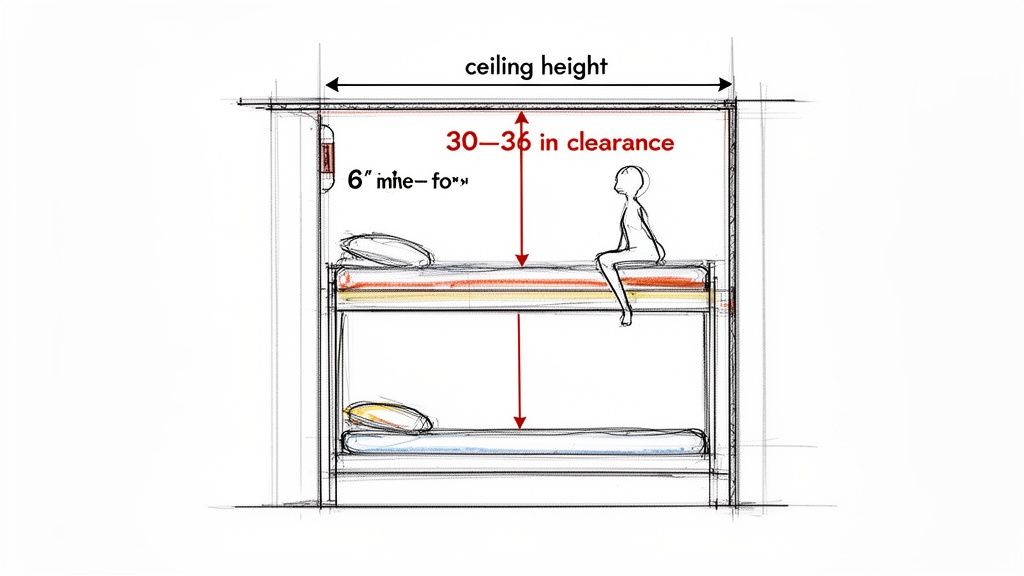
Here's the non-negotiable rule of thumb: you need at least 30 to 36 inches of clear space between the top of the upper mattress and your ceiling. This isn't just a friendly suggestion—it’s the industry gold standard for safety. Anything less than 30 inches is just asking for trouble, making the space feel tight and significantly increasing the risk of head injuries.
This clearance is the most crucial part of your setup. It gives an older kid or teen plenty of room to sit up without hunching over and provides a safe buffer for younger kids. Before you even start browsing, grab a tape measure and check this in the room.
A Simple Formula for a Perfect Fit
You don't need any complex math to figure out if a bunk bed will work. Just use this straightforward formula to measure your room like a pro and determine the absolute maximum height you can accommodate.
Here’s the breakdown:
- Bunk Bed Height: Find the total height of the bunk bed frame you have your eye on, measuring from the floor to the very top of the guardrail.
- Mattress Thickness: Add the height of the mattress you'll use for the top bunk (this is usually 6-8 inches).
- Safety Clearance: Finally, add the minimum safety clearance of 30 inches.
Bunk Bed Height + Mattress Thickness + 30 Inches = Your Minimum Required Ceiling Height
Let's run through a quick example. If a bed is 68 inches tall and you add a 7-inch mattress, you will need a ceiling that is at least 105 inches high (that’s 8 feet, 9 inches). This simple calculation lets you shop with confidence, knowing exactly what will—and won't—work in your space.
Why This Measurement Matters More Than Ever
As our homes get cozier, furniture that makes the most of every square inch has become a necessity. It’s no surprise that bunk beds are more popular than ever. In fact, the global bunk beds market was valued at around USD 4.9 billion in 2025 and is expected to hit USD 8.8 billion by 2035. If you're curious, you can explore more data on bunk bed market growth and see just how many families are turning to these space-saving designs.
This surge in popularity makes it all the more important to get the dimensions right. When you calculate your ceiling clearance correctly, you're not just buying furniture—you're thoughtfully designing a safer, more functional room for your family.
Now that you have the tools and know-how, you can explore beautiful and sturdy options like the Youth Full Over Full Bunk Bed without any of the guesswork. Bring your measurements with you to a Miller Waldrop showroom, and our experts will help you find the perfect solution for your home.
How to Choose the Right Bunk Bed Mattress
You’ve found the perfect bunk bed frame—that's a big win! But the job isn't done just yet. Picking the right mattress is just as crucial, and it’s about more than just finding a comfy spot to sleep. It’s a matter of safety.
While the length and width are straightforward (a twin bunk needs a twin mattress), the most important measurement by far is the mattress thickness.
Think of the guardrails on the top bunk like a safety barrier on a balcony. If the mattress is too tall, it essentially lowers that barrier, increasing the risk of an accidental fall. This is precisely why bunk bed manufacturers are so strict about mattress height limits.
Why Thickness Is a Safety Feature
Every single bunk bed sold is legally required to have a warning label that clearly states the maximum mattress thickness for the top bunk. This isn't a friendly suggestion; it's a non-negotiable safety standard from the Consumer Product Safety Commission (CPSC).
- The Sweet Spot: Most bunk beds call for a mattress between 6 and 8 inches thick.
- The 5-Inch Rule: To do its job properly, the top of the guardrail must sit at least 5 inches above the surface of the mattress.
- Find the Label: Before you even start shopping for a mattress, find that safety label on the bed frame. It will tell you the exact maximum thickness allowed.
Sticking to the manufacturer's recommended mattress height is the single most important thing you can do to keep the top bunk safe. This simple step ensures everyone can sleep soundly.
Finding Comfort in a Slimmer Mattress
Don't assume a thinner mattress means a less comfortable one. You can absolutely get fantastic comfort and support in a lower-profile design—you just have to know what to look for. Modern mattress materials are perfect for this.
- Memory Foam: These mattresses are amazing at contouring to the body and relieving pressure, all without needing to be super thick.
- Latex: Known for its responsive, durable support, latex offers a firm-yet-comfortable feel in a slim package.
- Low-Profile Hybrids: Some mattresses combine the best of both worlds—supportive innersprings and comfortable foam layers—all in a design that’s thin enough for a bunk bed.
Making the Right Choice for Your Family
Choosing the right mattress really comes down to balancing the strict safety rules with what feels best for your family. Now that you understand the "why" behind the thickness limits, you're ready to make a great decision. For more in-depth advice on choosing any mattress, check out our guide on what size mattress you need.
By prioritizing the correct thickness, you're ensuring your new bunk bed is more than just a cool, space-saving piece of furniture—it’s a safe haven. And if you’re ever unsure, our team at Miller Waldrop is always here to help you find that perfect mattress to complete your setup.
Planning Your Room Layout for a Perfect Fit
Alright, you've nailed down the bunk bed dimensions, figured out the ceiling clearance, and even sorted out mattress safety. Now comes the final challenge, what I like to call the "last boss" of furniture shopping: actually getting it into the room. A little bit of planning here saves a world of headache on delivery day.
Think of yourself as an air traffic controller clearing a runway. By measuring the path from your front door to the bedroom before the bunk bed even ships, you guarantee a smooth landing. This simple step is the difference between a frustrating day of wrestling boxes and a seamless, exciting setup.
Your Pre-Delivery Measurement Checklist
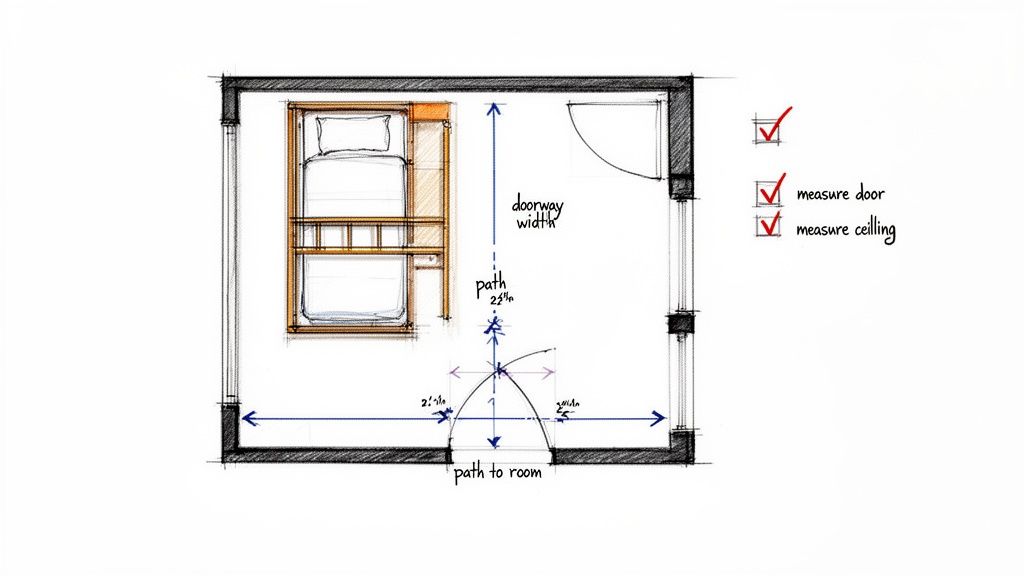
Time to grab a tape measure and a notepad. Your mission is to map out every potential bottleneck between the delivery truck and the final destination. Bunk beds usually arrive in a few large, flat-packed boxes, so you'll want to measure the height, width, and diagonal depth of these key spots:
- Entryways and Hallways: What’s the width of every doorway the boxes need to pass through? Remember to account for things like doorknobs that stick out and reduce your usable space.
- Stairwells: This is where things often get tricky. Measure the width of the stairs themselves, but also check the ceiling height at the lowest point. Pay special attention to the clearance around landings and turns.
- Corners and Tight Turns: Got any sharp corners in the hallway? Measure the clearance to make sure the longest box can pivot around it without scraping the paint off your walls.
Think of this as creating a blueprint for a successful delivery. This little checklist turns you from a hopeful shopper into a prepared planner, ensuring your new bunk bed arrives at its destination without a single scratch.
Arranging the Room for Function and Flow
Once you know the bed will physically fit into the house, it's time to decide where it will live in the room. A well-placed bunk bed does more than just save space—it makes the entire room feel more organized and usable. The goal is to create clear pathways and distinct zones for sleeping, playing, and homework.
As a rule of thumb, try to leave at least 24 to 30 inches of open floor space around the bed. This is absolutely critical on the side with the ladder or stairs, giving kids a safe and easy path to climb up and down. Also, think about your other furniture. Can dresser drawers still open all the way? Do closet doors have room to swing open?
For some great pointers on this, our guide on how to arrange bedroom furniture is packed with useful tips. As you map things out, you’ll see that a bit of foresight goes a long way in resolving space planning issues before they become a problem.
With your measurements and room plan complete, you’re ready to shop with confidence. Stop by a Miller Waldrop showroom in Lubbock, Hobbs, or Ruidoso, and let our team help you find that perfect bunk bed that fits your space—and your life—flawlessly.
Your Blueprint for a Perfectly Fitted Room
You've put in the work. You've measured your space, sorted through the different bunk bed types, and crunched the numbers on everything from ceiling clearance to mattress safety. You are officially the hero of this home project, ready to make a decision with complete confidence. This was never just about buying furniture; it's about making a smart investment in a room that's more functional, fun, and safer for your family.
You're holding the blueprint for a successful room makeover. This plan gives you the power to pick a bunk bed that doesn't just squeeze into a room but actually enhances it, opening up a world of possibilities for sleep, play, and storage.
Your Final Checklist for Success
Before you make your choice, run through this quick mental checklist. It’s a simple recap of the essentials to ensure you’ve covered all your bases.
- Measure Everything Twice: Double-check your room’s length, width, and especially the ceiling height. Don't forget to measure the path it'll take to get there—doorways and stairwells are critical. For a quick refresher, our complete guide on how to measure furniture can walk you through it.
- Calculate Safe Clearance: Remember the golden rule: at least 30 inches of space between the top bunk's mattress and the ceiling. This is an absolute must-have for safety.
- Confirm Mattress Thickness: Look for the safety label on the bunk bed. It will tell you the maximum mattress thickness allowed, which is usually between 6 to 8 inches, to ensure the guardrails can do their job properly.
- Visualize the Layout: Map out where the bed will go. Make sure there’s plenty of room to use the ladder easily and that you can still open dresser drawers or pull out a desk chair without any trouble.
Following these steps turns a potentially stressful decision into a simple, and even enjoyable, process. It's how you guarantee the bunk bed you bring home is the right one.
Understanding the Bigger Picture
Choosing the right bunk bed isn’t just about what works in your home; it’s part of a bigger shift toward smarter, more efficient living that’s happening everywhere. While the Asia-Pacific region currently leads the global market—generating around USD 1.18 billion in 2024—it’s North American families like yours that are driving the demand for higher quality materials and safer, more innovative designs. This focus on quality is exactly what we look for in our own collection. You can discover more insights on these bunk bed market trends to see how people all over the world are making the most of their space.
You're now more than just a shopper; you're the designer of your family's space. By following your own blueprint, you're setting yourself up for a result that is safe, stylish, and perfectly suited to your needs. This is your win.
Now for the fun part: bringing your vision to life. Bring your measurements and ideas into a Miller Waldrop showroom in Lubbock, Hobbs, or Ruidoso. Our team is ready to be your guide, helping you find that perfect bunk bed—like the beautiful Youth Full Over Full Bunk Bed—that will turn your blueprint into reality.
Bunk Bed FAQs: Answering Your Final Questions
Even after you've measured everything twice, a few nagging questions can pop up. It's completely normal. Let's tackle some of the most common ones we hear from families to make sure you have all the information you need to win the day.
What’s the Minimum Ceiling Height for a Bunk Bed?
This is a big one. The golden rule here is to leave at least 30 to 36 inches of headspace between the top bunk's mattress and the ceiling. Anything less, and the person on top won't be able to sit up comfortably without hitting their head.
A quick way to figure this out is with a simple formula: take the bunk bed's total height, add your mattress thickness (usually 6-8 inches), and then add that 30-inch safety clearance. So, for a typical 68-inch tall bunk bed, you're looking at a minimum ceiling height of 96 inches—or a standard 8-foot ceiling.
Are Bunk Bed Mattresses a Special Size?
Length and width-wise, no. A Twin bunk bed takes a standard Twin mattress, a Full takes a Full, and so on. The real difference, and it's a crucial one, is the thickness.
Bunk beds need thinner mattresses, almost always in the 6 to 8-inch range. This isn't a suggestion; it's a critical safety requirement. A mattress that's too thick can reduce the height of the guardrail, making it ineffective. Always look for the safety label on the bed frame itself—it will tell you the maximum mattress thickness allowed.
How Much Floor Space Do I Really Need?
The bed's footprint is just the starting point. A standard Twin-over-Twin bunk might only occupy about 42 by 80 inches, but that's not the whole story.
Don't forget to account for access. You need to plan for at least 2 to 3 feet of clear floor space next to the ladder so kids (or adults!) can get in and out safely.
And if your chosen model has extras like built-in drawers or a pull-out trundle, make sure you measure how far they extend and leave enough room for them to open all the way.
Can Adults Actually Use Bunk Beds?
Absolutely, as long as you pick the right one. Full-over-Full bunk beds are fantastic for guest rooms or vacation homes where you need to maximize sleeping space for adults.
The key is to check the manufacturer's specified weight capacity. Look for models with robust construction, like those made from solid wood or heavy-duty metal. Loft beds are also a great, practical choice for adults in smaller apartments, creating room for a desk or a small sofa underneath.
With these details sorted, you have everything you need to confidently choose the right bunk bed dimensions for your home. You’re ready to create a space that’s not just stylish, but also wonderfully functional and safe.
At Miller Waldrop Furniture & Decor, we love helping families bring these spaces to life. Explore our collection of beautifully crafted bedroom furniture online, or stop by one of our showrooms to see them for yourself.
Discover your perfect space-saving solution by browsing our collection at https://www.millerwaldrop.com.