

Big Comfy Chair: A Buyer’s Guide to Ultimate Comfort


A lot of people start shopping for a big comfy chair when they’re already tired. Tired of fighting for the good corner of the sofa. Tired of sitting in a chair that looks sharp but feels punishing after half an hour. Tired of having no real place in the house that belongs to them.
That’s why this purchase matters more than it seems. A big comfy chair isn’t filler furniture. It’s the seat where you read, recover, scroll, nap, watch a game, help with homework, or take a moment to relax. If you live in West Texas or SE New Mexico, where homes often need to work hard for family life, guests, and everyday comfort, one great chair can pull a whole room together and make it more usable.
Your Quest for the Perfect Comfort Zone
The desire for a big comfy chair is older than most decorating trends. People have always been drawn to chairs that feel generous, welcoming, and a little iconic.
Washington, D.C.’s famous Big Chair proves the point. It started as a marketing tool in 1959, stood 19.5 feet tall, and weighed 4,000 pounds, turning it into an instant landmark for Curtis Brothers Furniture, according to the history of the Big Chair sculpture). That oversized chair worked because it tapped into something simple. People respond to the idea of comfort made visible.
Your version doesn’t need to be monumental. It just needs to feel right the second you sit down.
Maybe you want one chair in the bedroom where you can read before bed. Maybe you need a living room seat that gives you more support than the sofa. Maybe you’re creating a quiet corner for recovery, long evenings, or slow mornings with coffee. That’s not indulgent. That’s good home design.
Comfort also goes beyond the chair itself. The whole ritual matters, from soft lighting to a throw you use to comfortable loungewear that makes downtime feel intentional instead of accidental.
A well-chosen chair gives a room a purpose. It tells you how to use the space.
I’m opinionated about this. Don’t buy a big comfy chair just because it looks cozy in a photo. Buy one because it supports the life you live. The right chair becomes your place. Once you know what to look for, choosing it gets much easier.
What Truly Defines a Comfy Chair
A big comfy chair is not just a larger chair. Size helps, but comfort is a combination of fit, support, materials, and construction. If one of those is off, the chair can look inviting and still leave you stiff, slouched, or disappointed.
Many oversized chairs feel plush in a showroom and fall apart in real life. That usually happens because shoppers focus on softness first and ignore support. That’s backwards.
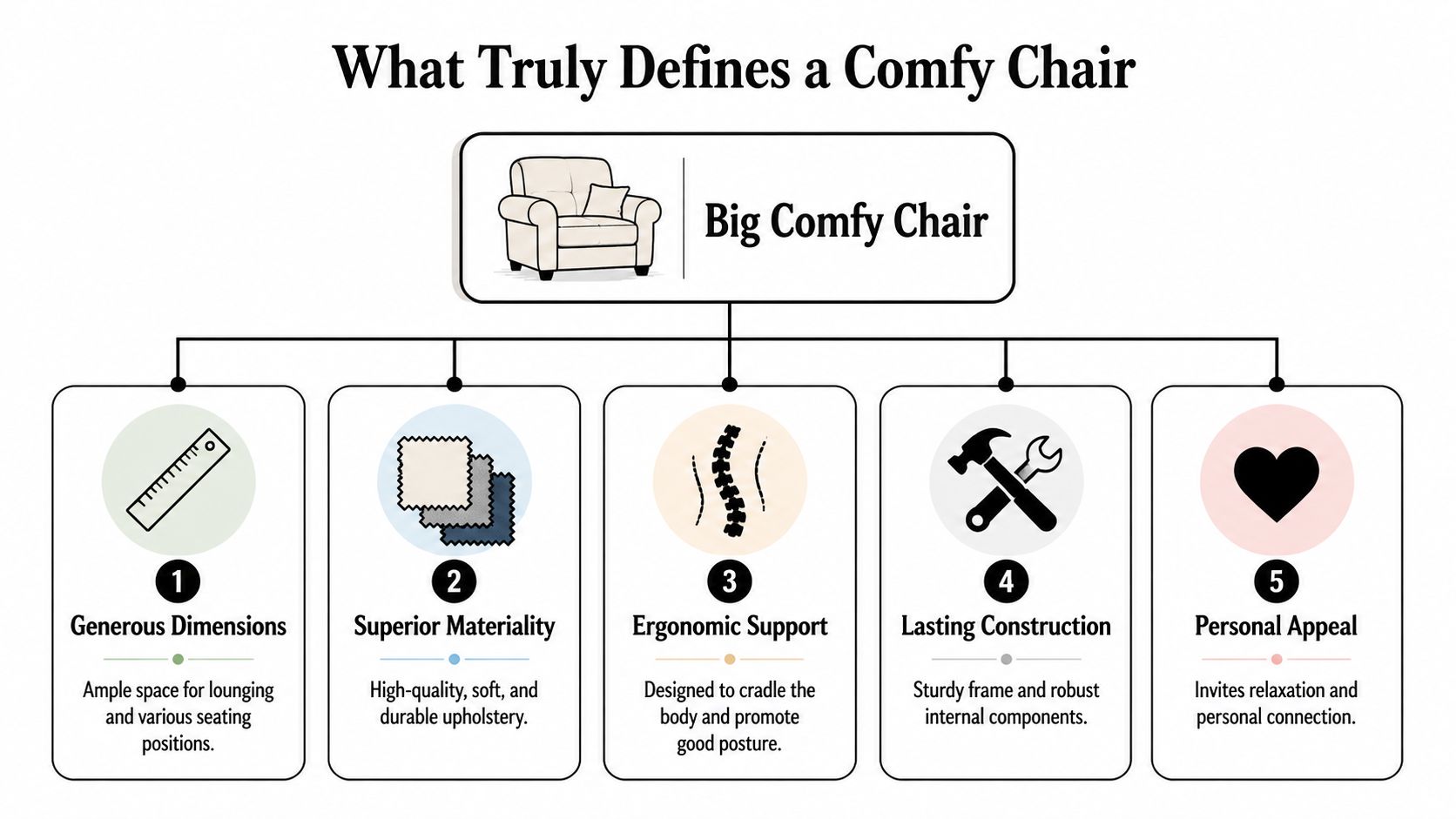
Comfort starts with body support
If you use a chair for long stretches, design affects your health. Oversized lounge chairs without proper ergonomic support can contribute to back pain and poor posture, which is why lumbar support and seat depth matter so much, as noted in this guidance on oversized lounge chair ergonomics.
That matters even more if your chair does double duty. A lot of people use one seat for evening TV, laptop time, recovery after work, or resting with chronic aches. In those cases, “soft” isn’t enough. You want a chair that holds you up, not one that lets you collapse.
Here’s the practical way to approach it:
- Lumbar support: Your lower back should feel supported without needing three extra pillows.
- Seat depth: If the seat is too deep, your lower back loses contact with the chair. If it’s too shallow, you won’t feel relaxed.
- Arm height: Your shoulders should settle naturally, not hunch upward.
- Back angle: A slight reclined feel is comfortable. A forced slouch is not.
Big doesn’t mean right for everyone
A chair can be oversized and still be the wrong fit. Some people prefer a structured sit that helps them stand up easily. Others want a deeper, loungey seat that invites curling up. Families with kids or pets usually need durability first. Readers and TV watchers often need neck and back support first.
That’s why I tell clients to stop asking, “Is this chair comfy?” and start asking, “Is this chair comfy for how I live?”
Fabric matters too, especially in busy households. If you’re comparing textures, weaves, and cleanability, this guide to how to choose upholstery fabric is worth reading before you commit.
Practical rule: If you feel great in a chair for five minutes but restless by fifteen, keep shopping.
The best big comfy chair feels easy. Your feet land naturally. Your back feels supported. Your body settles instead of fidgeting. That’s the standard.
Evaluating the Four Pillars of Lasting Comfort
Most regret starts when a chair is bought on looks alone. The fix is simple. Judge it like a designer, not like a browser.
A quality oversized chair typically starts at 40 inches wide and uses high-density foam at 2.5 to 3.0 lbs/ft³ with a kiln-dried hardwood frame built to support 300 to 500 lbs, according to this oversized chair buying guide. That combination helps prevent sagging and can reduce pressure on the spine by up to 30% in daily lounging. Those details matter because they tell you whether the chair will still feel good after real use.

Frame and construction
Start underneath the pretty part. A chair’s frame decides whether it will stay comfortable or slowly start leaning, creaking, and sagging.
Look for kiln-dried hardwood. It’s a strong sign the maker took durability seriously. If the frame is vague in the product description, ask. If nobody can tell you what it’s made of, that’s your answer.
Avoid flimsy construction dressed up with overstuffed cushions. Extra padding can hide a weak frame for a while, but not for long.
Support and cushions
Cushions are where comfort gets personal, but the structure behind that comfort still matters. High-density foam gives you shape retention and support. Down-like softness can feel luxurious, but too much plushness without enough core support turns into a pit.
Here’s how I break it down for clients:
- For everyday lounging: Choose a supportive foam core with enough softness on top to avoid a stiff feel.
- For easy maintenance: Structured cushions usually keep their shape better and need less fussing.
- For that sink-in look: Make sure there’s still enough resilience to help your back and hips, not just your eyes.
Upholstery
Fabric changes everything. It changes how a chair feels against your skin, how warm it sits, how easily it cleans, and how polished or casual the room feels.
For households with traffic, pets, or kids, performance-minded upholstery is the practical move. Tighter weaves often wear better, and easy-clean fabrics save a lot of frustration. If you want a deeper dive on texture, wear, and lifestyle fit, this guide to choosing the best fabric for chair upholstery is useful.
Don’t choose fabric only with your eyes. Touch it, sit in it, and think about what lands on it every day.
Scale and proportion
A big comfy chair should feel generous, not cartoonish. In a large room, an undersized chair looks apologetic. In a smaller room, an oversized piece can choke circulation and make everything feel cramped.
You’re balancing two things at once. The chair has to fit the room, and it has to fit your body. If one works without the other, it’s still the wrong chair.
Here’s a quick checklist you can use while shopping:
| Feature | What to Look For (High Quality) | Why It Matters for Comfort & Durability |
|---|---|---|
| Frame | Kiln-dried hardwood construction | Helps the chair stay solid and resist sagging with daily use |
| Seat width | Starts around 40 inches for oversized comfort | Gives you room to shift positions and lounge comfortably |
| Cushion core | High-density foam in the 2.5 to 3.0 lbs/ft³ range | Supports the body while holding shape over time |
| Weight support | Capacity in the 300 to 500 lb range | Signals stronger internal construction |
| Upholstery | Durable, lifestyle-appropriate fabric | Affects comfort, maintenance, and long-term appearance |
| Seat depth | Deep enough for lounging but supportive for your posture | Prevents the “too deep to sit well” problem |
| Arms and back | Supportive shape that lets shoulders and back relax | Makes long sitting sessions more comfortable |
One practical place to compare oversized seating options is the chairs collection at Miller Waldrop Furniture & Decor. Use it the right way. Don’t just scroll for style. Compare frame details, cushion feel, arm shape, and scale.
Exploring Types of Big Comfy Chairs
Not every big comfy chair solves the same problem. Some are built for sprawling. Some are built for support. Some are for motion, and some are for staying planted while looking sculptural.
That’s why “oversized chair” isn’t a style. It’s a category.

Chair and a half
This is the classic answer for people who want one-seat lounging without committing to a loveseat. A chair and a half gives you room to tuck your legs up, share the seat with a child, or stop perching on furniture.
I like this option for living rooms, bedrooms, and reading corners. It’s casual, versatile, and usually easier to style than a bulky recliner.
Swivel glider
A swivel glider is a smart choice if your room has multiple focal points. You can turn toward the TV, pivot toward a conversation area, or angle toward a window without dragging furniture around.
This type works especially well in nurseries, family rooms, and flexible spaces where the chair needs to move with your routine. The look can range from structured to soft and relaxed.
Power recliner
If comfort is your top priority, power recliners deserve serious attention. Modern power recliners from brands like La-Z-Boy can include zero-gravity positioning and heating elements that may reduce spinal disc compression by up to 40%, improve circulation, support weights up to 500 lbs, and use mechanisms tested for over 20,000 cycles, according to these expert insights on big reclining chairs.
That’s a completely different category of comfort from a static lounge chair. If you deal with back fatigue, want leg elevation, or need easier long-session support, a power recliner is often the right answer.
Some shoppers avoid recliners because they remember the clunky versions from years ago. Current models can be far more refined in both shape and function.
Accent lounge chair
This is for the shopper who wants comfort but still wants the room to feel visually edited. A large accent lounge chair can offer generous seating without the obvious mechanism of a recliner.
Choose this if style matters just as much as sink-in appeal. Just make sure you don’t sacrifice support for silhouette.
A useful contrast
Historically, grand chairs often symbolized status more than comfort. The Coronation Chair in Westminster Abbey, commissioned in 1296, is a 6.5-foot-high oak throne with ceremonial significance. It’s impressive, but it reminds us that older “big chairs” were built for symbolism and grandeur, not the way modern homeowners relax.
Your chair should do the opposite. It should fit your body, your routines, and your room. That’s progress.
How to Measure for Your New Chair
The easiest way to ruin a furniture purchase is to skip the measuring. A chair can be beautiful, supportive, and well-made, then fail at your front door.
Historically significant chairs were often built for grand settings instead of ordinary homes. The Coronation Chair, commissioned in 1296, stands 6.5 feet high, which is a good reminder that today’s furniture has to fit through standard doorways and everyday floor plans, as noted in this article on the history of the most famous chair in the world.
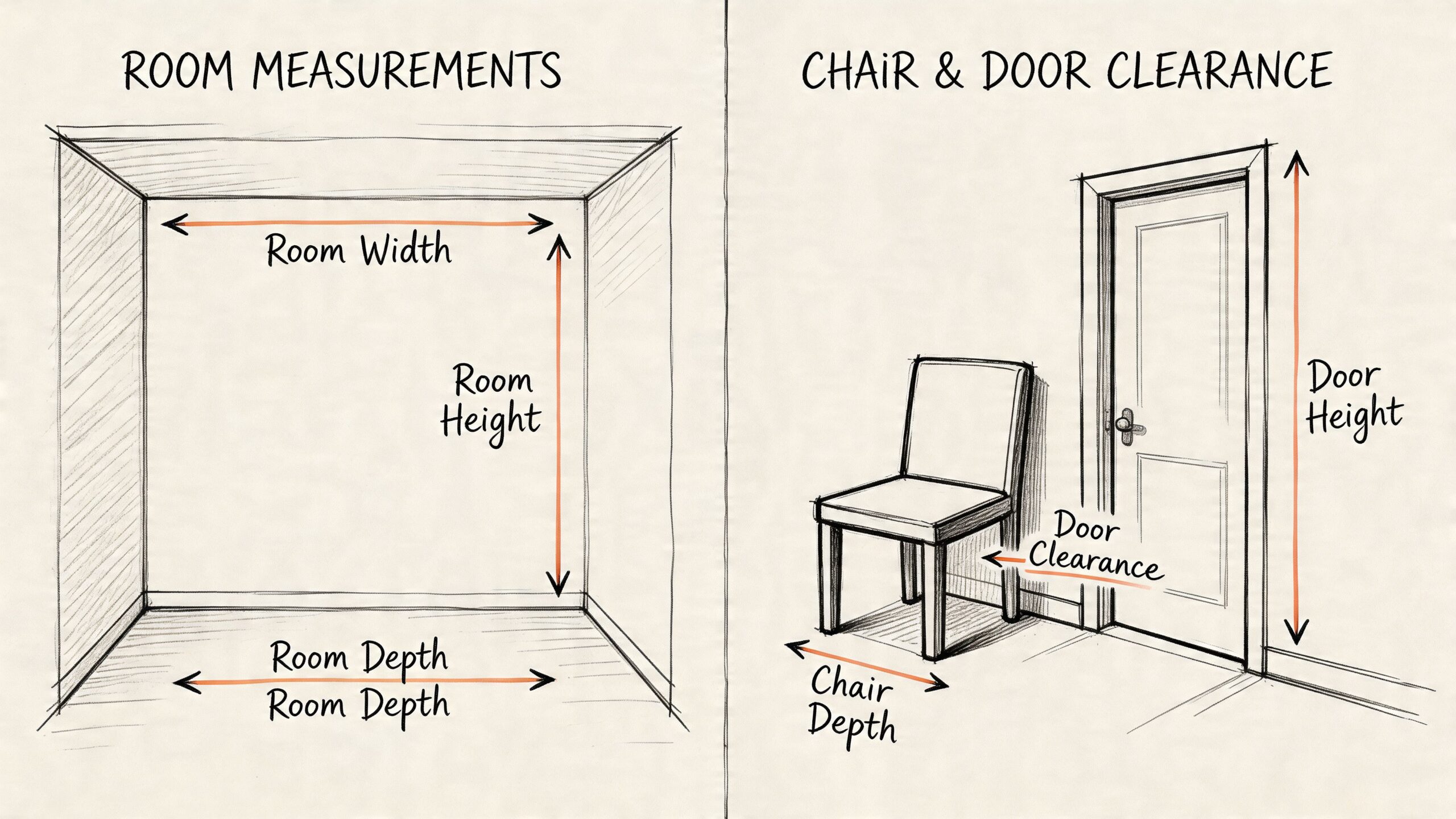
Measure the room first
Start with the spot where the chair will live. Don’t guess. Measure the width and depth of that area, then think about how people walk through the room.
If the chair reclines or swivels, account for movement space too. A chair that technically fits but blocks traffic is still a bad fit.
Measure the path second
This is the step people skip. Measure every point from the entry door to the final room.
Use this checklist:
- Doorways: Measure width and height.
- Hallways: Check narrow points and turns.
- Staircases: Measure width, ceiling clearance, and landings.
- Entry corners: Tight turns often cause more trouble than straight runs.
- Elevators or exterior gates: If applicable, measure those too.
If you want a practical refresher before shopping, this guide on dimensions of a chair can help you think through common sizing terms.
Write it down and bring it with you
Don’t rely on your phone memory and don’t round up. Keep exact measurements with you while you shop. Better yet, use a room-measuring guide like how to measure furniture so you can check placement and delivery access before you fall in love with a piece.
Take this seriously: A delivery path problem is not a minor inconvenience. It can turn an exciting purchase into an expensive headache.
Painter’s tape helps too. Mark the chair footprint on the floor so you can see how much space it will really claim. That one simple move prevents a lot of buyer’s remorse.
Styling Your Chair in Your Home
A big comfy chair should feel intentional. If it looks dropped into a room as an afterthought, even a beautiful piece will feel awkward.
In a bedroom, use it to create a private corner. Add a floor lamp, a small drink table, and one soft throw. That gives the chair a job. It becomes a reading seat, a quiet morning perch, or the place where you unwind before sleep.
In a living room, let the chair anchor one side of the conversation area. If you want inspiration on proportion and placement, this look at an accent chair for living room is a good reference for how one chair can change the balance of the whole space.
You can also use a pair of oversized chairs to replace a small sofa in a media room or open-plan living area. That setup often feels lighter while still giving everyone a designated place to sit.
A few styling rules I stand by:
- Use one grounding element: A rug, side table, or lamp keeps the chair from floating visually.
- Add only one or two soft accessories: Too many pillows make a comfy chair less comfortable.
- Match the mood of the room: Bouclé, linen-look weaves, leather, and smooth performance fabrics all send different signals.
The right big comfy chair doesn’t just fill a corner. It creates one of the most useful zones in the house.
Your Partner in Finding Perfect Comfort
You don’t need more opinions from random product listings. You need a chair that fits your body, your room, and the way you live.
That’s where local guidance matters. Miller Waldrop has served West Texas and Southeastern New Mexico for over 70 years and has been family-owned since 1952, with showrooms in Lubbock, Hobbs, and Ruidoso Downs. That kind of experience is useful when you’re comparing brands, sorting out fabric choices, or trying to decide whether your home calls for a chair and a half, a swivel glider, or a power recliner.
Their selection includes brands shoppers already know, including La-Z-Boy, Flexsteel, Hooker, and Ashley. What's more, you can get help from people who understand room scale, delivery realities, custom options, and the difference between a chair that photographs well and one that provides support every evening.
If you’re making your first major furniture purchase, use the tools available to you:
- Ask for design guidance: It helps when you’re balancing comfort, scale, and style.
- Compare materials in person: Fabric and cushion feel should never be an afterthought.
- Use financing if it helps you buy quality once: A chair you use every day is worth choosing carefully.
- Confirm delivery access before purchase: Smart planning protects the whole experience.
A big comfy chair should make your life easier. It should give you a place to land, not another problem to solve.
Ready to find a chair that feels right the first time? Visit Miller Waldrop Furniture & Decor to explore living room seating, compare styles in person, and get help choosing a big comfy chair that fits your home, your routine, and your comfort standards.