

How to Choose Upholstery Fabric for Lasting Style

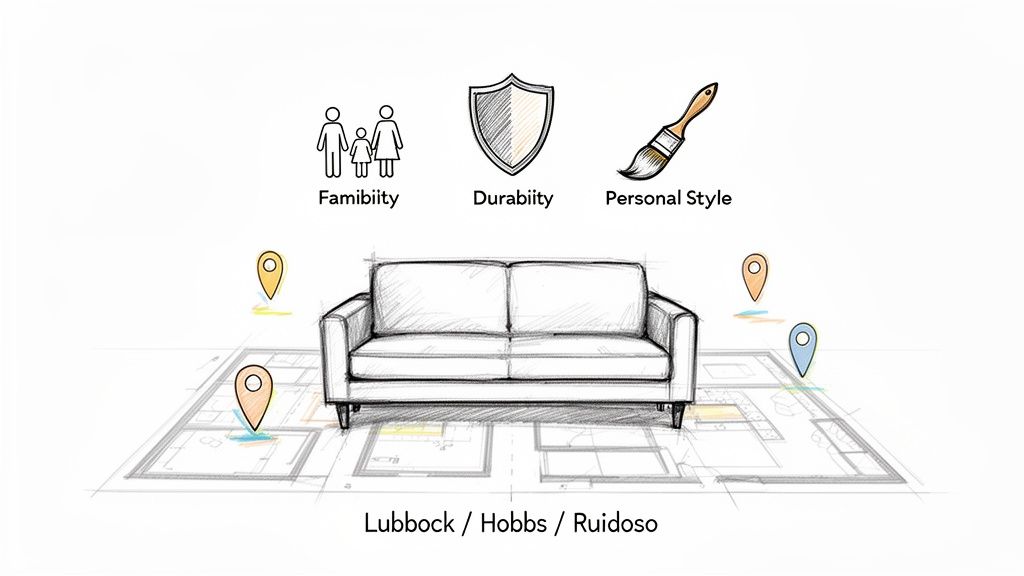
Choosing the right upholstery fabric is your first step to creating furniture that lasts. The secret is to balance three key elements: your lifestyle, the material's durability, and your personal style. When you get these right, you’ll have a fabric that not only looks fantastic but is perfectly equipped for your day-to-day life.
Your Starting Point for Choosing the Perfect Upholstery
Picking the fabric for a new sofa or chair is a powerful decision you make in the furniture buying process. It's the first thing you see, what you feel every time you sit down, and the part that takes the most abuse over the years. This guide is your personal roadmap, giving you the insider knowledge to choose with confidence.
Instead of getting lost in a sea of swatches, you'll learn what questions to ask before you even start looking. This simple step ensures the fabric you pick is both beautiful and practical. This is how you can empower yourself to create your ideal home, and the right fabric is a huge part of bringing that vision to life.
Key Factors for a Smart Fabric Choice
To get started, let's think through the three pillars of fabric selection. Getting clear on these now will make every other decision down the line so much easier.
- Your Family's Lifestyle: Be honest here. Is this sofa for a formal, rarely-used living room? Or is it command central for movie nights, pets, kids, and snacks?
- Fabric Durability: This is the technical side—understanding things like rub counts and cleaning codes. Don't worry, you'll master this in no time.
- Your Personal Style: Now for the fun part! This is all about the colors, patterns, and textures that feel like you and pull your room together.
This strategic approach is a core part of building a home that works for you, and it goes beyond just fabric. In fact, these same considerations are a huge piece of the puzzle you can solve with our comprehensive guide on how to buy a sofa.
Your furniture is an investment. The upholstery you choose is its first line of defense against daily life, making it a decision that pays dividends in both longevity and satisfaction.
It’s clear homeowners are putting more thought into these choices than ever before. The U.S. upholstered furniture market is projected to hit $28.63 billion by 2031, with sofas leading the charge. This growth tells us just how much people value creating comfortable, personalized living spaces that truly work for them.
Here's a quick cheat sheet to get your mind oriented around the common choices.
Quick Fabric Selection Cheat Sheet
This table offers a quick summary of key fabric types and where they shine, helping you narrow down your options at a glance.
| Fabric Type | Best For | Key Benefit |
|---|---|---|
| Natural Fibers (Cotton, Linen) | Casual, comfortable living rooms | Breathable and soft, offers a relaxed look. |
| Synthetics (Polyester, Nylon) | High-traffic areas, homes with kids/pets | Excellent durability and stain resistance. |
| Leather | Sophisticated spaces, long-term investment | Develops a rich patina; very durable and easy to clean. |
| Performance Fabrics | Any high-use area, especially dining chairs | Engineered to resist stains, spills, and fading. |
| Velvet | Formal living rooms or accent pieces | Luxurious texture and rich color depth. |
This is just the starting point, of course, but having a general idea of which fabric family aligns with your needs is a massive head start.
Exploring Natural and Synthetic Fabric Options
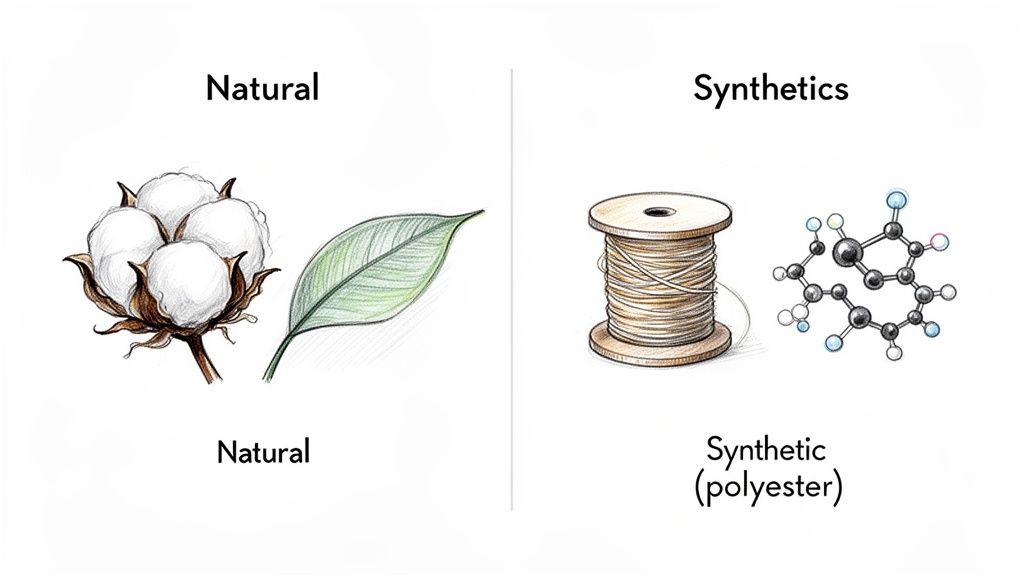
When you start looking at fabric swatches, it’s easy to get overwhelmed. But honestly, it all boils down to two main families: natural and synthetic. Understanding the difference is the first real step in picking something you'll love for years, not just for how it looks, but for how it lives.
Natural fibers come from plants and animals. They have an organic, breathable quality that's tough to truly replicate. On the flip side, synthetics are the problem-solvers. They’re engineered in a lab to stand up to the messy, real-world challenges of stains, sunlight, and constant wear and tear.
The Appeal of Natural Fibers
There's a reason classics like cotton, linen, wool, and leather never go out of style. They bring a unique texture and a certain kind of comfort into a room that just feels right. Imagine a crisp linen sofa in a formal living room or the relaxed, inviting feel of a cotton slipcover. They breathe, which makes them incredibly comfortable, especially when it gets warm.
- Cotton: A true classic. It’s soft, breathable, and generally affordable. It also holds up well against pilling and fading, but it can be a magnet for stains if it's not treated.
- Linen: Nothing says "effortless elegance" like linen. It’s incredibly strong, but it does wrinkle. That’s part of its charm for some, but it means it’s often best for less-used pieces unless it’s blended with a synthetic to help it keep its shape.
- Leather: The ultimate investment piece. It’s tough, a breeze to clean, and develops a gorgeous patina over time that adds so much character.
Natural fibers have a way of connecting your home to the outside world. They offer a richness you can feel and a lived-in comfort that only gets better with age. Choosing one is like choosing a piece that will tell a story.
It’s clear people value high-quality materials. The global upholstery fabric market actually grew to $45.214 billion in 2024, which shows just how much demand there is for fabrics that are both beautiful and built to last.
The Power of Synthetic Solutions
Now let's talk about the workhorses. Synthetic fabrics like polyester, nylon, and acrylic are where function often takes the lead. They are designed from the ground up to offer superior durability, stain resistance, and colorfastness. In short, they’re lifesavers for busy family rooms, dining chairs, or any home with kids and pets.
A polyester blend on a family sectional, for example, can handle spilled drinks and years of daily use without looking stretched out or faded. This same logic of choosing materials for their performance applies elsewhere in the home, too; people even explore synthetic material options like vinyl wrap for cabinets for similar reasons.
- Polyester: You'll find this everywhere, and for good reason. It’s fantastic at resisting wrinkles, fading, and stretching. We often see it blended with natural fibers to give them a durability boost.
- Microfiber: This is an MVP for families. It's incredibly soft, but its tightly woven fibers are amazing at repelling stains and spills before they can soak in.
Getting a feel for these basic differences will give you the confidence to look at a fabric label and know exactly what you're getting. For an even deeper dive, you can learn more about upholstery materials in our detailed guide to really round out your knowledge.
Understanding Durability Ratings and Cleaning Codes
Alright, let's talk about the nitty-gritty of choosing fabric. When you start looking at fabric swatches, you'll see a tag full of what looks like a secret code. Don't worry, it's not as complicated as it seems.
If you can get a handle on just two things—the durability rating and the cleaning code—you'll be able to make a choice that stands up to real life. This is how you pick a fabric that can handle movie night popcorn, muddy paws, and an occasional spilled drink without giving you a headache.
Decoding Fabric Durability with Double Rubs
When furniture pros talk about durability, you'll hear the term "double rubs" a lot. This number comes from a standardized test where a machine literally rubs a piece of heavy cotton back and forth across the fabric until it shows signs of wear.
Each back-and-forth pass is one double rub. The final number is a surprisingly straightforward indicator of how well the fabric will hold up to the abrasion of everyday life—think of it as a simulation of years of sitting down and getting up.
Here’s what those numbers actually mean for your home:
- Heavy Duty (15,000 to 30,000 double rubs): This is the gold standard for most homes. A sofa in your main family room that gets used every single day will do great with a fabric in this range.
- Commercial Grade (Over 30,000 double rubs): This is the seriously tough stuff, built for places like hotel lobbies and restaurants. If you have a house full of kids, pets, and constant activity, stepping up to this level buys you some serious peace of mind.
Choosing a fabric with the right double rub count for how you'll use the furniture is the single best thing you can do to make sure it looks great for years. It's a simple step that protects your investment.
Translating Upholstery Cleaning Codes
Right next to the durability rating on that tag, you’ll find a letter. This little letter is your instruction manual for cleaning, and you definitely want to know what it means before a spill happens.
Think of it as a cheat sheet for tackling messes.
Upholstery Cleaning Codes Explained
This quick guide breaks down what those letters on the fabric tag really mean for you and your cleaning routine.
| Code | Cleaning Method | Best For |
|---|---|---|
| W | Water-Based Cleaner | Use foam upholstery cleaners or mild soap suds. Perfect for most common household spills. |
| S | Solvent-Based Cleaner Only | Must use a water-free, dry-cleaning solvent. Water will cause stains or shrinking. |
| W/S | Water or Solvent Cleaner | The most flexible option. You can use either method, depending on the type of spill. |
| X | Vacuum or Brush Only | The "do not touch" code. No water, no solvents. Just vacuuming or light brushing. |
Knowing these simple codes empowers you to act quickly and correctly when life happens. For a deeper dive into techniques and tips, you can explore our complete guide on the best way to clean upholstery. Armed with this info, you’re ready to find a fabric that’s the perfect blend of beautiful and practical for your home.
Aligning Fabric Choices with Your Lifestyle
Let's be honest. The most durable, beautiful fabric on the planet is completely wrong if it doesn't fit the way you actually live. The real secret to choosing upholstery isn't just about color or texture; it's about taking an honest look at your home's daily rhythm.
Your furniture should work for you, not the other way around. A formal living room that's only used for special occasions has entirely different demands than a family den that's ground zero for movie nights, homework, and the family golden retriever. Getting real about your lifestyle is the most critical step in this entire process.
For Homes with Kids and Pets
If your home is filled with the happy chaos of kids or the pitter-patter of paws, your mission is simple: find a fabric that can stand up to spills, stains, and a whole lot of love. This is where performance fabrics truly shine. They aren't just coated with a protectant; these materials are engineered from the fiber up to resist stains and repel moisture.
You'll want to look for materials like microfiber. Its incredibly tight weave creates a natural barrier against spills and makes it tough for pet claws to snag. Leather is another champion in this arena—it wipes clean in an instant and won't trap pet hair or dander.
Don't think of a busy home as a style limitation. Think of it as a guide. Knowing you need something durable and easy-to-clean actually simplifies your choices, steering you toward options that give you both beauty and peace of mind.
This little decision tree can help you picture how your household points you toward the right fabric care strategy.
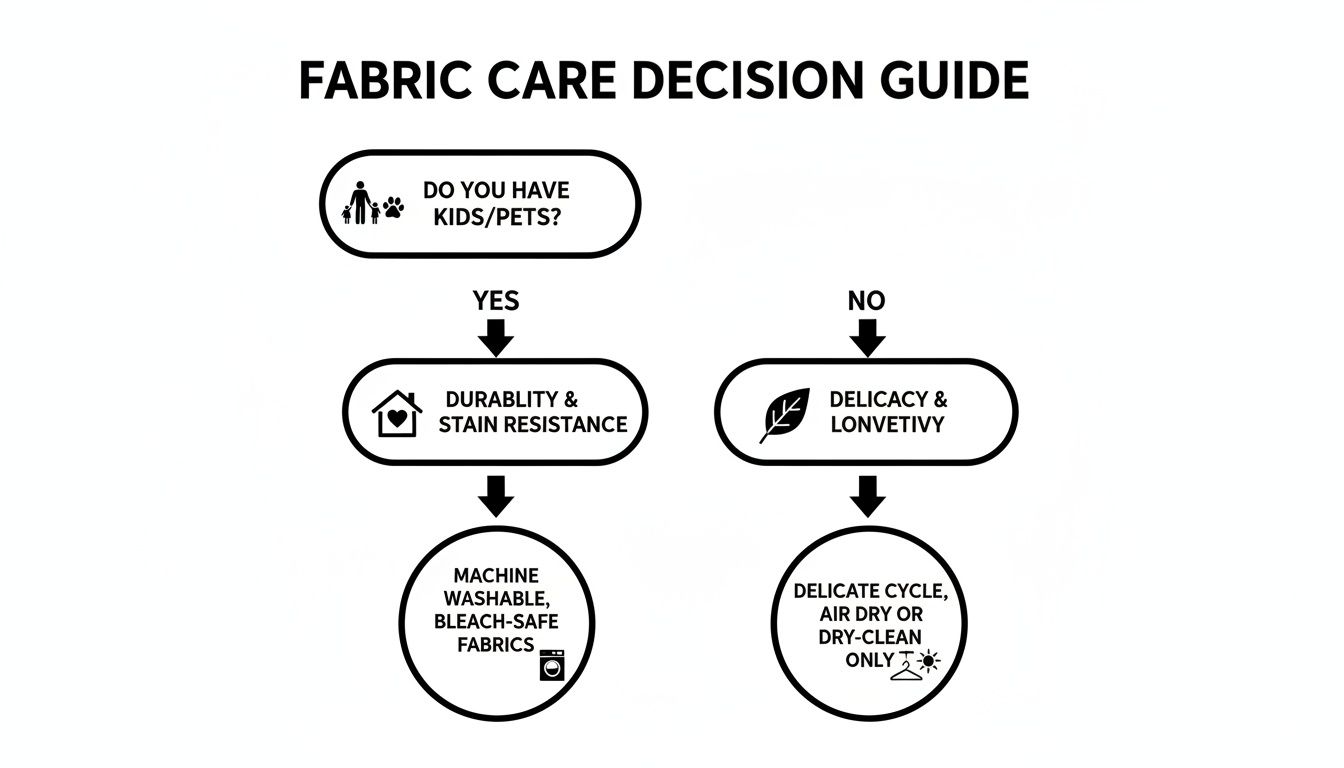
As you can see, the moment kids or pets enter the equation, the path logically leads toward more robust, easy-to-maintain fabrics.
Matching Fabric to Room Function
Once you've considered the occupants, think about the room's job. Every space in your home has a purpose, and your fabric choice should support it.
- High-Traffic Family Rooms: This is the command center of your home. You need a workhorse fabric with a high double rub count (think 15,000+) and top-notch cleanability. Here’s how you can choose the perfect sofa for your family’s needs with synthetic blends, performance fabrics, or a tough, durable leather. A piece like the Flexsteel Digby Power Reclining Sectional is a perfect example of a frame built for this kind of daily use, ready to be paired with these hardworking materials.
- Formal Living Rooms: For spaces that are more for show than for daily lounging, you can afford to be a bit more adventurous. This is your chance to use those beautiful but more delicate materials like a sumptuous velvet or a crisp linen blend.
- Sunny Spaces: Here in West Texas and New Mexico, the sun is no joke. If your furniture is going to be sitting in direct sunlight, you absolutely need a fade-resistant fabric. Solution-dyed synthetics like acrylic are a fantastic choice, as the color is part of the fiber itself, not just a surface treatment.
When you match your fabric to your real life, you're setting yourself up for a long and happy relationship with your furniture. You’re not just picking out a sofa; you’re investing in a piece that will be a comfortable and reliable part of your family’s story for years to come.
Expressing Your Style with Color and Pattern
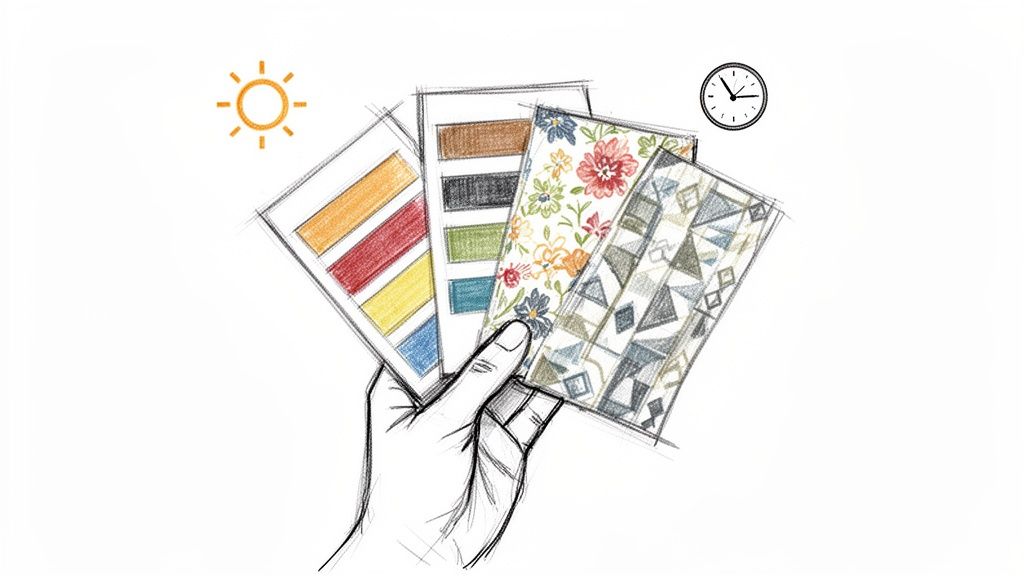
Alright, you've handled the practical stuff—now for the fun part. This is where you get to let your personality shine through and truly make a piece of furniture your own. The color, pattern, and texture you choose will do more than just cover a sofa; they'll set the entire mood for the room.
Think of your big furniture pieces as the foundation of your room's design. A large sectional in a calming, neutral tone can anchor the space, giving you a beautiful canvas to play with colorful pillows and throws. On the flip side, an accent chair in a wild, geometric print can instantly become the star of the show, injecting a dose of energy and a clear statement about your style.
Choosing Your Color Palette
Color is powerful. It can make a room feel cozy, airy, dramatic, or serene. Before you get your heart set on that perfect shade of emerald green, take a good look at the colors already living in your space—your walls, your rug, your artwork.
- To create harmony, look for fabrics in a similar color family. This doesn’t mean everything has to match perfectly, but sticking to a cohesive palette creates a calm, pulled-together feel.
- For a bolder statement, go for contrast. A pop of a rich jewel tone, like sapphire blue or ruby red, in a mostly neutral room can be breathtakingly chic.
And don't forget about texture! Even a simple beige can feel incredibly luxe and interesting in a chunky weave or a plush velvet.
The Power of Pattern
Patterns are fantastic for adding a layer of visual interest, but they're also incredibly clever. A subtle, multi-tonal pattern is a secret weapon for busy households—it's brilliant at camouflaging minor spills, a bit of pet hair, and the general evidence of a well-lived life.
When you're thinking about patterns, scale is everything. A huge, dramatic print might overwhelm a three-piece sectional but would look absolutely incredible on a single ottoman or a pair of dining chairs. Smaller, more intricate patterns are great, too; from a distance, they often read as a solid color with a bit of texture, so they add depth without dominating.
The Swatch Test: Your Most Important Tool
You wouldn’t paint an entire room without trying a sample on the wall first, right? The same logic is essential when you're learning how to choose upholstery fabric. Fabric swatches are your best friend in this process, bridging the gap between the showroom and your actual home.
A fabric swatch is your chance to see how a material really looks and feels in your own space, with your own lighting, before you commit. It’s the single best way to choose with confidence.
Once you have a few swatches you love, don't just give them a quick glance. You need to live with them for a few days.
- Check the Lighting: Tape the swatches right onto the piece of furniture you’re reupholstering. Pay attention to how they look in the bright morning light, in the warm afternoon sun, and at night under your lamps. You’d be amazed how much a color can change.
- Feel the Texture: Run your hand over it. Is it soft and cozy? Sleek and cool? This is your opportunity to make sure the physical feel of the fabric is exactly what you're hoping for.
This simple step takes all the guesswork out of the decision. It ensures that the fabric you bring home is one you'll be happy with for years to come. When you're ready, our design team can help you order the perfect swatches to test out, making it easy to bring your vision to life.
Need a Hand? Let's Talk Design
Let’s be honest—sometimes, the sheer number of fabric choices is the biggest hurdle. You can do all the research in the world, but sifting through thousands of swatches can feel overwhelming. This is where having a trusted guide can make all the difference, turning a potentially stressful decision into a genuinely fun, creative process.
Think of our in-store design team as your personal co-pilot. With over 70 years of hands-on experience, we provide the expertise you need to navigate the endless possibilities with confidence. We'll sort through our extensive custom-order books with you, making sure the final piece is a perfect match for your home, your lifestyle, and your budget.
Bringing Your Ideas to Life
Whether you're dreaming up a custom sectional for family movie nights or searching for the right durable material for a well-loved recliner, a design consultation is the tool you need to nail the details. We can walk you through premium options you might not have considered, from powerhouse performance fabrics to buttery-soft leathers.
A design expert doesn’t just show you fabrics; they help translate your family's needs and personal style into a beautiful, functional piece of furniture that you'll love for years.
This focus on quality is something we see across the industry. In fact, the high-end upholstery market is projected to hit $1.157 billion by 2031. It's no surprise that leather is leading the charge, prized for its classic look and incredible durability. If you're curious, you can read the full research about high-end upholstery trends to see how investing in better materials really does pay off in the long run.
Ultimately, our goal is simple: to help you make your vision a reality. Let us be the resource you need to pull it all together.
Ready to get started? Schedule a design consultation with our team in Lubbock, Hobbs, or Ruidoso today. Let’s create something amazing together.
Answering Your Top Upholstery Questions
After years of helping people choose fabrics, we've noticed the same questions tend to pop up. Let's tackle them head-on so you can feel completely confident in your final decision.
What's the Best Upholstery Fabric for Pets?
If you've got furry family members, durability and cleanability are non-negotiable. You can give your home the best defense by choosing performance fabrics. These have stain resistance built right into the fibers, making life so much easier.
Tightly woven synthetics like microfiber are another great option. They can stand up to occasional claws and are a breeze to clean. And don't forget leather! It's a fantastic choice because it just wipes clean and doesn't trap pet hair or dander like a woven fabric would.
How Many Double Rubs Should My Sofa Fabric Have?
This is a great question, and the answer really depends on how you live. For a sofa in the main family room—the one that sees daily use for TV nights, homework, and naps—you'll want a fabric rated for at least 15,000 to 30,000 double rubs. That's the sweet spot for heavy-duty residential use.
Now, if that sofa is the absolute command center of your home, where everyone piles on constantly, stepping up to a fabric over 30,000 will give you extra peace of mind and incredible longevity.
Choosing a fabric based on your real life—including kids, pets, and sunny windows—is the key to loving your furniture for years, not just for a season.
You now have all the tools you need to pick the perfect upholstery. You're ready to find that ideal balance of style, durability, and a perfect fit for your family's lifestyle.
Feeling ready to put your newfound knowledge to the test? The design experts at Miller Waldrop Furniture & Decor are here to help you turn your ideas into a space you'll absolutely love. Explore our collection of living room furniture today!