

How to Shop for a Mattress as a Couple When You Have Different Sleep Needs

Shopping for a mattress as a couple is one of those purchases that sounds simple until you actually start doing it. One person sleeps hot, the other is always cold. One needs a firm surface for their back, the other sinks into softness like it is the only way they can fall asleep. When two people share a bed every night, those differences matter more than most couples realize before they walk into a store. The good news is that the right mattress for two people with different needs absolutely exists. Getting there just takes a little more preparation than picking whatever feels good in the first five minutes.
Why Couple Sleep Incompatibility Is More Common Than You Think
Most couples assume their sleep preferences are close enough that any decent mattress will work for both of them. That assumption is where a lot of buyer’s remorse starts.
Sleep position alone creates wildly different pressure needs. A side sleeper needs cushioning at the shoulder and hip to keep the spine aligned. A back sleeper needs a flatter, more supportive feel so the lower back does not sag. When those two people share the same mattress, a surface that works for one often creates problems for the other.
Add in body weight differences and the gap gets wider. Heavier sleepers compress mattress layers more deeply, which means they feel a firmer resistance from the same mattress that a lighter person might find too soft. A couple where one partner weighs significantly more than the other is essentially sleeping on two different mattresses even when they share one.
Temperature is another layer entirely. Some people run warm at night due to metabolism, medication, or hormones. Others get cold easily. A mattress that traps heat to keep one person comfortable can make the other miserable by 2 a.m.
None of these differences mean a couple is stuck with a bad night’s sleep. They just mean the shopping process needs to account for both people from the start.
What to Do Before You Ever Visit a Store
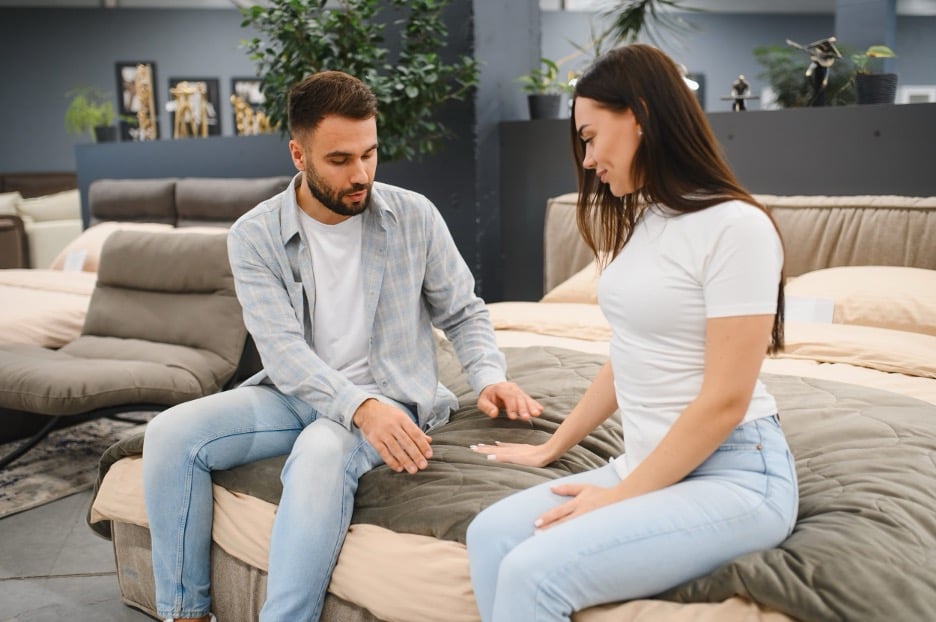
Walking into a mattress store without preparation as a couple is one of the most common mistakes we see. You end up lying on a few options, one of you loves something, one of you feels unsure, and you either leave without buying or go home with something that works for only one of you.
Before you go, both partners should separately write down answers to three questions. What position do you sleep in most of the night? Do you tend to sleep hot, cold, or neutral? Do you have any pain points, like lower back stiffness, hip pressure, or shoulder aches when you wake up?
Then compare your answers together. Look for where your needs align and where they conflict. The conflicts are what you need to bring to the store or call out when shopping online. A good mattress specialist will build a recommendation around those specific gaps, not just point you toward a bestseller.
Understanding Firmness as a Couple
Firmness is the most discussed mattress feature and also the most misunderstood. The industry uses a scale from 1 to 10, where 1 is extremely soft and 10 is extremely firm. Most mattresses sold to couples land somewhere in the 4 to 7 range.
Here is what most people are not told: firmness feels different depending on your body weight. A 130-pound person lying on a medium-firm mattress may feel like it is quite firm. A 230-pound person on the exact same mattress may feel like it is almost soft because their weight compresses the top layers more. This is why one partner can love a mattress during an in-store test while the other feels something completely different.
For couples with significant weight differences, a medium to medium-firm mattress in the 5 to 6.5 range tends to provide the best balance. It gives enough give for lighter sleepers to feel some pressure relief without letting heavier sleepers sink too far out of alignment.
For couples where both partners share similar sleep positions but just prefer different firmness levels, a split firmness option is worth considering. Several mattress brands now offer king or split-king configurations where each side of the mattress has a different firmness level built in. This is not a gimmick. It is a real solution that works well for couples whose needs are simply too different for any single firmness to satisfy both.
Motion Transfer: The Feature Couples Forget to Ask About
When one partner gets up at night or shifts position frequently, motion transfer is what determines whether the other person wakes up. This is one of the most important features for couples, and it rarely gets the attention it deserves during the shopping process.
Innerspring mattresses with interconnected coils have the highest motion transfer of any type. A movement on one side of the bed sends a wave across the whole surface. If one partner is a restless sleeper or gets up early, an innerspring mattress will likely disrupt the other partner’s sleep regularly.
Memory foam and latex mattresses absorb motion much more effectively. The material compresses locally around pressure, so a movement on one side stays largely contained to that area. Hybrid mattresses, which combine a coil base with foam or latex comfort layers, tend to fall somewhere in the middle depending on whether the coils are individually wrapped or interconnected.
The simplest way to test this in a store is to ask your partner to lie still on one side while you press down and release on the other side. What you feel is close to what you will experience every night.
How Mattress Type Affects Different Couples Differently
There is no single best mattress type for couples, but understanding how each one performs helps narrow the decision quickly.

Memory foam offers strong pressure relief and low motion transfer, which makes it good for couples where one or both partners are side sleepers dealing with hip or shoulder discomfort. Its biggest weakness is heat retention. Traditional memory foam traps warmth, so couples where one or both sleep hot should look for gel-infused or open-cell memory foam options specifically marketed for temperature regulation.
Latex mattresses are naturally cooler and more responsive than memory foam. They push back against the body rather than conforming to it, which works well for stomach sleepers and back sleepers who need more support. Latex also tends to last longer than foam, which matters when you are making a shared investment. The downside is weight. Latex mattresses are heavy and harder to rotate or adjust.
Hybrid mattresses are the most popular choice among couples right now, and for good reason. They combine the pressure relief of foam or latex comfort layers with the support and airflow of a coil base. The individually wrapped coil systems used in most modern hybrids also limit motion transfer better than traditional innersprings. For couples with mixed sleep positions and temperature preferences, a well-constructed hybrid often covers the most ground.
Adjustable air mattresses, which should not be confused with air mattresses for camping, allow each side to be inflated to a different firmness setting using a remote or an app. These are an expensive option but genuinely solve the firmness disagreement problem for couples who cannot find a single surface that works for both of them.
Temperature Regulation for Two People Who Sleep Differently
Sleeping hot is one of the top reasons couples are unhappy with their mattress within the first year. What felt fine during a store test can feel like sleeping under a heat lamp once two bodies are sharing the surface for eight hours.
A few things drive heat retention in a mattress. Dense foam layers trap air and body heat. Thick pillow tops with synthetic fill do the same. Mattresses without any cooling technology built in will always run warmer than those with gel infusions, copper-infused foam, or phase-change material covers.
For couples where one person sleeps hot and the other sleeps cold, a mattress with breathable materials throughout is a better starting point than one with a dedicated cooling layer on top. The cooling layer will help the hot sleeper but may make the cold sleeper uncomfortable. A breathable construction with good airflow across the whole surface keeps the bed from getting too warm for one without making it feel cold for the other.
Bedding matters here too. A mattress with moderate temperature regulation paired with separate blankets for each partner is often a more practical and affordable solution than chasing the most high-tech cooling mattress on the market.
Edge Support and Sleeping Space
Couples who share a queen mattress often underestimate how much sleeping space they actually have. A standard queen is 60 inches wide, which gives each person 30 inches. That is less than most people have sleeping solo.
Edge support determines how usable the full surface of the mattress is. A mattress with weak edge support compresses significantly along the sides, which forces both partners toward the center over time. This shrinks the effective sleeping area and leads to more contact and more disturbed sleep.
Mattresses with reinforced perimeter coils or high-density foam edges hold their shape when weight is applied near the side. For couples sharing a smaller mattress, strong edge support effectively adds inches of usable space back to both sides.
If budget allows, moving from a queen to a king is one of the most overlooked improvements couples can make. The additional 16 inches of total width gives each person 8 more inches of personal space, which reduces contact during the night without requiring separate beds.
Frequently Asked Questions
Can two people really share one mattress if their sleep needs are very different?
Yes, but it requires choosing the mattress more carefully than most couples do. Medium to medium-firm hybrids tend to balance the most common combination of needs. For couples with very different firmness preferences, a split firmness or adjustable mattress removes the compromise entirely.
How long should we spend testing a mattress before deciding?
Most sleep specialists recommend at least 10 to 15 minutes lying in your actual sleep position, not sitting on the edge. Both partners should test the mattress together, not one at a time, since the feel changes with two people on the surface.
Is a king mattress worth the extra cost for couples?
For most couples, yes. The added sleeping space reduces nighttime disturbances, gives each person room to move without affecting the other, and tends to improve overall sleep quality. The investment pays off quickly in better rest.
What if we buy a mattress and one of us still hates it?
Most quality mattress retailers offer a sleep trial period, typically between 30 and 120 nights. If the mattress is not working for one or both partners within that window, it can usually be exchanged or returned. Always ask about the trial and return policy before purchasing.
Does body weight really change how a mattress feels that much?
Yes, significantly. A mattress that feels medium-firm to a lighter person can feel soft or even unsupportive to a heavier person on the same surface. This is why couples with a large weight difference should look specifically for mattresses rated for their combined weight range and tested in stores with both partners lying down at the same time.
The Bottom Line
Finding the right mattress as a couple takes more thought than buying one for yourself, but it is not complicated once you know what to look for. Start by understanding where your sleep needs differ, prioritize motion transfer and temperature management alongside firmness, and test everything together rather than separately. The mattress that works for both of you is out there. Getting there just means walking in with a plan instead of walking out with a guess.