

Find Your Perfect Bathroom Over the Toilet Cabinet

The bathroom probably isn't short on items. It's short on places to put them. Extra paper goods crowd the vanity, skincare lines up around the sink, and cleaning supplies end up tucked into whatever corner is still open.
That's why a bathroom over the toilet cabinet stays popular. It uses a part of the room that often goes empty. But smart storage isn't just about filling a blank wall. The right cabinet solves clutter without making the room feel tighter, harder to clean, or awkward to use. In homes across West Texas and New Mexico, that balance matters because bathrooms vary widely, especially in guest baths, older homes, apartments, and secondary spaces where every inch has a job to do.
Table of Contents
- Is an Over the Toilet Cabinet Your Best Storage Solution
- Measure Twice to Ensure a Perfect Fit
- Choose a Material and Style That Complements Your Bathroom
- Install Your Cabinet Safely and Securely
- Organize and Style Your New Storage Hero
- Your Partner for a Stress-Free Bathroom Makeover
Is an Over the Toilet Cabinet Your Best Storage Solution
A cabinet above the toilet works well when the room lacks a linen closet, the vanity is undersized, and the wall over the tank is the cleanest unused storage zone. In that situation, vertical storage can make the room feel more finished and more intentional.
It isn't always the best answer.
Some bathrooms work better with floating shelves, a recessed medicine cabinet, vanity organizers, or a narrow storage piece elsewhere in the room. One of the biggest gaps in typical advice is that it rarely compares over-the-toilet storage with those alternatives based on accessibility and cleaning burden, even though the main question is often when this kind of cabinet improves the room and when it adds clutter or maintenance issues, as discussed in this design perspective on over-the-toilet storage ideas.
When this cabinet makes sense
An over-the-toilet cabinet is usually a strong choice if the bathroom needs hidden storage more than display space. Closed doors can calm visual noise fast. That matters in a compact bathroom where even a few exposed bottles can make the room feel busy.
It also helps when the household wants categories. Daily-use items can stay in the vanity, while backups, guest supplies, and less-used toiletries move above the toilet. For anyone also reviewing broader small bathroom remodeling tips, this is one of the clearest ways to reclaim space without changing the room's footprint.
Practical rule: Choose over-the-toilet storage when the main problem is missing enclosed storage, not when the main problem is poor layout.
When another option may work better
This cabinet may be the wrong move if users need everything at arm's reach, if the toilet sits in a tight alcove, or if the room already feels visually top-heavy. Open shelving can look airy, but it asks for disciplined styling. Recessed storage often feels cleaner, though it's a bigger project. Under-sink organizers improve function without adding anything to the walls.
Renters also need to think differently. A freestanding unit may be easier to live with than a more permanent installation, especially if wall changes are limited. Households planning a full update may want to think beyond one product and evaluate the room as a system, including vanity storage, towel placement, and circulation. A useful starting point is this look at furniture design for small spaces, which helps frame how scale and function should work together.
The better question to ask
Instead of asking, “Will a bathroom over the toilet cabinet fit here?” the better question is, “Will it make this room easier to use every day?”
That shift leads to better choices. If the cabinet clears clutter, stores the right things, and doesn't create cleaning headaches, it earns its place. If it blocks access, crowds the wall, or becomes a catchall, another storage solution will serve the room better.
Measure Twice to Ensure a Perfect Fit
Good results start with a tape measure, not a product photo. A bathroom over the toilet cabinet can look perfect online and still fail in the room if the tank lid can't lift, the flush handle feels cramped, or the cabinet projects too far into the space.
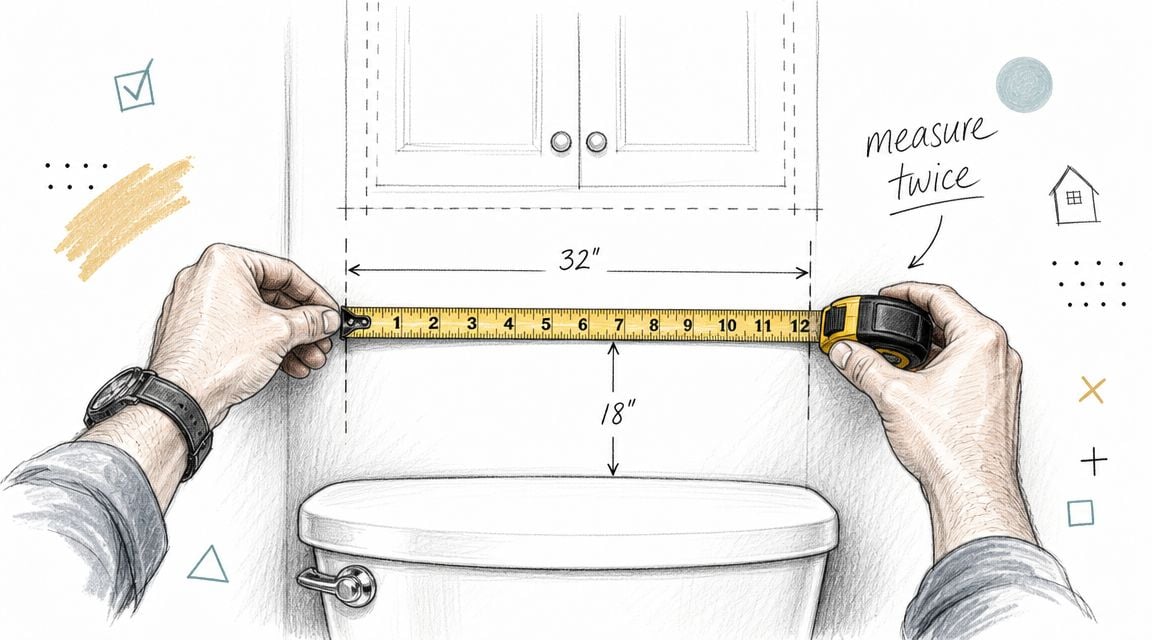
Retail dimensions show that common models land in a fairly tight range. Current listings commonly show cabinets around 23.7 to 26.7 inches wide, 9.1 to 10.1 inches deep, and 66.1 to 68 inches high, with examples including 26 in W x 10 in D x 61.8 in H, 32.09 in W x 7.68 in D x 67.44 in H, and 23.6 in W x 9.1 in D x 68.1 in H. They also show that many cabinets target a depth of roughly 8 to 10 inches, because deeper units can interfere with tank lids while shallower ones reduce usable storage, according to these over-the-toilet cabinet specifications.
The measurements that matter most
Start with the obvious dimensions, but don't stop there. The success of the installation depends on how the cabinet relates to the toilet, wall, and user movement.
Use this checklist before shopping:
- Measure the width of the open wall area. Don't assume the space is centered just because the toilet is.
- Measure from the floor to the top of the toilet tank. This tells you where the cabinet can begin.
- Measure the depth from the wall outward. That's how you'll know whether the cabinet body will crowd the tank or user space.
- Check side clearances. Flush handles, supply lines, and nearby trim can all affect fit.
- Note obstacles above. Light switches, towel bars, windows, and wall molding can change the plan.
What people miss
The most common measuring mistake isn't width. It's forgetting how the toilet needs to function after the cabinet is installed.
A cabinet may technically fit above the fixture and still create daily frustration. The tank lid should be removable. The flush mechanism should stay easy to use. Cleaning around the toilet shouldn't become a knuckle-scraping chore.
Leave enough breathing room around the toilet so the cabinet feels placed, not squeezed in.
A simple way to test the footprint
Painter's tape helps. Mark the cabinet width on the wall, then mark its projected depth visually from the side. This quick mock-up reveals whether the unit will overpower a small bath or feel balanced.
That dry run also helps renters and first-time buyers avoid a common trap. Product listings often say a unit fits most standard toilets, but room-by-room verification still matters because toilet sizes and wall conditions vary.
Bring a measurement sheet when shopping
A small note on a phone works, but a written measurement list is better. Include wall width, tank height, obstacle locations, and the cabinet dimensions being considered. That makes it easier to compare options without relying on memory.
A well-measured cabinet usually looks custom, even when it isn't. A poorly measured one always looks like an afterthought.
Choose a Material and Style That Complements Your Bathroom
Once the dimensions are right, the next decision is what the cabinet should be made of and how it should look in the room. Such choices often lead many bathrooms to either come together beautifully or feel pieced together.
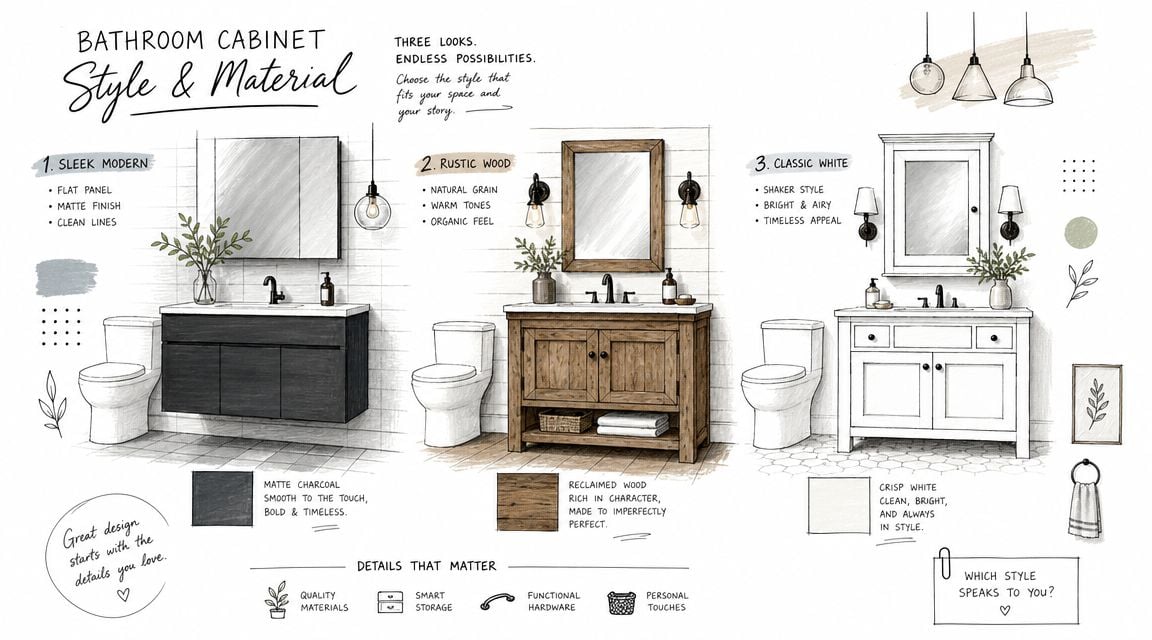
Today's market makes style matching easier because this category has become more standardized. Common over-the-toilet cabinets are typically about 23.7 to 26.7 inches wide, and that repeatable sizing helped turn the product into a furniture subtype that manufacturers could offer in many styles without requiring custom carpentry, as shown in these current retail dimensions and category details.
Material affects more than appearance
Bathrooms are humid, high-use spaces. Even in bathrooms with decent ventilation, surfaces deal with moisture, frequent wiping, and temperature swings. Material choice affects how the cabinet ages, how it cleans, and how polished it still looks later.
Here's a practical comparison.
| Material | Pros | Cons | Ideal For |
|---|---|---|---|
| Solid wood | Strong feel, long-term durability, rich finish potential | Often heavier, can react to moisture if poorly finished | Primary baths and buyers focused on longevity |
| MDF | Smooth painted finish, often budget-friendly, easy to style | Can suffer if water exposure is repeated or prolonged | Guest baths and decorative painted looks |
| Bamboo | Light visual feel, natural texture, suits relaxed spaces | Style is more specific and may not fit every bathroom | Spa-inspired or casual bathrooms |
For readers comparing painted surfaces and finish ideas across the home, these kitchen cabinet painting ideas offer useful inspiration for color direction and finish consistency, even though the application is different.
Match the cabinet to the bathroom's visual weight
The cabinet shouldn't just coordinate with the vanity. It should match the room's overall visual weight.
A modern bath usually benefits from flat planes, cleaner lines, and less ornament. A rustic or casual bath can handle more texture and warmth. A traditional bath often looks better with framed doors, softer detailing, and a furniture-like silhouette.
Design note: If the vanity is the room's anchor, the cabinet above the toilet should support it, not compete with it.
Keep the finish practical
White and light painted finishes stay popular for a reason. They reflect light well and help compact bathrooms feel cleaner. Wood tones can add warmth, especially in homes where the bathroom otherwise leans hard toward tile, stone, and metal.
The safest route is usually repeating one existing finish family rather than introducing a new one. If the room already has warm woods, a cool gray cabinet may feel disconnected. If the vanity is sleek and simple, a heavily distressed cabinet can look out of place.
For buyers weighing real wood against engineered options in other areas of the home, this guide to choosing the right hardwood for longevity and style is useful context for understanding how material decisions affect long-term performance.
Closed, open, or mixed storage
Door-front cabinets hide the mess. Open shelves display it. Mixed designs do a bit of both.
Closed storage works best for practical households that don't want every item curated. Open shelving works for towels, small containers, and a few decorative objects, but only if the household will maintain it. A mixed cabinet often gives the most flexibility because it hides backups and leaves one shelf available for a softer, finished look.
Install Your Cabinet Safely and Securely
A bathroom over the toilet cabinet should never feel wobbly. If it shifts when the doors open, leans forward, or depends too heavily on drywall alone, the installation needs attention.
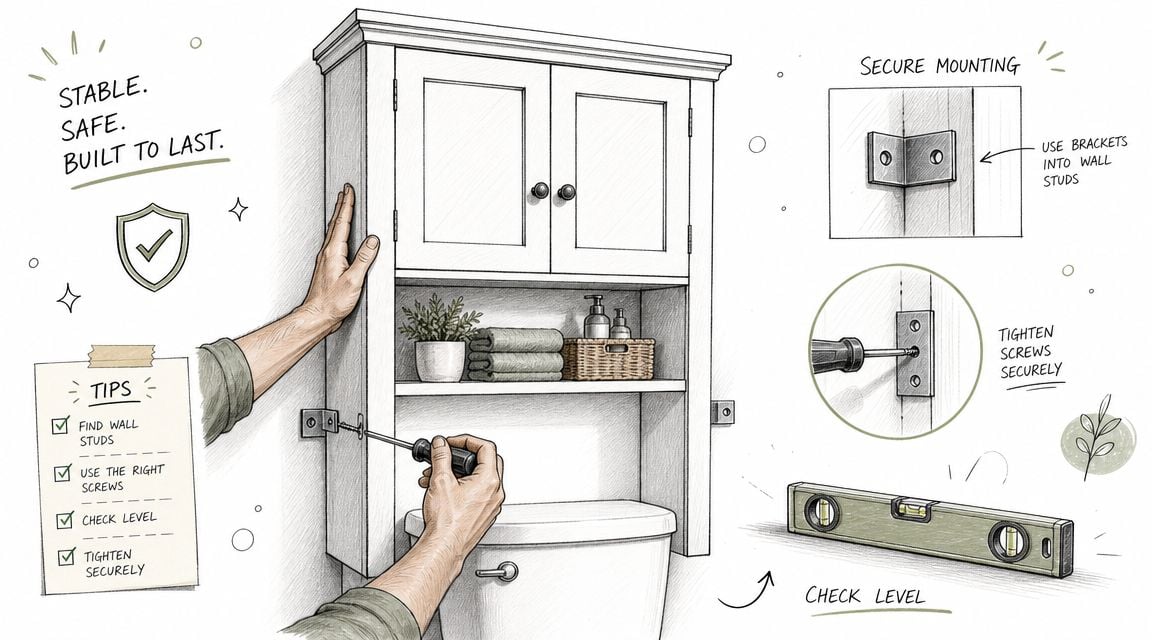
The key structural step is simple. For standard installation, pilot holes should be drilled 1 to 1.5 inches deep into wall studs, and the cabinet should not rely on drywall anchors alone for primary support. A practical guideline is also to leave at least 24 inches between the toilet tank lid and the bottom of the cabinet so the lid can be removed and head-strike risk is reduced, according to these installation recommendations for over-toilet cabinets.
Start with a dry fit
Before any drilling happens, place the cabinet where it's intended to go and confirm the fit. This is the moment to check centering, lid clearance, handle access, and door swing.
A helper makes this easier. One person holds the unit in place while the other confirms level lines and mounting points. This step prevents the most frustrating problems, especially in bathrooms where the toilet isn't perfectly centered on the wall.
A practical installation sequence
Many homeowners can handle this project if they move carefully and don't rush the setup.
- Locate studs first. The cabinet's primary support should transfer into framing, not just wallboard.
- Mark the height clearly. Use a level and painter's tape so the marks stay visible without covering the wall in pencil lines.
- Confirm toilet clearance. Recheck the relationship between the tank lid and cabinet bottom before drilling.
- Drill pilot holes with control. The target depth matters because it prepares the fastener path into the stud.
- Fasten, then test gently. Once mounted, open doors and place light items inside before fully loading the cabinet.
What goes wrong most often
Three mistakes show up again and again. The cabinet ends up off-center over the toilet. The bottom shelf sits too low for the tank lid to come off comfortably. Or the planned fastener points miss the studs, leading to weak support.
None of these issues are complicated, but all of them matter. The cabinet may look acceptable from a distance and still be annoying every day.
Mounting hardware should support the cabinet's real use, not just hold it in place for a photo.
When to pause the DIY plan
Older walls, uneven surfaces, tile complications, or uncertain framing can all turn a simple project into a repair project. In those cases, it's worth slowing down. A cabinet installed cleanly once is far better than patching holes and starting over.
Anyone comparing wall attachment methods in other furniture contexts may find this guide on attaching a headboard to a wall helpful because the same core principle applies. Secure attachment depends on proper wall assessment and reliable anchoring, not guesswork.
Organize and Style Your New Storage Hero
Installation is only half the win. The cabinet has to work well once everyday life moves in.
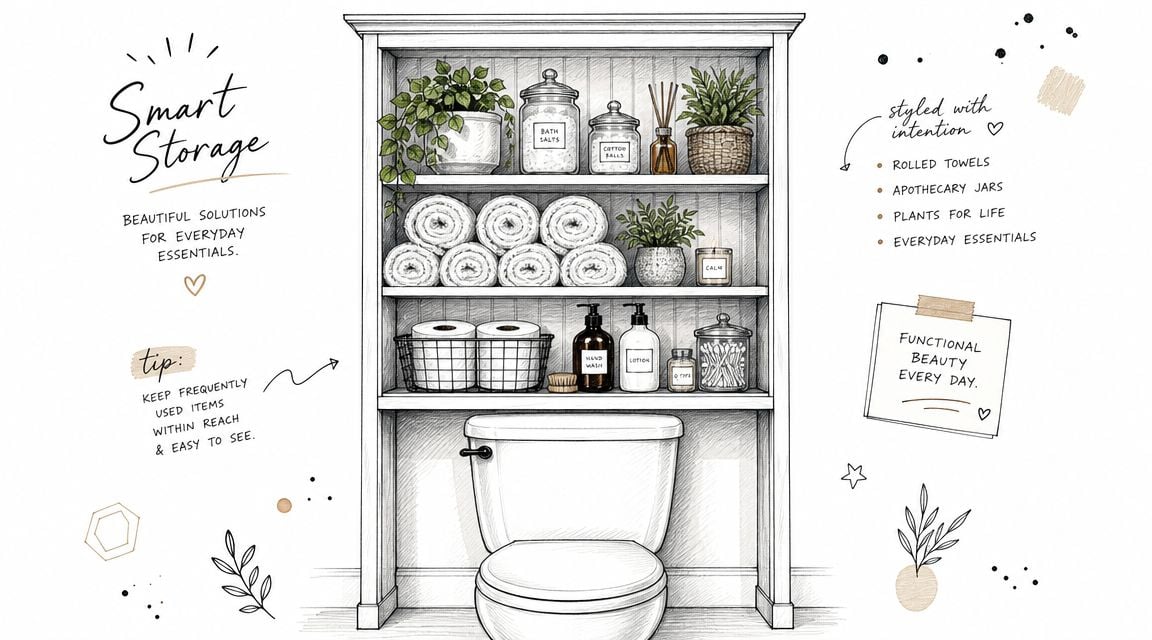
A well-organized bathroom over the toilet cabinet makes the room feel calmer because it removes decision fatigue. People know where the backup soap goes, where guest towels live, and where extra paper products belong. That kind of order matters more than decorative styling.
Three real-life ways to use it
In a primary bathroom, the cabinet often works best when it stores reserve items instead of the products used every hour. Extra toothpaste, refill toiletries, travel items, first-aid basics, and folded washcloths can all live there without crowding the vanity.
In a guest bathroom, the cabinet becomes a hospitality tool. One shelf can hold extra tissue and hand towels. Another can store guest basics such as sealed toiletries or a small basket of essentials. If the cabinet has an open shelf, that's a good place for neatly folded towels and one small decorative touch.
In a powder room, less is more. This room doesn't need deep storage categories. A few backups and a polished display shelf are usually enough. Overfilling a powder room cabinet makes a small space feel overworked.
Use containers before you use decor
The easiest way to keep the cabinet useful is to organize by category. Small baskets, trays, and lidded bins keep unlike items from spreading across shelves.
Try this approach:
- Top shelf items. Store lesser-used supplies, seasonal extras, or backup stock.
- Middle shelf access. Keep the items guests or household members reach for most often.
- Lower enclosed space. Hide less attractive necessities such as cleaning cloths or extra rolls.
- Open shelf styling. Limit display to towels, a compact plant, or one small object with texture.
For more ideas on grouping and storing bathroom essentials without creating visual clutter, this roundup on smart storage for bathrooms offers helpful inspiration.
How to keep it from looking crowded
A cabinet above a toilet already carries visual presence because it occupies wall space at eye level. That means styling should stay restrained.
Leave some breathing room on each shelf. Fold towels consistently. Decant only if the household will maintain it. Don't place too many tiny items on open shelves because they read as clutter faster than useful storage.
A styled shelf should still look easy to dust.
What belongs inside and what doesn't
Items that look untidy, duplicate often, or come in noisy packaging should go behind doors. Items with soft texture or attractive form can stay visible. This simple distinction keeps the cabinet from becoming both a junk drawer and a display case at the same time.
The best-looking bathroom storage usually follows one rule. Everyday function comes first, and style sits on top of that structure.
Your Partner for a Stress-Free Bathroom Makeover
A good bathroom over the toilet cabinet does more than fill blank wall space. It solves a specific storage problem. The cabinet has to fit the toilet and wall correctly, suit the room's materials, install safely, and hold the items that actually need a home.
That's why this choice tends to go better when shoppers treat it like a design decision, not a quick add-on. The right piece feels proportional, looks settled in the room, and supports daily routines instead of interrupting them.
In homes across Lubbock, Hobbs, and Ruidoso Downs, bathrooms often come with quirks that online shopping doesn't reveal well. Tank shapes vary. Wall locations aren't always ideal. The room may need a different storage solution entirely. That's where local guidance becomes useful. One practical option is to explore storage-focused furnishings such as an accent cabinet collection through Miller Waldrop Furniture & Decor, especially when a project needs help bridging the gap between inspiration and a finished room that works.
The strongest bathroom updates usually come from a clear sequence. Measure the room carefully. Choose a material and finish that fits the space. Install with safety in mind. Then organize the cabinet so it supports the way the bathroom is used.
That's a manageable process. It also leads to better results than choosing a cabinet based only on appearance.
If the bathroom still feels harder to plan than it should, Miller Waldrop Furniture & Decor can help turn ideas into a room that fits the home and the way it's used. Their team serves Lubbock, Hobbs, and Ruidoso Downs with personalized guidance, curated furnishings, and design support that can make a bathroom upgrade feel far more straightforward.