

Microfiber vs Leather Sofa: The Ultimate 2026 Buying Guide

If stain resistance, low-maintenance care, and a budget-friendly choice matter most for a busy household, microfiber usually wins. If long-term premium aesthetics, luxury resale value, and regular conditioning fit the household better, leather is the right choice.
The more useful question isn't which sofa material is universally better. It's whether the upholstery matches the home's climate, pets, children, cleaning habits, design taste, and budget. A family in a hot, active household has different needs from a couple furnishing a formal sitting room, and a sofa that succeeds in one room can create daily friction in another.
A microfiber vs leather sofa decision also changes depending on whether the shopper can test both materials in person. Showroom lighting can hide texture, heat retention, sheen, and seat comfort, while online descriptions rarely reveal how upholstery feels after a long evening. The right purchase begins with compatibility, not with a generic durability claim.
| Decision factor | Microfiber | Leather |
|---|---|---|
| Spill cleanup | Usually easier, with the correct care code | Usually simple to wipe from the surface |
| Everyday feel | Soft, suede-like, warm, matte | Smooth, structured, natural, and polished |
| Pet concerns | Tight surface can reduce snagging, but hair still collects | Hair wipes away easily, but claws can scratch or puncture |
| Maintenance pattern | Regular vacuuming and spot cleaning | Periodic cleaning and conditioning |
| Design position | Practical, contemporary, and accessible | Premium, established, and timeless |
| Best household match | Busy families prioritizing easy care | Owners prioritizing natural material and aging character |
The Microfiber vs Leather Sofa Debate Explained
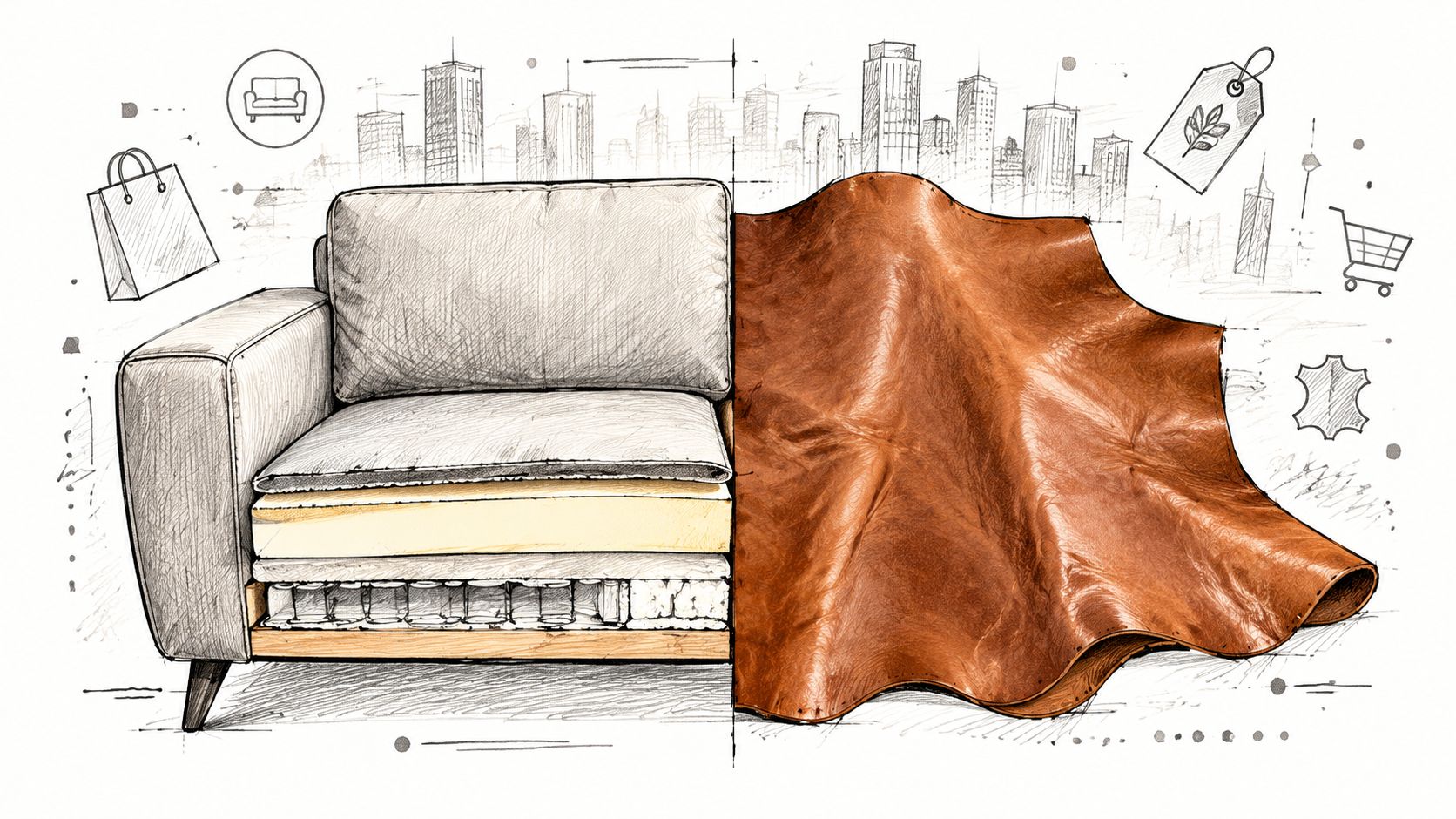
Microfiber and leather represent two different furniture philosophies. Microfiber is a modern performance-oriented upholstery material, while leather is a long-established premium covering with a natural surface and a recognizable aging process.
Microfiber became a mainstream upholstery material after micro-denier products were introduced in Japan in the 1970s. Europe adopted microfiber production in the 1980s, and American manufacturers followed in the 1990s, according to ScienceDirect's overview of microfiber. In sofa terms, microfiber uses extremely fine synthetic filaments, commonly polyester or polyamide, made thinner than one denier.
Leather had already dominated upholstery for decades before microfiber entered major furniture markets. That longer commercial history helps explain why buyers associate leather with established luxury, while microfiber is more often associated with affordability, stain resistance, and practical household performance.
Market position affects expectations
Leather remains a major upholstery category in retail measurements. One industry report recorded leather at 34% of upholstery retail sales and 29% of upholstery unit sales during one period, while another measured leather at 36% of upholstery pieces. A separate stationary-upholstery analysis reported a split of 76% fabric to 24% leather in units, and 68% fabric to 32% leather in dollars, showing that leather represents a larger share of spending than unit volume alone suggests. The same industry source reported leather upholstery sales of $11.74 billion in 2015, representing 38% of the upholstery category. These figures appear in Furniture Today's leather upholstery analysis.
Microfiber sits within the broader fabric category, while leather often serves as the dollar-weighted premium benchmark. That doesn't make leather automatically superior. It means shoppers are choosing between performance convenience and natural material character, not between good and bad furniture.
Practical rule: Choose the upholstery that makes everyday living easier, not the one that sounds most impressive in a showroom.
Visual Appeal and Tactile Comfort Comparison
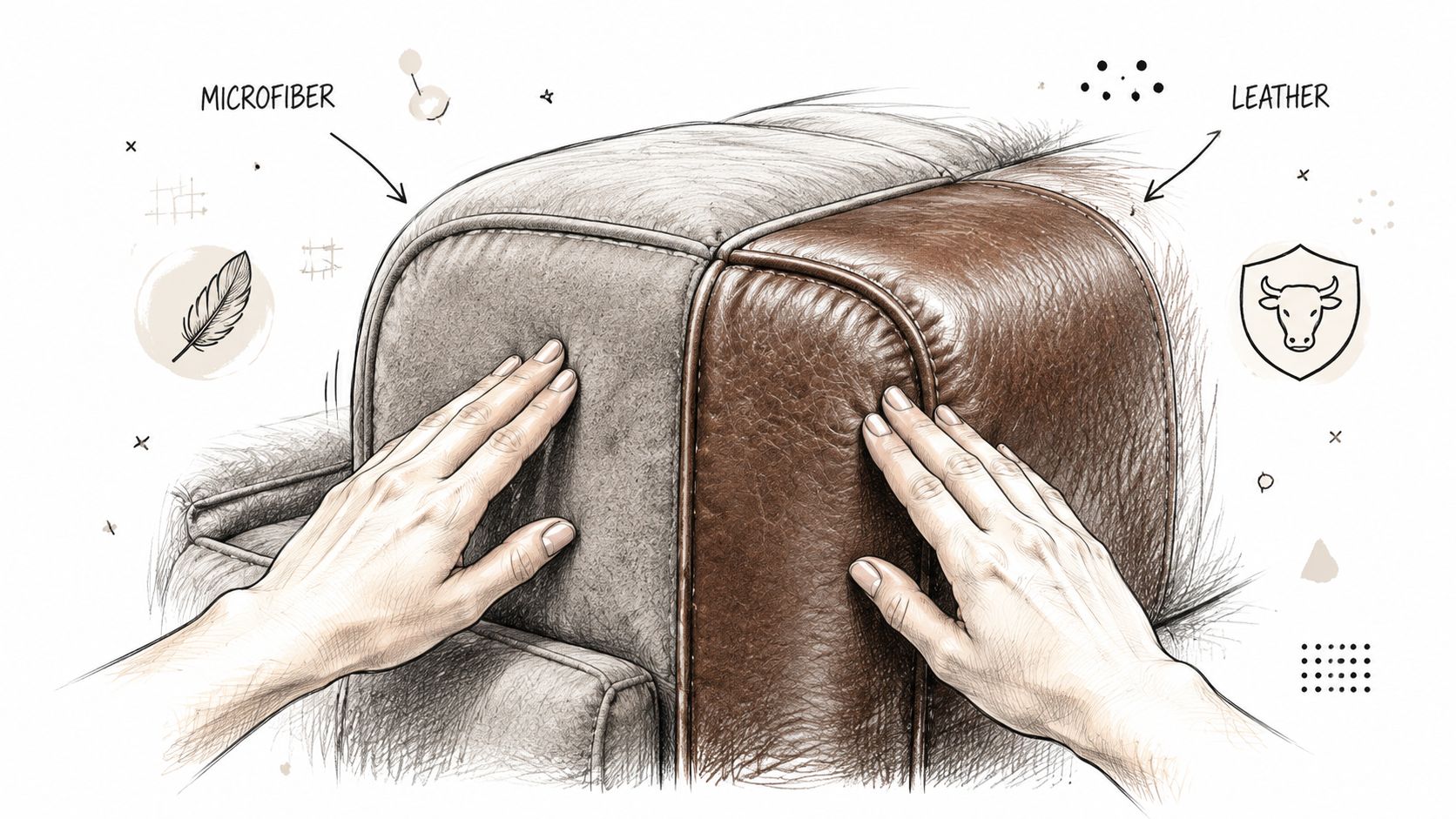
A sofa's appearance sets the room's mood, but its tactile experience determines whether people want to use it. Microfiber feels soft and suede-like, with a matte surface that tends to create a relaxed, inviting impression. Leather feels smoother and more structured, with a natural variation that gives the sofa visual authority.
Microfiber suits living rooms designed around comfort, layered textiles, and casual use. Its low-glare finish works well under strong daylight and in rooms with warm paint colors, patterned rugs, or relaxed wood furniture. The surface invites touch, and its visual softness can make a large sectional feel less imposing.
Leather makes a clearer statement. Its surface can look sleek and formal, particularly in darker colors or clean-lined silhouettes. Natural markings give quality leather a distinct identity, and the material can develop a patina as it ages. That evolving appearance appeals to owners who want the sofa to look more personal over time rather than remain visually uniform.
Match the upholstery to the room
The room's light and temperature matter. A glossy or highly finished leather can reflect more light than a matte microfiber cover, so leather may feel more visually prominent in a bright room. Microfiber can soften a space that already contains hard flooring, metal accents, or strong architectural lines.
Climate also affects comfort. In a hot regional climate, leather can feel warm or sticky against bare skin, especially in rooms without consistent cooling. Microfiber generally offers a softer, less surface-sensitive experience, which can matter in West Texas and Southeastern New Mexico homes during warm weather.
Sit, don't just look
A showroom test should include more than a quick perch on the edge. Each shopper should:
- Sit in the preferred position: Check whether the surface feels comfortable against bare arms and legs.
- Stay seated: Notice whether the upholstery feels warmer or cooler after several minutes.
- Check the finish in different light: A surface that looks subtle under showroom lighting may appear more reflective at home.
- Compare cushion support: Upholstery cannot compensate for a seat that lacks the desired firmness or depth.
The polished sofa isn't always the comfortable sofa, and the softest sofa isn't always the right visual anchor.
Leather is the stronger choice for a formal, refined room where the sofa should anchor the design. Microfiber is the better choice for a family room that needs warmth, softness, and a welcoming everyday feel.
Durability, Wear Resistance, and Longevity Analysis
How a sofa ages depends less on the material label than on the friction your household creates. Microfiber durability is often measured through fabric abrasion testing, while leather performance depends on hide quality, finish, construction, and how the surface changes with use. For a busy family room, inspect the exact cover and finish rather than accepting a sales tag at face value.
Microfiber upholstery is commonly specified at 30,000 to 50,000 Martindale cycles, placing it in the heavy-use category for residential sofas. Independent furniture guidance identifies 25,000 cycles as a practical minimum for daily use, with 30,000 to 40,000 or more preferred for pets or frequent use, as explained in this furniture fabric wear-test guide.
Leather does not perform like woven textile upholstery, so the figures are not a perfect one-to-one comparison. Public furniture-comparison guidance commonly places full-grain leather around 50,000 to 100,000 Martindale cycles, meaning microfiber can match or exceed many leather covers for abrasion resistance depending on grade and testing method. The rating for the specific sofa matters more than the material name alone.
What household wear looks like
A tightly woven microfiber cover handles repeated sitting, shifting, and routine household activity without the loose-thread problem found in more open weaves. Pet claws have fewer opportunities to snag, although microfiber can still collect hair, show pressure changes, or suffer damage from persistent scratching.
Leather ages through visible surface change. A quality hide may develop marks rather than conventional fabric abrasion. Some households value that patina, while others want the sofa to keep a uniform appearance. Sharp claws can puncture or score the surface, and body oils can alter the finish where people sit most often.
| Feature | Microfiber | Leather |
|---|---|---|
| Primary wear measure | 30,000 to 50,000 Martindale cycles for commonly specified upholstery, wear-test guidance | Often judged through hide quality and finish, with full-grain leather commonly positioned around 50,000 to 100,000 cycles in public comparisons |
| Abrasion behavior | Resists heavy friction when properly rated | Develops character, marks, or finish changes |
| Pet-claw risk | Lower snag risk with a tight weave, but not scratch-proof | Scratches and punctures are more visible |
| Oil and dirt response | Requires routine vacuuming and spot care | Can darken or change sheen with contact |
| Long-term decision | Check cover rating and test method | Check hide grade, finish, and care requirements |
For leather buyers, this guide to protecting leather furniture explains why choosing a durable hide and maintaining it correctly are separate decisions.
The durability verdict
Choose microfiber when measurable abrasion resistance and a more predictable wear pattern fit your household. Choose leather when you accept visible marks and want the surface to develop character over time. The right sofa is the one whose aging pattern matches your room, climate, cleaning habits, and tolerance for wear. Test the actual showroom sample, then ask for its cover rating, leather grade, finish, and care instructions before ordering.
Pet-Friendliness and Family Life Compatibility
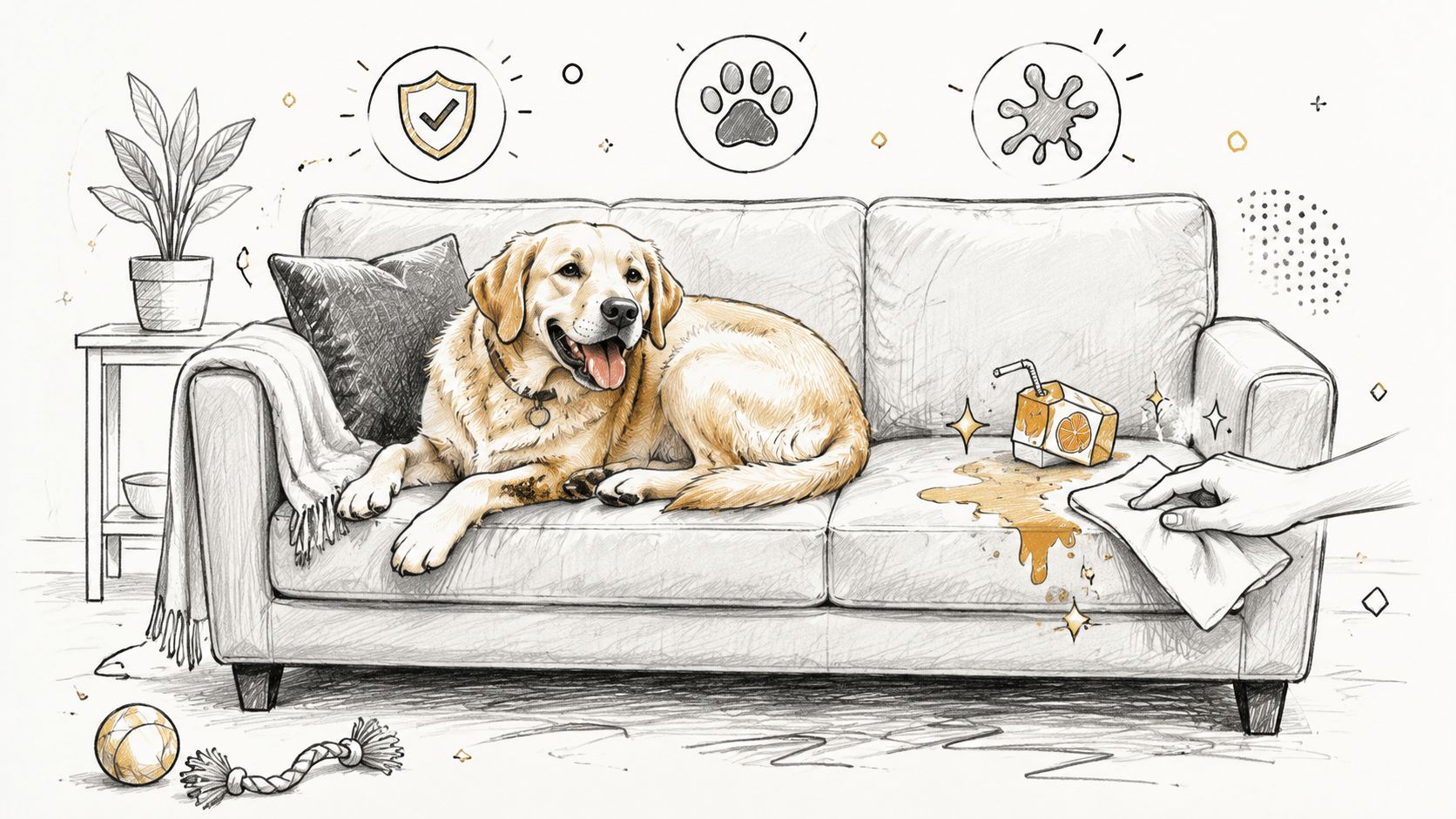
A pet-friendly sofa has to survive more than one type of mess. It must handle hair, claws, wet paws, food, and the repeated movement of people and animals sharing the same seating. Microfiber usually fits a busy family when spill control and a forgiving surface matter most, while leather suits owners who value quick wipe-down cleaning and can manage claw exposure.
Microfiber's tight synthetic structure can make it harder for claws to catch than they would on a loose weave. It isn't immune to scratching, and pet hair can still settle across the surface, but routine vacuuming keeps the problem manageable. The best choice still depends on the specific cover, not merely the word “microfiber” on a product tag.
Leather handles surface spills well because liquid generally remains on top long enough for prompt wiping. The vulnerability is mechanical. Sharp claws can scratch or puncture the hide, and repeated animal activity can make those marks prominent.
Use the upholstery care code
Microfiber requires the correct cleaning method. The care code should be checked before any liquid or cleaner touches the sofa:
- W means water-based cleaner only.
- S means solvent-based cleaner only.
- S-W means either water-based or solvent-based cleaner is allowed.
These codes and cleaning instructions are outlined in this microfiber sofa cleaning guide. Blot spills instead of rubbing them deeper into the cover, and test an approved product in a hidden area first.
Leather needs prompt wiping too, but the follow-up is different. A soft cloth can remove many surface spills, while the owner must avoid treating leather like washable fabric. Excess moisture, unsuitable cleaners, and neglected conditioning can create their own problems.
Build a pet routine
- Vacuum the sofa regularly: Remove hair and grit before they work into seams or abrade the surface.
- Trim claws: This reduces the chance of punctures, scratches, and snagging.
- Protect favored resting areas: Households needing a removable barrier can find stylish pet furniture covers.
- Keep cleaning supplies appropriate: Use the sofa's care code or leather-care instructions, never guesswork.
Households with dogs, cats, or young children can also review guidance on the best sofa fabric for pets. The recommendation is direct: choose microfiber for frequent spills and a cozy family room, leather for easy surface wiping and lower tolerance for embedded hair, provided the pets aren't aggressive scratchers.
Maintenance, Cleaning, and Care Requirements
Maintenance is where many sofa decisions succeed or fail. A material can look ideal in the showroom and still become a poor fit if the household won't follow its care routine. Microfiber asks for consistent light upkeep, while leather asks for less frequent but more deliberate conditioning.
Microfiber guidance recommends weekly vacuuming, monthly damp wiping or spot cleaning, and monthly cushion rotation to limit uneven wear, according to independent microfiber furniture-care guidance. The routine is manageable because it breaks care into small tasks rather than waiting for a major cleaning session.
The care code determines the cleaning product. A W-coded sofa accepts water-based cleaner only, an S-coded sofa accepts solvent-based cleaner only, and an S-W sofa accepts either. A household that ignores the code can create rings, discoloration, or texture changes even when the cleaner seems mild.
A practical microfiber routine
- Weekly: Vacuum cushions, seams, and exposed edges with an upholstery attachment.
- Monthly: Damp wipe or spot clean according to the code.
- Monthly: Rotate cushions when the design permits it.
- Immediately: Blot fresh spills and avoid aggressive rubbing.
A detailed guide to cleaning a microfiber couch can help owners match the method to the cover. The key is consistency. Small, correct actions protect the appearance better than occasional improvised deep cleaning.
Leather requires a different calendar
Leather typically needs cleaner and conditioner every 6 to 12 months to help maintain suppleness, according to leather care guidance. Conditioning is not decorative maintenance. It supports the material's flexibility and helps reduce the risk of drying and cracking when the sofa faces demanding household conditions.
Owners should also manage placement. Direct heat, intense sunlight, and dry indoor conditions can stress leather and alter its finish. Microfiber can also fade or change appearance under harsh light, so neither material should be treated as maintenance-free.
Consider the lifetime workload
Microfiber often has the lower day-to-day burden because spot cleaning and vacuuming fit naturally into household chores. Leather may require fewer cleaning sessions, but those sessions demand the correct products and a regular conditioning schedule. Before choosing, the household should decide which inconvenience feels easier:
- Frequent small tasks: Choose microfiber if weekly vacuuming and monthly spot care are realistic.
- Periodic material care: Choose leather if conditioning every 6 to 12 months feels acceptable.
- Professional help: Households uncertain about product selection can review how to vet leather cleaners before hiring a service.
The upfront price doesn't tell the whole ownership story. A less expensive sofa that needs early replacement may cost more emotionally and financially than a well-maintained premium sofa, but longevity depends on construction and care, not upholstery alone. Buyers should compare frame quality, cushion construction, cover performance, warranty terms, and the maintenance routine they can sustain.
Cost Analysis and Local Shopping Guidance
Microfiber is generally the more accessible choice for shoppers managing a strict furniture budget. Leather occupies a more premium position because the material, processing, and established market perception support a higher ticket. The sensible comparison isn't just the sticker price. It is the total value of comfort, care, appearance, and expected use.
A low upfront price can be attractive for a growing family, a rental property, or a first home where needs may change. Microfiber also makes sense when the household wants a softer, contemporary look without committing to the visual permanence of leather. The buyer should still inspect the frame, cushions, seams, and abrasion rating rather than assuming every microfiber sofa offers the same performance.
Leather can justify its higher cost for an owner who wants a long-term visual anchor and accepts regular conditioning. Its natural surface may become more distinctive with age, but scratches and finish changes remain part of the ownership experience. Anyone expecting a flawless surface forever should not choose leather because it carries a premium label.
Make the local showroom visit count
Residents of Lubbock, Texas, Hobbs, New Mexico, and Ruidoso Downs, New Mexico, can learn more from sitting on both materials than from relying on product photography. A showroom visit should test:
- Seat comfort: Spend enough time seated to identify pressure points and preferred firmness.
- Surface response: Compare warmth, softness, grip, and sheen.
- Scale: Confirm that the sofa suits the room, doorways, and traffic paths.
- Customization: Ask whether fabric, finish, configuration, and other order details can be adjusted.
- Service: Clarify delivery, care instructions, and support after purchase.
Local conditions matter. Warm weather can make leather feel less comfortable against bare skin, while strong daylight can affect either material's appearance. A family-owned showroom with regional knowledge can help translate those conditions into a practical selection rather than pushing a universal answer.
The direct recommendation
Choose microfiber if the home has frequent spills, active children, pets that don't aggressively scratch, or an owner who wants a soft surface and straightforward spot care. Choose leather if the home favors polished design, quick surface wiping, natural aging, and a scheduled conditioning routine.
For shoppers in West Texas and Southeastern New Mexico, Miller Waldrop Furniture & Decor can serve as a local resource for testing sofa materials, comparing configurations, and discussing furniture suited to the room and household. A careful in-person comparison gives the Hero of this purchase decision the information needed to choose confidently, instead of gambling on a material that looks right only in a photograph.
Miller Waldrop Furniture & Decor offers curated living room furniture, personalized design guidance, custom-order options, and service for shoppers in Lubbock, Hobbs, and Ruidoso Downs. Visit Miller Waldrop Furniture & Decor to sit on microfiber and leather options, compare the details, and choose the sofa that fits the household's real life.