

Hybrid Mattress Pros and Cons: The Complete Buyer’s Guide


The most popular advice about mattresses is also the least reliable: a hybrid isn't automatically the best of both worlds. It combines coil support with foam or latex comfort, but that combination creates a compromise, not a universal winner. The same bounce that helps a combination sleeper move can disturb a light-sleeping partner, and the same coil system that improves airflow doesn't prevent lower-quality foam from wearing out.
That's why the useful question isn't whether hybrid mattresses are good. It's whether a particular hybrid matches the sleeper's position, body weight, temperature preferences, partner needs, and willingness to manage a heavier, higher-cost bed. The hybrid mattress pros and cons become much clearer when the focus shifts from showroom feel to ownership after the first few years.
The Truth Behind Hybrid Mattress Marketing
“Best of both worlds” sounds attractive because hybrids really do combine two familiar experiences. Coils provide lift, responsiveness, and structure. Foam or latex adds contouring and pressure relief. In practice, the mattress lands somewhere between a traditional spring bed and a dense all-foam mattress, and that middle position is its main selling point.
It's also the source of the confusion. A hybrid can offer stronger edge support and better airflow than many all-foam beds, while still cushioning the shoulders, hips, and other pressure points. Yet those benefits depend on the construction. Coil design, perimeter reinforcement, comfort-layer material, and the quality of the foam all shape the final result. The word “hybrid” alone tells shoppers far less than many product tags suggest.
Independent review coverage supports a balanced interpretation. A pocketed-coil core can create a durable, springy, breathable surface with stable edges and limited motion transfer, but the finished mattress still varies by design and materials. A well-built model can suit couples, heavier sleepers, and hot sleepers, but it isn't guaranteed to be the right choice for every person.
Showroom rule: The mattress label is only the starting point. The comfort layers and coil system determine whether the bed actually solves the sleeper's problem.
Marketing language also shapes expectations before a shopper lies down. Readers who want more context on how positioning influences mattress buying can review these marketing insights for mattress brands, but the buying decision still comes down to construction and personal fit. A hybrid deserves serious consideration when a sleeper wants pressure relief without losing movement, support, or airflow. It shouldn't be purchased just because the category is popular.
How Hybrid Mattresses Are Built
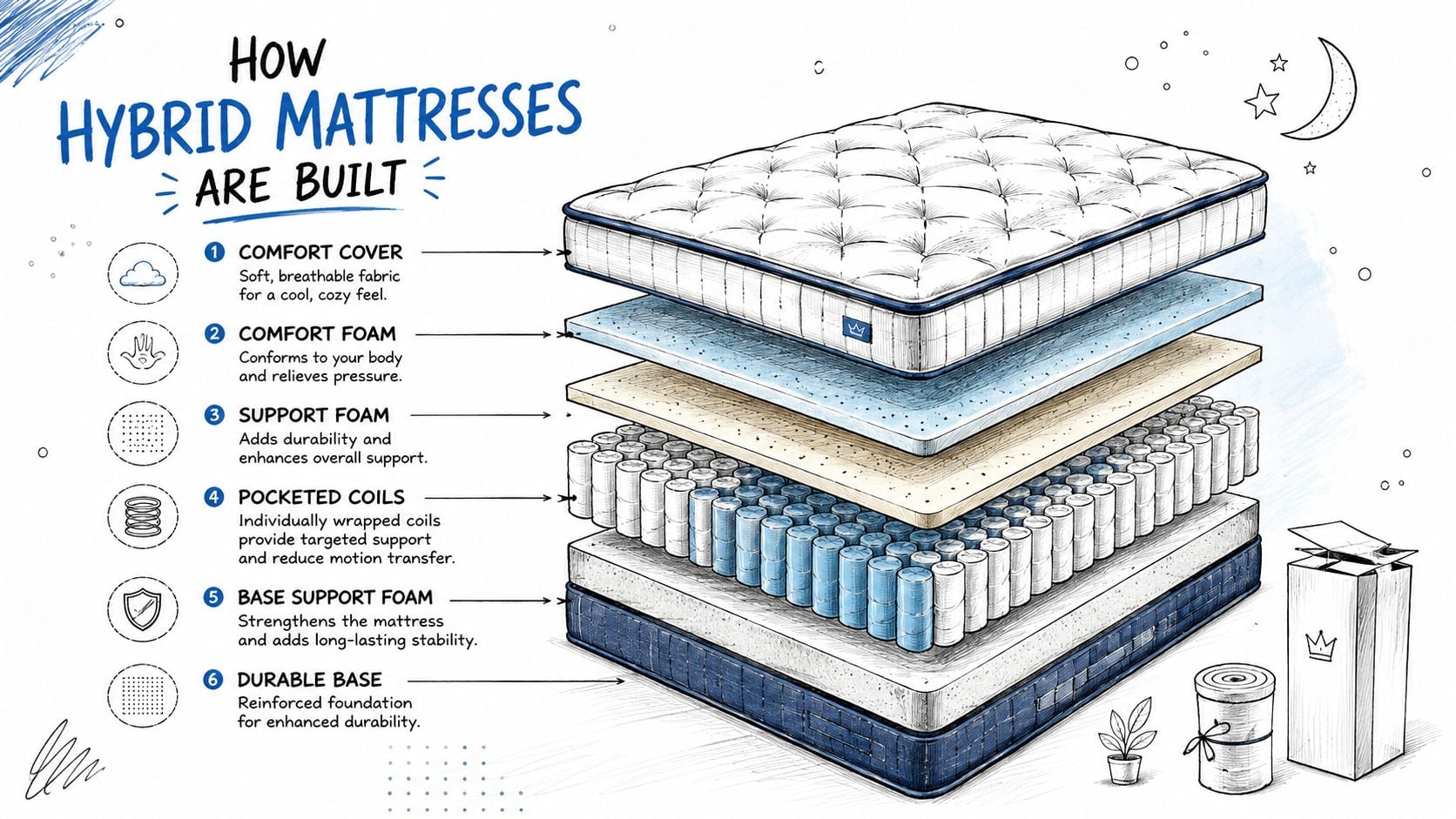
A hybrid mattress usually has a pocketed-coil support core beneath comfort layers made from foam, latex, or both. The defining structure is commonly a coil core topped with at least 2 inches of comfort material, according to hybrid mattress construction guidance. That top layer prevents the sleeper from feeling the springs directly and determines much of the surface comfort.
The coil core
Pocketed coils are individually wrapped rather than connected into one continuous spring unit. That independent compression matters because one part of the mattress can respond to a shoulder or hip without forcing a distant area upward. It gives the bed more targeted support and makes the surface more adaptable than a simpler connected-spring design.
The core also creates open space inside the mattress. Air can move through that space more easily than through a solid block of foam, which helps explain why hybrids often feel less heat-prone than dense all-foam beds. The coils contribute responsiveness too. When a sleeper rolls over or gets out of bed, the surface rebounds instead of holding the body in a slow, deep contour.
The comfort stack
Foam layers change the character of the mattress. Memory foam usually creates closer contouring and a slower response, which can relieve pressure but may feel restrictive to sleepers who dislike sinking. Latex generally feels more buoyant and quick to respond, while other foams can be tuned for cushioning, transition support, or surface softness.
The ratio between comfort material and coils is critical. A thicker, softer comfort stack can make a hybrid feel more like foam, with greater contouring and potentially weaker responsiveness. A thinner or firmer stack leaves more of the spring character intact, which may suit back, stomach, or combination sleepers but feel too firm at the shoulder for some side sleepers.
Shoppers comparing available constructions can review the hybrid queen mattress selection and focus on the specifications rather than the category label. The useful questions are straightforward: What material sits above the coils? How much comfort material is included? Does the perimeter feel reinforced? Does the mattress allow movement without creating excessive bounce?
The Real Advantages of Choosing a Hybrid
A hybrid earns its place when the sleeper needs several qualities at once. It doesn't usually dominate every performance category, but it can deliver a practical balance of pressure relief, responsiveness, cooling, and support.
The most consistent advantages come from the coil core. Open space around the coils supports airflow, while the spring structure helps the mattress resist compression near the perimeter. Foam or latex then supplies the contouring that a bare innerspring surface often lacks.
Where the design performs well
Edge support is one of the clearest reasons to consider a hybrid. Coil reinforcement can make the perimeter feel more stable when a sleeper sits down, gets up, or uses the full width of the bed. It also matters for couples because usable sleep space extends closer to the edge when the sides don't collapse easily.
Cooling is another genuine strength. Airflow through the coil unit can help dissipate heat more effectively than a dense all-foam structure. That doesn't make every hybrid a cooling mattress, because thick or heat-retaining foam can still influence the surface, but the coil base gives manufacturers a useful foundation for temperature management.
Responsiveness suits sleepers who change positions. The mattress can provide cushioning without creating the stuck sensation associated with some foam-heavy designs. That livelier response also helps couples who prefer a traditional spring feel but still want foam comfort at the shoulders and hips.
Testing commonly places hybrids around a medium to medium-firm feel, about 6.5 out of 10, although the result varies considerably with the foam-to-coil design.
| Performance Category | Hybrid Rating | Why It Matters |
|---|---|---|
| Pressure relief | Strong | Foam or latex cushions shoulders, hips, and other pressure points |
| Airflow | Better than many all-foam beds | Coil spacing creates room for heat dissipation |
| Edge support | Often stronger than softer foam beds | The perimeter feels more usable for sitting and sleeping |
| Responsiveness | Strong | Easier movement benefits combination sleepers |
| Motion isolation | Variable | Pocketed coils can limit movement, but springiness may still transfer it |
| Firmness | Typically medium to medium-firm | A balanced starting point, not a guarantee of proper alignment |
The practical recommendation is clear. A hybrid is a strong candidate for hot sleepers, combination sleepers, couples, and heavier sleepers who want support without abandoning cushioning. The construction can solve several problems simultaneously, but shoppers should inspect the actual materials before assuming the category delivers all of those benefits equally.
The Drawbacks Shoppers Rarely Hear About
The headline benefits are easy to feel in a showroom. The costs show up during delivery, partner sleep, moving, and long-term ownership. Hybrids are generally heavier and more expensive than many other mattress types, and they usually transmit more movement than full memory-foam beds. That combination makes them a poor automatic upgrade for shoppers who value low cost, easy handling, or maximum quietness.
Weight is the first practical problem. Steel coil systems add bulk, making a hybrid harder to carry, rotate, or reposition on a bed frame. Renters and frequent movers should treat that as a real ownership issue, not a minor inconvenience. A mattress that needs two people to move can complicate setup, rearrangement, and eventual replacement.
The long-term weakness
The coil unit may remain supportive while the foam layers lose their original feel. That distinction matters because the sleeper interacts with the comfort stack first. If the upper materials soften or develop impressions, a durable core won't restore the original pressure relief or alignment.
Consumer Reports describes a durability evaluation in which a 309-pound wood roller crossed each tested hybrid 30,000 times to simulate eight to 10 years of typical use. The highlighted hybrids resisted sagging and softening through that test period, which is encouraging, but it doesn't mean every hybrid will perform that way or remain ideal beyond the benchmark (Consumer Reports' hybrid mattress explanation provides the testing context).
Owner data adds an important counterweight. About 17% of hybrid owners report sagging or body impressions, making it the top complaint in the cited dataset, while hybrid durability receives only a fair overall assessment. That figure doesn't condemn the entire category, but it does challenge the assumption that coils automatically guarantee long service.
Partner movement and odor
Motion isolation varies widely. Some pocketed-coil models control movement well, while bouncier designs allow a partner's turn or rise to travel across the surface. Independent roundups describe motion isolation as ranging from excellent to merely fair, and edge support as frequently middling rather than consistently strong.
Off-gassing also deserves attention. At least 15% of owners report significant off-gassing in the cited owner data. New-foam odor may fade, but sensitive sleepers should ask about materials, ventilation, and return procedures before committing.
Hybrid vs Memory Foam vs Innerspring
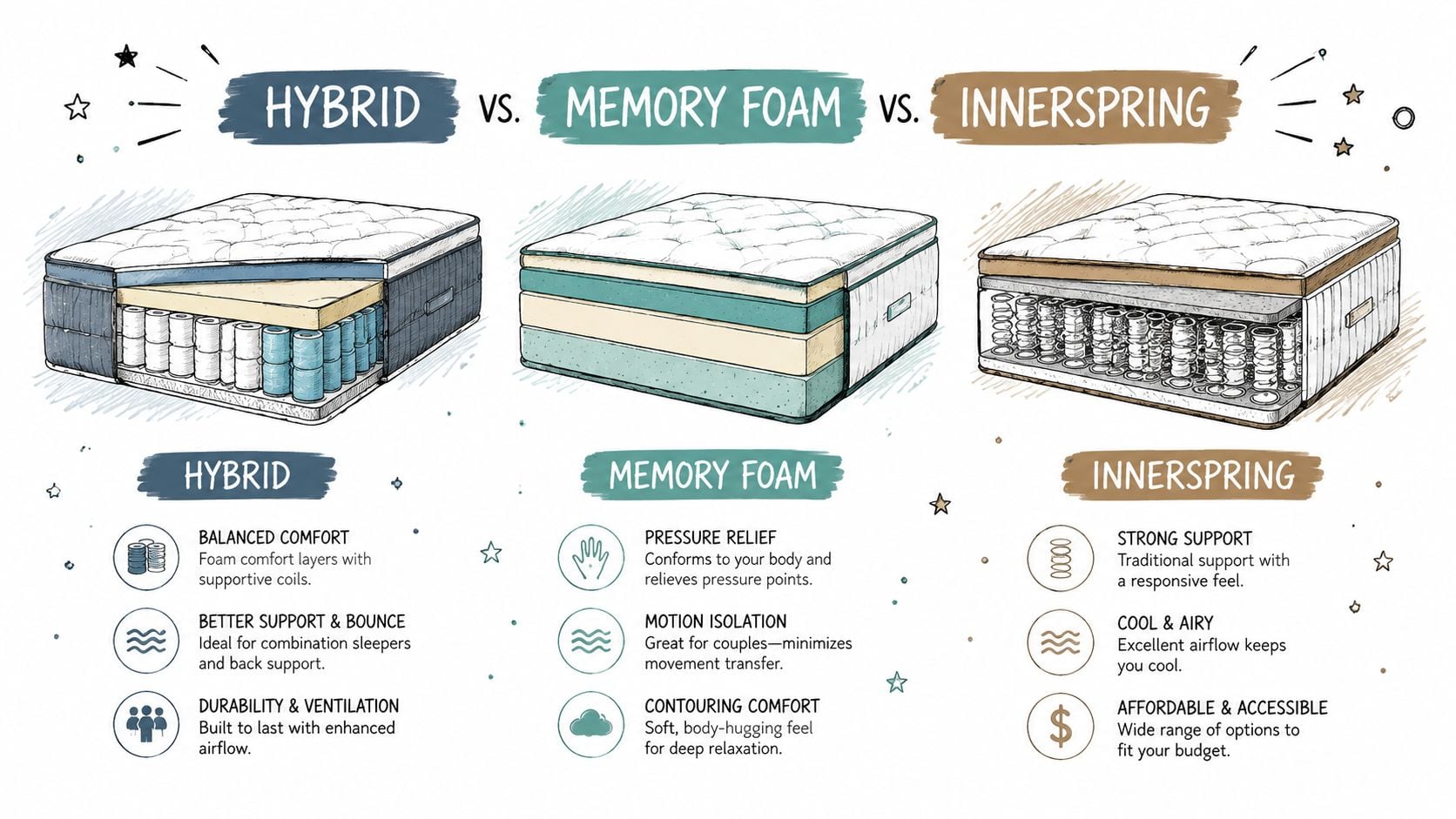
The right comparison starts with the sleep problem, not the mattress category. Memory foam, hybrid, and traditional innerspring designs each solve different complaints. Hybrids occupy the middle, which makes them versatile but also means they rarely win every individual test.
Memory foam generally provides the deepest contouring and strongest motion absorption. That makes it attractive for couples who wake easily when a partner moves, or for sleepers who prefer a close, enveloping feel. Its slower response can make position changes harder, and dense foam may feel warmer than a coil-based construction.
Traditional innerspring beds usually provide pronounced bounce, easy movement, and good airflow. Their weaker point is the comfort layer. Without enough cushioning above the springs, side sleepers may feel more pressure at the shoulders and hips, and connected spring systems can allow more movement to travel across the bed.
Which performance trait matters most
| Priority | Most suitable starting category | Reason |
|---|---|---|
| Deep contouring | Memory foam | Closely conforms to the body |
| Maximum motion isolation | Memory foam | Dense foam absorbs partner movement |
| Airflow and bounce | Innerspring or hybrid | Coil systems encourage movement and ventilation |
| Pressure relief with responsiveness | Hybrid | Foam cushions while coils provide lift |
| Stronger perimeter feel | Hybrid or supportive innerspring | Coil structures can stabilize the edges |
| Easy position changes | Innerspring or hybrid | Responsive surfaces rebound more quickly |
A hybrid is the sensible middle choice when a sleeper wants pressure relief but dislikes feeling trapped. It can also offer better airflow than dense foam and more cushioning than a basic spring mattress. However, “middle” shouldn't be mistaken for “superior.” A light sleeper with a restless partner may prefer foam's motion control, while someone who wants maximum bounce may prefer a traditional spring feel.
For shoppers comparing construction and bedding comfort together, this guide from SouthShore Fine Linens offers useful context on sheet considerations for foam-based surfaces. A broader side-by-side shopping process is available through the mattress comparison resource, where the decision can stay tied to personal priorities instead of a generic category ranking.
Which Sleeper Type Benefits Most from a Hybrid
A hybrid works best for sleepers who want cushioning with a quick, supportive response. Combination sleepers are natural candidates because they can roll from side to back without fighting a deep foam impression. The coil core supplies movement, while the comfort layers reduce the harshness of a bare spring surface.
Side sleepers need a more careful match. Shoulders and hips require enough cushioning to avoid concentrated pressure, so a softer feel or more substantial comfort stack may be appropriate. A very firm hybrid can leave a side sleeper feeling compressed at the shoulder, while an overly soft build may allow the midsection to sink too far.
Back sleepers usually need the pelvis and lower back to remain supported without creating a rigid surface. A medium to medium-firm hybrid is a practical starting point, but the correct feel depends on body shape and how the comfort layers compress. Stomach sleepers generally need firmer support to prevent excessive sinking through the midsection.
Body weight changes the equation
Heavier sleepers often benefit from a coil core because it provides a stronger structural base than a soft, all-foam construction. The benefit isn't automatic. The comfort layers still need enough quality and support to avoid premature impressions, and the perimeter should remain stable when the sleeper uses the edge.
Lighter sleepers may not compress a firm comfort stack enough to access its intended pressure relief. That's why a model that feels supportive to one person can feel uncomfortably rigid to another. Couples should test together whenever possible. Edge stability can expand the usable surface, but motion isolation varies, and a lively mattress may still disturb a partner who wakes easily.
Fit test: Each sleeper should lie in the position used at home, not just press a hand into the mattress. Shoulder pressure, hip compression, ease of turning, and edge stability matter more than the showroom label.
Hot sleepers should prioritize a coil core with breathable comfort materials rather than assuming every hybrid sleeps cool. The open structure helps, but surface foam remains part of the thermal experience. Side sleepers seeking a better match can also review the side-sleeper mattress guidance before testing specific models.
How to Choose the Right Hybrid Mattress for Your Home
A smart purchase starts with the sleeper's requirements. First, identify the main problem: pressure at the shoulder or hip, excessive heat, partner movement, weak edges, or difficulty changing positions. Then test models that address that problem without creating a new one.
Check the coil design, foam quality, comfort-layer thickness, and total mattress weight. Coil details help indicate how the support system responds. Foam quality matters because the upper layers can determine long-term comfort even when the coil unit remains sound. Weight predicts how difficult delivery, rotation, and future moving may be.
A practical showroom test
- Lie in the usual sleep position long enough to notice pressure, not just the initial softness.
- Roll between positions and check whether the surface releases the body easily.
- Have both partners move while the other remains still.
- Sit near the edge and assess compression and stability.
- Read the trial, return, and warranty terms before purchase.
For shoppers in West Texas and Southeastern New Mexico, Miller Waldrop's dedicated Sleep Experts use a high-tech bed matching system that identifies pressure points and supports personalized mattress recommendations. Flexible financing may also help shoppers consider a suitable premium construction within a defined budget, but the terms should be reviewed carefully.

A hybrid is worth choosing when its specific construction solves the sleeper's needs better than foam or springs alone. The right next step is to test suitable models in a showroom or explore a curated online selection with the sleeper's position, body type, cooling needs, partner sensitivity, and moving requirements in mind.
Miller Waldrop Furniture & Decor offers hybrid mattresses, adjustable sleep solutions, and guidance from dedicated Sleep Experts for shoppers in Lubbock, Hobbs, and Ruidoso Downs. Visit Miller Waldrop Furniture & Decor to compare suitable mattress constructions online or plan a showroom visit for a more confident fit.