

Your Manual Reclining Leather Sofa Buyer’s Guide

You get home, drop your keys, and head straight for the one seat in the house that lets your shoulders relax. That moment is why people keep coming back to a manual reclining leather sofa. It isn’t just about putting your feet up. It’s about choosing a piece that feels good at the end of a long day, fits your room, and still works well years from now.
The hard part is that furniture shopping can blur together fast. A sofa can look substantial on a showroom floor and still disappoint once it’s in a West Texas or Southeastern New Mexico home where dry air, sun, dust, and daily use expose every shortcut in the build. Leather quality matters. Mechanism quality matters. The way the frame is built matters even more than most shoppers realize.
A good buying decision starts with knowing what to check before you fall for the look of the piece. If you’re comparing styles, sizes, and room fit, this guide on how to buy a sofa is a helpful place to start.
Your Guide to Lasting Comfort
A reclining sofa often earns its place the old-fashioned way. It becomes the spot where somebody reads every evening, where the family settles in for a movie, or where a tired back finally gets support after a long workday. That’s why this category deserves more than a quick glance at color and price tag.

What buyers usually notice first
The purchasing process often begins with obvious questions. Does it feel soft enough? Does the leather look rich? Will it fit the wall where the current sofa sits? Those are fair questions, but they don’t tell you whether the recline will still feel smooth after years of use or whether the leather will stay comfortable through hot summers and dry winters.
That’s where a little insider knowledge changes the whole shopping experience.
What matters after the first month
Once a sofa is in your home, daily ownership becomes the ultimate test. The best manual reclining leather sofa usually gets a few things right at the same time:
- Comfort that lasts: The seat shouldn’t feel great for one afternoon and tired after regular use.
- A mechanism you can trust: The action should feel steady, not jerky or loose.
- Leather that suits your climate: In this part of the country, breathability and care matter more than shoppers often expect.
- A frame with backbone: Reclining furniture asks more of its structure than a stationary sofa does.
A reclining sofa is part upholstery, part motion furniture, and part long-term investment. If one of those parts is weak, the whole experience suffers.
Old-school product knowledge still helps. When you understand how a sofa is built under the leather, you can judge quality with more confidence and avoid paying for features that won’t improve how the piece lives in your home.
The Enduring Appeal of Manual Reclining Sofas
A manual reclining leather sofa stays popular for one simple reason. It solves the comfort problem without adding much complexity. You sit down, use a lever or a push-back motion, and the seat reclines through a mechanical system instead of a motor.
That simplicity is not a compromise for many households. It’s the point.
Why the mechanism still appeals to experienced buyers
Manual recliners rely on body weight, mechanical advantage, and a mechanical linkage system. In day-to-day use, that gives you a tactile feel some people prefer over buttons. There’s no need to place the sofa near an outlet, and there’s no power cord affecting where the piece can go in the room.
That freedom matters in real homes. If you’re arranging around windows, traffic flow, side tables, or a fireplace, a manual recliner gives you more flexibility.
A lot of long-term owners also appreciate the straightforward nature of the design. Fewer powered parts usually means fewer things to troubleshoot when the sofa ages.
A design with real history
Manual recliners aren’t a trend item. They come out of a long line of comfort-focused furniture design. As noted in the history of recliners from Couchery’s overview of how reclining sofas evolved, in 1929, cousins Edward Knabush and Edwin Shoemaker patented the wooden bench recliner, which led to upholstered models with side levers and the founding of iconic brands like La-Z-Boy.
That matters because it explains why the category feels so established. The format has been refined over time, not invented last year for a marketing cycle.
Some furniture categories change because fashion changes. Recliners changed because people kept asking for better support, easier movement, and more comfort at home.
Where manual works best
Manual reclining sofas tend to fit especially well when your priorities look like this:
- You want dependable operation: A lever-based or push-back system is easy to understand and easy to test.
- Your room layout is tight or unconventional: No outlet planning makes placement easier.
- You prefer a classic look and feel: Manual recliners often carry a more traditional comfort story.
- You want comfort without added electronics: That can be a better fit for living rooms, dens, and family spaces where simplicity wins.
For many homes in Lubbock, Hobbs, and Ruidoso Downs, that combination makes practical sense. You get the familiar comfort of a recliner, the feel of leather, and a format that doesn’t ask much from the room.
Manual vs Power Recliners A Practical Comparison
Choosing between manual and power isn’t about which one is universally better. It’s about which trade-offs fit your household. If you want a deeper look at powered options, this guide on what a power recliner is is worth reading before you decide.
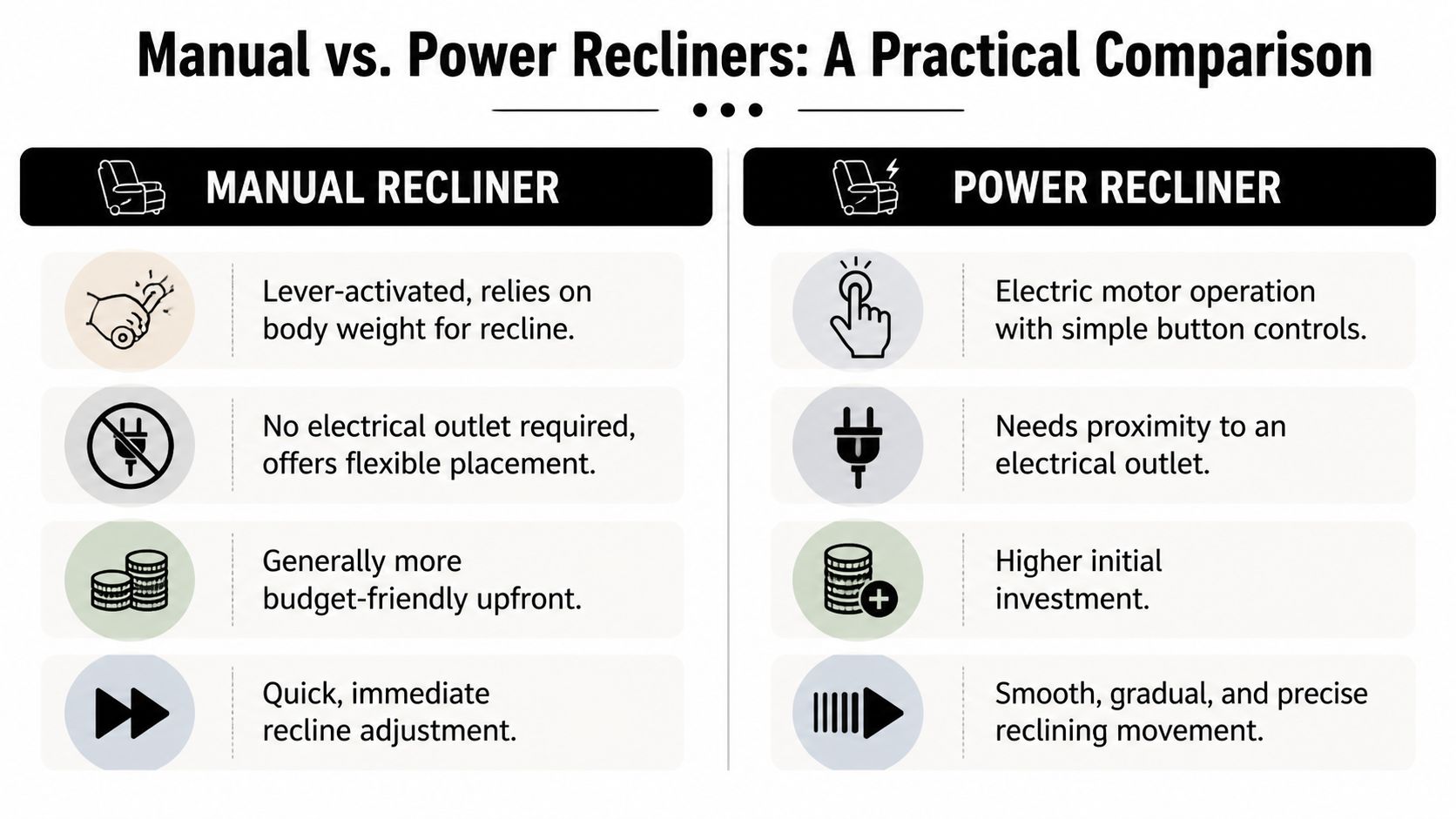
Manual vs. Power Recliner At-a-Glance
| Feature | Manual Recliner | Power Recliner |
|---|---|---|
| Operation | Lever or push-back motion | Button-controlled motorized movement |
| Room placement | Flexible, no outlet required | Needs access to power |
| Upfront cost | Often lower | Often higher |
| Feel of adjustment | Faster, more direct motion | Smoother, more gradual movement |
| Repair profile | Simpler mechanical system | More components to service |
| Best fit | Buyers who value simplicity and flexibility | Buyers who want ease and finer control |
Where manual has the edge
A manual reclining leather sofa does a few things especially well.
- Placement freedom: You can float it in a room or place it where it works best visually, not just where a plug happens to be.
- Straightforward use: Pull the lever, shift your weight, and recline.
- Less complexity: For many households, that means less concern about cords, switches, or motor-related service issues.
- A more immediate response: Some people like the quicker movement of a manual seat compared with the slower glide of a powered one.
This is often the right answer for buyers who want a durable family-room piece and don’t care about extra tech.
Where power can be worth it
Power recliners answer a different set of needs. They usually suit people who want lighter-effort operation, more precise stopping points, or added convenience. If someone in the home has trouble pushing a footrest down or prefers push-button control, power can be the smarter fit.
That doesn’t make manual outdated. It means the best choice depends on who uses the sofa and how often.
Practical rule: If your top priorities are reliability, room placement, and a simpler ownership experience, manual is often the safer pick. If your top priorities are low-effort operation and fine-tuned positioning, power deserves a serious look.
How to decide without overthinking it
Use your actual living room habits, not showroom excitement.
- Choose manual if you want comfort with fewer moving parts and don’t want to plan around outlets.
- Choose power if easy operation matters more than mechanical simplicity.
- Choose based on the primary user if one person will use the recline far more than everyone else.
- Choose based on the room if furniture placement is already constrained by windows, lamps, traffic paths, or wall layout.
The right answer usually appears once you stop asking which sofa is more advanced and start asking which sofa will be easier to live with every single day.
What to Look For Under the Leather
A manual leather recliner can feel great on the showroom floor and still disappoint after a year in a hot, dry West Texas or Southeastern New Mexico home. The reason is usually hidden under the upholstery. Dry air, big temperature swings, and heavy daily use put stress on the frame, suspension, and motion hardware long before the leather itself looks worn.
Start with the motion hardware
The recline mechanism gets plenty of attention, but the quality of the steel, pivots, and attachment points decides how the sofa will hold up. According to product specifications summarized in American Home Furniture’s Flexsteel Rio listing, a well-built manual recliner can include heavy-gauge steel linkage and 8-gauge sinuous springs. Those are useful details to ask about because they point to a chair built for repeated use, not occasional use.
Operate the recliner several times. Do it from a full upright position and again after sitting in it for a few minutes. Good hardware should feel controlled and consistent.
Watch for these signs in the showroom:
- Smooth travel: The footrest and back should move without jerking or scraping.
- Solid lock-up: Once open, the seat should feel secure, not loose or shaky.
- Low noise: A manual recliner will make some sound, but it should not clatter.
- Even pull: One side should not feel tighter or slower than the other.
In our part of the country, dust also matters. Fine dust works its way into moving parts over time, so a cleaner, tighter mechanism usually ages better than one with exposed, flimsy-looking hardware.
The frame carries the real load
A reclining sofa deals with shifting body weight every time someone leans back, sits forward, or drops the footrest. That repeated movement exposes weak joinery fast. A frame should feel planted and square, with reinforced corners and no side-to-side sway when you sit down hard or push off the arms to stand.
Weight can be misleading.
Some sofas feel heavy because they are overpadded, not because the frame is well built. What you want is stability. If the sofa racks, creaks, or twists during a simple sit test, keep looking.
Suspension and support
Seat comfort starts below the cushion. Springs and support wires do the daily work, especially in a recliner where pressure shifts from the back to the seat and then toward the footrest as you change position. If the suspension is weak, the seat loses its shape faster and the comfort drops with it.
The recline mechanism gets the headlines. The suspension does the daily labor.
That matters in dry climates because foam and upholstery can feel firmer as humidity drops. A good suspension system helps the seat stay supportive instead of turning hard and flat.
A quick showroom checklist
Use this before you buy:
- Sit all the way back: Lower back support should feel placed where your body needs it.
- Recline more than once: The motion should feel the same each time.
- Press on the arms: Arms that collapse too easily tend to break down faster.
- Look underneath: Hardware should look substantial and neatly installed.
- Ask how the frame is built: A clear answer is a good sign. A vague one usually is not.
Real product examples can still help with comparison. A model such as the Flexsteel Rio manual reclining sofa gives shoppers a useful benchmark for judging how motion seating, leather upholstery, and hidden construction come together in one piece.
Choosing the Right Leather for Your Home
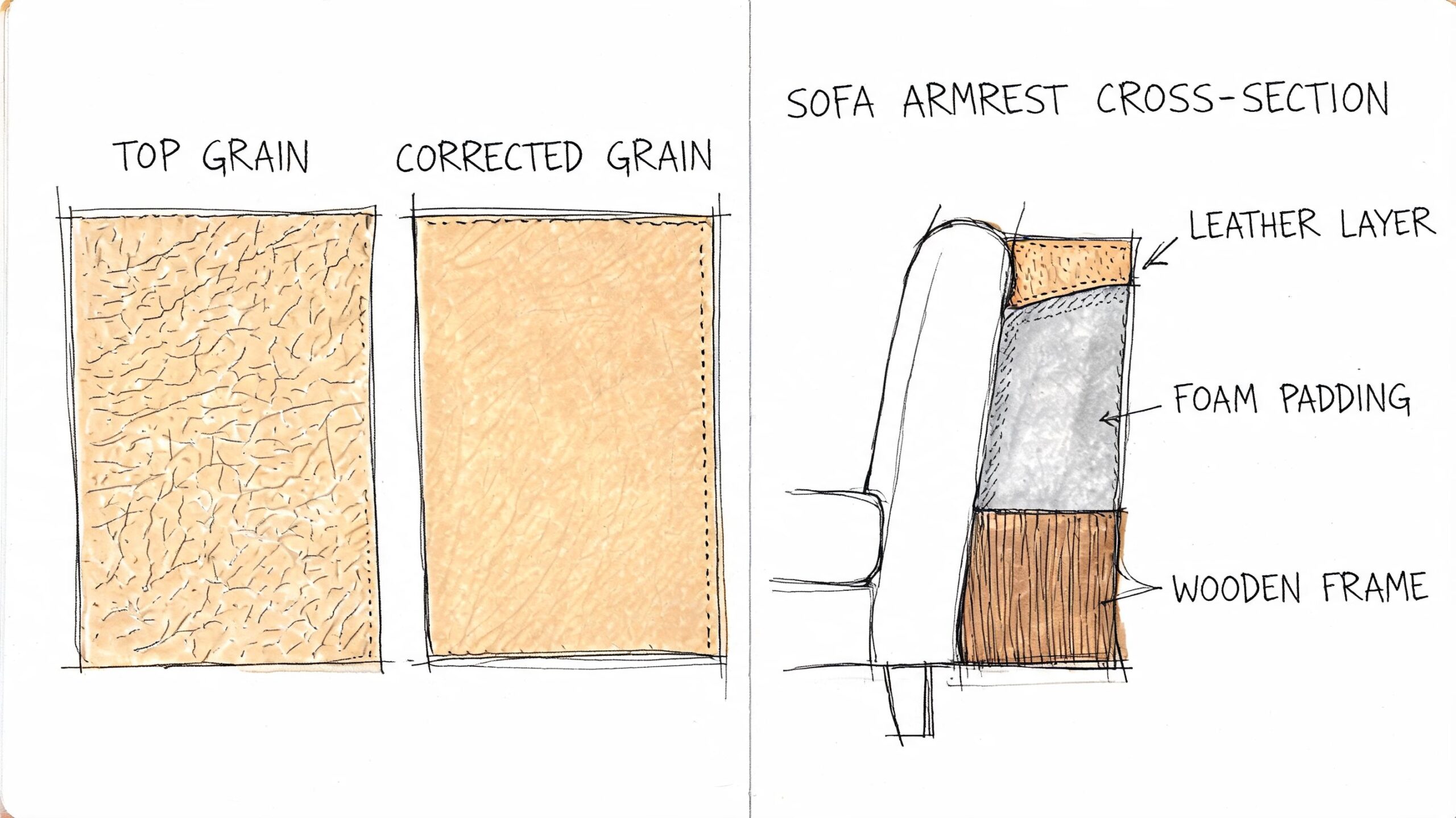
Leather can make a reclining sofa feel richer, cleaner-lined, and more lasting. But leather isn’t one thing. The type and finish affect comfort, appearance, and how forgiving the sofa will be in a busy household.
Why leather choice matters in this region
In West Texas and Southeastern New Mexico, heat and dry air change the conversation. Leather that breathes well can feel better over long sitting sessions, especially during warm weather. Based on leather durability data from Living Spaces’ Ellicott Silver Grey product information, top-grain leathers have 2-4 times the abrasion resistance of faux leathers, and genuine aniline-dyed leather can reduce heat buildup by up to 10°C compared to vinyl.
That doesn’t mean every home should choose the softest, most natural-looking leather available. It means you should match the leather to the way your home operates.
A simple way to think about leather types
- Top-grain leather: A strong choice when you want durability and a more refined feel. It tends to wear better than lower-grade lookalikes.
- Aniline or more natural leather looks: Attractive and breathable, often with more character and variation.
- Protected or more finished leather surfaces: Often easier for family use because they’re more forgiving around daily contact.
- Lower-end imitation materials: They may help on price, but they usually don’t deliver the same feel, aging pattern, or long-term performance.
Match the leather to your household
A family with pets, frequent guests, and kids climbing onto the sofa may prefer a leather with a bit more finish and protection. A quieter household may value the softer hand and natural character of a more premium leather.
The mistake is choosing by label alone. Touch the leather. Sit on it for a few minutes. Notice whether it feels tacky, stiff, overly glossy, or plasticky. Good leather usually feels more balanced than that.
Breathability isn’t a luxury detail in a hot climate. It changes whether the sofa feels inviting in the evening or something you avoid until the room cools down.
What works and what doesn’t
What works is choosing leather with your real life in mind. What doesn’t work is buying a sofa that looks dramatic under bright showroom lights but feels uncomfortable in shorts, traps heat, or shows every bit of wear in the wrong way.
A manual reclining leather sofa should feel better after you live with it, not only while you’re shopping for it.
Styling and Maintaining Your New Sofa
The right recliner should fit your room visually and practically. That means leaving enough space for the motion, protecting the leather from avoidable wear, and giving the sofa a setting that doesn’t fight its scale.
Make the room work for the recline
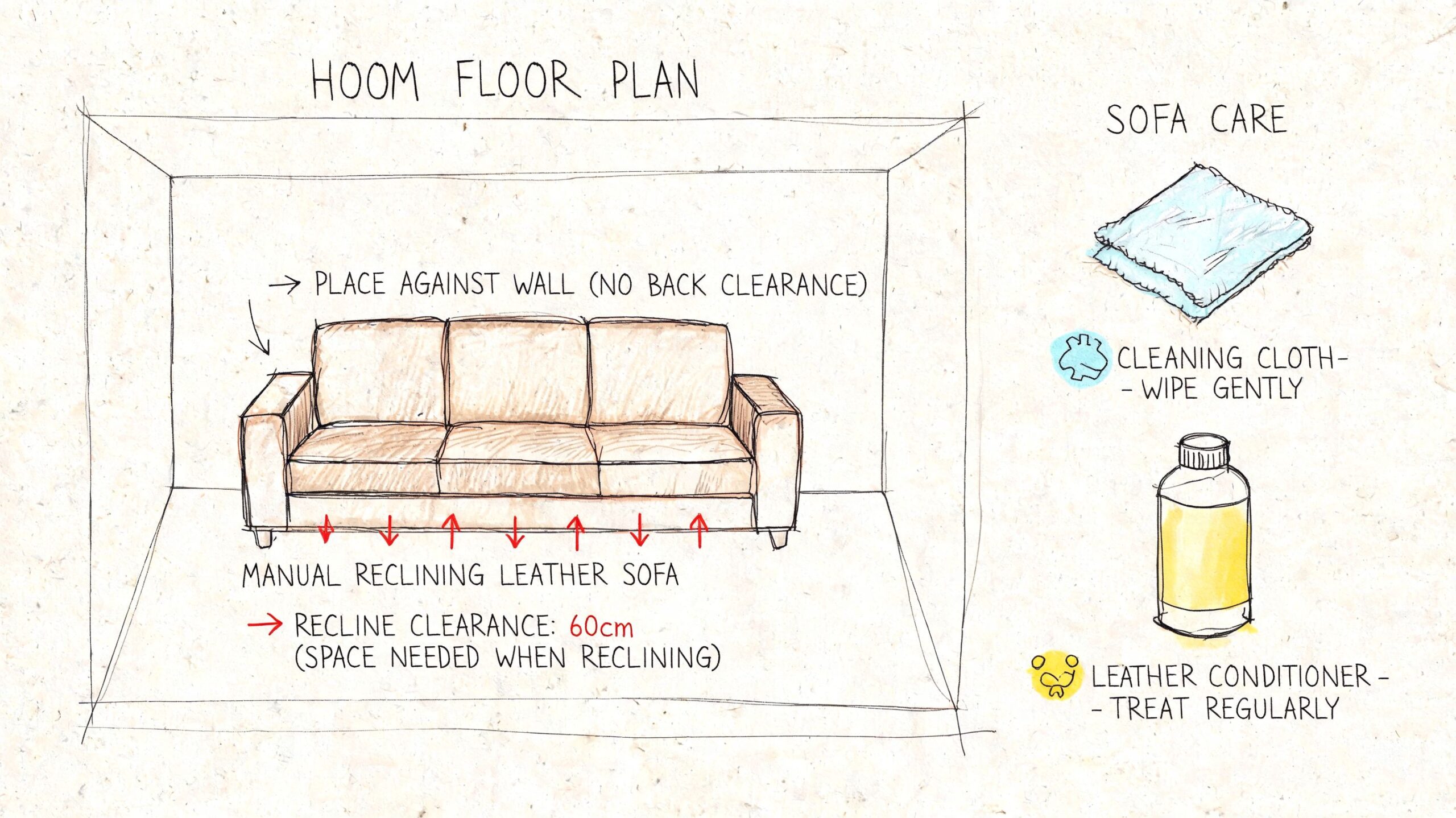
A reclining sofa needs breathing room. Before delivery, measure the wall, the coffee table distance, and the walking path in front of the sofa. Don’t guess. Reclining furniture can feel perfect in a showroom and crowded at home if the footrest projects into the main traffic lane.
Style-wise, leather recliners can anchor several looks:
- Rustic interiors: Pair them with wood tables, woven textures, and warmer tones.
- Transitional rooms: Use cleaner lamps, refined rugs, and softer neutrals to balance the bulk.
- Modern spaces: Choose simpler silhouettes and let the leather provide the visual weight.
If your room gets strong sun, placement matters as much as styling. Try not to put leather where intense direct sunlight hits it for long stretches.
Care habits that pay off
According to practical maintenance guidance from Living Spaces’ Braun Brown leather recliner information, regular conditioning prevents leather from drying out and cracking, which is especially important in the dry climates of West Texas and Southeastern New Mexico.
That advice is simple because it works.
- Dust routinely: Fine dust settles into seams and surface texture.
- Wipe spills promptly: Fast response matters more than aggressive scrubbing.
- Condition on a regular schedule: Dry climates ask more of leather than milder regions do.
- Keep sharp objects away: Rivets, toys, and pet claws can leave permanent marks faster than people expect.
For homes with pets, I also recommend using a removable barrier when animals share the sofa regularly. This guide to Nandog Pet Gear furniture protection is a useful resource if you want a cleaner way to protect high-contact areas without wrapping the whole room in plastic-looking covers.
A few ownership mistakes to avoid
Some habits shorten the life of good leather furniture.
- Don’t let the sofa bake in direct sun if you can avoid it.
- Don’t ignore dryness once the leather starts looking thirsty.
- Don’t treat all cleaners as safe just because they’re sold for furniture.
- Don’t wait until damage shows before learning the basics of care.
For a deeper look at upkeep, this article on how to protect leather furniture is a strong companion to keep bookmarked after your sofa arrives.
Find Your Perfect Sofa at Miller Waldrop
By this point, you know what separates a sofa that merely reclines from one that will hold up well in your home. You know to look past surface softness. You know to check the mechanism, the frame, the suspension, and the leather itself. You also know that climate changes the ownership experience, especially with leather.
That puts you in a much better position than the average shopper. You can ask sharper questions. You can test motion furniture with purpose. You can choose based on how your family lives instead of how a sofa looked for five minutes under showroom lighting.
Why seeing it in person still matters
Reclining furniture is one of the categories that benefits most from in-person shopping. You need to feel how the seat supports your legs, how the back hits your shoulders, and whether the leather has the hand you want. The recline should feel natural to your body, not just functional.
That’s especially true if you’re comparing brands like La-Z-Boy and Flexsteel or deciding between different leather finishes. Photos help narrow options. They don’t replace sitting down and operating the mechanism yourself.
The right sofa usually becomes obvious when you stop looking at it and start using it.
Use the showroom as a testing ground
When you visit a showroom in Lubbock, Hobbs, or Ruidoso Downs, treat it like a hands-on evaluation.
- Recline more than once
- Sit in your normal posture
- Check the leather with your hand, not just your eyes
- Ask about custom-order choices if the frame is right but the cover isn’t
That’s also where design help becomes useful. If you’re unsure about scale, color, or how a reclining sofa will live with the rest of your room, getting guidance before delivery is far easier than correcting a mismatch after the fact.
If you’re ready to compare a manual reclining leather sofa in person, explore the selection and design help at Miller Waldrop Furniture & Decor. Visit a showroom in Lubbock, Hobbs, or Ruidoso Downs, test the mechanisms yourself, and use what you’ve learned here to choose a sofa that fits your room, your climate, and your everyday life.