

Innerspring vs Memory Foam Mattress: How to Choose the Right One for You

At its core, the difference is simple. Innerspring mattresses give you that classic bouncy feel with solid support, while memory foam mattresses are all about that deep, contouring comfort that hugs your body. The right choice really comes down to whether you prefer a traditional, firm bed with plenty of airflow or a modern, pressure-relieving surface that isolates movement. This guide is your tool to unlock that decision.
Choosing Your Ideal Mattress: Innerspring or Memory Foam?
A great night's sleep truly begins with the right mattress. For most people, the big decision boils down to the classic debate: innerspring vs. memory foam. This single choice affects everything from your spinal alignment to how well you sleep next to a restless partner, making it a crucial step in building your perfect sleep environment.
Understanding what each type does best is the key to matching a mattress to your body and sleep habits. Think of it as finding the right tool for nightly recovery—one offers sturdy, breathable support, and the other delivers a quiet, personalized cradle. Your goal is to find the one that will help you win the day, every day.
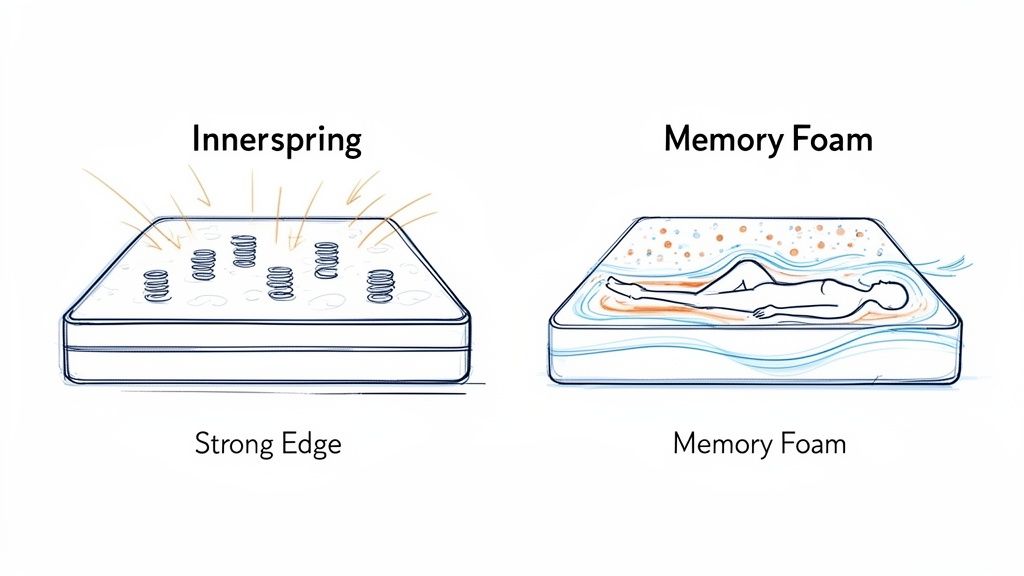
A Quick Comparison
To get you started, here’s a high-level look at how these two mattress types stack up. This table is a quick reference for their key characteristics, giving you a clear snapshot of their main differences before we dive into the details.
| Feature | Innerspring Mattress | Memory Foam Mattress |
|---|---|---|
| Feel | Bouncy and responsive with a firm surface. | Contouring and slow-moving with a "hug" sensation. |
| Support | Strong, uniform support, especially at the edges. | Targeted pressure relief that molds to your body. |
| Motion Isolation | Tends to transfer motion across the surface. | Excellent at absorbing movement for undisturbed sleep. |
| Temperature | Promotes airflow for a cooler sleep experience. | Can retain heat, though modern gels help. |
| Best For | Back/stomach sleepers, those who sleep hot. | Side sleepers, couples, and those with joint pain. |
The right mattress isn’t just about comfort; it's a performance tool for daily recovery. Matching the mattress construction to your specific needs is the key to unlocking truly restorative sleep.
This guide will break down the essential differences, explore the unique benefits of each, and help you find the mattress that fits your sleep needs. The goal is simple: to empower you to make a confident choice that transforms your bedroom into a true retreat, starting with the perfect foundation.
Of course, feeling the difference for yourself is the ultimate test. You can visit a Miller Waldrop showroom in Lubbock, Hobbs, or Ruidoso Downs to try our wide selection of Serta and Beautyrest mattresses and discover the one that will become your greatest ally for restorative sleep.
Understanding How Each Mattress Is Built
To really get to the bottom of the innerspring vs. memory foam debate, you have to look under the hood. The materials and craftsmanship inside a mattress are what give it that distinct feel, support, and lifespan. Once you know what makes each one tick, you can make a choice based on quality and long-term performance, not just how it feels for a few minutes in a showroom.
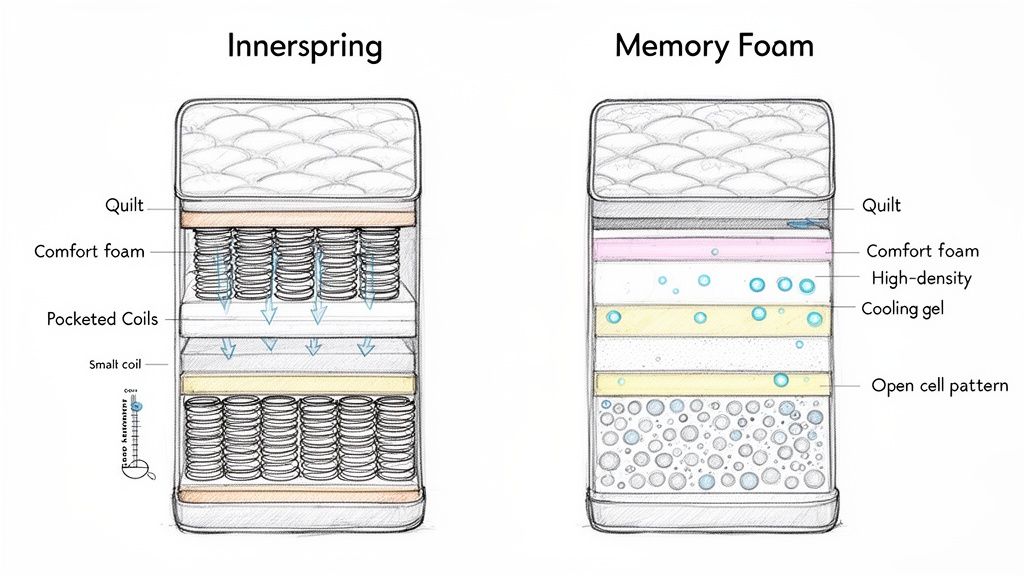
This internal design is exactly why each mattress type serves a different sleeper. One is all about responsive support and airflow; the other is engineered for deep contouring and soaking up movement.
The Anatomy of an Innerspring Mattress
At the heart of every innerspring mattress is its coil system. This network of steel springs is what provides that foundational support and classic bounce people have known for decades. But not all springs are the same.
- Coil Gauge: This is simply the thickness of the wire. A lower gauge number (like 12.5) means a thicker, sturdier coil, giving you a firmer feel. A higher gauge (like 15) is thinner and more flexible.
- Coil Count: A higher number might sound better, but the quality of the steel and the overall mattress construction matter much more. Think of it as the whole system working together, not just one number.
Today's best innerspring models, like many you'll find from Beautyrest, use pocketed coils. Each spring is individually wrapped in its own fabric sleeve, so it can move on its own. This is a game-changer for reducing motion transfer—no more feeling every toss and turn from your partner—and delivering more precise support.
It's this tried-and-true construction that explains why innersprings are still so popular. In fact, they make up a massive 44.72% of the U.S. mattress market, proving that plenty of people still value that familiar bounce and breathability.
Deconstructing the Memory Foam Mattress
Memory foam, or viscoelastic foam, is a whole different ballgame. It started out as a NASA invention and is engineered to react to your body's heat and pressure, molding perfectly to your shape. This is what creates that signature "hugging" feel that memory foam is known for.
Memory foam is designed to eliminate pressure points by spreading your weight evenly across the entire surface. That’s why it’s so often recommended for side sleepers and people dealing with chronic pain.
A few key factors determine how a memory foam mattress will actually feel and hold up over time:
- Density: Measured in pounds per cubic foot (PCF), this tells you a lot about durability. Higher-density foams (5 PCF or more) last longer and offer deeper, more supportive contouring.
- Cooling Technology: To solve the old problem of sleeping hot, modern memory foams are often infused with cooling gels or designed with an open-cell structure to let air move more freely.
Knowing these details is key because they directly affect how comfortable you'll be and how long your investment will last. And while we're talking about materials, it's worth noting the wide world of options out there, including unique designs like natural Kapok Fibre filled mattresses that offer a different kind of sleep experience.
To dig deeper into what makes a great foam mattress, check out our guide on how to choose the best memory foam mattress brands.
Comparing Core Performance for Better Sleep
Think of your mattress less like a piece of furniture and more like a high-performance tool you rely on every single night for recovery. The secret to choosing the right tool for your body and sleep style is understanding how innerspring and memory foam mattresses perform across a few key areas. Let's break down the critical differences that will directly impact how well you sleep.
Pressure Relief and Contouring
How well a mattress cushions your body's pressure points—think hips and shoulders—is the foundation of comfort. This is where you'll feel the most immediate difference between these two mattress types.
Memory foam was literally engineered for this. Its viscoelastic nature allows it to soften and mold perfectly to your unique shape in response to body heat and pressure. For side sleepers, this creates that classic "cradling" sensation that lets your shoulder and hip sink in just enough, promoting healthy spinal alignment and preventing you from waking up sore.
In contrast, a traditional innerspring mattress delivers a more uniform, uplifting feel. While it won't offer that same deep, body-hugging contour, modern designs have come a long way. Advanced innerspring systems now often feature zoned support, which uses coils of varying firmness in specific areas to give your shoulders more cushion while providing stronger support for your lower back.
Motion Isolation for Shared Beds
If you share your bed, you know how a partner's simple toss or turn can feel like a seismic event. Motion isolation is just a technical term for how well a mattress absorbs that movement so it doesn't transfer to your side.
This is memory foam's undisputed superpower. The dense foam structure is exceptional at absorbing energy and deadening movement right where it happens. In fact, this quality is a huge reason for its popularity. The U.S. memory foam market was valued at USD 12.23 billion in 2020 and is projected to hit USD 17.69 billion by 2026, largely because it can slash partner disturbance by up to 80%.
Innerspring mattresses, with their interconnected steel coils, naturally have more bounce and are more likely to transfer motion. The game-changer here has been the introduction of pocketed coils, where each spring is individually wrapped in fabric. While they might not erase motion quite like foam, they offer a massive improvement over older, interconnected coil designs.
Temperature Regulation and Airflow
Sleeping hot is one of the most common issues that can wreck a good night's rest. The construction of your mattress plays a massive role in how well it breathes and pulls body heat away from you.
The open structure of an innerspring mattress inherently allows for superior airflow. The space between the coils creates natural ventilation, helping heat and moisture escape and keeping the sleep surface cooler throughout the night.
Memory foam has a historical reputation for trapping heat because of its dense structure. But don't count it out—manufacturers have come up with some brilliant solutions to combat this. Modern memory foams often include:
- Cooling Gel Infusions: Gel beads are swirled into the foam to draw heat away from your body.
- Open-Cell Structures: This newer foam design creates more internal air pockets, boosting breathability.
- Conductive Materials: Some high-end foams are infused with naturally conductive materials like copper or graphite to actively pull heat away.
For anyone who prioritizes a cool sleep environment above all else, an innerspring often has the natural edge. If you're especially sensitive to overheating, checking out our guide to the best mattress for hot sleepers can point you toward even more specialized options.
Before we dive into support and alignment, let's quickly summarize how these mattresses stack up on key performance metrics. This table gives you a bird's-eye view to help you identify which type might be your best fit right off the bat.
Innerspring vs Memory Foam at a Glance
| Performance Metric | Innerspring Mattress | Memory Foam Mattress | Best For Sleepers Who |
|---|---|---|---|
| Pressure Relief | Good, with a firm feel. Zoned coils can add cushioning. | Excellent, with deep body-hugging contouring. | Prioritize a cradling feel and have sharp pressure points (side sleepers). |
| Motion Isolation | Fair to Good. Pocketed coils significantly reduce motion. | Excellent. Absorbs movement and isolates it completely. | Are light sleepers or share a bed with a restless partner. |
| Temperature | Excellent. Open coil structure promotes superior airflow. | Good to Excellent. Modern cooling tech has improved it. | Tend to sleep hot and prioritize a cool, breathable surface. |
| Responsiveness | High. Bouncy and easy to move around on. | Low. Slow-moving feel that you sink "into." | Change positions frequently or prefer feeling "on top of" their mattress. |
This quick comparison highlights the core trade-offs. Now, let's talk about the most important job a mattress has: keeping your spine happy.
Support and Spinal Alignment
Ultimately, the most critical job of any mattress is to support your body and keep your spine in a neutral, healthy line. Both mattress types can get this right, but they approach it from completely different angles.
An innerspring mattress offers that firm, responsive support that keeps you sleeping "on" the mattress rather than "in" it. This push-back support is fantastic for many back and stomach sleepers who need a robust foundation to prevent their hips from sinking too low and straining their lower back.
Memory foam, on the other hand, provides support by conforming to your body and distributing your weight evenly. It fills in the gaps, especially in the curve of your lower back, to provide consistent, contoured support. The trick is finding the right foam density to get that support without sinking in too far. When you're ready to find that perfect balance, our Sleep Experts at Miller Waldrop can help you test different models, like the exceptional options from Beautyrest, to feel the difference firsthand.
Matching Your Mattress to Your Sleep Style
Deciding between an innerspring and a memory foam mattress isn't about finding the "best" one—it's about finding the right one for you. Your sleep position, body type, and even your daily habits all play a part in determining which mattress will feel like it was made just for you.
Think of it this way: the mattress that gives your friend the best sleep of their life might leave you feeling sore and unrested. Let's dig into how your specific needs line up with what each of these mattresses has to offer.
Guidance for Side Sleepers
If you're a side sleeper, your biggest challenge is finding a mattress that can properly cushion your shoulders and hips. These are the widest points of your body, and if the surface is too firm, they end up taking on all your weight, which often leads to morning stiffness.
This is where memory foam really shines. Its signature ability to contour and cradle your body provides a gentle, supportive hug that lets your shoulders and hips sink in just enough. This keeps your spine in a straight, neutral line—a critical factor for waking up pain-free. An innerspring can often feel too rigid for side sleepers, creating pressure points instead of relieving them.
Recommendations for Back and Stomach Sleepers
Back and stomach sleepers have the opposite problem: they need solid support to keep their hips and midsection from sinking too far into the mattress. When your torso sags, your spine gets thrown out of alignment, and that's a fast track to lower back pain. To learn more, you can explore the best sleep positions for back pain relief to see how your posture and mattress work together.
For these sleep styles, an innerspring mattress is usually the perfect fit. The coil system offers a firm, consistent lift that keeps you sleeping "on top of" the mattress, not sinking "into" it. This sturdy foundation ensures your spine stays level all night long. While some very firm memory foam options can do the job, the reliable push-back from an innerspring is often the better choice.
Key Takeaway: Side sleepers generally need the deep contouring of memory foam to relieve pressure, while back and stomach sleepers often require the firm, consistent support of an innerspring to maintain spinal alignment.
Lifestyle Factors to Consider
Your sleep position is just the start. Other preferences and habits can tip the scales in the innerspring vs. memory foam debate.
-
If you sleep hot: An innerspring mattress is your best friend. The open space between the coils allows air to circulate freely, which helps pull body heat away from you and keeps you much cooler.
-
If you share your bed: This is where memory foam is the undisputed champion. It absorbs movement like a sponge, so you’re far less likely to feel your partner tossing, turning, or getting out of bed. This incredible motion isolation is a huge reason for its popularity.
The graphic below shows just how much memory foam’s unique benefits, like motion reduction, have driven its growth in the market.
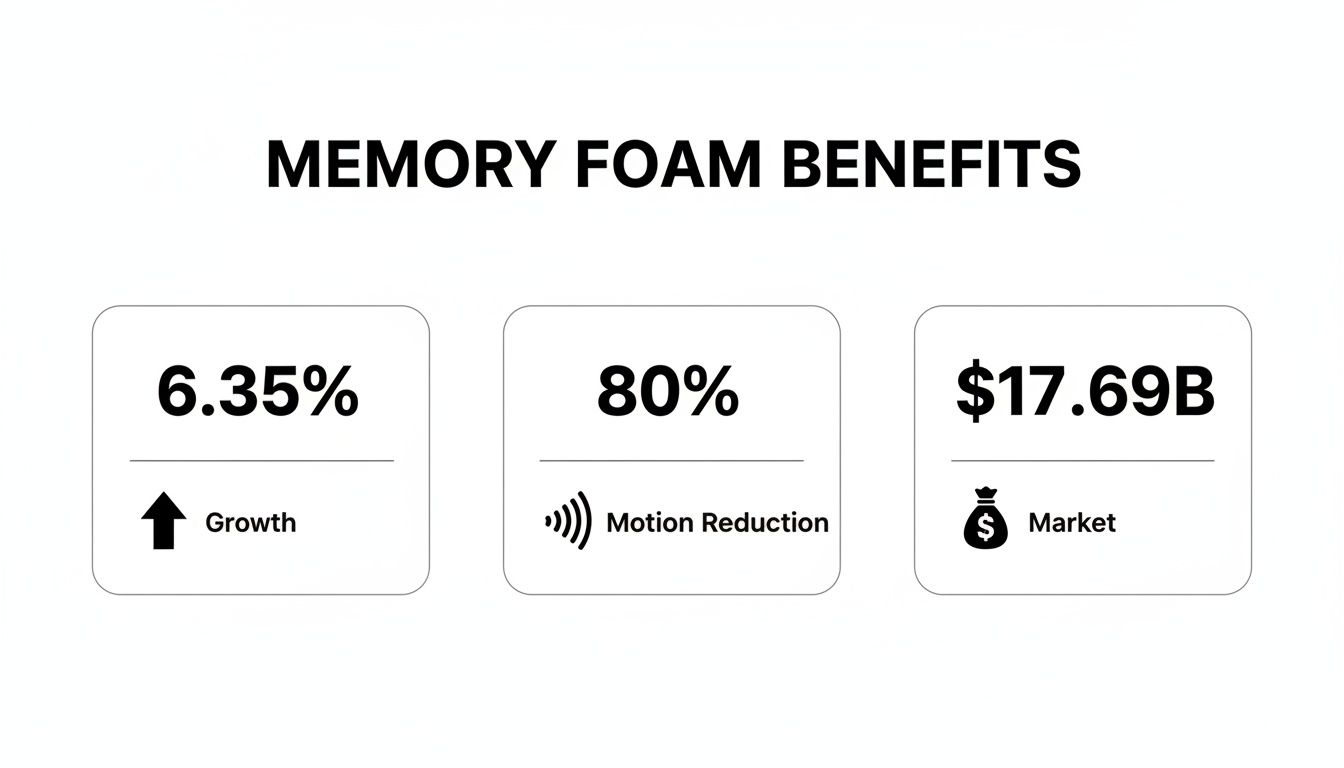
These numbers really tell the story of how much people value an undisturbed night's sleep.
- If you value edge support: Do you often sit on the edge of the bed to put on your shoes or just get ready for the day? Innerspring mattresses typically have a reinforced perimeter, giving them much stronger edge support. This prevents that sinking feeling and makes getting in and out of bed easier.
Ultimately, the best way to know for sure is to feel the difference for yourself. Our Sleep Experts can guide you to the perfect mattress that becomes your ultimate tool for better rest. By trying out different options in person at a Miller Waldrop showroom, you can make a confident decision that will lead to countless nights of incredible sleep.
Exploring Hybrid Mattresses: The Best of Both Worlds
So, what happens when you don't want to choose between the responsive support of coils and the deep comfort of foam? The innerspring vs. memory foam debate often leaves out a fantastic third option that brings together the best features of each. A hybrid mattress is that modern solution, engineered for sleepers who feel like traditional mattresses just don't quite get it right.
This clever design starts with a sturdy innerspring coil base and tops it with thick comfort layers of memory foam, gel foam, or even latex. What you get is a sleep surface that truly offers the best of both worlds. It has that familiar push-back support, breathability, and solid edge you expect from an innerspring, but it's fused with the targeted pressure relief and motion-dampening qualities of memory foam.
Who Should Seriously Consider a Hybrid?
Understanding this balanced approach can be a game-changer in your search for better sleep. Hybrids are often the perfect fit for people whose needs fall somewhere in the middle of the two classic mattress types.
- Couples with Clashing Tastes: If one of you loves the bounce of springs and the other swears by the cushioning of foam, a hybrid is the ultimate peacekeeper. It can satisfy both of you in a single bed.
- Hot Sleepers Who Still Want That Foam Hug: Hybrids deliver the deep pressure relief of memory foam without its notorious heat buildup. The coil core allows air to circulate freely, keeping things cool.
- Sleepers Needing Both Solid Support and Gentle Relief: If you struggle with back pain and find innersprings too hard but memory foam too soft, a hybrid hits the sweet spot. The coils provide essential spinal alignment while the foam cushions your shoulders, hips, and knees.
A hybrid mattress is built to bridge the gap. It delivers a balanced feel that doesn't make you sacrifice support for comfort or coolness for pressure relief. Think of it as an all-in-one solution for more complex sleep needs.
This combined construction makes hybrids incredibly versatile. They work well for a huge range of sleep positions and body types, from side sleepers who need that extra cushion to back sleepers who require a firm foundation. By fusing these two technologies, a hybrid creates a nuanced feel that adapts to you. To really get into the nuts and bolts of how they work, check out our guide that answers the question, what is a hybrid mattress?
At the end of the day, a hybrid means you can stop making compromises. You can have that responsive feel you love without giving up the motion isolation that ensures a peaceful night's sleep. When you're ready to feel this dynamic performance firsthand, we invite you to stop by a Miller Waldrop showroom. Our Sleep Experts can have you test out the unique balance of a Serta iComfort Hybrid mattress and help you decide if it’s the right tool to help you win the day.
Find Your Perfect Sleep Solution at Miller Waldrop
Choosing between an innerspring and a memory foam mattress is a big deal, but you don't have to figure it out on your own. At Miller Waldrop Furniture & Mattress, our entire process is designed to take the confusion out of mattress shopping and guide you straight to better rest.
Think of us as your support team on this journey. We combine old-fashioned, personalized service with some pretty smart technology to make sure the mattress you choose is the one that helps you wake up ready for the day, every single day.
Your Guides to Better Sleep
Our Sleep Experts aren't just salespeople—they're seasoned professionals genuinely dedicated to improving your sleep. With our family's legacy of over 70 years serving communities like Lubbock, Hobbs, and Ruidoso Downs, they know that the right mattress is a deeply personal choice. They're here to listen, answer your questions, and offer honest advice based on what you actually need.
Of course, there's no substitute for trying a mattress out for yourself. We always encourage you to visit our showroom and feel the difference. You can lie down and compare the classic, responsive support of a Serta mattress with the gentle, body-hugging feel of a top-tier memory foam model. That hands-on experience is the best way to make a decision you'll be happy with for years.
Science-Backed Recommendations for Your Body
To take the guesswork out of the equation, we use an advanced bed-matching system right here in our stores. This isn't just a gimmick; it’s a diagnostic tool that maps your body’s unique pressure points as you lie down, creating a clear picture of where you need the most support and where you need more cushioning.
This technology gives us a scientific starting point. It allows our Sleep Experts to pinpoint specific innerspring or memory foam mattresses that are truly a good match for your body type and sleep style.
This data-driven approach means the mattress you select won’t just feel good for a few minutes in the showroom—it will be properly engineered for your long-term health and wellness. It's all about matching the mattress's performance to your body's needs. Stop by a Miller Waldrop location today and let our team help you finally get the restorative sleep you deserve.
Your Top Mattress Questions, Answered
Shopping for a new mattress often brings up a handful of important questions. Let's tackle some of the most common ones we hear from our customers to help clear things up as you start your search.
How Long Should a Mattress Last?
Think of a good mattress as an investment in your health. With that in mind, you should expect a quality one to provide consistent comfort and support for about 7 to 10 years.
Of course, the actual lifespan really comes down to the quality of the materials. Denser memory foams and innerspring models built with durable, high-gauge steel coils are designed to go the distance. You can also do your part by using a solid, supportive bed frame and a quality mattress protector from day one.
Do I Need to Flip My Mattress?
This is a classic question, and for good reason—it used to be standard practice! But with today's mattress technology, the answer is almost always no.
Most modern mattresses, whether innerspring or memory foam, are built from the ground up with specific layers that aren't meant to be inverted. What you should do, however, is rotate the mattress 180 degrees every six months or so. This simple step helps it wear evenly and last longer.
Expert Tip: Rotating your mattress from head-to-foot prevents body impressions from forming in one spot. It’s the single best thing you can do to maintain that “new mattress” feel for years to come. Just be sure to double-check the manufacturer's care guide for their specific advice.
How Do I Know When It’s Time for a New Mattress?
Your body will tell you long before the mattress does. Are you waking up with stiffness or new aches in your back, hips, or shoulders? That’s a huge red flag that your mattress has lost its ability to support you properly.
Other tell-tale signs are a little more obvious: visible sagging or lumps you can feel. And if you find yourself getting a much better night's sleep in a hotel bed or at a friend's house, it’s probably time to make a change. Don't underestimate how much an old, worn-out mattress can sabotage your sleep quality.
At Miller Waldrop, we believe you should feel completely confident in your choice. Our Sleep Experts are always here to answer your questions, and our bed-matching system is the ultimate tool for taking the guesswork out of it. Come see us in Lubbock, Hobbs, or Ruidoso Downs to find the perfect sleep solution that empowers you to win the day.
Explore our Serta Mattresses Today