


Your Guide on How to Break In a New Mattress for Better Sleep


That first night on a brand-new mattress can be a little… surprising. You’re expecting that cloud-like comfort you fell in love with at the store, but instead, it feels much firmer. Don’t worry. This is completely normal and a good sign that your mattress is fresh from the factory and ready for you to begin the break-in period.
The key thing to remember is that a new mattress needs time to get to know you, just as you need time to get used to it. Your investment in better sleep is about to pay off, and this guide will empower you to get the most out of it from night one.
The All-Important Break-In Period
Think of your new mattress like a quality pair of leather shoes. Straight out of the box, they’re stiff. It’s only after you’ve walked around in them for a bit that the leather softens, stretches, and molds perfectly to your feet. A mattress is no different—it needs a little time and use to deliver the personalized comfort you chose.
This initial firmness is by design. Manufacturers use brand-new, dense materials that haven't had a chance to be compressed or softened by body weight yet.
- Materials Need to Settle: Things like memory foam, latex, and even the plush comfort layers over innerspring coils have been tightly packed for shipping. They need time to fully breathe and expand to their true shape and feel.
- Your Body Needs to Adjust: For better or worse, your body was used to your old mattress. It takes time for your muscles and spine to adapt to a new, more supportive surface, which is essential for proper alignment.
Why It Feels Firmer Than the Showroom Model
The mattress you tried out in our store has a head start! It’s been tested by countless shoppers, which has already done the initial softening work for you. We do this on purpose so you can experience how your mattress will feel once it’s fully broken in.
The one delivered to your home is factory-fresh, ready to conform uniquely to your body over the next 30 to 60 nights. Choosing the right foundation from the start is key, and understanding how to choose the right mattress firmness will make this adjustment period feel much smoother.
The break-in period isn’t just about the mattress getting softer. It's about the materials contouring to your specific body shape, weight, and favorite sleeping positions to provide truly personalized support.
This focus on getting your sleep just right is part of a much bigger picture. As people everywhere put more emphasis on their wellness, the global mattress market ballooned to USD 551 billion in 2023. It’s a massive investment in better sleep, pushing brands like Serta and Beautyrest to create incredible materials that offer lasting comfort—once they’ve had a chance to settle.
You can dive deeper into this growing investment in sleep quality on news.market.us. By understanding this break-in process, you’re setting yourself up to get the absolute most out of your new mattress.
How To Break In Your New Mattress (And Actually Speed It Up)
So, you've got your new mattress home. Fantastic! But if it feels a little stiffer than the one you tested in the showroom, don't panic. That's completely normal. The best things you can do are give it time and use it consistently, but here are a few ways you can empower the process.
Think of it less like "breaking" it and more like "settling it in." You're essentially helping the materials adapt to your unique shape and weight, which is exactly what they're meant to do. The number one rule? Sleep on it. Every single night. Spending extra time in bed reading or relaxing before you doze off also helps accelerate the process.
Gentle, Even Pressure is Your Friend
Want to give it a little extra encouragement? For a few minutes each day, you can carefully walk or crawl across the entire surface of the bed. This helps loosen up any stiffness in the foams and fibers, making them more pliable.
The goal here isn't force; it's about consistency. You're just gently waking up the materials inside—encouraging the foam cells to open and the fibers to settle into their new supportive role.
Just remember to be gentle. Jumping on the bed might have been fun as a kid, but it can cause real damage to the foams, coils, and internal support structure. It could even void your warranty, so it's best to avoid any roughhousing.
Rotate, Rotate, Rotate
This is a classic for a reason. During the first couple of months, make a point to rotate your mattress 180 degrees (head-to-foot) every two weeks. This simple step is crucial for ensuring the entire surface breaks in evenly, preventing one side from getting softer faster than the other.
Once you’re past that initial break-in window, you can dial it back to rotating every three to six months. This is just good mattress maintenance that helps prevent deep body impressions and extends its supportive lifespan.
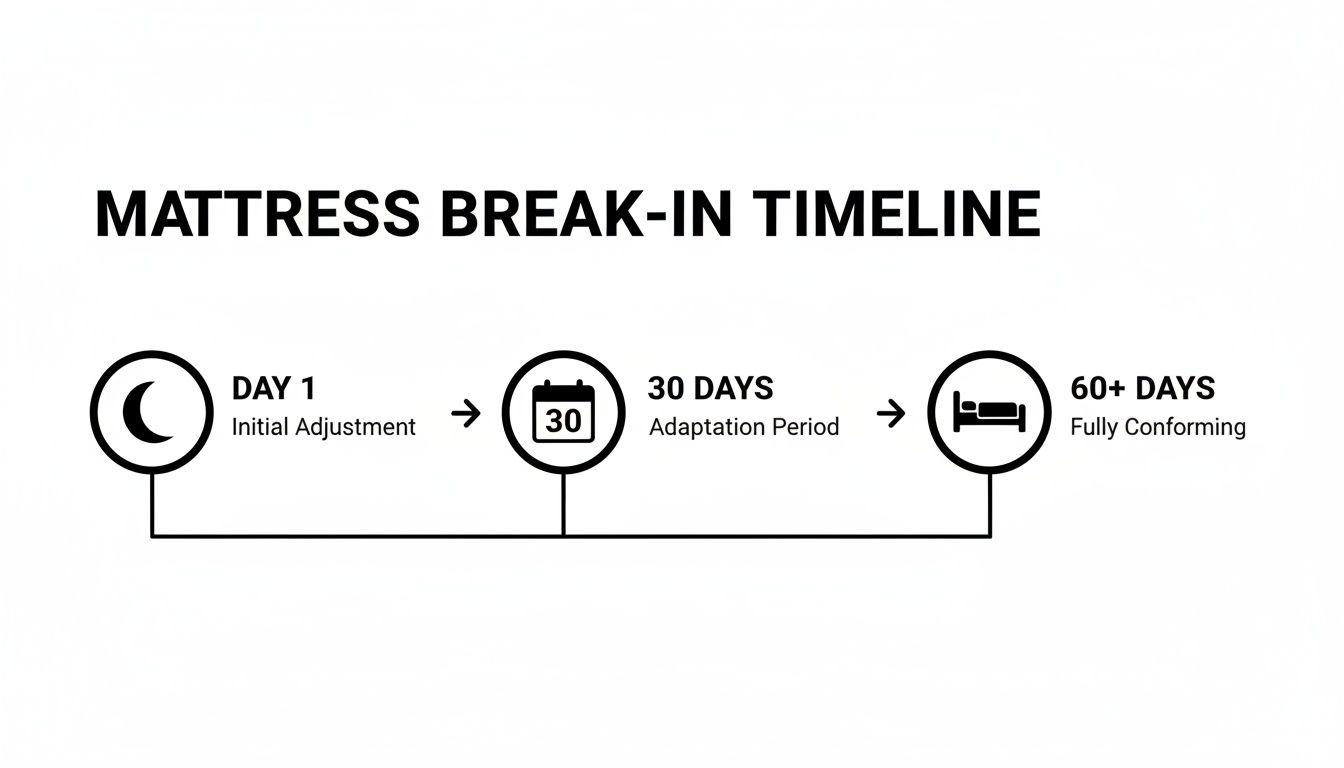
As you can see, the biggest changes happen in that first 30 to 60 day window. Patience and consistent use are truly your best allies here.
That New Mattress Feel: What to Expect
Every mattress is different, and the materials inside play a huge role in how long it takes to feel just right. This timeline offers a realistic look at the average break-in period for different mattress types, helping you set clear expectations.
Mattress Break-In Timeline by Type
| Mattress Type | Average Break-In Period | Key Characteristics During Break-In |
|---|---|---|
| Memory Foam | 30–60 Days | Can feel very firm at first, especially in cooler rooms. Expect a gradual softening as foam cells open and conform to your body. |
| Innerspring | 30 Days | The quickest to break in. You might notice some initial stiffness, but coils and comfort layers adapt relatively fast. |
| Latex | 2–14 Days | Latex is naturally resilient and breaks in very quickly. You may notice a slight softening, but the change is minimal. |
| Hybrid | 30–90 Days | A combination of foam and coils means a longer, more layered break-in. Both the foam layers and the springs need time to settle. |
Remember, these are just averages. Your body weight, room temperature, and how much time you spend in bed can all influence the final timeline.
Don't Want to "Tough It Out"? Try a Topper
If that initial firmness is making it hard to get comfortable, there’s no need to suffer. A mattress topper is the perfect temporary tool. It adds a plush layer of comfort on top while the mattress underneath continues to do its thing and break in properly.
A good topper can make a world of difference in those first few weeks. If you're really looking to fine-tune your comfort, here's how you can elevate your sleep with an adjustable bases. It allows you to find the perfect position for everything from sleeping to reading, putting you in complete control of your comfort.
Tailoring the Break-In to Your Mattress Type
You wouldn't use the same recipe for every type of cake, right? The same logic applies to breaking in a new mattress. What works for a dense memory foam bed won't be the best approach for a bouncy innerspring. The materials inside—whether it's high-tech foam, traditional steel coils, or natural latex—determine how the mattress settles and adapts.
Getting to know your mattress's specific needs is the secret to unlocking its full comfort potential and making sure that new Serta or Beautyrest feels like it was made just for you.
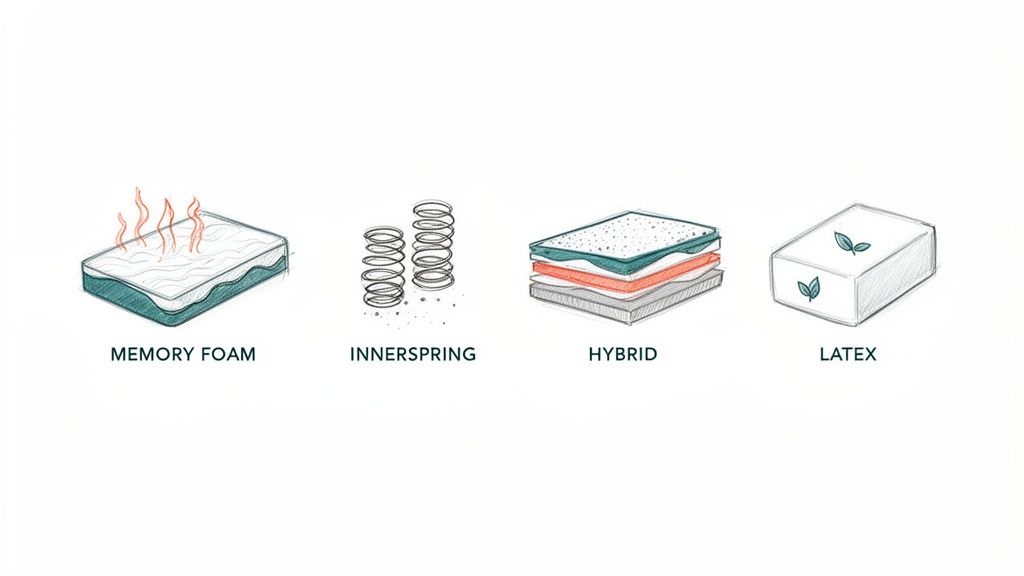
Working with Memory Foam
Memory foam is a pretty incredible material, designed to react to your body's unique heat and pressure. That very characteristic is what allows it to contour so perfectly to your shape. To get it there faster, your own body is the best tool you have.
- Bring the Heat: Try keeping your bedroom a degree or two warmer than you normally would for the first couple of weeks. A little extra warmth makes the foam more pliable, encouraging it to soften up and conform to you more quickly.
- Log More Bed Time: This is the easy part. Just spend more time on the mattress. Reading, watching a movie, or just lounging around gives the foam more contact time with your body, speeding up the process.
Proper care is also a big part of memory foam's performance, ensuring you get the comfort and support you deserve for years to come.
The Innerspring and Hybrid Strategy
Innerspring mattresses get their support from a network of steel coils, while hybrids pair those coils with comfort layers of foam. For both of these types, the main goal is to get all those components to settle in evenly.
With innerspring and hybrid models, consistent rotation is the most important thing you can do. You want every coil and every inch of foam to adjust uniformly to prevent dips and sags from forming down the road.
Make it a habit to rotate the mattress 180 degrees every couple of weeks for the first few months. This simple trick ensures your body weight is distributed across different areas, preventing one side from breaking in faster than the other. It’s a small effort that pays off with a balanced, supportive feel that will last for years.
The Lowdown on Latex Mattresses
Latex is famous for its natural springiness and durability. The good news is that its break-in period is often much shorter than other materials, usually feeling just right within a few days to two weeks.
Thanks to its inherent bounce, latex doesn't need a lot of extra encouragement. Simply sleeping on it every night is typically enough for the material to make its final, minor adjustments. While you don't need to be as strict with it initially, rotating it every so often is still a great habit for long-term health and even wear.
Common Mistakes to Avoid When Breaking In a Mattress
You’ve made a great investment in your sleep, and knowing what not to do is just as important as knowing what to do. Breaking in your new mattress is a process, and avoiding a few common missteps will ensure it feels fantastic for years to come—and that you don't accidentally damage it.
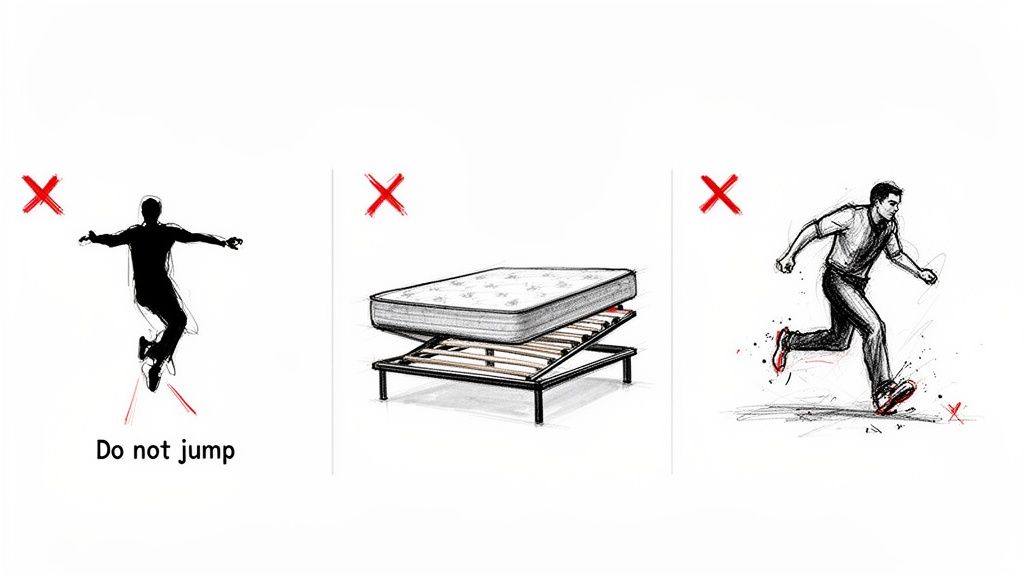
The biggest mistake is trying to rush the process with brute force. It's tempting to think you can speed things up, but jumping on the bed can permanently damage the internal foam layers and delicate spring systems. The materials just aren't designed to handle that kind of concentrated, high-impact force. It can cause premature sagging and might even void your warranty.
The Foundation is Not Negotiable
It’s easy to overlook, but placing your brand-new mattress on an old, worn-out foundation is a recipe for trouble. An old box spring that’s started to sag or a frame with slats that are too far apart won't give your mattress the flat, stable support it needs.
Without a solid base, the mattress can't break in evenly. This often leads to dips and soft spots that make you think the mattress itself is defective, when the real culprit is what's underneath.
Think of your mattress and foundation as a team. One can't perform its best without the other. Ensuring your foundation is solid is the first step toward a successful break-in period.
Don't Block the Heat
Your own body heat is one of the best tools for softening up a new mattress, particularly if it has memory foam. During those first few weeks, that warmth helps the foam become more pliable and contour to your shape.
Heavy, quilted mattress protectors or thick featherbeds can create an insulating barrier, blocking that crucial body heat. For the initial 30-day period, try using just a thin, breathable mattress protector. This lets your body warmth get right to work on the mattress materials, helping them adapt much faster.
People take their sleep seriously—the U.S. mattress market is valued at USD 11.57 billion, after all. By avoiding these simple mistakes, you're protecting your part of that investment. You can dig into more interesting mattress industry statistics over at NapLab.com.
Ultimately, a patient and gentle approach always wins. If you're ever unsure about the right foundation or accessories for your specific mattress, our Sleep Experts are the resource you need. You can always get personalized advice by visiting us at one of our showrooms in Lubbock, Hobbs, or Ruidoso Downs.
How to Know if a Mattress Isn't the Right Fit
Patience is key when you're getting used to a new mattress, but you absolutely deserve a bed that feels great and supports your sleep. So, after you’ve given it a solid 30 days to break in, how do you know if it's a genuine mismatch or just a longer adjustment period? The best advice we can give is to trust your body—it’s usually sending you pretty clear signals.
If you find yourself waking up with new or worsening aches and pains day after day, that's a huge red flag. A little initial stiffness can be normal as your muscles adapt to proper support, but persistent pain in your lower back, hips, or shoulders means something isn't right for your body type or sleep style.
Listening to Your Body's Feedback
Think about how your spine feels when you lie down. Ideally, it should hold a fairly straight, neutral line from your neck down to your hips. If you feel your hips sinking way down into the mattress, it's probably too soft. On the other hand, if your shoulders feel jammed up and there’s a gap under your lower back, it's likely too firm.
After that first month, keep an eye out for these tell-tale signs:
- Persistent Aches and Pains: Don't brush off morning soreness or stiffness that just won't go away. Your bed should relieve pain, not cause it.
- Tossing and Turning: If you’re constantly shifting positions all night trying to get comfortable, the mattress isn't doing its job of relieving pressure points.
- Visible Sagging: A slight body impression where you sleep is normal. But if you see significant dips or a permanent crater forming, that could be a defect.
Your mattress should work for you, not against you. If you feel like you're fighting for comfort every single night, it's a strong sign you might have the wrong firmness level.
Your Path to the Perfect Match
At Miller Waldrop, your long-term comfort is our ultimate goal. We know that even with the best research, sometimes a mattress just isn't "the one." Our Sleep Experts are your partners in finding the right solution, and our sleep trial policy is designed to give you total peace of mind.
If you’ve given your mattress a fair 30-day trial and it’s still not giving you that deep, restorative sleep you need, let's talk. Sometimes the signs are subtle, and it can help to compare your experience with the classic 7 signs it's time to replace your mattress. Don't hesitate to reach out to our team. We'll work with you to figure out the next steps, because your perfect night's sleep is what we care about most.
Let Our Experts Help You Find Your Perfect Sleep Solution
Finding the right mattress isn't just a purchase; it's an investment in your well-being, and you don't have to go it alone. At Miller Waldrop, we see it as a partnership. We believe the right mattress is the cornerstone of a healthy, energized life, and we are here to provide the tools you need to win the day.
We even have a high-tech bed matching system that pinpoints your unique pressure points. This data gives our Sleep Experts the insights they need to make recommendations that are genuinely tailored to you. Whether you're at the very beginning of your search or just have a few questions about breaking in your new bed, we're here to help.
Your ideal mattress should empower you to wake up refreshed and ready for the day. We provide the expertise and tools you need to find that perfect fit, transforming your sleep from a necessity into a restorative experience.
The best way to know for sure is to try them out. We invite you to stop by one of our showrooms in Lubbock, Hobbs, or Ruidoso Downs to experience our handpicked selection of Serta and Beautyrest mattresses for yourself.
And if you want to take your comfort to the next level, here's how our adjustable bases can turn your bedroom into the ultimate sleep sanctuary.
Remember, breaking in your mattress is just one piece of the puzzle. Fine-tuning your sleep environment and daily habits can make a huge difference. You can discover more ways to improve sleep quality naturally. Let us help you win the day, starting with a perfect night's sleep.
Got Questions About Your New Mattress? We've Got Answers.
Even after you've done all the research, a few questions always seem to pop up once the new mattress is actually in your home. We get it. Think of this as your go-to cheat sheet, where we’ve compiled the answers our own Sleep Experts give customers every day.
We want you to feel confident and informed, taking the mystery out of the whole break-in process.
How Long Does It Really Take to Break In a Mattress?
You can generally expect it to take somewhere between 30 and 90 days. This isn't a hard-and-fast rule, but more of a window that depends a lot on what your mattress is made of.
Denser materials, like high-quality memory foam, and intricate hybrid models often need the full 90 days to really settle and adapt. On the other hand, a more traditional innerspring mattress might feel just right in as little as 30 days. The key ingredient, no matter the type, is consistent, nightly sleep that allows the materials to soften and contour to your body.
The break-in period is more than just making the mattress feel softer. It's a critical time when all the layers are conforming to your specific body shape, which is what creates that personalized support you'll enjoy for years.
Can I Accidentally Damage My Mattress by Trying to Break It In Faster?
Absolutely. It's tempting to want to speed things along, but getting too aggressive can cause real, lasting harm. Things like jumping on the bed (no matter how fun it looks) can permanently damage the foam layers and even misalign the coil systems inside.
This kind of forceful impact creates weak spots, which leads directly to premature sagging. Worse yet, it could void your warranty. The best and safest approach is always gentle, consistent pressure. Just sleeping on it every night or walking softly across the surface is all you need to do.
What's That Faint Smell Coming From My New Mattress?
That slight, new-product scent is called off-gassing. Don't worry—it's a completely normal and harmless part of the process, especially for mattresses with foam layers that have been compressed and sealed for shipping.
The odor is just a temporary release of compounds from the manufacturing process. The fix is simple: let your new mattress air out in a well-ventilated room for a day or two. The smell usually vanishes completely within a week.
At Miller Waldrop Furniture & Decor, our Sleep Experts are always here to guide you, from finding the perfect mattress to making sure you love it long-term. Ready to take your comfort to a whole new level? Explore our collection of adjustable bases and find the perfect foundation for your best night's sleep.