

Why Does My Back Hurt After Sleeping? Find Relief Now

You wake up, swing your feet to the floor, and your back objects immediately. Sometimes it’s a dull stiffness. Sometimes it’s a sharp catch that makes brushing your teeth feel like a project. By lunchtime, you may feel almost normal, which makes the whole thing even more confusing.
If you’ve been asking why does my back hurt after sleeping, the answer usually isn’t random. Your body spent hours in one position, and something in that setup didn’t support you well enough. The good news is that morning back pain often leaves clues. Your sleep position, your mattress, your pillow setup, and even the tension you carry into bed can all point to the cause.
The most helpful way to approach this is like a diagnosis, not a guess. Instead of blaming “getting older” or assuming you just slept wrong, you can look at your sleep environment piece by piece and figure out what your back has been dealing with all night.
That Familiar Ache Your Guide to Understanding Morning Back Pain
You wake up, stand up, and your lower back feels older than the rest of you. Ten or fifteen minutes later, it loosens. By midday, you may wonder if you imagined it. Then the same ache greets you again the next morning.
This recurring pattern is a significant clue.
Pain that shows up after sleep and fades as you move usually points to what happened overnight. Your back spent hours in one position, and something in that setup asked too much of it. The stress may come from pressure on a joint, a twisted hip position, a mattress that lets your midsection sink, or muscles that stayed tense instead of fully relaxing.
Your spine is a structure that requires balance to remain pain-free. During the day, walking, turning, and changing positions spread load around. In bed, your body loses that variety. If one area is slightly unsupported for seven or eight hours, a small mismatch can feel big by morning.
That is why morning back pain is often easier to troubleshoot than pain that lasts all day. The timing gives you a starting point. Instead of blaming your back in general, you can test a short list of likely causes: mattress age, firmness, pillow height, sleep position, and habits that carry tension into bed.
Practical rule: If your back improves after a warm shower, a short walk, or a few gentle stretches, overnight stiffness and sleep setup move higher on the suspect list.
A self-check can help you sort out where to look first. If your mattress is old, visibly sagging, or softer in the spot where you usually sleep, your sleep environment may be the problem. If your mattress seems fine but you wake up twisted, curled tightly, or flat on your stomach, posture may be driving the pain. If your neck, shoulders, and lower back all feel off, your pillow setup may be changing the alignment of your whole spine.
This is the point where expert guidance starts to make sense. By the time many shoppers visit Miller Waldrop, they are not casually browsing. They are trying to solve a pattern their body has repeated for weeks or months. A better mattress or pillow is not a luxury in that situation. It is a tool that can help your spine stay level, your muscles relax, and your mornings start without that familiar warning shot.
You do not need to guess. You can observe the pattern, adjust one variable at a time, and let your body show you what is helping.
The Hidden Culprits Behind Morning Back Pain
You fall asleep tired, stay in one position for hours, and wake up with a low back that feels older than the rest of you. That pattern usually points to a mechanical problem. Something in your sleep setup or sleep posture is holding your spine in a position it does not tolerate well for long.
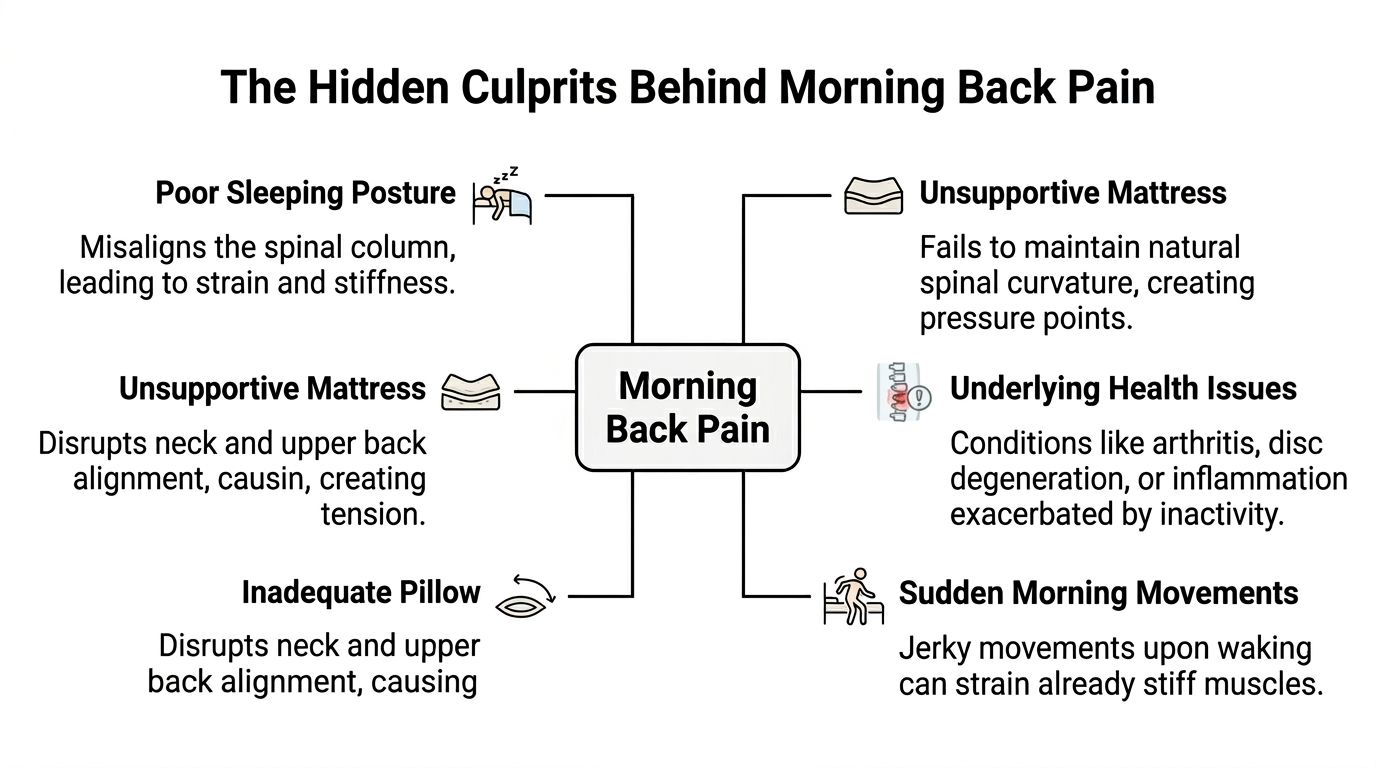
Your back handles small stresses well during the day because movement spreads the load around. Sleep changes that equation. If your hips sink, your neck tilts, or your torso twists and stays there, the same mild strain gets repeated for six to eight hours. By morning, muscles tighten to protect the area, joints feel stiff, and getting out of bed can feel like starting cold.
The useful question is not just “Is my mattress bad?” A better question is, “Which part of my overnight setup is nudging my spine out of line?”
Your sleeping position may be stressing the same area all night
Sleeping position works like the steering wheel of your sleep posture. It sets the basic shape your body holds for hours.
Stomach sleeping often creates the most trouble for the lower back. Your head usually turns to one side, and your midsection can sink into the mattress. That combination increases the arch in the low back and adds rotation through the spine.
Side sleeping is often the easiest position to fine-tune, but only if the rest of the setup matches your body. Without enough support, the top leg can roll forward and pull the pelvis with it. That twist may be small, but after a full night it can leave your lower back and hips irritated.
Back sleeping can be comfortable and stable for many people. It becomes a problem if the mattress does not support the natural curve of the lumbar spine or if the pillow pushes the head too far forward.
The distinction is important because the painful spot is not always the true cause. A twisted pelvis can show up as low back pain. A poor pillow can start at the neck and end up changing the position of the whole spine.
Try this quick diagnostic check:
- You fall asleep on your side but wake up half on your stomach: your trunk may be rotating overnight.
- You wake with pain mostly on one side of the low back: uneven twisting or hip drop may be part of the pattern.
- You wake on your back and feel a hollow or unsupported gap at the waist: your mattress may not be contouring enough through the lumbar area.
- You wake on your stomach with neck stiffness too: your posture is likely stressing more than one region.
Your mattress may be unsupportive, mismatched, or worn
Firmness gets all the attention, but firmness alone is not the goal. Your mattress needs to keep heavier areas, especially the hips and torso, from dropping too far while still allowing enough give at the shoulders and hips. The goal is to find a mattress that provides both support and contouring, rather than one that is hard.
A mattress works like a foundation under a house. If one section dips, the structure above it has to compensate. Your spine does the same thing at night.
A mattress that is too soft can let the pelvis sink and pull the lower back into strain. A mattress that is too firm can create pressure points and keep the spine from settling into a natural line, especially for side sleepers. Body weight, shoulder width, hip shape, and sleep position all affect which feel works best.
Age matters too. Materials soften gradually, so people often adapt bit by bit and miss the change until morning pain becomes a pattern.
Signs your mattress deserves a closer look:
- Visible sagging or body impressions: A dip where you sleep can hold your spine in the same stressed shape every night.
- You sleep better somewhere else: A hotel stay, guest room, or newer bed that leaves you less sore is a useful clue.
- Pain shows up in the same spot each morning: Repeated pressure often creates repeated pain.
- Your mattress is older and feels different than it used to: Foams lose resilience and coils lose pushback over time.
For some sleepers, adjustability helps with this trial-and-error process. Slightly raising the head or legs can reduce pressure and improve spinal comfort, especially if flat sleeping leaves the lower back tense. If you are comparing options, these adjustable bed benefits for sleep posture and pressure relief can help you decide whether that feature belongs in your setup.
Your pillow setup may be changing your whole alignment
A pillow does more than cushion your head. It sets the starting position for your neck, and the rest of the spine follows that line.
If the pillow is too tall, your head gets pushed up or to the side. If it is too flat, your head drops back or downward. Either pattern can tighten the neck and shoulders, which changes how your upper back and lower back settle into the mattress.
Side sleepers usually need enough loft to fill the space between the ear and the mattress. Back sleepers usually do better with a lower pillow that supports the neck without forcing the chin toward the chest. Stomach sleepers often need very little pillow at all, or none under the head, because extra height increases spinal rotation and extension.
Small changes matter here. A one-inch difference in pillow height can be the difference between waking up loose and waking up braced.
Daytime habits can load the system before you even get into bed
Morning pain sometimes starts long before bedtime. Long hours of sitting, tight hip flexors, stress-related muscle clenching, and evening inactivity can all leave the back guarded before sleep begins.
That helps explain why two people can sleep on the same mattress and report completely different mornings. One person relaxes into the surface. The other stays tense all night.
Heat can sometimes help with that guarded, stiff feeling. Some readers also explore recovery habits such as a sauna for back pain relief, especially when muscle tightness seems to be part of the picture rather than the whole cause.
If you want to sort out your own pattern, start with the simplest test. Ask whether the problem looks more like environment, posture, or carryover tension. Environment points to mattress age, firmness mismatch, or pillow setup. Posture points to stomach sleeping, twisting, or unsupported curves. Carryover tension points to stiff hips, stress, and long sedentary days. Once you know which bucket is loudest, the next step gets much clearer.
Finding Immediate Relief When You Wake Up Sore
When you wake up hurting, the first few minutes matter. A stiff back usually doesn’t like sudden bending, twisting, or jumping straight into the day. It responds better to gentle motion that tells the muscles it’s safe to relax.
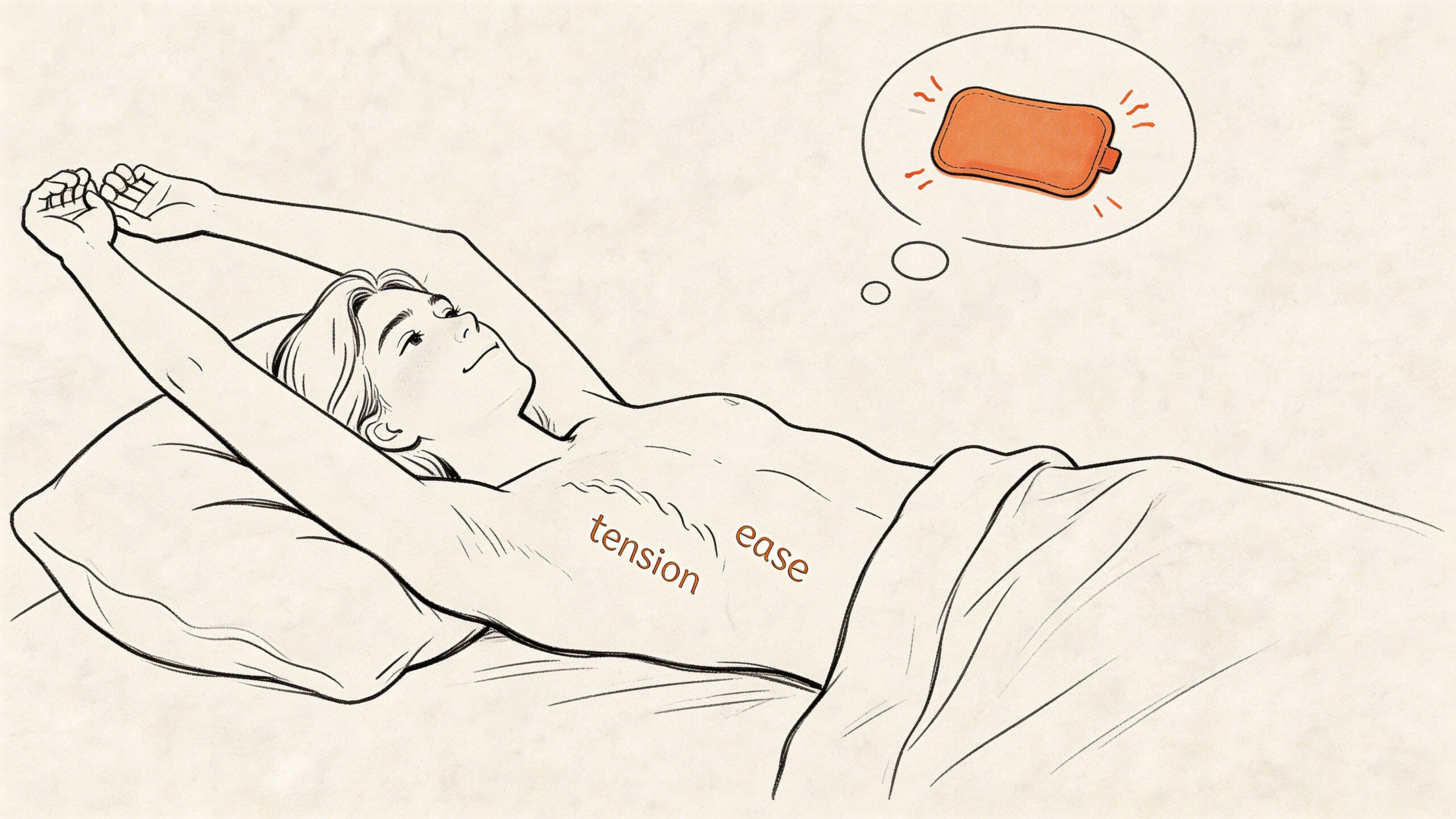
Start before you even stand up
Try this slow sequence while you’re still lying down:
Take a few calm breaths
Put one hand on your stomach and let your ribs expand. Tight muscles often loosen better when you stop bracing.Pull one knee toward your chest
Hold gently, then switch sides. Don’t force range. You’re waking the area up, not trying to win a stretch.Let both knees rock side to side
Keep the motion small. A gentle rotation can reduce the feeling that your lower back is locked.Roll onto your side before sitting up
Use your arms to push up rather than curling straight forward from your waist.
That last step is simple, but it can make a big difference. A sore back often hates fast flexion first thing in the morning.
Use heat or cold based on what you feel
People often ask which is better. The answer depends on the type of soreness.
- Choose heat if your back feels tight, guarded, or stiff.
- Choose cold if it feels inflamed, irritated, or sharply aggravated after a rough night.
Heat often helps muscles release. Cold can calm a flare. Some people do well with heat first, then gentle movement.
If you enjoy deeper heat as part of your recovery routine, this guide on sauna for back pain relief gives practical context on when warmth may help sore, tight muscles.
Get moving within the first half hour
The verified data notes that when morning stiffness is driven by overnight immobility or inflammation, it may improve within 30 to 60 minutes of activity. That’s a useful clue. Motion is often part of the fix.
A short routine can help:
- Walk for a few minutes: Even around the house counts.
- Take a warm shower: The combination of heat and movement can reduce guarding.
- Avoid heavy lifting right away: Your back may need time before handling load.
- Notice patterns: If walking helps fast, stiffness may be playing a large role.
Move gently first. Speed comes later.
Consider whether your bed can help you change positions more easily
Some people wake sore not only because of support, but because changing positions is hard. If getting comfortable takes effort, or if lying flat increases strain, an adjustable base can be worth exploring. This overview of adjustable bed benefits explains how changing the angle of your upper body or legs can support a more comfortable sleep posture.
Immediate relief matters because it gets you through the morning. But it also gives you clues. If a knee pillow, a slower rise from bed, or slight elevation helps right away, your sleep setup is telling you where to look next.
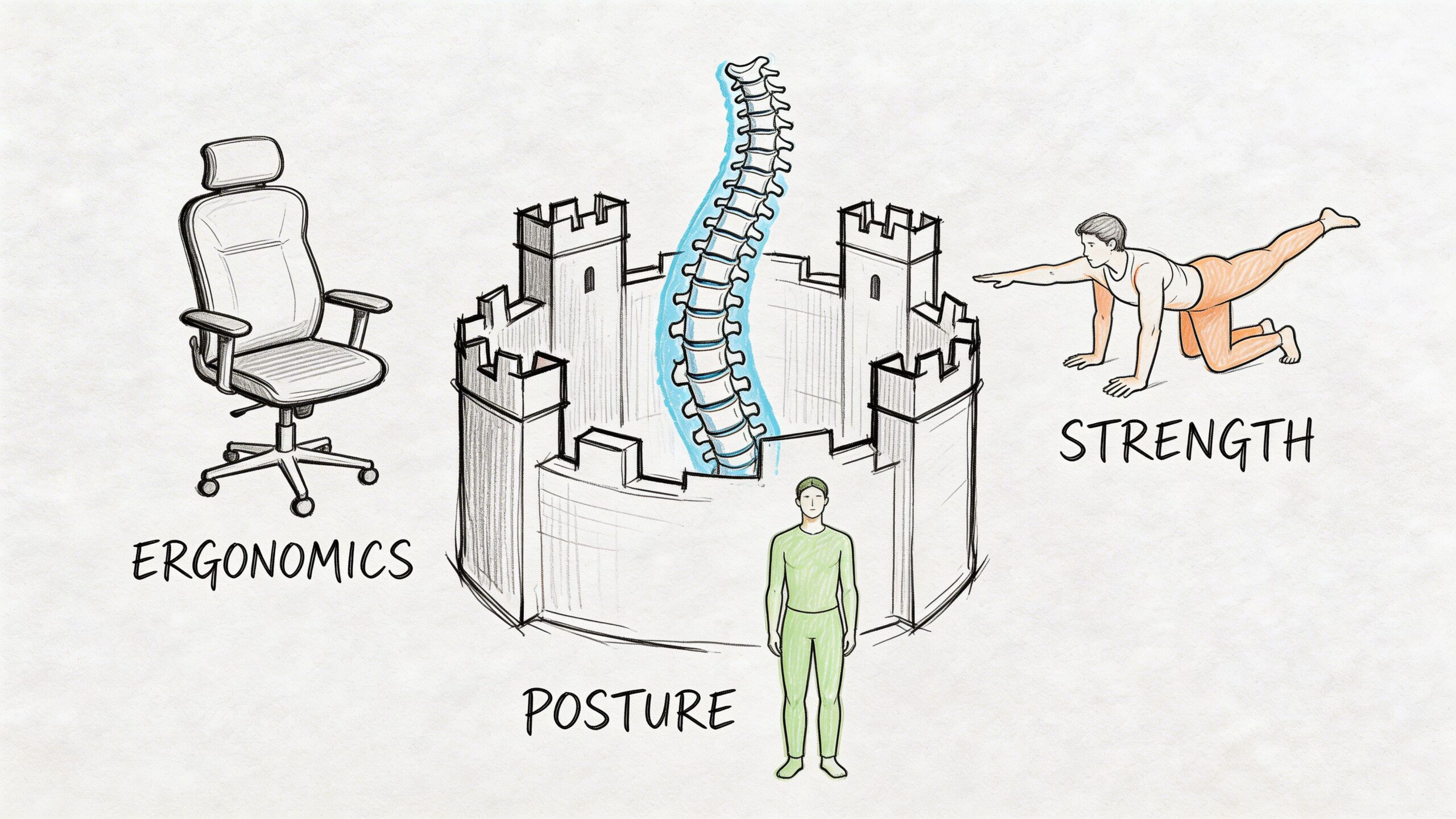
Building Your Fortress Against Future Back Pain
Morning back pain often comes from a pattern, not a single mistake. A mattress can be part of it, but so can pillow height, sleep position, muscle tension, and broken sleep. If you want fewer painful wake-ups, it helps to treat your bed like a system and check each part one by one.
Start with a simple sleep setup check
Use this quick test. Ask yourself three questions:
- Is the mattress old or uneven? Sagging changes how your spine rests for hours at a time.
- Does the firmness match your body and sleep position? A bed can feel comfortable for ten minutes and still let you sink or jam pressure points overnight.
- Is your pillow keeping your neck level with the rest of your spine? If the head is tipped up, down, or off to one side, the strain can travel into the upper and lower back.
That last point surprises people. Your neck and back work as one chain. If the top of the chain is bent, the rest has to compensate.
Audit your pillow setup
A pillow should fill the gap between your head and the mattress. It should not push you into a bend.
For side sleepers, the pillow usually needs enough height to keep the nose lined up with the center of the chest. If your head drops toward the mattress, the pillow is likely too low. If your neck angles upward, it is likely too high.
For back sleepers, the pillow should support the natural curve of the neck without shoving the head forward, like sleeping in a partial crunch.
For stomach sleepers, the pillow often needs to be very thin. In many cases, reducing time spent on the stomach is the better long-term fix because that position can twist the neck and compress the low back.
A photo test helps. Have someone take a picture of you in your usual sleep position. If your neck looks bent instead of level, your pillow setup deserves attention before you blame everything on the mattress.
Build a short evening release routine
Tight muscles can pull your body out of a comfortable resting position. That is why some people wake up feeling as if they slept in a bad posture, even when the bed is reasonably supportive.
A short pre-bed routine is often enough:
- Hip flexor stretch: Long hours of sitting can leave the front of the hips tight, which can tug on the lower back.
- Gentle hamstring stretch: Tight hamstrings can affect pelvic position and change how your back settles into the bed.
- Easy trunk rotation: Keep the motion light and controlled.
- Slow breathing for a minute or two: Less guarding often means less tension carried into sleep.
The goal is not a workout. The goal is to lower the pull on your spine before you lie still for several hours.
Protect sleep quality along with posture
Poor sleep can make pain feel louder. Researchers in Frontiers in Neuroscience found a causal association between insomnia and low back pain, with links running in both directions. In plain language, pain can disrupt sleep, and disrupted sleep can make pain harder to control.
The reason this is important is clear. If your sleep is light, fragmented, or restless, your body gets less of the recovery time it needs. Even a decent mattress setup may not fully help if your nights are consistently broken.
A few habits can reduce that load:
- Keep a regular sleep and wake time
- Cut back on late-night scrolling or stimulation
- Keep the room cool, dark, and quiet
- Notice whether extra time in bed leaves you more sore instead of more rested
Choose materials that fit your pressure points and movement style
Some sleepers need more contouring around the shoulders and hips. Others feel trapped by slow-sinking foam and rest better on a more responsive surface. The right material depends on how your body settles, where you feel pressure, and how often you change positions.
If you are comparing different types of mattresses, focus on what your body is asking for, not just brand names or showroom comfort. For a closer look at how contouring materials can reduce pressure buildup, this guide to the benefits of memory foam mattress designs is useful.
This is the diagnostic mindset that helps. Check the age and feel of your mattress. Check whether your pillow keeps your neck aligned. Check whether your habits and posture are setting you up for tension before bed. Once you know which part of the system is failing, a visit to Miller Waldrop becomes a logical next step, because you are solving a specific problem instead of guessing.
How to Choose a Mattress That Works For You Not Against You
When people shop for a new bed, they often test comfort for two minutes and call it good. Back pain usually shows up after six hours, not six minutes. The better question isn’t “Does this feel soft enough?” It’s “Will this keep my spine supported through the night?”
That’s where a framework helps.
Start with the job your mattress has to do
A mattress needs to do two things at the same time:
- Support your body weight so your spine doesn’t sag
- Relieve pressure so your shoulders, hips, and ribs can settle comfortably
If you only get support, the bed may feel hard and pushy. If you only get pressure relief, you may sink out of alignment.
The verified data states that spinal misalignment on an unsupportive mattress induces mechanical stress, and that medium-firm mattresses rated 5 to 7 out of 10 can reduce this risk by 55% in chronic back pain sufferers by maintaining neutral spine alignment. The same verified source also states that pressure-mapping mattress fitting can help prevent morning stiffness in 70% of users. Those figures are tied to the provided reference URL for the YouTube source on mattress support and pressure mapping.
Use your sleep position to narrow firmness
A firmness scale doesn’t tell the whole story, but it gives you a starting point.
| Sleep Position | Ideal Firmness (1-10 Scale) | Why it Works |
|---|---|---|
| Side sleeping | 5-7 | Helps shoulders and hips sink enough for alignment while still supporting the waist |
| Back sleeping | 5-7 | Supports the natural curve of the spine without excessive sagging |
| Stomach sleeping | 5-7, though changing positions is often better | More support can reduce sink, but posture is still a challenge in this position |
This table reflects the verified data’s emphasis on medium-firm mattresses in the 5 to 7 range. Within that range, your body shape and comfort preference still matter.
Compare the main mattress types by feel and function
If you’re sorting through different types of mattresses, it helps to think in terms of response, contour, and support rather than marketing labels.
Innerspring
An innerspring mattress tends to feel more buoyant and easier to move on. Some sleepers like the lifted feel. For back pain, the key question is whether the comfort layers on top are substantial enough to prevent pressure buildup.
This can work well for people who dislike the hug of foam.
Memory foam
Memory foam contours more closely to the body. That can help if you wake with pressure at the hips or shoulders, or if you need the bed to fill in gaps around the waist and lumbar area.
It may not feel right for people who want a springier surface.
Hybrid
Hybrids combine coils with foam or other comfort layers. For many people with morning back pain, hybrids strike a useful middle ground. They can offer support from below and contour from above.
That combination is one reason shoppers often land here when they want both stability and cushioning.
Check whether your current mattress has aged out of the job
An old mattress doesn’t always look broken. It just stops supporting you evenly.
The verified data notes that mattresses typically lose some of their support over time. That doesn’t mean every older mattress is automatically wrong for you, but it does mean age should be part of the diagnosis.
Use this quick checklist:
- Lie where you normally sleep: Do you feel a dip beneath your hips?
- Look for body impressions: Especially if they remain after you get up.
- Check edge support: If the perimeter feels weak, the internal structure may be declining.
- Notice repeat pain patterns: Same mattress, same pain, same morning usually means something is consistent.
- Compare nights away from home: Less pain elsewhere is useful evidence.
A mattress doesn’t need to collapse to become a problem. It only needs to stop holding your body in a neutral position.
Match the bed to your body, not to a slogan
“Firm is better for your back” is too simplistic. The right bed depends on how your shoulders, hips, and waist interact with the surface.
A lighter side sleeper may need more pressure relief than a heavier back sleeper. A person with broad shoulders may need deeper contouring than someone with a straighter build. Partners may need a compromise feel or a mattress with strong motion isolation.
That’s why in-store testing should be intentional. Lie in your normal position long enough to notice where your body settles. Pay attention to the small signs.
Ask yourself:
- Does my lower back feel unsupported?
- Are my shoulders jammed upward?
- Are my hips sinking too far?
- Can I relax, or am I subtly bracing?
One practical option for people who want a guided fit is to work with sleep specialists who use pressure mapping rather than guesswork. Miller Waldrop Furniture & Decor offers mattress guidance through sleep experts and a high-tech bed matching system, along with options from brands such as Serta and Beautyrest. If you want to compare support features with back pain in mind, this page on the best mattress for back pain is a useful next step.
A mattress is not just a bedroom purchase. It’s a tool your body uses for hours every night. If your back hurts after sleeping, the right mattress can remove a problem your muscles have been trying to solve on their own.
Beyond the Bedroom When Pain Signals a Deeper Issue
Most morning back pain comes from mechanics. Position, support, stiffness, tension. But sometimes the pain is a signal that something more is going on.
One clue is what happens after you get moving.
Mechanical pain often improves as your body warms up. You walk, shower, stretch lightly, and things loosen. That doesn’t make it trivial, but it does suggest your sleep setup may be a major factor.
Pain that stays intense, spreads, or comes with other symptoms deserves more attention.
Signs to take seriously
Contact a healthcare professional if you notice any of these:
- Pain that shoots down a leg
- Numbness or tingling
- Weakness in the leg or foot
- Pain that keeps worsening instead of easing
- Morning pain that doesn’t improve after trying sleep changes for a few weeks
Those patterns can show up with issues such as disc irritation, nerve involvement, or spinal narrowing. Arthritis can also contribute, especially when stiffness is pronounced in the morning.
When poor sleep itself may be part of the problem
Poor sleep doesn’t just make pain feel more annoying. It may directly affect pain pathways.
Verified data from the 2022 genetic study found that insomnia increased the odds of developing low back pain by nearly double, supporting the idea that disrupted sleep can contribute to morning back pain by interfering with the body’s natural pain inhibition pathways. That means if you’re tossing, waking often, or never reaching restorative sleep, your back may feel the effects even if your mattress isn’t the only issue.
Don’t ignore patterns that feel different from simple stiffness
If your pain is new, intense, radiating, or paired with neurologic symptoms, get checked. If it feels like ordinary stiffness that improves with movement, keep working through the sleep-environment checklist.
Both responses are reasonable. The key is not treating every kind of morning pain as if it has the same cause.
Your Action Plan for Pain-Free Mornings
Morning back pain usually improves when you stop treating it like a mystery and start treating it like a pattern.
Tonight, check your sleep position. If you’re on your stomach, try shifting to your side or back. If you’re on your side, add a pillow between your knees. If you sleep on your back, pay attention to whether your lower back feels unsupported.
Next, inspect your mattress and pillow setup. Look for sagging, pressure points, awkward neck angles, or signs that your bed no longer matches the way you sleep. If your mattress is older, uneven, or leaves you with the same ache every morning, that’s useful information.
In the morning, move slowly. Use the gentle wake-up sequence, add warmth if tightness is the main issue, and notice whether motion helps. Then build prevention into your evenings with a short stretch routine and better sleep habits.
You don’t have to solve everything in one night. Small changes often reveal a lot.
If you’ve worked through the self-check and you’re ready for help choosing a more supportive sleep setup, Miller Waldrop Furniture & Decor can help you compare mattresses, pillows, and sleep solutions in a way that fits your body, your comfort preferences, and your home.