


Fix Sagging Bed: Your Guide to Better Sleep


You know the feeling. You lie down, settle in, and within a few minutes your hips sink lower than your shoulders. Instead of sleep, you get that slow-roll slide toward the middle of the bed and the familiar thought that something expensive is probably failing.
A sagging bed feels like a mattress problem, but that’s not always where the trouble starts. In homes across West Texas and Southeastern New Mexico, the issue is often lower down in the bed system. A loose frame, wide slat gaps, or a weak center support can create the same “my mattress is shot” feeling long before the mattress itself is done.
The good news is that a fix sagging bed project usually starts with diagnosis, not shopping. That matters because the wrong fix wastes time, money, and sometimes your warranty. The right fix can be as simple as tightening hardware, correcting slat spacing, or reinforcing the support under the mattress.
Beds fail in predictable ways. Once you know where to look, you can usually sort the problem into one of three buckets. The mattress is worn out. The foundation is failing. The frame has lost its shape and support.
Reclaiming Your Sleep from That Dreaded Sag
Many sleepers wait too long to deal with a sagging bed because they assume the answer will be expensive. They throw on a topper, shove something under the middle, or start sleeping closer to the edge. That buys a little time, but it rarely fixes the reason the bed started sagging in the first place.
A bed is a system. The mattress gets the blame because that’s what you feel, but support problems often begin under it. I’ve seen plenty of beds that felt worn out from the top, only to find a loose center rail, bowed slats, or a tired foundation doing most of the damage. That’s why guessing is a mistake.
Practical rule: If the bed started sagging suddenly or within a relatively short time, inspect the support structure before you assume the mattress is done.
There’s also a trade-off people miss. Some DIY fixes help comfort in the short run but can complicate a warranty claim if you alter the setup before documenting the problem. If you own a quality mattress, that detail matters.
The smart approach is simple:
- Start with the cause: Separate mattress wear from frame or foundation failure.
- Match the fix to the problem: Tightening hardware and correcting slat spacing works differently than replacing a worn-out sleep surface.
- Know when to stop repairing: Some beds need reinforcement. Some mattresses need replacement. They are not the same call.
This is a solvable problem. You don’t need guesswork, and you don’t need a pile of random boards under the bed. You need a clean diagnosis, a fix that supports the mattress correctly, and enough confidence to know whether you’re repairing or replacing.
The Diagnosis Is It Your Mattress Foundation or Frame
A customer complaint I hear all the time goes like this: “The mattress suddenly feels shot.” Then we pull it apart and find a bowed slat, a center leg hanging above the floor, or a foundation that has been flexing for months. Diagnosis comes first because the right fix depends on what is failing, and guessing can cost you a warranty claim or a mattress you did not need to replace.

Start with the simplest controlled test. Put the mattress flat on the floor for a short comparison. The floor is not a proper long-term setup, but it gives you one thing your bed may not: a flat, fully supported surface.
If the mattress feels more even on the floor, look below it first.
Do the floor test first
Once the mattress is off the bed, check for signs that point to wear inside the mattress versus support failure underneath:
- Visible body impressions on a flat surface: That usually points to mattress wear.
- A dip that only shows up on the bed: That usually points to the foundation or frame.
- A lower feel on one side: The frame may be twisted, out of level, or loosening at the joints.
This step matters for another reason. Many manufacturers want the mattress measured on a proper surface before they will review a sagging claim. If you start adding plywood, extra boards, or other makeshift fixes before you document the problem, you can make that process harder.
Check the foundation next
Now inspect the layer under the mattress. That may be a box spring, a rigid foundation, or a slat system. Press on the center and both sides. Look underneath if you can. Listen for cracking, shifting, or hardware movement.
If you are not sure what support your mattress is designed to use, read our guide on why you really do need a box spring for your bed before you assume any flat platform will work the same way.
A weak foundation usually gives clear clues:
| Sign | What it usually means |
|---|---|
| Bowed or cracked slats | Load is not being carried evenly |
| Wide gaps between slats | Foam or hybrid materials can sink between supports |
| Soft spot in the middle | Center support is weak, undersized, or missing |
| Popping or squeaking | Joints, fasteners, or support points are loosening |
Slat spacing and hardware both matter. If fasteners are stripped, mismatched, or missing, use a guide on choosing the right fittings before replacing parts. The wrong bolt or bracket can leave the frame looking tight while it still shifts under load.
Inspect the frame last
With the mattress and foundation removed, test the frame by hand. Grab the side rail near each corner and apply light pressure. A sound frame should stay square and planted. If the corners rack, the rails bow, or the center beam moves, the frame is part of the problem.
Queen and king beds fail in the middle more than anywhere else. I pay closest attention to the center rail and support legs because that is where sagging usually shows up first. If a center leg does not firmly contact the floor under load, the bed can dip even when everything else looks fine at a glance.
Use this order every time:
- Mattress on floor
- Foundation inspection
- Frame inspection
That sequence keeps the diagnosis clean and gives you a better shot at preserving your warranty options before you try any repair.
Reinforcing Your Bed Frame for Solid Support
When the frame is the weak link, random bracing usually makes things worse. The fix is to restore shape, tighten connections, and add support where the frame carries load.

A proven repair sequence is to tighten all fasteners, reduce slat spacing to 3 inches or less, and confirm center support legs contact the floor under load. Following that protocol leads to 75–85% satisfaction, versus 40–50% for incomplete fixes, according to this bed-frame support guide.
What to gather before you start
You don’t need a workshop full of equipment, but you do need the right basics.
- Hand tools: Allen keys, screwdrivers, socket set, and an adjustable wrench
- Reinforcement material: A solid center beam, wood slats, metal corner brackets, or angle braces
- Hardware: Fresh bolts, washers, lock nuts, and replacement screws if the originals are stripped
- Measuring tools: Tape measure and a straightedge
If you’re replacing worn or mismatched hardware, this resource on choosing the right fittings can help you match fasteners to the frame instead of forcing in “close enough” parts that loosen again.
Tighten the structure before adding anything
A lot of sagging starts because the frame racks out of square over time. That changes how weight transfers across the rails and slats. Before you add wood or braces, tighten every accessible connection.
Work in a sequence rather than tightening whatever you reach first:
- Corner joints first: Headboard-to-rail and footboard-to-rail connections.
- Side rail hardware next: Check brackets, hooks, and bolts for play.
- Center rail connection last: This area carries the load that people feel most.
If a bolt spins and never cinches down, the issue may be a worn insert, stripped hole, or missing washer. Replace the hardware before moving on.
Don’t use shims as your main structural repair in the center of the bed. They can prop up one point while leaving the rest of the frame free to flex.
Add a true center support
For many frames, the single best fix sagging bed move is adding a true center support beam with legs that reach the floor. That’s very different from a decorative middle rail or a beam that floats above the surface until someone sits on the bed.
A proper reinforcement usually includes:
- A solid beam: Wood or engineered support running head to foot
- Floor-contact legs: Adjustable if your floor isn’t perfectly even
- Stable placement: Positioned to carry the middle third where sagging shows up first
If you’re also weighing an upgrade path, it helps to understand what an adjustable base bed is and how a solid support platform changes the way a mattress performs.
Correct the slat layout
Even after you reinforce the frame, the sleep surface can still fail if the slats are too far apart. Measure the gaps, not just the number of slats. Many older frames weren’t built for modern foam and hybrid mattresses.
If the slats are sparse, you have two good options:
| Option | Best use | Limitation |
|---|---|---|
| Add more slats | Keeps airflow and maintains a lighter structure | Requires proper fit and spacing |
| Install a support panel over slats | Creates a more uniform surface | Can reduce airflow depending on material |
The goal is uniform support across the span, not just “more stuff under the bed.” A square, tight frame with a real center beam solves far more problems than improvised braces screwed in after the fact.
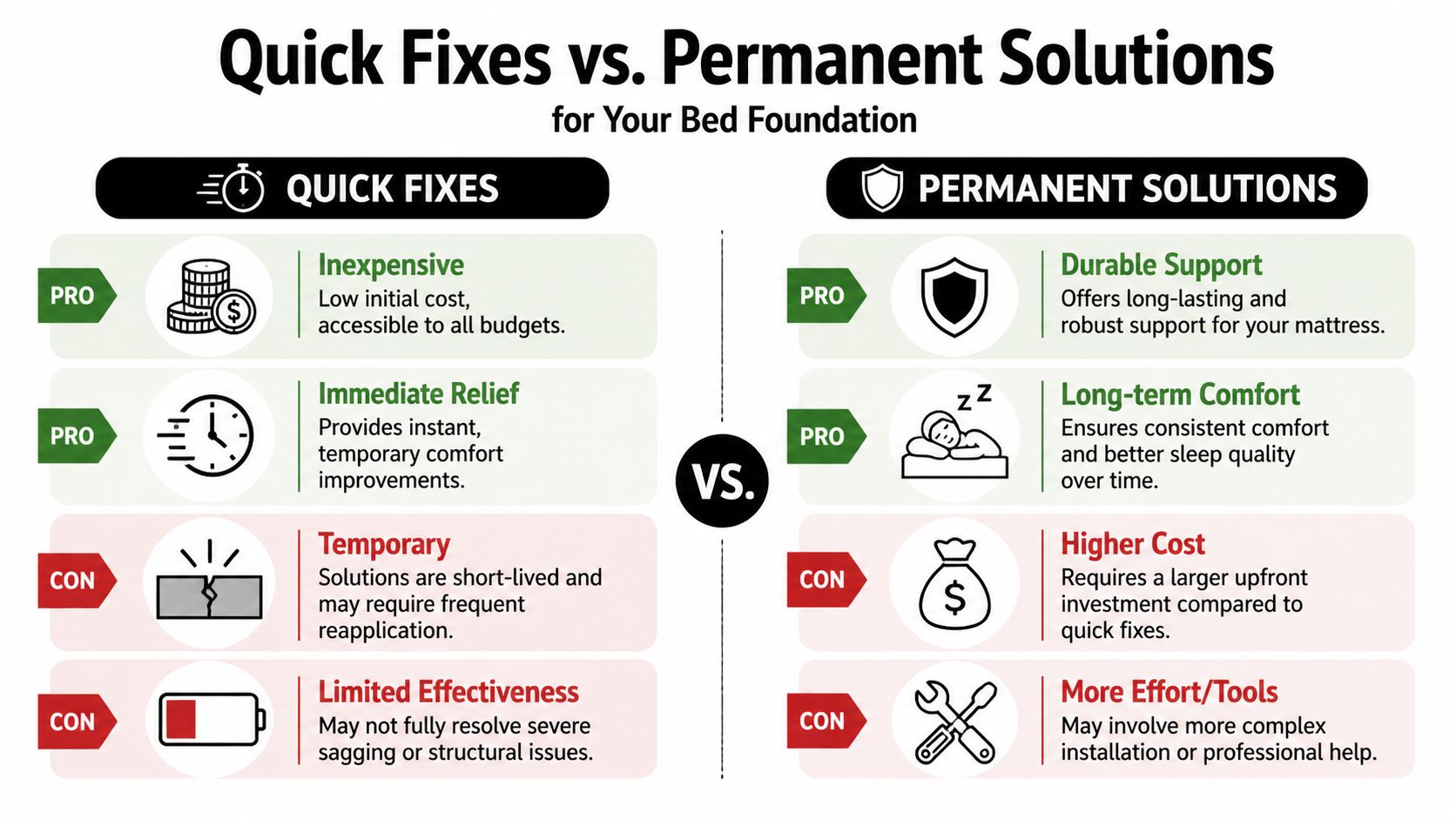
Quick Fixes and Permanent Solutions for Your Foundation
Sometimes the frame is fine and the trouble sits one layer higher. A worn box spring, undersized slat system, or poorly spaced support deck can make a mattress feel broken when the mattress is only reacting to what’s under it.
Manufacturer guidance aligned with brands like Serta and Beautyrest recommends a center support beam and slat spacing of no more than 3 inches for foam or hybrid mattresses. Reducing slat gaps can cut mid-span mattress deflection by 60–80%, according to this foundation support overview.
What helps right away
Quick fixes have a place. They’re useful when the mattress is still in decent shape and you need better support while you plan a proper repair.
Common short-term options include:
- A bunkie board: Useful when you need a flatter, more continuous surface without changing the whole bed
- A plywood overlay: Often used to bridge weak slat systems and reduce sink between gaps
- A mattress helper or support pad: Helpful for comfort, but only if the base issue is mild
These fixes can improve feel quickly, but they don’t rebuild a failing foundation. If the support below is cracked, bowed, or structurally weak, a patch only spreads the problem out.
What holds up longer
Permanent solutions do more than disguise the sag. They correct the support geometry so the mattress can perform the way it was designed to.
The strongest long-term fixes are usually structural:
- Replace wide-spaced slats with closer-spaced slats
- Add missing center support
- Replace a failing box spring or foundation
- Rebuild the support deck to match the mattress type
If you sleep on memory foam or a hybrid, slat spacing matters more than many people realize. Too-wide gaps create unsupported zones. The mattress dips into those openings night after night, and the problem shows up where your hips and lower back carry the most load.
A topper can hide discomfort. Better support underneath changes the reason you were uncomfortable in the first place.
Comparing the trade-offs
Here’s the practical view:
| Approach | Cost and effort | Best for | Weak point |
|---|---|---|---|
| Bunkie board | Lower effort | Mild support issues | Doesn’t fix broken structure |
| Plywood overlay | Fast and accessible | Slat systems with too much spacing | Can affect airflow |
| Additional slats | Moderate effort | Frames that are mostly sound | Needs accurate spacing |
| New foundation | Higher effort | Worn or failing support systems | More upfront cost |
A lot of people reach for plywood first because it’s easy. That can be a reasonable test. But if the issue is a failing box spring, a missing center support, or cracked support members, plywood becomes a bandage over a structural problem.
Choose the quick fix if you need immediate relief and the rest of the bed is sound. Choose the permanent repair if the base is clearly the reason the mattress is dipping.
Knowing When to Repair Versus Replace Your Mattress
A lot of sagging-bed problems get misdiagnosed at this stage. The frame gets reinforced, the foundation gets patched, and the bed still feels wrong because the mattress itself has already lost the support and comfort it was built to provide.

Here is the practical line I use in the showroom and in customers' homes. If the mattress improves noticeably on a flat, solid surface, keep looking at the support system. If it still has a body impression, uneven feel, or that hammocking sensation on a proper base, the mattress is usually the problem.
Repair makes sense when the mattress still has life left
Keep working on the bed setup if the signs point to support failure rather than mattress wear:
- The mattress felt better on the floor
- The sag showed up earlier than expected
- The dip lines up with bad support underneath
- The mattress surface looks more even once it is off the frame
- You can trace the problem to warranty-safe issues like slat spacing or missing support
That last point matters. Before making any DIY change, check the warranty terms. A lot of mattress warranties require a specific foundation, proper center support, and no unauthorized alterations. If you start modifying the setup without documenting the condition first, you can make a valid claim harder to prove. SleepWorld's article on understanding mattress sagging signs and warranty impact is a useful reference.
Replace when wear is the real issue
A new foundation will not fix broken foam, tired coils, or permanent impressions in the sleep surface. I see this often with older mattresses that have been sitting on weak support for too long. The owner fixes the frame, the bed gets slightly better, and then realizes the mattress itself is still the weak link.
Replacement moves to the front of the list when:
- The mattress is showing clear body impressions or soft spots
- You still feel the sag after fixing the support underneath
- You wake up sore even though the frame is now stable
- The mattress age and condition match normal wear, not a sudden support failure
- A topper only masks the problem for a short time
If you want a broader checklist, this guide on when to replace your mattress lays out the common signs in plain terms.
One more practical point. If you are replacing the mattress, plan the removal before delivery day. Tight stair turns, narrow hallways, and apartment entries create their own problems. This practical moving checklist in Emmanuel Transport's guide is useful if you need to get the old one out safely.
The goal is not to keep repairing forever. The goal is to diagnose the right layer first, protect any warranty you still have, and spend money where it solves the problem. If the mattress is worn out, more lumber underneath will not turn it back into a supportive bed.