

What Size Rug for Living Room: Your 5-Step Guide to the Perfect Fit

Choosing the right rug for your living room is your secret weapon for creating a space that feels truly complete. Your mission is to find a rug that's large enough to anchor your main seating area, transforming it into a cohesive and inviting hub. Many people accidentally choose a rug that's too small, which can make a room feel disjointed and chaotic. With this guide, you'll have the power to avoid that common pitfall.
The golden rule to empower your design? At least the front legs of your sofa and any accent chairs should sit comfortably on the rug.
Answering Your Biggest Rug Size Question
Think of your living room rug as the foundation of your design. It's the essential tool that pulls everything together, connecting your sofa, chairs, and tables into one unified group. When you get the size right, every piece of furniture will feel like it was placed with intention.
A rug that's too small "floats" in the middle of the floor, making your furniture look like it's drifting apart. This optical illusion can make your room feel smaller than it is. On the other hand, a correctly sized rug unifies the entire setup, creating a harmonious conversation area that invites people to gather.
The Three Core Placement Rules
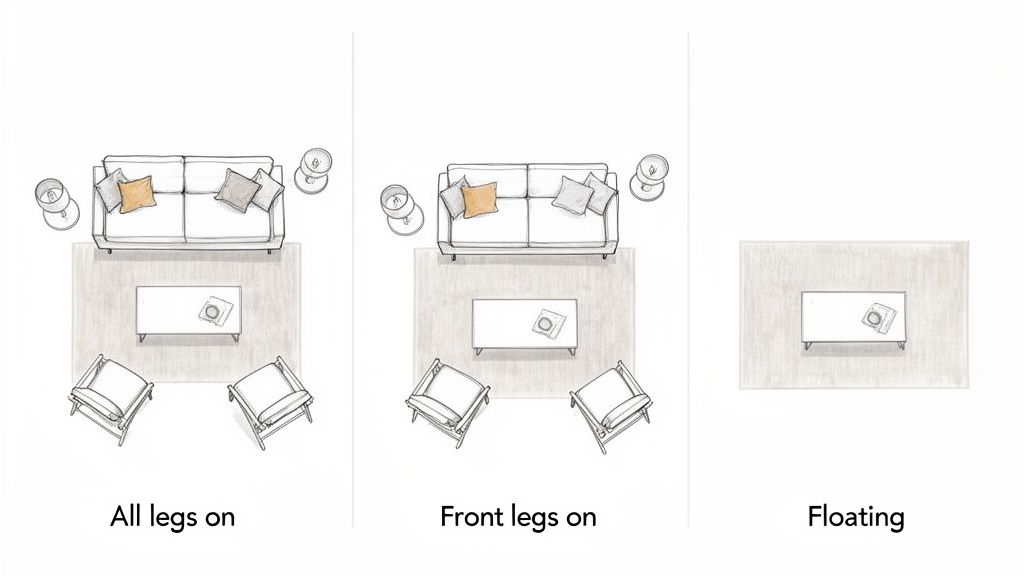
To simplify your decision, you can use the same three basic placement rules that interior designers use. The one you choose will depend on your room's size and the overall vibe you want to create. Knowing these options is the key to visualizing how you can achieve the look you want for your space.
-
All Legs On the Rug: This is where every piece of furniture sits completely on top of the rug. It creates a very luxurious, clearly defined seating zone and works beautifully in larger or open-concept living rooms.
-
Front Legs On the Rug: This is by far the most popular and versatile approach. You simply place the front legs of your sofa and chairs on the rug. This technique does a fantastic job of visually connecting everything without closing off the room, keeping it feeling open and airy.
-
Coffee Table On the Rug (The 'Floating' Method): This option is best reserved for very small spaces or for showcasing a unique vintage or oddly shaped rug. In this layout, only the coffee table sits on the rug, which "floats" in the space between the furniture.
"A rug in a living room should really ground the whole seating around – it tells everyone that THIS is where the conversation is, this is the focal point of the room, and a too small rug makes it feel disjointed and really just cheapens everything."
Each of these layouts offers a different blueprint for your room. To help you decide, here’s a quick breakdown of where each rule shines.
Quick Guide to Living Room Rug Layouts
| Layout Rule | Best For | Visual Effect |
|---|---|---|
| All Legs On | Large, open-concept rooms | Defines a luxurious and unified seating area. |
| Front Legs On | Most living rooms; very versatile | Connects furniture while keeping the room feeling spacious. |
| Floating (Coffee Table On) | Small spaces or unique accent rugs | Creates a central focal point without overwhelming the room. |
Once you understand these basic layouts, you can measure your space with confidence and select a rug that doesn't just fit, but actually enhances your living room's style. After you've figured out the perfect size, you can dive into other details. This broader guide on how to choose a living room rug is a great next step for exploring patterns and materials.
Ready to find the piece that will tie your room together? Explore our collection of high-quality area rugs or schedule a complimentary design consultation with our experts in Lubbock, Hobbs, or Ruidoso today. Let’s help you create a space you love.
How to Measure Your Living Room for a Rug
Before you fall in love with a rug pattern, your first and most important mission is to understand the space it’s going into. Measuring isn’t just about getting numbers; it’s about creating a blueprint for a living room that feels cohesive and thoughtfully designed. A few minutes with a tape measure now will empower you to avoid the common mistake of choosing a rug that's too small and throws the whole room off balance.
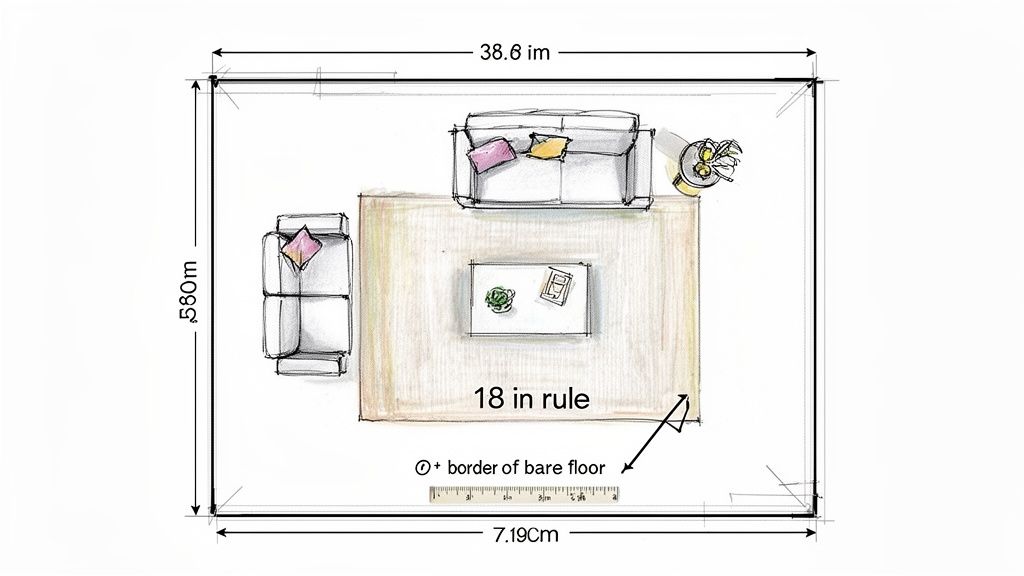
Your design journey begins with the big picture. Grab a tape measure and get the total length and width of your living room, from wall to wall. This gives you the maximum canvas size you have to work with.
But here’s the key: the most important measurement isn't the entire room—it's your seating area. This is the heart of the room, where your sofa, chairs, and coffee table create a conversation zone. Measure the length and width of this entire furniture cluster. This tells you the minimum size your rug needs to be to properly anchor everything.
Mastering the Rule of 18 Inches
Ever wonder how you can achieve that polished, finished feel you see in professionally designed rooms? Often, it’s the perfect border of bare floor around the rug. This is where a classic design principle, the "rule of 18 inches," comes into play. For most living rooms, leaving about 18 inches of exposed floor between the rug’s edge and the walls is the sweet spot.
Think of this gap as a frame for your rug. It defines the seating area without making the rug look like it’s trying (and failing) to be wall-to-wall carpet. This simple border makes the room feel more spacious and intentional.
Of course, rules are made to be adjusted. If you're working with a smaller living room, a full 18-inch border might cramp your style. In cozier spaces, you can shrink that gap down to 8 to 12 inches. The real goal is consistency—a uniform border on all sides is what delivers that clean, composed look.
Pro Tips for Spot-On Measuring
Numbers on a tape measure can be hard to visualize. That's why one of the best tricks in the book is using painter's tape. Once you have a potential rug size in mind, say an 8'x10' or 9'x12', you can mark out its exact dimensions on your floor with the tape.
This simple step is a game-changer. It lets you see and feel how the rug will occupy the space long before you buy it. You can walk around it, see how it lines up with your sofa, and make sure your walkways are clear. It’s the easiest way to avoid the headache of a return.
A great rule of thumb is to ensure your rug is at least 6-8 inches wider than your sofa on both sides. This helps frame the largest piece of furniture in the room, making the whole arrangement feel grounded and deliberate.
Finally, don't forget to account for your room's unique quirks. A few things to keep an eye on include:
- Door Swings: Make sure your rug won't get caught under any doors that swing into the room.
- Fireplace Hearths: A rug should never cover the hearth. Decide if you want it to sit just in front of the hearth or if you want the front legs of your furniture to rest on it.
- Floor Vents & Built-ins: Keep these areas clear. You don't want to block airflow or access to custom cabinetry.
By taking these steps, you're doing more than just measuring; you're setting the stage for a perfectly pulled-together room. When you're confident in your dimensions, the fun part begins. Start by exploring our collection of high-quality area rugs to find the perfect piece for your home.
Matching Standard Rug Sizes to Your Furniture
Walking into a rug showroom and seeing sizes like 5'x8', 8'x10', and 9'x12' can feel like trying to solve a puzzle. How do those numbers on a tag translate to your actual living room? The secret is to stop thinking about a rug's dimensions in isolation and start seeing it as a partner to your furniture.
Each standard size is really a blueprint for a common furniture layout. It’s designed to help you transform your space from a collection of separate items into one unified, welcoming whole. A rug isn't just something you put on the floor; it's the stage where your living room's story plays out. Once you understand how each size works with sofas, sectionals, and chairs, choosing the right one becomes a powerful and intuitive process.
The Small but Mighty 5'x8' Rug
A 5'x8' rug is the perfect fit for smaller living rooms or those defined seating nooks. It works best with a "floating" layout, where the rug sits right under the coffee table but doesn't actually touch any of the surrounding furniture.
This is a fantastic tool for apartments or condos where a bigger rug might just swallow the room whole. It anchors your central table and creates a clear focal point without making the space feel any smaller. Keep in mind, though, for a standard living room with a full-sized sofa, this size is almost always too small and can make the room feel disconnected—exactly what you are trying to avoid.
The Versatile 8'x10' Rug
There's a reason the 8'x10' rug is the reigning champion of living rooms: it's incredibly versatile. This size is the ideal solution for the most popular and foolproof layout—the "front legs on" rule. It’s large enough to connect all your main furniture pieces without demanding a massive room.
Imagine your classic three-seater sofa with a couple of accent chairs. An 8'x10' rug lets you place the front feet of every piece comfortably on its surface. This one simple move visually ties everything together, creating a cohesive and beautifully designed conversation area. It’s the key to achieving that grounded, intentional look, making it the go-to choice for countless homes.
The growing importance of area rugs in design is huge. The global market for area rugs was valued at USD 11.77 billion and is expected to hit USD 17.38 billion by 2032. Since North America is the largest market, you have access to all the best trends right here in Lubbock, Texas, and Southeastern New Mexico.
The Luxurious 9'x12' Rug and Larger
When you’re working with a more expansive living room or a large sectional sofa, a 9'x12' rug (or even bigger) is your best friend. This is the size you need for the "all legs on" layout, where every single piece of your seating arrangement sits completely on the rug.
A larger rug creates a truly defined zone, almost like a room within a room. It's a powerful tool in open-concept spaces for separating the living area from a dining room or kitchen, offering a sense of luxury and completeness.
This generous sizing ensures your furniture looks anchored and grand, not like it's lost in a wide-open space.
- For Large Sectionals: A 9'x12' or 10'x14' rug ensures the entire sectional can rest on it, which unifies the biggest piece of furniture in the room.
- For Multiple Seating Groups: If you have two sofas facing each other, a large rug can bridge the gap and connect them both into one grand conversation pit.
Of course, the rug is just one piece of the puzzle. The coffee table that sits on top of it is just as crucial for both function and style. You can explore our expert advice on how to choose a coffee table to really complete your living room's central hub.
To see how this all comes to life, imagine a piece like the stunning Hooker Furniture Abstract Performance Rug. Its beautiful design can serve as the centerpiece, and picturing it in different sizes makes these concepts much more tangible. Whether you need an 8'x10' to unify your sofa and chairs or a 9'x12' to ground a sectional, seeing a real product in context makes all the difference.
Ready to find the perfect anchor for your living room? Visit one of our showrooms in Lubbock, Hobbs, or Ruidoso, and let our design experts help you match the right rug size to your unique space.
Choosing a Rug Layout for Your Room
Your furniture arrangement sets the stage for your living room, and the rug is the foundation that ties everything together. Choosing a rug layout is more than just covering the floor; it's about defining the space, creating a sense of order, and making the room feel complete. Whether you're working with a classic sofa and a couple of chairs or a huge sectional that commands the room, the rug placement will define the entire vibe.
Think of it as the final, crucial step in designing your space. You can use one of three common strategies: having all furniture legs on the rug, just the front legs on, or letting the rug "float" on its own. Seeing how these apply to different furniture setups will help you visualize what works best for your home.
To get started, this decision tree is a great visual aid for connecting your room's general size to the right rug layout.
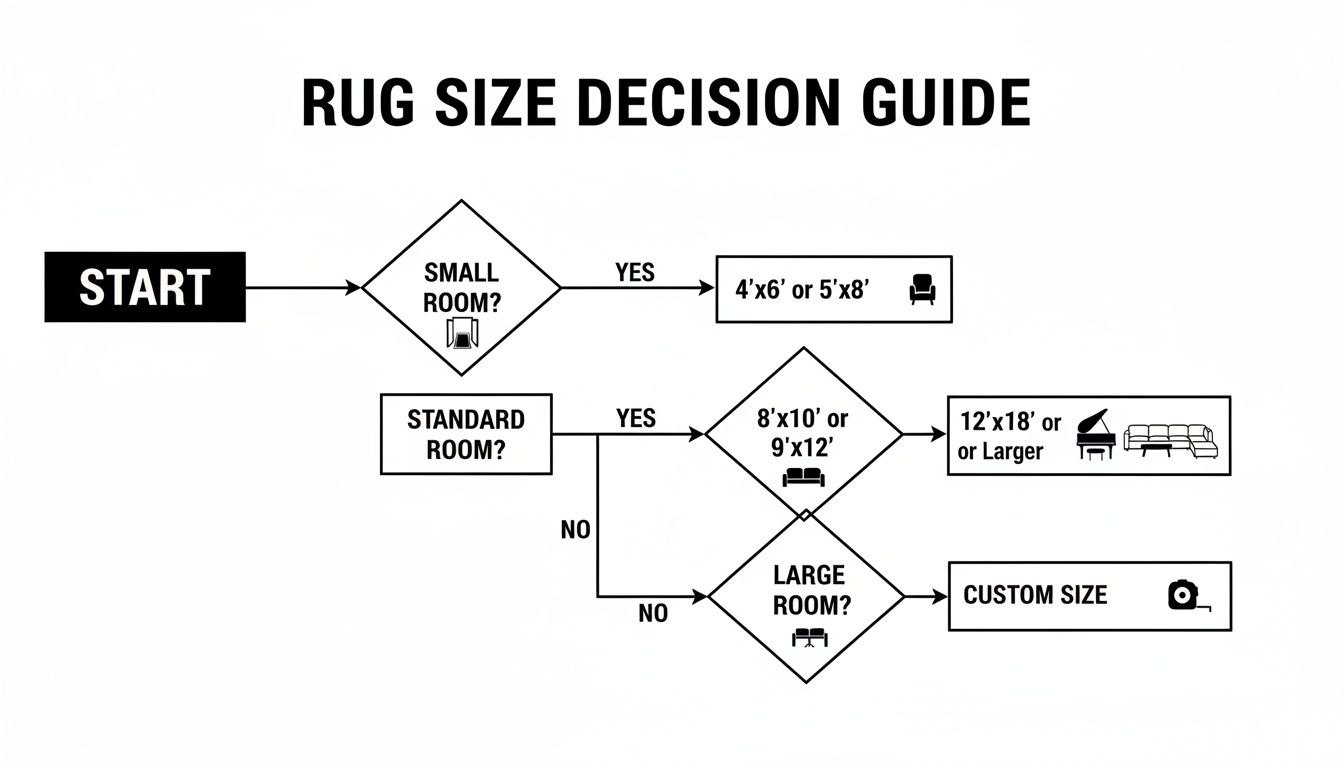
It helps take the guesswork out of the process, giving you a solid starting point based on the scale of your living area.
The All Legs On Layout
This is the most luxurious and cohesive option. When you place every piece of furniture—the sofa, chairs, and tables—completely on the rug, you create a very clear and unified seating area. It’s like creating a beautiful, comfortable island. This approach is fantastic for large, open-concept spaces where you need to carve out a distinct living zone from, say, a dining area or entryway.
For a sprawling sectional, this is almost always the way to go. A generous rug, like a 9'x12' or 10'x14', makes sure the entire sectional feels grounded and doesn't look like it's just floating in the middle of the room. A good rule of thumb is to leave at least 8 inches of rug showing behind the furniture to create a deliberate, spacious border.
This layout makes a statement: this is the spot for gathering and relaxing. It’s a powerful way to bring a sense of purpose to a large room.
The Front Legs On Layout
There's a reason this is the most popular layout—it's incredibly versatile and strikes the perfect balance for most living rooms. The "front legs on" method gives you that connected, grounded feeling without needing a massive rug or an oversized space. Here, only the front legs of your sofa and accent chairs sit on the rug, while the back legs stay on the floor.
It’s the go-to solution for a standard sofa-and-chairs setup. The rug acts as a visual bridge, connecting all the pieces into a single group. This keeps the conversation area feeling anchored while allowing the room to seem open and airy.
More and more, homeowners are seeing a great rug as a key investment. The global carpet and rug market, valued at around USD 55.87 billion, is expected to hit USD 88.41 billion by 2030. This shows how much a well-sized rug contributes to a home's comfort and style.
The Floating Layout
This one is best saved for smaller rooms or when you have a truly special rug you want to feature as a piece of art. The "floating" layout means the rug sits under the coffee table but doesn't touch any of the surrounding furniture. It can be tricky to pull off, because if the rug is too small, it can end up looking like a postage stamp in the middle of the floor.
To make this work, the gap between the rug's edge and the furniture has to be minimal—no more than a few inches. This keeps the whole arrangement feeling tight and intentional. While these rules are your foundation for the living room, you can adapt the core ideas for other spaces, too. For more tips, take a look at our guide on area rug placement in the bedroom.
Ready to find the perfect foundation for your living room? Come visit us at our showrooms in Lubbock, Hobbs, or Ruidoso to see our curated collection of rugs. Our design experts are always on hand to help you bring your vision to life.
Styling Your Rug for Maximum Impact
You've nailed down the right size for your living room rug—that’s the technical part. Now comes the fun: making it look incredible and bringing your room to life. Think of the rug's size as the canvas; the style, color, and texture are the paint you use to create your masterpiece.
This is where you get to decide if your rug will be a quiet, supporting actor or the star of the show. By choosing the right colors, patterns, and materials, you can turn a simple floor covering into the element that pulls the entire room together and makes it feel uniquely yours.
Choosing Colors and Patterns
The color of your rug is one of the fastest ways you can set the mood. A neutral rug in a soft cream, a gentle gray, or an earthy beige creates a serene, calming foundation. This is a great choice if you already have bold furniture or artwork and just need something to ground the space with a bit of texture and warmth.
On the flip side, a rug with a vibrant color or a striking pattern can be the focal point of the entire room. If your sofa and chairs are mostly solid, neutral colors, a dynamic rug can inject a huge dose of energy and personality. You can confidently pick a rug that demands attention—it can be the single thing that makes your room feel intentional and professionally designed.
Here's a pro tip: Look around your room and find 2-3 accent colors you already love, maybe from a piece of art, a throw pillow, or your curtains. Find a rug that picks up on those same shades, and you'll create a cohesive look that feels like it was put together by an expert.
Finding the Right Material
A rug isn't just about looks; it's also about how it feels under your feet and how it holds up to your life. The material you choose should match your lifestyle, ensuring it’s not just beautiful but practical, too.
- Wool: This is a classic for a reason. Wool is incredibly durable, naturally stain-resistant, and feels wonderfully soft. It’s a fantastic investment for a high-traffic living room and will look great for years.
- Synthetics (Nylon, Polyester): If you have kids, pets, or just life happening, synthetic rugs are your best friend. They are built to resist stains, are a breeze to clean, and offer a luxurious feel without the high-maintenance stress.
- Natural Fibers (Jute, Sisal): For a relaxed, earthy, or coastal vibe, nothing beats the texture of a natural fiber rug. They are tough as nails and provide a perfect neutral base, which makes them ideal for layering.
The Art of Layering Rugs
Want a look that feels truly curated and high-end? Try layering your rugs. This designer technique adds so much depth and texture to a room. The trick is to create a pleasing contrast. A popular approach is to lay a large, neutral base rug—like a jute or sisal—and then place a smaller, more decorative rug on top. Think a plush, patterned rug or even an animal hide.
Layering lets you play with patterns and styles without committing to one bold choice for the whole floor. It’s also a brilliant solution if you've fallen in love with a vintage rug that’s too small to anchor your furniture arrangement on its own.
The focus on rugs as a key design element is bigger than ever. In North America, the carpets and rugs market holds a massive 36.92% global share, valued at USD 21.76 billion, and it's still growing. As people continue to invest in making their homes beautiful, the living room rug has become non-negotiable. You can read more about the growing rug market on Fortune Business Insights.
Figuring out the perfect material and style is part of the creative process. To get a real feel for the different textures and see the true colors, we invite you to browse our hand-picked collection of high-quality area rugs. Even better, stop by one of our showrooms—our design experts would love to help you find the one piece that will truly complete your space.
Find Your Perfect Rug in West Texas and New Mexico
Knowing the rules for rug sizing is a great start, but sometimes you just need to see it for yourself. That's where having an expert on your side can make all the difference, and at Miller Waldrop Furniture & Decor, we love being that partner for our neighbors. For over 70 years, our family has helped people in Lubbock, Hobbs, and Ruidoso create homes they absolutely love.
Our team isn't here to just sell you something; we're here to guide you. When you're wrestling with what size rug is best for your living room, touching the fibers and seeing the colors in person can be a game-changer. We always encourage you to bring in your room measurements, a few photos of your furniture, and any inspiration you've gathered.
Your Personal Design Team Awaits
Think of our design consultants as your trusted friends in the business. They’ve seen it all and can help you visualize how different rug sizes and styles will actually look with your sofa and chairs. We can help you confirm if that 8'x10' is the right call or suggest going a bit larger to really pull your sectional together, giving you the confidence to make the final choice.
We'll happily walk you through our curated collection, from plush wool rugs to durable, family-friendly options. It’s all about finding that one piece that not only fits your space perfectly but also feels like you.
Our goal is simple: to help you make design choices you'll be proud of for years. Your vision and our experience are the perfect combination for a beautiful home.
Don't let a little uncertainty stop you from finishing your living room. Let us help you turn those ideas into a reality you can enjoy every day. To get a feel for what's possible, take a look at our beautiful collection of area rugs online.
Ready to pull it all together? Schedule a complimentary design consultation with our experts. Let’s find the perfect rug for your home, together.
Answering Your Final Rug Questions
Even after you've measured and planned your layout, a few nagging questions can pop up right before you make your choice. It's completely normal. Getting these last details sorted out is what separates a good choice from a great one you'll love for years.
Here are answers from our design experts to the questions we hear most often in our showrooms. Think of it as a final confidence boost before you commit.
Should a Living Room Rug Touch the Walls?
In a word: no. You always want to leave a "frame" of bare floor around the edges of your rug. When a rug runs right up to the baseboards, it visually shrinks the room and gives the impression of poorly fitted wall-to-wall carpeting.
A good rule of thumb is to leave about 18 inches of exposed floor between the rug and the walls. This creates a clear boundary for your seating area and actually makes the room feel bigger and more thoughtfully designed. If your living room is on the smaller side, you can shrink that border down to 8 to 12 inches and still achieve that same clean, professional look.
Can I Put a Rug on Top of Carpet?
Absolutely! Layering a rug over carpet is a brilliant design trick. It’s a perfect way to define a specific zone, like your conversation area, within a larger carpeted space. Plus, it’s an easy method for injecting a new color, pattern, or texture into the room.
The trick is to create contrast. A low-pile rug over a plusher carpet usually works best. The most critical tool for this, though, is a quality rug pad designed for this exact purpose. It’s non-negotiable for preventing the top rug from wrinkling, creeping, and becoming a safety hazard. For a more detailed look, you can check out our whole guide on how to put an area rug over carpet.
What if My Living Room Has an Open Floor Plan?
For an open-concept home, a rug isn't just an accessory—it's your most important tool for creating definition. Think of it as a way to build a “room within a room,” carving out the living area from an adjoining kitchen or dining space. To do this effectively, the rug needs to be large enough to anchor the entire furniture grouping.
This is where the 'all legs on' or 'front legs on' rules become essential. By having all the major furniture pieces physically connected by the rug, you establish a unified, grounded zone that makes the whole open space feel more organized and intentional. While rug sizing is key, your choice can also be influenced by understanding the different types of wood floor coverings you're working with.
At Miller Waldrop Furniture & Decor, we know you have a vision for your home. Our job is simply to give you the tools and guidance to make it a reality. When you’re ready to find that perfect piece to tie your living room together, feel free to explore our beautiful collection of area rugs online or stop by for a visit. Your perfect living room is just one step away.