


1.6 GPF Toilet: Your Guide to a Smarter Bathroom

A bathroom remodel usually starts with tile, paint, or a vanity style. Then the toilet decision shows up and suddenly you're comparing flush systems, bowl shapes, rough-in measurements, and labels like 1.6 GPF.
That label matters more than most homeowners expect. A 1.6 gpf toilet can be the difference between a bathroom that functions reliably for years and one that turns into a string of clogs, callbacks, and second-guessing. For homes in West Texas and Southeastern New Mexico, the choice gets even more practical because water quality, pressure, and aging drain lines can change how a toilet performs under actual conditions.
A good toilet isn't just a plumbing fixture. It's part of how the room feels to use every day. It should flush cleanly, fit the space well, and hold up without asking for constant attention.
Your Guide to Choosing the Right Toilet
If you're standing in a showroom or scrolling product pages, GPF means gallons per flush. It tells you how much water the toilet uses each time it flushes. That sounds simple, but it drives nearly every trade-off that follows, from water savings to bowl cleaning to how forgiving the toilet will be in an older house.
The fanciest toilet on the market isn't always necessary. What's needed is the right one for one's layout, household habits, and plumbing conditions. That's why it helps to approach the choice the same way you'd plan the rest of the room. If you're also sorting fixture placement, vanity proportions, and clearances, this guide on planning a room layout is useful for getting the whole space to work together.
What to focus on first
Start with three questions:
- How hard does the toilet need to work: A powder bath used by guests has different demands than a primary bath used all day.
- How old is the plumbing: Older homes with marginal pressure or less-than-ideal drain conditions often benefit from a better-engineered toilet, not just a cheaper one.
- How tight is the room: In compact bathrooms, bowl shape and tank depth matter almost as much as flush performance.
A lot of buyers also benefit from reading broader advice on choosing reliable toilets for your home, especially when comparing brands that all look similar on paper.
Practical rule: Don't choose a toilet by water use alone. Choose it by how well it balances flush quality, maintenance risk, and fit in your actual bathroom.
That mindset saves more frustration than chasing one spec.
The Story Behind the 1.6 GPF Standard
Before the 1990s, toilets used far more water than is commonly understood. Many older models flushed with 3.5 gallons per flush on average, and some earlier models used even more. The national shift came when the 1.6 gallons per flush standard was established by the Energy Policy Act of 1992, signed by President George H.W. Bush. It became effective in 1994 for residential homes, reducing flush volumes from the previous average of 3.5 GPF and laying the groundwork for modern water conservation, as noted in this history of toilet water usage and the 1992 standard.
That law changed the market fast. Manufacturers could no longer rely on brute-force water volume to move waste. They had to redesign the bowl, trapway, rim wash, siphon action, and tank delivery system to make less water do more work.
Why the change mattered
This wasn't a cosmetic update. It was a major design and infrastructure shift.
Older toilets solved performance with volume. Newer toilets had to solve performance with engineering. That pushed the industry toward better trapway geometry, better glazing, stronger flush valves, and later, more refined high-efficiency designs.
It also changed the conversation homeowners have today. A toilet isn't judged only by whether it flushes. It's judged by whether it flushes well without wasting water.
The early reputation problem
The first wave of low-flow toilets didn't always impress people. Many early models tried to meet the new limit before the engineering had fully caught up. That's where the reputation for weak low-flow toilets came from.
Some homeowners still carry that memory into current buying decisions, which is understandable. But it can lead them to compare today's better-designed 1.6 gpf models to the wrong generation of products.
The history matters because a modern 1.6 gpf toilet is the result of decades of improvement, not just a watered-down version of an older toilet.
What that means for buyers now
The 1.6 GPF standard became the baseline that shaped everything after it. It opened the door to newer high-efficiency toilets and better testing standards, but it also left homeowners with one useful lesson: flush volume alone doesn't tell you enough.
When I evaluate a toilet today, I don't treat 1.6 GPF as a warning sign or a selling point by itself. I treat it as the starting line. The primary question is how well the toilet uses that water.
How 1.6 GPF Toilets Actually Perform
Performance is where the conversation gets real. A modern 1.6 gpf toilet can work extremely well, but only when the internal design is doing the heavy lifting.
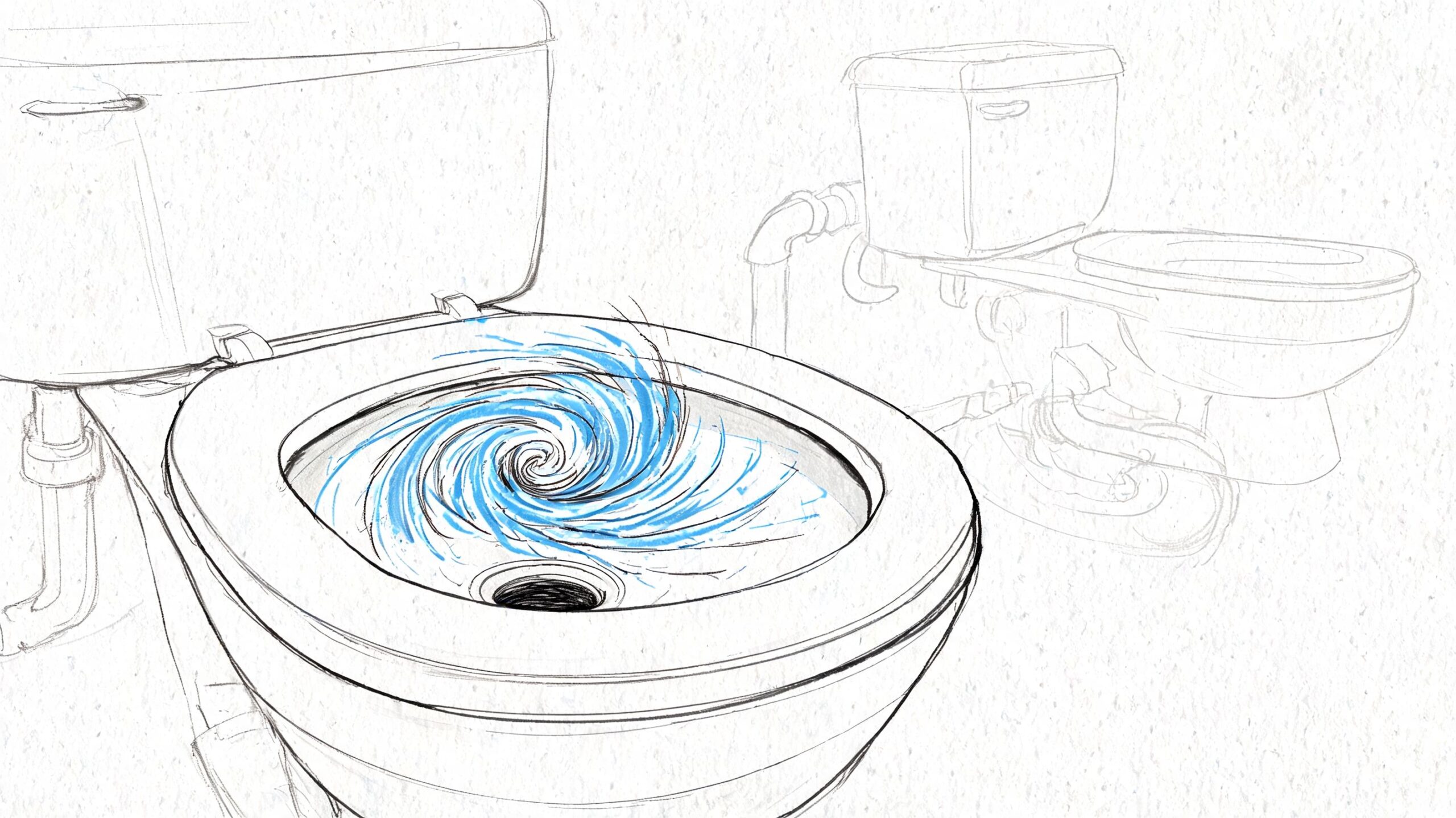
Two toilets can use the same amount of water and perform very differently. One clears the bowl in a single flush. The other leaves streaking, partial evacuation, or repeated clogging. The difference usually comes down to flush technology, trapway finish, and how well the toilet matches the conditions in the home.
Gravity flush versus pressure assist
A standard gravity toilet relies on the drop of water from the tank and the siphon effect created through the trapway. Good gravity toilets are quieter, simpler, and familiar to most homeowners. In many homes, they're the right call.
Pressure-assist models use a sealed air vessel inside the tank to deliver a more forceful flush. According to Mansfield Plumbing, in pressure-assist 1.6 GPF toilets, a pressurized air tank creates a piston-like flush that can evacuate over 1000g of waste, clearing the bowl up to 30% faster than many gravity-fed models in products like the Mansfield Quantum 1.6 elongated toilet combination.
That extra force can be a smart choice in busy households, commercial-style settings, or bathrooms where users don't want to think about flush performance at all. The trade-off is noise. Pressure-assist toilets are usually louder, and some homeowners dislike that in a primary suite or nursery-adjacent bath.
Why trapway design matters
A toilet doesn't just need a strong flush. It needs a clean path to move waste out consistently. That's where trapway design becomes more important than many buyers realize.
A modern toilet can achieve strong waste removal because the bowl, jet openings, and trapway are shaped and finished to reduce resistance. A fully glazed trapway also helps reduce buildup over time.
If you're comparing products, look for a model with a published MaP score and a reputation for reliable evacuation rather than just a stylish silhouette.
Better flush performance usually comes from smart internal design, not from a bigger-looking tank or heavier bowl.
The hard-water factor in West Texas and Southeastern New Mexico
Spec sheets stop being enough. In areas with harder water, mineral buildup can affect rim ports, internal passages, and moving parts over time. A toilet that performs well in lab conditions may lose some of that edge if maintenance gets ignored.
That doesn't mean a 1.6 gpf toilet is a bad fit. It means you should be more selective.
Consider these real-world adjustments:
- Choose better flushing hardware: Pressure-assist or well-designed siphonic systems tend to hold performance better when conditions aren't ideal.
- Pay attention to maintenance access: If replacing fill valves, flappers, or seals is awkward, upkeep gets postponed.
- Don't ignore supply issues: Older homes with marginal pressure or undersized supply lines can make any low-volume toilet feel weaker.
For homeowners already dealing with recurring stoppages, local troubleshooting can help separate a toilet problem from a drain-line problem. Resources like these Las Vegas clogged toilet solutions are useful because they show how often “bad toilet performance” is a blockage, venting, or line issue.
What works and what doesn't
What works:
- A proven flush system
- A smooth, well-finished trapway
- A model matched to your home's pressure and pipe conditions
What doesn't:
- Buying the cheapest low-flow toilet assuming all 1.6 models perform the same
- Ignoring hard-water maintenance
- Using style as the main filter before performance
That's the difference between a toilet that saves water on paper and one that works every morning without drama.
Comparing Flush Rates for Your Home
A 1.6 gpf toilet sits in the middle of the modern market. It's no longer the only efficient option, but it remains a strong one because it balances water use with broad, dependable performance.
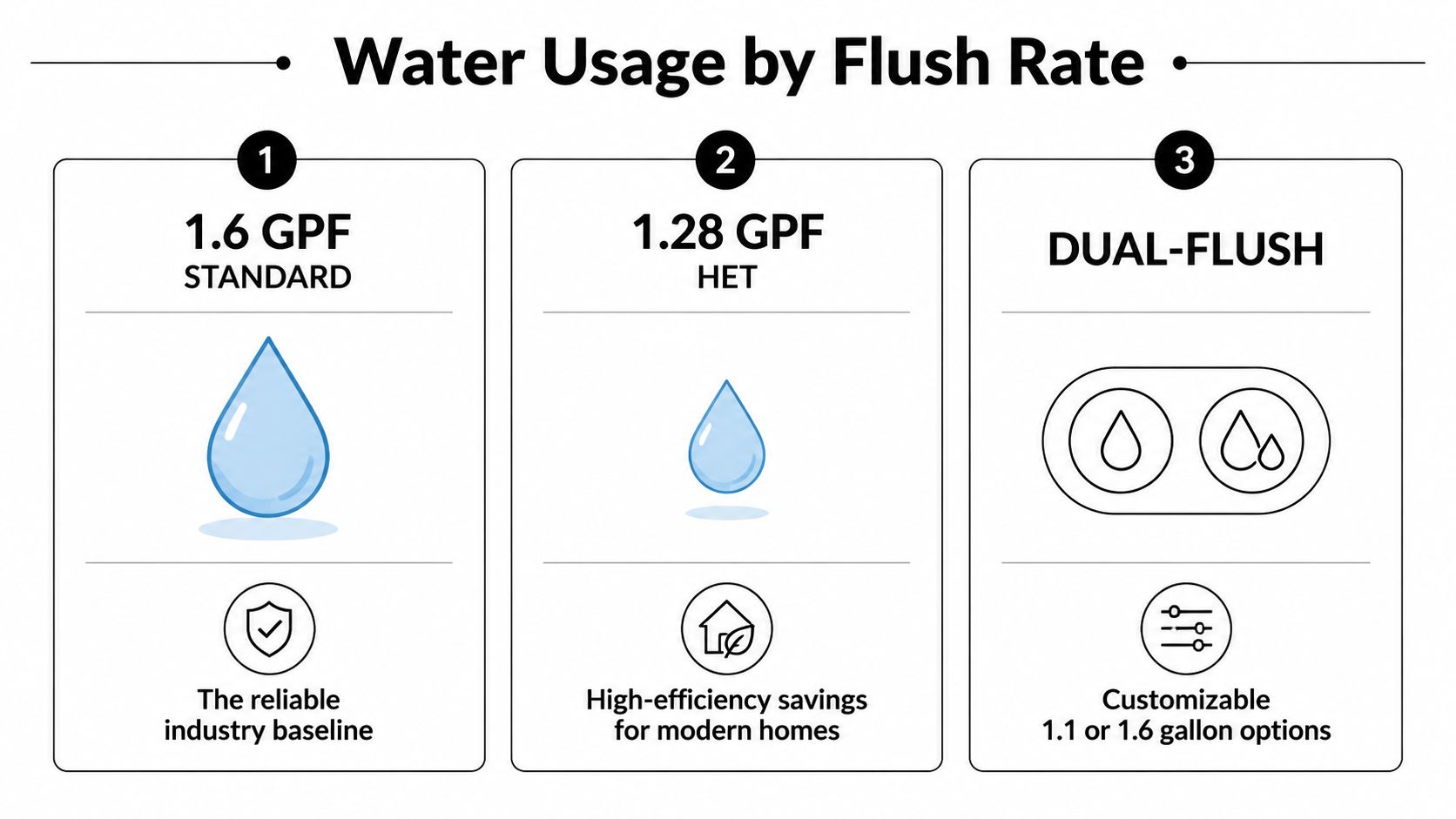
The main alternatives are 1.28 GPF high-efficiency toilets and dual-flush toilets that typically give you one lower-volume option and one full flush option. The right choice depends less on marketing language and more on your household's habits, line conditions, and tolerance for maintenance.
What the numbers tell you
One of the clearest benchmarks comes from the move away from older 3.5 GPF toilets. Mansfield Plumbing notes that an average family of four switching from an old 3.5 GPF toilet to a modern 1.28 GPF model can save over 16,000 gallons of water and more than $64 annually, which is a useful reminder of how much efficient toilet design can affect both utility use and operating cost over time in its overview of water-efficient toilets and performance.
That doesn't mean 1.28 GPF is always the best answer for every house. It means newer efficient toilets can make a meaningful difference when they're well chosen.
Toilet Flush Rate Comparison
| Flush Rate (GPF) | Type | Annual Water Use (per person) | Best For |
|---|---|---|---|
| 1.6 | Standard | Moderate | Homes that want a dependable baseline with broad model availability |
| 1.28 | High-efficiency | Lower than 1.6 GPF | Buyers prioritizing stronger water savings with proven performance |
| 1.1 / 1.6 | Dual-flush | Varies by usage habits | Households willing to use the correct flush option consistently |
This table is best used as a decision tool, not a winner board.
How each option behaves in real life
1.6 GPF standard toilets
These remain a strong fit for many homes because they're familiar, widely available, and often forgiving. If your plumbing is older, or if you want a toilet that feels less fussy about user behavior, 1.6 GPF is often the safe middle path.
A well-designed gravity model can be all a typical household needs. In a harder-working bath, a stronger flush platform may be worth the upgrade.
1.28 GPF high-efficiency toilets
These can be excellent when the engineering is there. Good 1.28 models don't feel weak. They feel refined. But lower water use leaves less margin for a poorly designed bowl or a marginal drain setup.
That's why product quality matters more as flush volume drops.
Dual-flush toilets
Dual-flush models offer flexibility. They let users choose a reduced flush for liquid waste and a fuller flush when needed. In a disciplined household, that can be a smart blend of control and savings.
In rentals or guest-heavy spaces, though, dual-flush success depends on user behavior. If people don't use the buttons correctly or treat every flush the same, the theoretical advantage shrinks.
A dual-flush toilet is only as efficient as the people using it.
A practical way to compare them
If you're choosing for your own home:
- Pick 1.6 GPF when you want dependable daily use with less sensitivity to habits.
- Pick 1.28 GPF when water savings matter and you're buying a proven model.
- Pick dual-flush when your household will use the two settings correctly.
If you like seeing how other remodelers compare complete toilet suites and style choices, this Melbourne toilet suite selection guide is a helpful reference for looking at performance and design together.
The best option isn't the one with the lowest number. It's the one that still performs well after months and years of regular use.
Choosing the Best Toilet for Your Space
The right toilet has to do more than flush well. It has to fit the room, feel comfortable to use, and make sense for the long haul. That's where many buying decisions improve or fall apart.

A toilet can have strong specs and still be the wrong choice if it crowds a tight bath, sits too low for the user, or creates extra service calls in a rental. The best buying decisions come from matching the fixture to the room and the people using it.
Bowl shape and room size
An elongated bowl usually gives adults a more comfortable seat shape. In a primary bathroom or any room with decent clearance, that's often the better everyday choice.
A round-front bowl can help in smaller bathrooms where every inch matters. Powder rooms, compact hall baths, and some older homes often benefit from the shorter footprint.
A skirted toilet can deliver a cleaner visual line and make exterior cleaning easier, but you should also confirm access for installation and future service. Sleek doesn't always mean simpler.
Height and daily comfort
Seat height changes the experience more than many buyers expect. Comfort height or chair-height models can make sitting and standing easier for many adults, especially in a primary bath or aging-in-place setting.
Standard-height toilets still have their place. Some people prefer them, and they can feel more natural for children or shorter users. This is one of those decisions where trying a few models in person is worth it.
Don't buy only on price
This matters even more for landlords and property managers. A bargain model can become expensive if it creates repeat problems.
According to the product analysis cited in the article brief, choosing the cheapest 1.6 gpf model can sometimes increase plumbing service incidents by 15–25% in buildings with older drainage, while a better-quality toilet with stronger flush technology can lower total cost of ownership over time, as discussed on this dual-flush toilet product page and analysis.
That's a useful lens for any buyer, not just property managers.
A decision checklist that works
Use this when narrowing options:
- For a primary bathroom: Lean toward elongated bowl, comfortable seat height, and stronger flush performance.
- For a small secondary bath: Prioritize footprint, rough-in fit, and ease of cleaning.
- For rentals or shared-use spaces: Favor proven internal parts, straightforward maintenance, and a forgiving flush design.
- For hard-water areas: Keep future cleaning and parts replacement in mind before choosing a highly stylized model.
A well-regarded product to compare against is the American Standard Champion Pro, especially if you want to benchmark what a performance-oriented 1.6 GPF toilet looks like in the market. Even if you choose another brand, it helps to compare bowl shape, trapway design, flush reputation, and serviceability against a known performer.
If you're designing the whole room at once, visual cohesion matters too. Toilet shape, vanity mass, wall color, hardware finish, and flooring all affect how finished the bathroom feels. These brown bathroom decorating ideas are useful if you're trying to make practical fixture choices work with a warmer, more intentional design direction.
Installation, Maintenance, and Long-Term Value
A good toilet choice can still disappoint if the installation is sloppy. Before buying, confirm the rough-in distance so the toilet fits the drain location in your floor. Check side clearance, door swing, and whether the supply line location will be easy to access once the bowl is in place.
For maintenance, simple habits make a real difference in hard-water areas. Clean rim openings periodically, watch for slow tank refill or weak bowl wash, and replace worn internal parts before they create bigger problems. Toilets aren't maintenance-free. The best ones are just easier to keep performing well.
Modern performance can be impressive when the design is right. American Standard notes that modern 1.6 GPF toilets can achieve MaP scores of up to 1000 grams of solid waste removal per flush, and features like fully glazed 2-inch trapways can reduce the chance of clogs by 30 to 50 percent compared to older unglazed designs, as shown in the specifications for the American Standard Champion Pro toilet.
That's the bigger lesson. A toilet is a long-use fixture, just like the other major pieces you choose for a home. Buying for durability, fit, and serviceability almost always pays off. The same thinking applies across the room, and it's why guidance on how long furniture should last is a useful reminder that good home decisions are rarely about the lowest initial price.
A well-chosen 1.6 gpf toilet should feel boring in the best possible way. It fits, it flushes, it stays reliable, and it supports the room instead of demanding attention.
If you're planning a bathroom refresh or furnishing an entire home, Miller Waldrop Furniture & Decor can help you make the rest of the space work as well as your fixture choices do. Their team helps homeowners in West Texas and Southeastern New Mexico pull together layouts, finishes, and furnishings that fit real life, so your bathroom and adjoining spaces feel cohesive, comfortable, and built to last.