

Custom Upholstery Services: Complete Guide


That sofa in the living room still looks fine from across the room, but up close the seat cushions are tired, the arms are flattened, and the fabric no longer fits the way it used to. Most homeowners sit with that decision for months, because the question isn't whether the piece looks worn, it's whether custom upholstery services will give it a smarter life than replacement. The right answer depends on the frame, the build, the fabric, and the true cost of each path.
What Custom Upholstery Services Actually Include
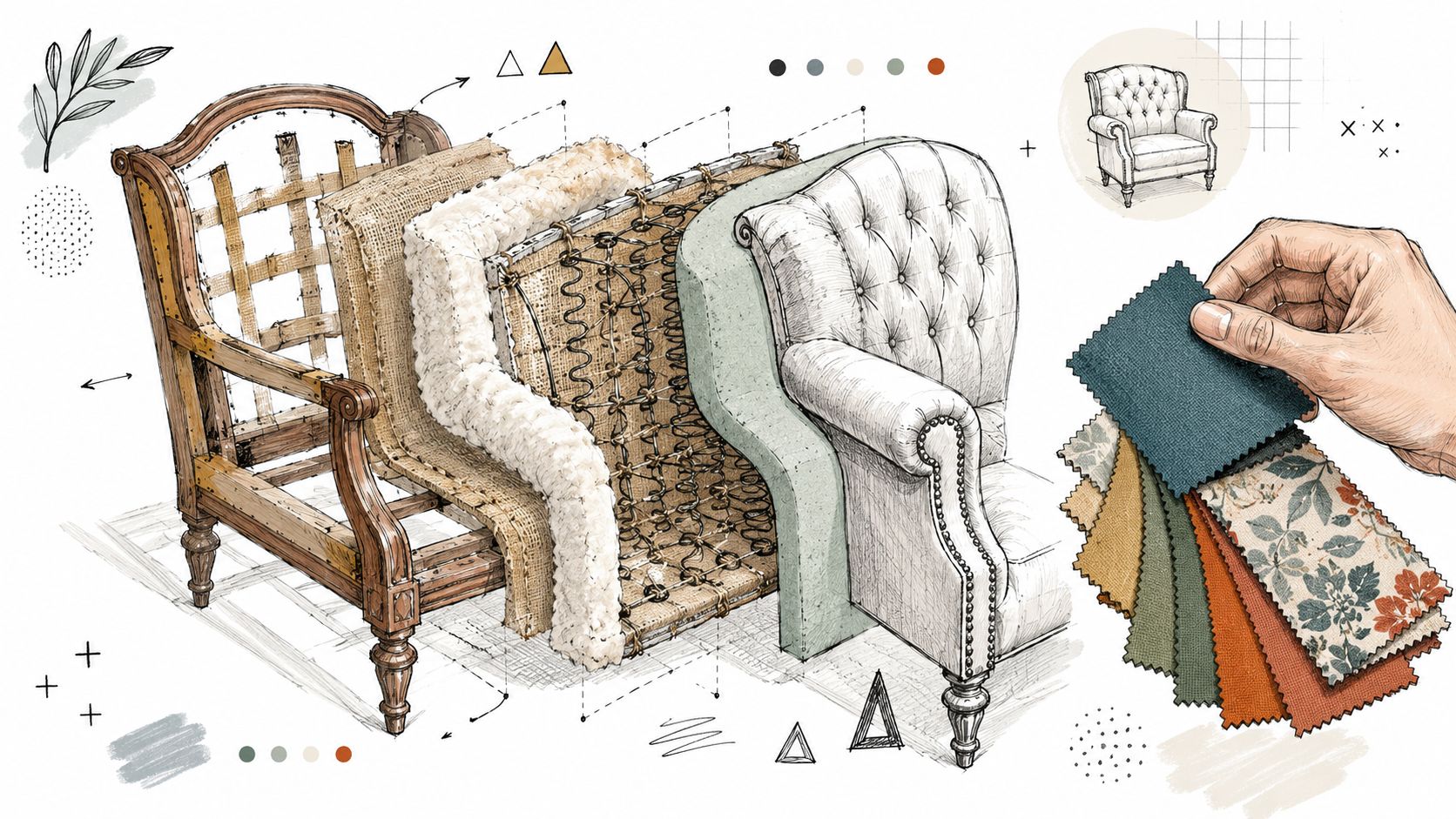
A worn sofa rarely needs just “new fabric.” A proper custom job starts underneath, where the piece either has enough structure to deserve saving or doesn't. A homeowner staring at a sagging chair might think the problem is cosmetic, but the work often begins with frame inspection, joint repair, spring correction, cushion rebuilding, and then fabric fitting.
The build matters more than the fabric
Good upholstery work is a skilled trade, not an add-on. The Bureau of Labor Statistics reported 25,740 upholsterers in May 2023, with a mean hourly wage of $21.55 and a mean annual wage of $44,820, which is a strong reminder that this is specialized labor, not simple sewing work. The craft depends on trained hands, judgment, and patience, especially when a piece has to be stripped, repaired, and rebuilt without losing its shape or comfort. BLS upholsterer wage data
That is why a serious upholsterer thinks in layers. Frame species, joinery, moisture content, suspension, fill architecture, and performance requirements all belong in the specification before fabric is chosen. If those basics are ignored, the final piece may look fresh for a while, then begin to sag, shift, or wear unevenly.
Practical rule: if the seller or workroom talks about fabric before they talk about the frame, the process is backwards.
Homeowners who want a deeper breakdown of fabric choices and project options can start with custom fabric upholstery guidance, which is useful when comparing what can be saved and what should be replaced.
Signs Your Furniture Needs Reupholstery
A piece needs more than a loose cushion cover when the comfort has changed along with the appearance. A sofa that leans, creaks, sags in the middle, or feels uneven from one side to the other is usually telling the truth about what's happening inside. Cosmetic wear alone is one thing. Structural fatigue is another.
Check the frame before you think about fabric
Press both arms. If they wobble or shift, the frame or joinery may already be compromised. Sit in the center of the seat and then near each arm, because a healthy frame should feel consistent, not hollow in one zone and firm in another.
Look at the cushions next. If they flatten quickly, stay dented, or no longer support the body evenly, the fill system is tired. That doesn't always mean the whole piece is beyond saving, but it does mean the project is bigger than a simple cover change.
Separate damage into cosmetic and structural problems
Surface pilling, faded cloth, and dated color are cosmetic. Broken springs, cracked rails, loose corner blocks, and badly compressed padding are structural. The first category supports reupholstery almost automatically, while the second category demands a cost check before any promise is made.
A good piece to save usually has a frame worth rebuilding, a shape worth keeping, or a comfort level that's hard to find in replacement furniture.
The biggest red flag is a low-grade frame that has already failed once. If the structure is particle board, the joints are failing across multiple points, and the cushions are not worth rebuilding, replacement often makes more sense. Reupholstery should rescue strong furniture, not prop up weak construction.
Reupholstery Versus Replacement Making the Right Choice
Most homeowners get stuck here, because the emotional answer and the financial answer don't always match. A favorite chair may be worth restoring because it fits the room and still has a solid frame. A mass-produced sectional that's falling apart may cost too much to rebuild compared with starting over.
A Furniture Today/Strategic Insights survey found that 40% of consumers considering a new upholstered furniture purchase within the next year said customization was extremely or very important, which shows how much people value getting the right fit instead of settling for whatever is on the floor. Furniture Today custom upholstery survey
Use the decision, not sentiment, to spend the money
Reupholstery wins when the frame is solid, the style is worth preserving, or the piece has a shape that suits the room better than anything currently available. Replacement wins when the construction is weak, the damage is widespread, or the size no longer works. The smart move is to judge the carcass first, then the economics, then the appearance.
| Factor | Choose Reupholstery | Choose Replacement |
|---|---|---|
| Frame condition | Solid, stable, worth rebuilding | Weak, damaged, or failing in multiple places |
| Construction quality | Well-made piece with lasting structure | Low-grade frame or poor original build |
| Fit in the room | Perfect scale or layout already | Wrong size, shape, or comfort profile |
| Emotional value | Family piece or hard-to-replace design | No special attachment |
| Customization need | Exact fabric, comfort, or finish matters | A standard new piece fits the need |
The hidden value is control
Replacement forces a buyer to accept what's available. Reupholstery lets the homeowner decide on comfort, shape, and finish instead of compromising. That matters most in rooms where the furniture has to work hard, look right, and last.
The better question is not “Is it cheaper?” It's “What delivers the most value over the next several years?” For a strong frame and a room-specific fit, reupholstery often makes the sharper long-term decision. For badly built furniture, replacement protects the budget.
Understanding Fabric Options and Performance Ratings
Fabric choice decides how forgiving the finished piece will be in real life. A beautiful textile that wears out quickly is expensive in the end, because it forces earlier replacement and invites disappointment. The right upholstery cloth matches the room, the light, and the amount of use.
Residential upholstery fabrics often fall around 54 to 60 inches wide and 150 to 250 GSM, with lightfastness Grade 4 as a common minimum and Grade 5+ preferred in sunnier rooms for better fade resistance. Residential upholstery fabric widths and lightfastness
Read the spec before falling for the sample
Width affects waste. Narrower fabric or busy pattern repeat can mean more yardage loss, more seam planning, and more visible mismatch at the corners. Weight matters too, because a heavier cloth often behaves differently under tension than a lighter one.
Lightfastness is the number most homeowners ignore until the fading shows up. If the room gets serious sun, the fabric needs stronger fade resistance or the piece will age unevenly. That's a practical issue, not a luxury concern.
For a useful overview of thread and needle choices that support the build, the materials and stitch techniques guide is worth reviewing before finalizing a project.
Match the fabric to the room, not the trend
High-traffic seating needs stronger wear performance and easier maintenance. Quiet rooms can tolerate more delicate cloth if use is lighter. Homes with children or pets should lean toward durable, forgiving materials that won't punish everyday life.
If a fabric sample looks perfect in a showroom but already seems delicate in a bright window, it's probably the wrong pick for a family room.
For homeowners narrowing choices, a focused upholstery fabric selection guide helps frame the decision around use, light, and long-term upkeep rather than color alone. That's the right way to buy once and avoid regret.
The Custom Upholstery Process and Timeline
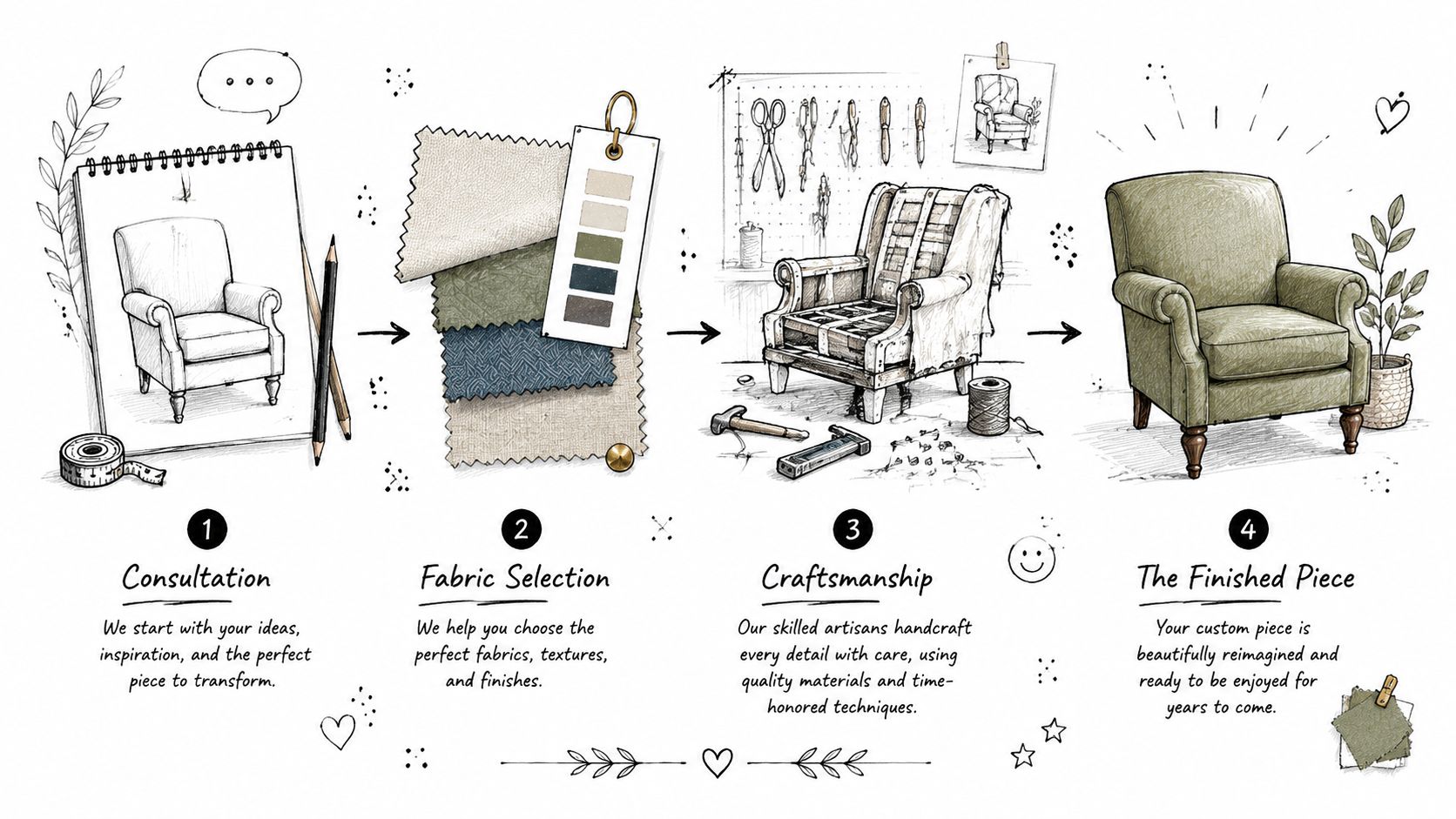
A good project feels organized because the work is organized. Once the furniture leaves the house, the sequence should be clear, from consultation and measurement to teardown, repairs, rebuild, and final fitting. If a provider can't explain that order, the process is already too loose.
The best work starts before fabric is cut
Detailed specifications should cover frame species, joinery method, moisture content, suspension type, fill architecture by layer, and performance requirements before fabric is selected. That sounds technical because it is technical. Those details protect the final fit and keep the structure from drifting out of shape as the piece gets used.
The practical result is fewer surprises. A tight spec reduces backtracking, limits avoidable rework, and gives the workroom a clear target. It also makes communication simpler when the homeowner wants to understand why a piece takes longer or costs more.
Delays usually come from decisions, not mystery
Project timing slows down when fabric choices change late, repairs reveal hidden damage, or the structure needs more correction than expected. Those are normal issues in this trade. They're not failures, but they do affect the calendar.
A homeowner should prepare by confirming dimensions, room use, comfort preference, and finish details before the piece is handed over. The cleaner the brief, the smoother the job. That matters even more on complicated pieces with cushions, trims, and mixed materials.
Cost Factors and How to Budget for Custom Upholstery
Pricing in upholstery is driven by labor, fabric yardage, structural repair, cushion replacement, and the complexity of the piece. That is why two sofas that look nearly identical can land at very different totals once the work begins. Homeowners who want a real budget should ask what is being repaired, what is being replaced, and what is being rebuilt.
The National Upholstery Association's 2025 Pricing Survey found that median pricing across surveyed upholstery services increased overall compared with its November 2022 survey, and the association says that lines up closely with roughly 10% U.S. services inflation over the past 26 months. National Upholstery Association pricing survey
Budget for the whole job, not the cover
The biggest mistake is pricing fabric and ignoring labor. A project can look modest on the surface and still become expensive once the frame is opened up and the true condition appears. That's especially true on older furniture or pieces with decorative details that take more time to fit cleanly.
Homeowners should get a written estimate that separates labor from materials and spells out repair assumptions. That makes it easier to compare quotes without being fooled by a low starting number that grows later. It also makes financing decisions clearer when the project is part of a larger room refresh.
For shoppers thinking through payment options as they plan a larger home update, furniture financing options can be part of the budget conversation without changing the design goals.
Budget rule: if the quote doesn't explain where the money goes, it isn't a quote worth trusting.
The right provider will also tell the customer when replacement beats repair. That honesty is more valuable than a polished sales pitch, because it protects the budget and keeps the project grounded in real value.
Choosing the Right Upholstery Provider
The work is only as good as the person doing it. A strong upholstery provider should explain construction clearly, show examples of past work, and ask detailed questions about how the furniture gets used. If those questions never come up, the service is probably too shallow for a serious project.
Ask for process, not just a price
A professional should be able to describe how the frame will be inspected, how the cushions will be rebuilt, and what gets documented before fabrication begins. The answer doesn't need to be theatrical. It needs to be precise.
A local provider is often the better choice because the conversation is easier, measurements are more accurate, and adjustments are simpler. That local advantage matters in custom work, where fit and communication are tied together. A broader shopping experience can help too, especially when a retailer can guide selection, fabric choice, and delivery in one place. Miller Waldrop Furniture & Decor is one option that handles custom-order furniture alongside showroom selection, which can make the decision path less fragmented.
Look for proof in the details
A portfolio should show neat seams, consistent pattern alignment, solid cushion shape, and clean tailoring at the arms and corners. If a provider can't explain those details, they may not understand them well enough to deliver them. The same logic applies to any skilled trade, which is why it helps to choose a hardwood expert with care when the project depends on structural judgment.
Maintenance matters after delivery too. Rotate cushions regularly, keep the piece out of harsh sun when possible, and clean spills quickly before they set. Small habits protect the investment and slow down the kind of wear that shortens service life.
The right upholsterer doesn't just recover furniture. They protect the structure, fit the fabric to the use, and leave the homeowner with a piece that earns its keep.
If a sofa or chair is starting to fail, don't guess your way through it. Visit Miller Waldrop Furniture & Decor to compare custom-order options, ask about fabric and finish choices, and get a practical path toward furniture that fits the room and the budget.