


Adjustable Bed Frame Reviews That Actually Help You Choose


You're lying flat at midnight while your partner is already asleep, and the three pillows behind your back have become part of the bedding. Sitting up helps with reading, breathing, or reflux, but the pillows slide, your neck bends forward, and the mattress still doesn't support the position properly. That's the moment an adjustable base starts to look less like a luxury gadget and more like a solution to a problem that has been ruining bedtime.
The strongest adjustable bed frame reviews don't stop at remote controls, massage settings, or showroom price tags. They examine mattress compatibility, weight capacity, motor behavior, emergency lowering, replacement timing, and total cost, because those details determine whether the setup still feels useful years after delivery.
The category has grown well beyond a niche bedroom product. The global adjustable bed frames market was estimated at USD 4,376.4 million in 2024 and is projected to reach USD 8,614.4 million by 2033, with a projected 7.8% CAGR from 2025 to 2033. A separate estimate places the 2024 market at USD 4.5 billion, with a projection of USD 9.6 billion by 2034 and North America representing 36.1% of global share, or about USD 1.6 billion. Those figures help explain why shoppers now face a crowded field of bases and why careful comparison matters. (Grand View Research adjustable bed frames market report)
Why an Adjustable Base Is the Most Personal Bedroom Purchase You'll Make
The right adjustable base becomes obvious at a very specific moment: you are trying to read with a stack of pillows behind your back, your neck is bent forward, and your mattress keeps sliding you flat. One sleeper may need the head raised to reduce snoring, while another wants the legs raised after a long day. Someone recovering from surgery may need to reach a seated position without forcing an awkward sit-up. Couples may want separate positions at bedtime.
An adjustable base addresses those situations by changing the angle beneath the mattress. Head elevation can make reading more comfortable, leg elevation can support a more relaxed position, and a split configuration lets partners choose different settings. The benefit is physical, not cosmetic. The base changes how the body meets the mattress.
Practical rule: A useful preset gets a sleeper comfortable quickly. A flashy preset that never gets used is an expensive remote button.
Start with the discomfort, not the feature list. A base will not repair a sagging mattress, correct every sleep-hygiene problem, or replace medical advice for unresolved pain, breathing problems, or reflux. If the mattress feels lumpy, too soft, too firm, or structurally tired, movement underneath can expose those flaws. Buyers should confirm that elevation addresses the actual problem before paying for motors and extras.
The comfort problem comes before the feature list
A shopper focused on snoring may need a dependable head-up position. A reader needs an incline that supports the neck without sliding the body toward the foot of the bed. Someone with limited mobility may value a smooth transition into a seated position more than massage or app control.
That is why Miller Waldrop's adjustable bed zero-gravity guidance makes a useful starting point. The question is not whether a base includes zero gravity. Test whether that position feels supportive on the intended mattress, whether the remote is easy to reach, and whether returning to flat takes one clear command.
The category's long history also puts current features in perspective. Historical accounts trace adjustable sleep surfaces to reclining practices in the Roman Empire, a recognizable movable bed frame from 1874, and later hinged and healthcare-oriented designs associated with early manufacturers and medical equipment designers. (Spherical Insights adjustable bed frames market background)
Owner satisfaction can be strong, but broad averages should not decide a purchase. A base that performs well for one sleeper may feel wrong with another mattress, body type, or room setup. In year five, mattress compatibility, weight capacity, motor reliability, and replacement timing matter more than a remote with settings nobody uses. Check those details before comparing finishes, apps, or massage modes.
How Adjustable Bases Actually Work and Why Motor Choice Matters
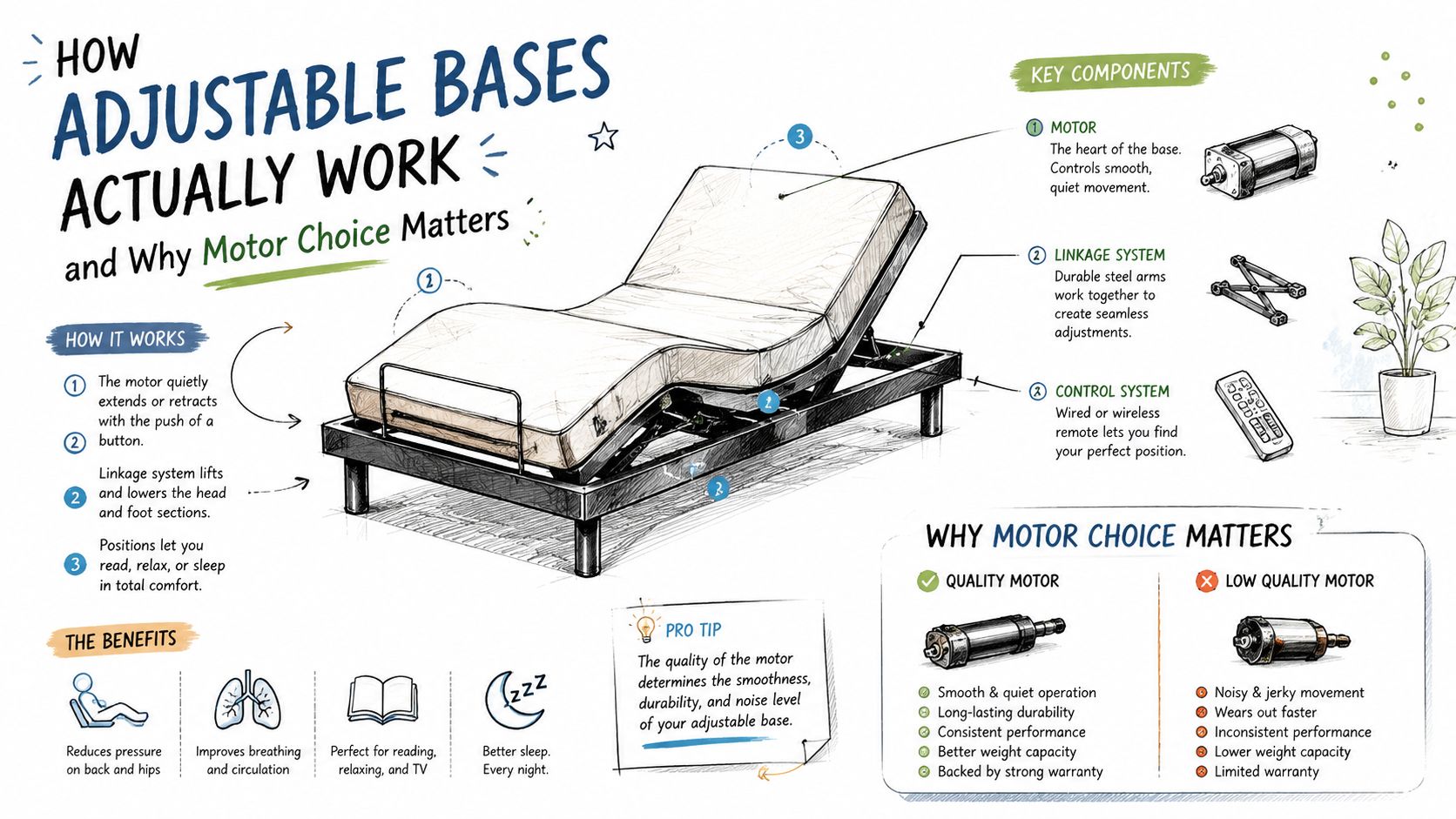
At bedtime, the difference between an adjustable base you still use years later and one that gathers dust appears in the movement. An adjustable base is an articulated platform powered by electric motors. Hinged sections raise the head, legs, or both, while the mattress flexes above them. What matters is how independently the sections move, how steadily the motors operate, and whether the system returns reliably to a comfortable flat position.
A manual incline offers limited adjustment and requires physical effort. A single-motor powered base usually raises the head or links head and leg movement in a simpler pattern. A dual-motor split base gives each side more control, which suits partners with different schedules, reading habits, or comfort preferences.
Match the mechanism to the daily moment
Head articulation is the feature most sleepers try first. It creates a reading or television position and can provide a gentler incline for someone who dislikes sleeping fully flat. Leg articulation matters more to sleepers who want their feet raised or need an easier way to get into and out of bed.
Wall-hugging designs deserve attention. A conventional base can move you away from the nightstand as the head rises, while this mechanism is designed to preserve access to nearby furniture. Confirm that the model includes it instead of assuming it does. Under-bed lighting helps with nighttime movement, but stable motion and a remote you can operate without looking should rank higher.
Motor strength appears in repeated use, not a dramatic showroom demonstration. The base should raise the mattress without hesitation, excessive vibration, or disruptive noise. Weight limits vary widely, so check the stated capacity for the specific model and make sure it covers the sleepers, mattress, bedding, and any additional load included in the manufacturer's calculation. Read the BedTech weight-limit guidance for the factors that belong in that calculation.
Emergency lowering is not an optional footnote
Power-loss handling belongs in every serious review. Check the owner's manual for the emergency-lowering procedure, whether it uses two single-use 9-volt batteries or a manual release, and replace any single-use batteries after operation as instructed. The owner manual emergency-lowering instructions illustrate one battery-powered approach, while this mechanical emergency lowering guide shows a hex-key procedure.
Before buying, locate the battery compartment or release point and operate it once. A household member should be able to lower the bed without assistance. Replacement timing matters too. Ask how the motor, control box, remote, and power components are serviced after the warranty period, because a base that cannot be repaired can turn a compatible mattress into an expensive short-term setup.
Comparing the Bases Worth Your Shortlist
A base that feels impressive for five minutes can become frustrating after the novelty fades. Compare models by the work they do every night, then check the details that determine whether the setup remains useful years later: mattress support, weight capacity, motor operation, and access to replacement parts.
Adjustable Bed Base Comparison by Tier
| Tier | Typical Capacity | Standout Presets | Noise Level | Best For |
|---|---|---|---|---|
| Value | Published capacity varies by model | Head-up, flat, basic leg elevation | Must be tested in person | Buyers who want powered positioning without extra technology |
| Mid-range | Often around 650 to 850 lb total capacity | Zero gravity, anti-snore, head-up, flat, custom | Quieter transitions are a key selling point, but testing matters | Sleepers who use presets regularly and couples who need more control |
| Premium | Some queen bases reach 1,000 lb | Expanded custom settings, massage, lighting, advanced convenience features | Premium claims still require an in-store listening test | Buyers who value frequent adjustment and polished daily operation |
Treat these tiers as shorthand, not a guarantee. Published specifications for some models list 750 lb, while a queen base may support up to 1,000 lb, or 500 lb per side. Verify the exact size, configuration, and stated capacity. Include sleepers, mattress, bedding, and any load the manufacturer counts in its calculation.
Capacity also affects replacement timing. A base that operates near its limit may leave less practical headroom for a heavier mattress or changing household needs. Check the manual before buying, not after delivery.
Where the trade-offs become obvious
A value base is the sensible choice if you use head elevation, leg elevation, and flat positioning. App control, massage, lighting, and elaborate presets are wasted money when the remote is the only control you will use. A mid-range base usually offers the better balance, adding zero gravity, anti-snore positioning, custom angles, and a more capable remote without turning the bedroom into a technology project.
Premium features earn their cost only when they solve a recurring problem. Under-bed lighting helps with nighttime movement without switching on a bright lamp. A custom preset saves time for sleepers who change position each night. Split movement lets couples choose different angles instead of compromising on one shared setting.
Operation matters more than a long feature list. Test the motor while lying on the mattress, listen during head and leg movement, and try every control you expect to use. Published testing commonly examines feature set, remote-control usability, installation difficulty, and operating noise, the measures that reveal daily performance more clearly than marketing language. Price can range from a few hundred dollars to several thousand dollars, so spend extra on quieter movement, reliable controls, and serviceable components rather than decorative extras.
Before replacing a traditional foundation, confirm what support structure the mattress requires. A box spring and a foundation serve different purposes, and an adjustable base is a separate support system. The Meliusly box spring and foundation guide explains the distinction.
For models available to test locally, review Miller Waldrop's adjustable bed brands and shortlist bases that match the mattress, capacity, and service requirements. Choose the base you can still operate, repair, and live with after the first year.
Mattress Compatibility and Why Pairing Wrong Wrecks the Whole Setup
A new adjustable base cannot rescue the wrong mattress. If the mattress resists bending, bunches as the head rises, slides out of position, or loses support during movement, the entire sleep system feels poorly built. The base may have quiet motors and useful presets, but compatibility determines whether those features remain valuable after the first few months.
Traditional innerspring designs can resist articulation when they lack enough flexibility. Memory foam, latex, and modern hybrids usually conform more readily, but the label alone proves nothing. Check the mattress warranty and the base requirements together before ordering. The right question is whether the exact mattress can flex repeatedly while preserving a stable, comfortable surface.
Perform a fit check before delivery
Confirm the mattress type, thickness limits, weight, and approved base configurations. The base manual may specify whether a retainer is required, whether a split setup needs two mattresses, and which positions the manufacturer supports. Ignore those conditions and you risk poor movement, shifting, or a warranty dispute.
Check the existing mattress. A base can remain useful long after the mattress above it has lost its support. Consumer-facing guidance indicates that adjustable beds may last 10 to 20 years, while mattresses typically last 7 to 10 years.
That difference should shape the purchase. If the mattress is approaching the end of its useful life, pairing it with a new base may deliver only a short improvement before you need to make another compatibility decision. Choose a base that can support the mattress you expect to buy next, rather than treating the current mattress as permanent.
Weight capacity belongs to the mattress calculation
Capacity must cover both sleepers, the mattress, bedding, and any listed accessories. Split configurations can distribute that load differently between sides, so verify the rating for each side and the complete setup instead of assuming the total figure applies evenly.
Some split-king specifications list 37 inches wide by 79 inches long, with height from 9 to 15 inches and a 1,400 lb capacity. Treat those figures as model-specific examples, not universal standards. Confirm the exact width, length, height range, and capacity for the base you are buying.
Moving the mattress during a household move requires protection from dirt and handling damage. A mattress protector for house move helps keep it clean while it is carried or stored. For foam shoppers, the memory foam mattress with adjustable base guide provides a useful starting point for checking whether the mattress and base should work together.
What to Test in the Showroom Before You Buy
A showroom test should be deliberate. A quick sit on the edge tells a buyer almost nothing about pressure, movement, remote usability, or nighttime convenience. The base needs to be tested as a sleeping system, with the mattress and position changes doing the talking.
Use a timed comfort routine
Start flat and remain there long enough to notice pressure at the shoulders, hips, and lower back. Then raise the head into a reading position and check whether the neck stays supported or the body slides toward the foot of the bed. Raise the legs separately and notice whether the position feels balanced rather than sharply bent.
Next, activate the zero-gravity preset. The position should feel stable and easy to exit, not like a novelty angle that requires constant remote adjustments. If anti-snore positioning is available, test whether it creates a practical incline without compromising the sleeper's preferred posture.
A focused showroom checklist should include:
- Pressure points: Lie flat and notice whether the mattress remains comfortable before testing movement.
- Neck support: Raise the head and check reading posture without stacking pillows.
- Leg comfort: Raise the legs and look for a relaxed, supported position.
- Remote layout: Find flat, lowering, preset, and light controls without staring at the handset.
- Transition noise: Listen during both upward and downward movement.
- Nighttime access: Check whether the base preserves access to the nightstand or shifts away from it.
- Split behavior: Test whether each side moves independently and whether the center gap feels acceptable.
Test the safety details, not just the comfort
The remote should work in a dark bedroom, not merely under showroom lighting. Buttons need enough separation to identify by touch, and the flat control should be easy to locate when someone is tired or uncomfortable.
Emergency lowering deserves a direct demonstration or clear explanation. Depending on the base, the system may use a battery-backed lowering function or a mechanical hex-key release. A salesperson should be able to identify the location, explain the steps, and show the relevant documentation.
Couples should test both sides separately. A split base can solve different sleep preferences, but it also introduces two remotes, a center seam, and the possibility of movement that feels less unified. Those trade-offs are easier to judge in person than in any set of adjustable bed frame reviews.
Price Ranges and Where the Extra Money Actually Goes
Adjustable bases range from a few hundred dollars to several thousand dollars. That spread reflects real differences in construction, controls, motor performance, and support, but the highest price does not guarantee better sleep. Your mattress, the base's weight capacity, and the timing of replacement matter more than a long feature list.
What each tier should deliver
A basic base should provide dependable powered movement, a usable remote, a stable frame, and a clearly stated weight rating. Choose this tier if you want head or leg elevation without advanced controls. The value is in reliable movement.
A mid-range base should earn its higher price through smoother transitions, useful presets, better control for couples, or convenience features you will use often. Zero-gravity and anti-snore settings can help when they match your routine. Custom memory positions matter for daily adjusters, not for someone who raises the head occasionally.
A premium model needs better execution, not just more buttons. Under-bed lighting, massage, expanded presets, and app functions may be pleasant, but they should not distract from motor noise, remote design, emergency lowering, mattress fit, or capacity. A USB port or app can become irrelevant long before the base does.
Calculate the whole purchase
The base is only one line in the budget. Plan for the complete setup:
- A compatible mattress: An aging or unsuitable mattress can undermine a new base.
- Delivery and setup: Powered bases are awkward to move and position.
- Old mattress removal: Disposal may carry a separate charge.
- Fitted sheets: Moving configurations may require better-fitting bedding.
- Protection coverage: Extended coverage can help when repair access matters.
Independent testing covers adjustable bases across a broad price range, with options from a few hundred dollars to several thousand dollars. Consumer Reports adjustable bed frame testing The practical lesson is simple: spend first on compatibility, adequate capacity, quiet movement, an intuitive remote, and emergency lowering. Replace a worn mattress before blaming the base, and account for replacement timing when comparing long-term value.
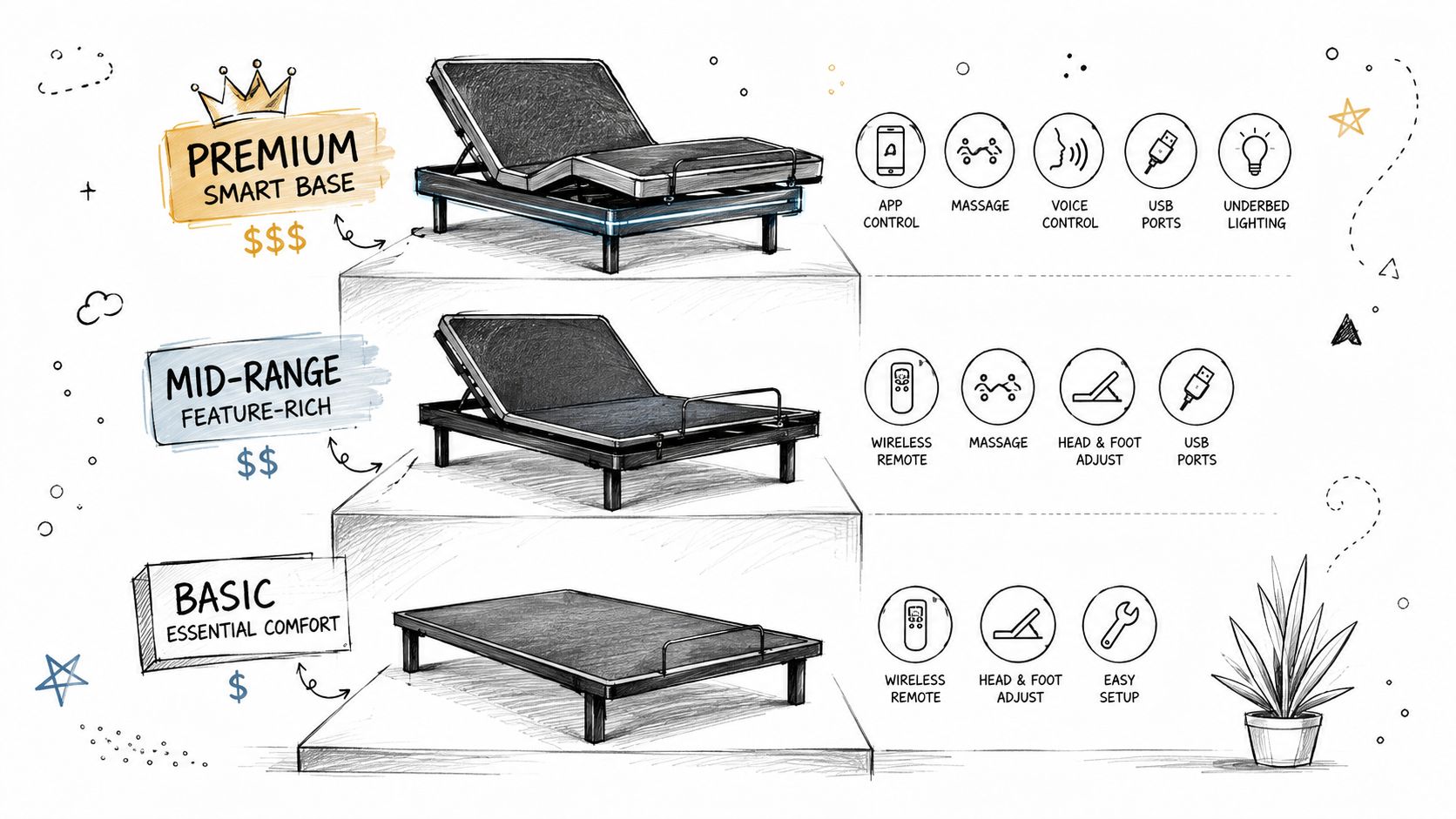
Add massage, lighting, or app control only after those requirements are satisfied. The features you will still use years later are the ones that make the mattress work properly, support the sleepers' combined weight, and keep everyday adjustments quiet and easy.
Why Buying Locally at Miller Waldrop Makes the Decision Easier
An adjustable base can look perfect online and feel wrong in your bedroom. The important questions require a mattress, a sleeper, and a working remote: Does the mattress flex naturally? Does the head angle support your neck? Is the motor quiet enough for a partner? Can you use the remote in the dark? A local showroom lets you answer those questions before delivery.
Miller Waldrop's high-tech bed matching system helps identify pressure points and pair a mattress with an adjustable base. That matters because mattress compatibility determines whether the base feels supportive or awkward. Test different mattresses through the same positions instead of buying a base and hoping your current mattress cooperates.
Local support covers the awkward parts
Miller Waldrop operates showrooms in Lubbock, Texas, Hobbs, New Mexico, and Ruidoso Downs, New Mexico, giving shoppers in West Texas and southeastern New Mexico a place to test the complete setup. Its brand partners include Serta, Beautyrest, and Mattress 1st, so the discussion can stay focused on fit, intended use, and the sleeper's needs rather than features that will rarely be used.
Delivery and setup deserve attention. Adjustable bases are heavier than ordinary bed frames, and split configurations can complicate placement in an existing bedroom. Financing may make a large mattress-and-base purchase easier to manage, while local service gives buyers somewhere to return with questions after the initial excitement fades.
Miller Waldrop Furniture & Mattress has been a fourth-generation family-owned business since 1952, serving Lubbock, Texas, and Hobbs and Ruidoso Downs, New Mexico, for more than 70 years. (Miller Waldrop Furniture & Mattress)

A useful consultation should not steer you toward the costliest base. It should identify the comfort problem, test compatible mattresses, confirm weight capacity and emergency lowering, and discuss what happens when the mattress needs replacement. Those details determine whether you still value the base years later.
Visit Miller Waldrop Furniture & Decor to meet with a Sleep Expert, test adjustable bases with compatible mattresses, and compare a setup built around real sleeping needs. Ask about capacity, replacement timing, delivery, and service before choosing the base.