

Your Guide to Finding the Best Recliner for Back Support

When you're looking for the best recliner for back support, you're on a mission to find a chair that combines a few critical elements: adjustable lumbar support, a reclining angle that takes pressure off your spine, and a fit that feels like it was made just for you. Top-tier brands like La-Z-Boy and Flexsteel have engineered solutions with designs that actively support your spine's natural curve, turning a simple chair into a powerful tool for your daily comfort.
Finding Lasting Comfort and Back Pain Relief
Your search for the right recliner is more than just buying furniture—it’s an investment in your well-being. So many of us deal with chronic back pain, often caused by poor posture and sitting in chairs that lack the right kind of support. A well-designed recliner tackles this problem head-on, creating a personal sanctuary where your body can recover from the stresses of the day.
Instead of a temporary fix, the right recliner becomes a key part of your strategy for managing discomfort. It provides a consistent, reliable source of ergonomic support that a standard armchair simply can't match. This guide is your tool to move from simply enduring pain to actively finding a solution. Here’s how you can choose the features that truly make a difference and turn your living room into a place of genuine, long-term relief.
Why a Standard Chair Isn't Enough
An ordinary chair can force your body into awkward positions, putting significant strain on your lower back and neck. A recliner, on the other hand, is built to support you as you move, distributing your weight evenly and taking pressure off those sensitive spots. It’s especially helpful for people recovering from surgery, like a mastectomy, offering a comfortable place to sleep when getting in and out of a regular bed is too difficult.
That difference is everything. A simple armchair gives you a place to sit, but a great ergonomic recliner provides a platform for true rest and healing.
Understanding the Role of Ergonomics
Ergonomics is the science of designing things to fit the people using them, empowering you to find comfort without compromise. When it comes to recliners, this means the chair should mold to your body's unique shape. The core principles are all about:
- Spinal Alignment: Keeping that natural "S" curve in your spine, even when you’re fully kicked back.
- Pressure Distribution: Spreading your body weight across the chair to eliminate painful pressure points.
- Circulation: Elevating your legs to boost blood flow and reduce swelling.
A recliner with proper ergonomic features isn't just comfortable—it actively supports your body's natural posture, minimizing strain on joints and muscles while improving blood circulation.
Comparing Key Support Features
Not all recliners are created equal, especially when back support is your top priority. Understanding the different support mechanisms is your first step toward making a smart choice. Here’s a quick breakdown of how a basic model compares to a truly ergonomic one, equipping you to spot quality.
| Feature Type | Basic Recliner | Ergonomic Recliner |
|---|---|---|
| Lumbar Support | Often just a fixed, puffy cushion that might not line up with your spine's curve. | Features adjustable support (air, mechanical, or memory foam) to perfectly match your lower back. |
| Recline Mechanism | Limited positions, often requiring you to push back with your body to adjust. | Power controls allow for endless adjustments, helping you find the precise angle for relief. |
| Fit & Sizing | Usually a one-size-fits-all design, which can easily lead to poor posture if it's not right for you. | Available in different sizes with options for seat depth and height, giving you a personalized fit. |
Your journey to a pain-free life starts with choosing the right tools. Now that you're equipped with this knowledge, you're ready to pick a recliner that delivers genuine, lasting back support. Explore our collection of premium La-Z-Boy recliners to see how advanced engineering can transform your comfort.
How a Good Recliner Actually Supports Your Back
Before you dive into different models, it’s important to understand how a recliner provides real back support. To get the full picture, it helps to start by understanding posture and its musculoskeletal effects on your body. A great recliner is so much more than a comfy chair; it's a piece of engineering designed to work with your body's natural alignment, helping to reduce stress and encourage recovery.
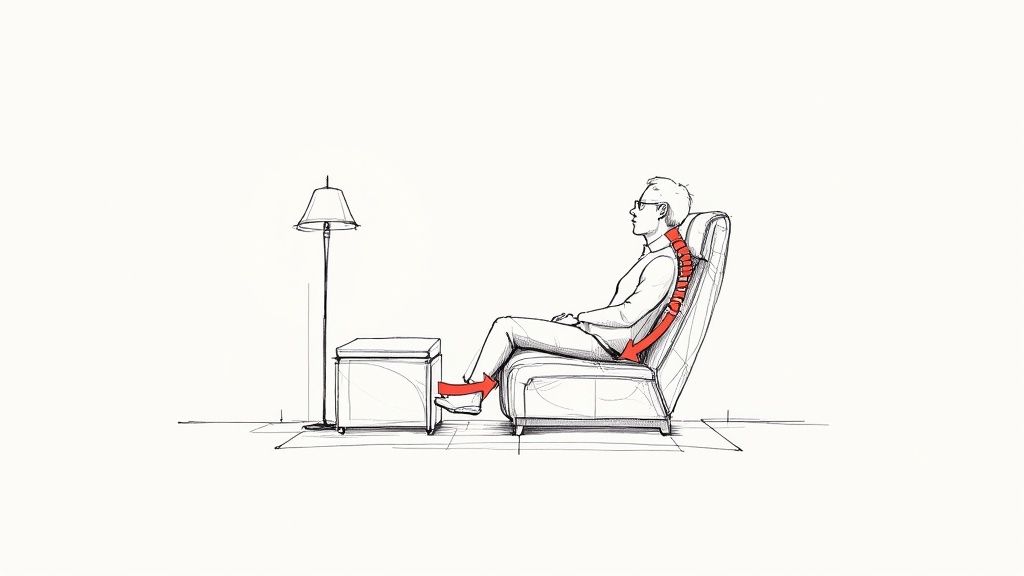
The magic is in how it supports your spine’s natural “S” curve. A regular sofa or stiff-backed chair often forces you into a slumped position, but a well-designed recliner gives targeted support right where you need it most: the lumbar region. This is the lower part of your back where so much of our daily strain collects.
Keeping Your Spine’s Natural ‘S’ Curve Aligned
Your spine isn't a straight rod—it has a gentle, natural curve that’s vital to maintain. Proper alignment is what prevents muscle fatigue and keeps pressure off the discs between your vertebrae. A quality recliner is built from the ground up to preserve this curve, even when you’re kicked back and fully reclined.
The key player here is the lumbar support. This isn't just a fancy pillow; it's an integrated feature specifically designed to fill the gap between your lower back and the chair. This prevents your spine from flattening out unnaturally. When that area is properly supported, the muscles around it can finally let go, easing tension and pain.
By distributing your body weight more evenly and propping up that lumbar curve, a recliner takes a significant load off your spine. This simple shift can dramatically reduce the compressive forces that often lead to chronic back pain.
People are definitely catching on. Ergonomic designs with advanced back support are no longer a niche feature but a top priority for many buyers. With the American Chiropractic Association reporting that 31 million Americans experience lower back pain at any given moment, the demand for truly supportive seating has never been higher.
The Science Behind Relieving Pressure Points
Sit in one spot for too long, and you'll feel it. Your tailbone, hips, and shoulders start to ache because they're bearing the brunt of your body weight. Recliners are designed to solve this problem by letting you shift your position and spread that weight out over a much larger surface area.
Elevating your legs with the footrest is a huge part of this. Not only does it boost circulation (a nice bonus!), but it also gently tilts your pelvis, which helps decompress the lower spine. It’s this feeling of weightlessness that truly defines an exceptional recliner.
For example, some of the most advanced models are built to achieve a state of near-weightlessness. Here's how you can unlock zero-gravity comfort with a recliner that raises your legs slightly above your heart, a position that’s been shown to take immense pressure off the spine and deepen relaxation.
It’s About Support from Head to Toe
Let's be clear: true back support isn't just about your lower back. A genuinely ergonomic recliner offers a complete system of support that benefits your entire body.
- Adjustable Headrests: These are crucial for supporting the natural curve of your neck (the cervical spine). They help prevent that dreaded "forward-head" posture that causes so much stiffness and pain.
- Contoured Seating: Seats that are shaped to cradle your body help maintain proper hip alignment, which is directly linked to the stability of your lower back.
- Supportive Footrests: Lifting your feet does more than just feel good. It reduces swelling and takes the strain off your legs, which in turn eases the burden on your lower back.
Every one of these features works in harmony to create an environment where your body can completely relax and recover. When you’re ready to experience this for yourself, our team can help you test out different models. We'll guide you to find the one that gives your body the exact support it's been craving.
Comparing Recliner Types for Optimal Back Support
Finding the right recliner when your back is hurting is about more than just kicking your feet up. It's about understanding the mechanics of each chair and how its design can either help or hinder your comfort. With so many options out there, it’s easy to get lost.
Let's break down the most popular types—Power, Lift, and Zero-Gravity—so you can find which one is the right tool for your body and your needs.
The Precision of Power Recliners
At its core, a power recliner is all about control. Unlike a manual recliner that clunks into two or three set positions, a power model uses a motor to give you an almost infinite range of motion at the touch of a button. This is its biggest advantage for back support.
Think about it: some days, you might just need a tiny 15-degree lean to take the pressure off your lower back. A power recliner can do that. A manual one can't. This ability to make micro-adjustments is critical when you're dealing with pain that changes from day to day.
Many modern power recliners also come with features that specifically target back pain:
- Power Lumbar Support: This isn’t just a pillow stuffed in the back. It’s an adjustable cushion that can be inflated or shifted to perfectly fill the gap in your lower back, supporting your spine's natural curve.
- Power Headrests: A proper headrest keeps your neck aligned, which prevents that awful strain that can travel all the way down your spine.
This level of fine-tuning makes power recliners a fantastic choice for anyone needing consistent, personalized support. To dig deeper into the different options, our guide on the types of power reclining seating is a great place to start.
The Supportive Independence of Lift Chairs
Here’s a key distinction: all lift chairs are power recliners, but not all power recliners are lift chairs. A lift chair has one more trick up its sleeve—a motorized base that gently tilts the entire chair forward, lifting you to a near-standing position.
For anyone with mobility issues, severe arthritis, or recovering from surgery, this feature is a lifesaver. The simple act of getting out of a chair can put a huge amount of strain on a sore back or weak knees. A lift chair removes all that stress, giving you a safe, stable way to get on your feet.
A lift chair isn't a luxury; it's a tool for daily living. For someone managing chronic pain or healing from an operation, it provides the support needed to move with confidence and independence.
Because they're built for people who need extra support, these chairs typically have very robust construction, from reinforced frames to high-density foam that won’t sag and throw your spine out of alignment.
This flowchart illustrates how the right support foundation leads to real relief.
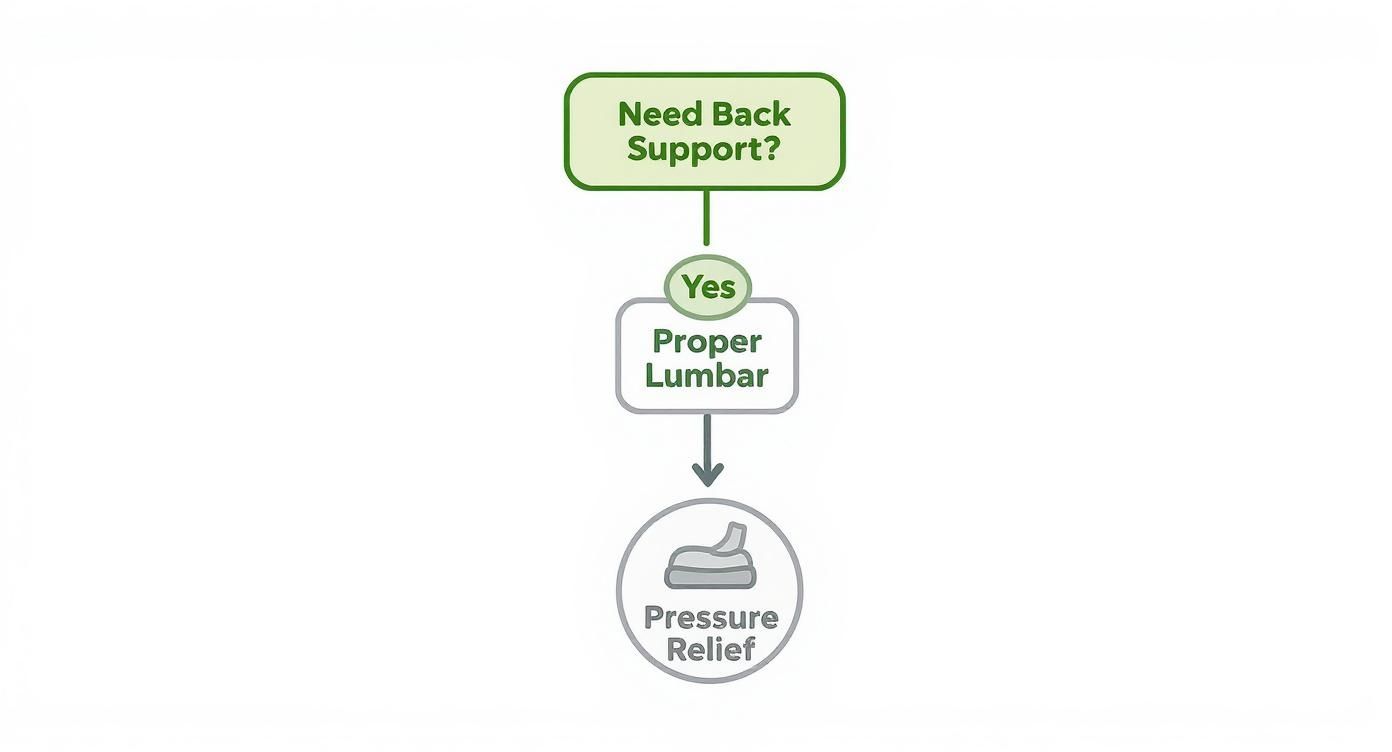
As you can see, it all starts with proper lumbar support. Get that right, and you're well on your way to taking the pressure off and feeling better.
The Decompressive Power of Zero-Gravity Recliners
The term "Zero-Gravity" comes from a position NASA engineers figured out for astronauts—a deep recline where your legs are elevated just above your heart. This angle distributes your body weight so evenly that it creates a feeling of weightlessness, which takes almost all the pressure off your spine.
If you deal with spinal compression from being on your feet all day, a Zero-Gravity recliner offers a unique kind of relief. By gently separating the vertebrae, this position can help ease pinched nerves, let tight muscles finally relax, and even improve blood flow. It’s particularly effective for people with sciatica or herniated discs because it puts the body in a completely neutral posture.
Recliner Type Comparison for Your Back Support Needs
To help you match your situation to the right chair, here’s a straightforward table comparing the key differences. Use this as your quick guide to narrow down your search.
| Recliner Type | Primary Back Support Mechanism | Ideal For… | Key Feature to Look For |
|---|---|---|---|
| Power Recliner | Infinite-position adjustments and targeted power lumbar/headrest support. | Individuals who need precise, customizable angles to alleviate specific pressure points and fluctuating pain. | Independent controls for the back, footrest, lumbar, and headrest for maximum customization. |
| Lift Chair | A motorized lifting mechanism that assists the user from a seated to a standing position. | Those with mobility issues, arthritis, or who are recovering from surgery and need to avoid strain on their back and joints. | A smooth, quiet motor and a sturdy frame that feels stable and secure during the entire lift and lower process. |
| Zero-Gravity Recliner | A reclining angle that elevates the legs above the heart to decompress the spine. | Anyone seeking maximum spinal decompression, relief from sciatica, or improved circulation. | A true Zero-Gravity position that achieves the correct angle for that "weightless" feeling, not just a deep recline. |
In the end, the best recliner is the one that directly addresses your specific aches and pains. By understanding how each of these types works, you’re in a much better position to choose a chair that will truly feel like a partner in your comfort. Of course, the best way to know for sure is to try them out, and our team is always here to help you do just that.
What to Look For in a Recliner for Back Support
Once you’ve narrowed down the type of recliner you need, it's time to get into the details. The real magic of a back-friendly chair isn't just its category—it's the specific features that deliver personalized comfort and support. These are the non-negotiables that separate a truly therapeutic recliner from just another piece of furniture.
Your body is unique, so your recliner should be able to adapt to you, not the other way around. This means scrutinizing the adjustability, checking the quality of the materials, and ensuring the design promotes a healthy posture right from the start. Let's dig into the essential features you should have on your checklist.
The Critical Role of Adjustable Lumbar Support
If there's one feature you absolutely cannot compromise on for back pain relief, it's adjustable lumbar support. Your lower back has a natural curve, and keeping that curve properly supported is key to preventing muscle strain and spinal pressure. A standard, fixed cushion is a one-size-fits-all solution that rarely fits anyone perfectly. It either pushes your spine too far forward or leaves an unsupported gap.
To really get the job done, the support needs to be fine-tuned to your body. You'll generally find a few different kinds of systems:
- Mechanical Systems: These are pretty straightforward, often using a lever or a dial to manually shift a support pad forward or backward. It gives you direct control over the pressure.
- Air Bladder Systems: Often found in higher-end power recliners, these use a remote to inflate or deflate an air chamber inside the chair. The precision you can get with these is fantastic.
- Memory Foam: While not "adjustable" in the same way, high-quality memory foam is designed to conform to your unique shape. It provides passive, customized support that molds perfectly to your lower back.
A recliner without adjustable lumbar support is like a car without an adjustable driver's seat. It might work for some, but it will never provide the tailored fit required for genuine, long-term comfort and spinal health.
Perfecting Your Posture with Seat Depth and Height
Good posture starts from the ground up, and the dimensions of the seat itself are foundational. The seat's depth and height can make or break your entire experience.
Seat depth is all about how your back aligns with the chair's lumbar support. If the seat is too deep, you’ll find yourself slumping just to make contact with the backrest, which completely defeats the purpose. Too shallow, and your thighs won't be properly supported. The sweet spot is a depth that lets you sit all the way back while leaving about a two-to-three-finger gap between the front edge of the seat and the back of your knees.
Likewise, seat height is crucial. For proper alignment, your feet should rest flat on the floor with your knees at roughly a 90-degree angle. A seat that's too high will leave your feet dangling and strain your lower back. One that’s too low can put uncomfortable pressure on your hips and knees. To learn more about getting the measurements just right, check out The Ultimate Recliner Buying Guide.
Unlocking Spinal Decompression with Full Recline Angles
The ability to recline deeply isn't just for taking a nap—it’s a genuinely therapeutic feature. A chair that offers a "lay-flat" or near-flat recline allows for true spinal decompression. This position takes the gravitational pressure off your vertebrae and discs, something that’s especially helpful after a long day of sitting or standing. It gives the muscles all along your spine a chance to fully relax and recover.
Look for recliners that offer a smooth, wide range of motion. This is where power recliners really shine, since they let you stop and lock the chair into any position you find most comfortable.
The Foundation of Quality Materials and Construction
What’s on the inside of a recliner matters just as much as what you see on the outside. High-quality components are what ensure your chair will provide consistent, reliable support for years.
- Foam Density: Always check for high-density foam, especially in the seat cushion. Low-density foam breaks down quickly, leading to sagging that will throw your posture completely out of whack.
- Frame Construction: The chair’s skeleton needs to be solid. A frame made from kiln-dried hardwood or steel is the gold standard for a durable recliner. A weaker frame can warp, compromising the entire chair's support system.
- Motor Quality: For power and lift recliners, the motor is the heart of the machine. A quiet, smooth motor is a clear sign of quality engineering. When a recliner becomes a key part of daily life, its reliability is crucial, much like other effective mobility aids that promote long-term independence.
Armed with this checklist, you're no longer just a casual shopper—you're an informed buyer. You now have the knowledge to assess any recliner and see if it truly has what it takes to deliver the back relief you deserve.
How to Test a Recliner for Your Perfect Fit
Finding the best recliner for back support isn't about picking one off a list—it's about finding the one that fits your body. Think of it less like shopping and more like a fitting for a custom suit. The goal is to match the chair’s dimensions to your own. Armed with a few simple tests, you can walk into a showroom with confidence and turn guesswork into a precise, effective process.
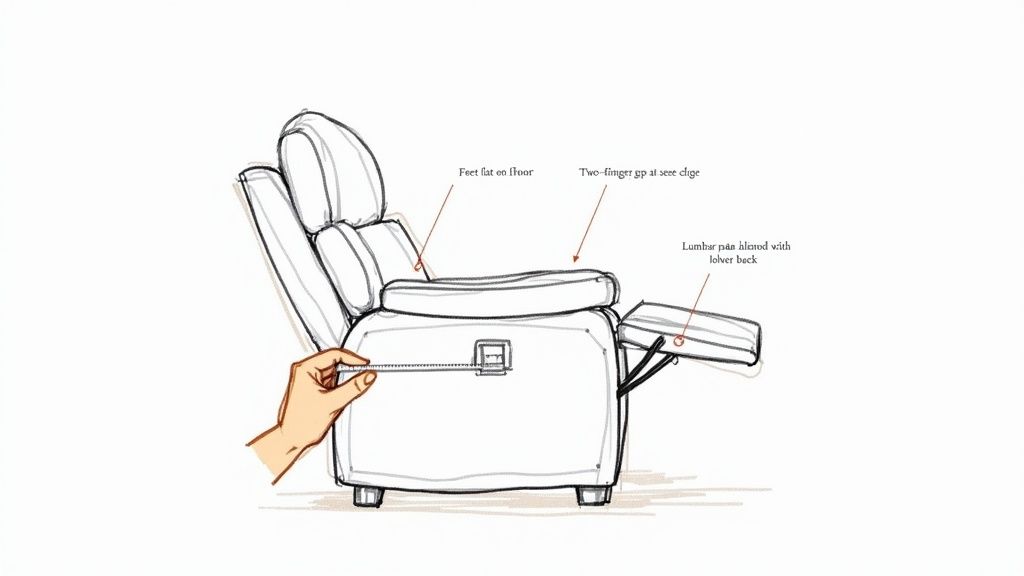
The Upright Seating Test
Before you even think about leaning back, your evaluation starts in the upright position. Sit all the way back in the chair so your back is flush against the backrest.
First, check where your feet land. They should rest flat on the floor, with your knees at a natural 90-degree angle. If your feet are dangling or your knees are bunched up toward your chest, the chair’s height isn't right for your leg length.
Next, gauge the seat depth. Try to slide your hand between the front edge of the seat and the back of your knees. You’re looking for a gap of about two to three fingers. Any more space means the seat is too shallow, and no space at all means it's too deep, which can restrict circulation and throw your lower back out of alignment.
The Lumbar Alignment Check
While you're still sitting upright, tune into how your lower back feels. A good recliner’s lumbar support should perfectly fill the natural curve of your spine. It should feel like a gentle, cradling pressure—not a hard lump pushing you forward or, even worse, a hollow gap leaving you unsupported.
This single checkpoint is often what separates a generic chair from the best recliner for back support. When it's right, the support feels like it was molded just for you.
Your body is the ultimate expert here, so trust your instincts. If the lumbar support feels even slightly off, that feeling will only get more pronounced over time.
This demand for a personalized fit is a huge driver in the furniture industry. The global recliner market is projected to reach USD 6.8 billion by 2033, a boom fueled by a growing awareness of how ergonomic features impact health. Chairs with adjustable lumbar, headrests, and proper seat dimensions are leading the way because they are proven to help maintain the spine's natural S-curve.
The Full Recline Evaluation
Now for the main event. As you recline, the motion should be fluid and easy. Pay attention to how the chair supports your body throughout the entire movement, from upright to fully reclined.
Here’s a quick checklist to run through:
- Head and Neck Support: Does the headrest cushion your head without jutting it forward? Your neck should feel relaxed and stay in a neutral line with your spine.
- Lumbar Contact: As you lean back, check if the lumbar support stays in firm contact with your lower back. Some recliners create a gap in this area when reclined, which defeats the purpose and can cause strain.
- Footrest Position: Once fully extended, the footrest should support your lower legs all the way to your heels. Your ankles shouldn't be left hanging off the edge.
By running through these simple tests, you're no longer just buying a piece of furniture—you’re making a smart investment in your body's well-being. Ready to try it for yourself? Explore our premium selection of La-Z-Boy recliners online, then come visit our showroom to find your perfect fit.
Time to Put Your Knowledge to the Test in Our Showroom
You've done the homework. You now know exactly what to look for in a recliner that truly supports your back. But reading about comfort is one thing—feeling it is another. The next step is the most critical one: trying them out for yourself.
Think of our showroom as your personal comfort lab. This is where all the features and measurements we've talked about come to life. Armed with what you've learned, you're no longer just browsing chairs. You're an informed buyer, ready to assess each one against your unique needs.
From Reading to Relaxing: A Hands-On Approach
Our design and sleep experts are here to help you connect the dots, not to push a sale. They'll listen to what you need—whether it’s targeted lumbar support or the full-body relief of a zero-gravity model—and guide you to the recliners that fit the bill.
This is your chance to feel the difference between the high-resiliency foam in a Flexsteel recliner and the legendary comfort of a La-Z-Boy. Does the power headrest hit the right spot? Is the leather as supple as you hoped? You can only answer these questions by sitting down, leaning back, and experiencing it firsthand.
This isn't just about buying furniture. It's the final, crucial step in your mission for lasting back relief. This is where your research pays off.
Your Partners in Finding the Perfect Fit
We're committed to empowering you to make a decision you'll be happy with for years. That means creating a relaxed, no-pressure space where you can take your time, compare different models, and ask every question that comes to mind. Our job is to make sure you walk out with a recliner that feels like it was custom-made for you.
Your search for the best recliner for back pain ends here. Get a head start by browsing our extensive online collection of recliners to see what styles you like. Then, come visit us at Miller Waldrop to make a confident choice and finally get the comfort you deserve.
Got Questions? We've Got Answers
When you're shopping for a recliner to help with back pain, a few questions always seem to pop up. Getting the right answers can mean the difference between temporary relief and long-term comfort. Let’s clear up a few of the most common ones.
Is a Firm or Soft Recliner Better for Back Pain?
This is a classic question, but "firm" and "soft" aren't the best words to use. Think supportive instead. You're looking for a sweet spot: a chair that's firm enough to hold your spine in its natural S-curve but has enough give to cushion your body and ease pressure points.
High-density foam is usually the star player here. It offers that crucial support without letting you sink into a slouch, which is what ultimately leads to more pain.
Can Sleeping in a Recliner Actually Hurt My Back?
For a lot of people, sleeping in a recliner is a game-changer, especially if they deal with issues like sleep apnea, acid reflux, or even some types of back pain that feel worse lying flat. A zero-gravity or infinite-position recliner can take pressure off the spine in a way a bed sometimes can't.
The secret is consistent support. If the chair keeps your lower back supported all night long without creating any gaps, you're in good shape. Of course, it's always smart to run this by your doctor to make sure it's the right move for your specific health situation.
The key takeaway is consistency. Whether you're watching a movie or dozing off for the night, the recliner needs to maintain proper spinal alignment. No gaps, no awkward pressure points.
How Do I Know if the Lumbar Support Fits Me Correctly?
It should feel like it was made for you—natural and almost unnoticeable. Sit down and make sure your hips are pushed all the way to the back of the chair. The lumbar cushion should fill the small curve of your lower back perfectly.
It shouldn't feel like it's shoving you forward, nor should there be a gap. If you’re testing an adjustable model, play with the settings until it feels like it’s giving your lower back a gentle, supportive hug.
At Miller Waldrop, we see the right recliner as more than just furniture; it’s a tool for better daily living. Now that you're armed with this knowledge, you have the power to find the chair that feels just right. Take a look at our premium collection of Flexsteel recliners online, then come visit our showroom to put your new expertise to the test and claim the comfort you deserve.