

Best Mattress Types for Back Pain: Find Your Ideal Support

If you've ever woken up feeling like you went a few rounds in a boxing ring overnight, your mattress is probably the main suspect. That stiff, aching back is a miserable way to start the day, and it's a clear signal that you're not getting the support you need.
To win the battle against back pain, you need the right tools. The best mattress types for back pain almost always fall into one of three categories: medium-firm hybrid, memory foam, or latex. What do they have in common? They all master the delicate balance between supporting your spine and cushioning your body, which is the secret to waking up refreshed instead of sore.
Your Guide to a Pain-Free Morning

Waking up in pain shouldn't be your "normal." Your mattress is the single most powerful tool you have for truly restorative sleep, and choosing the right one is an investment in your well-being. This guide is here to empower you with the knowledge to walk through exactly what to look for, so you can make a choice with total confidence.
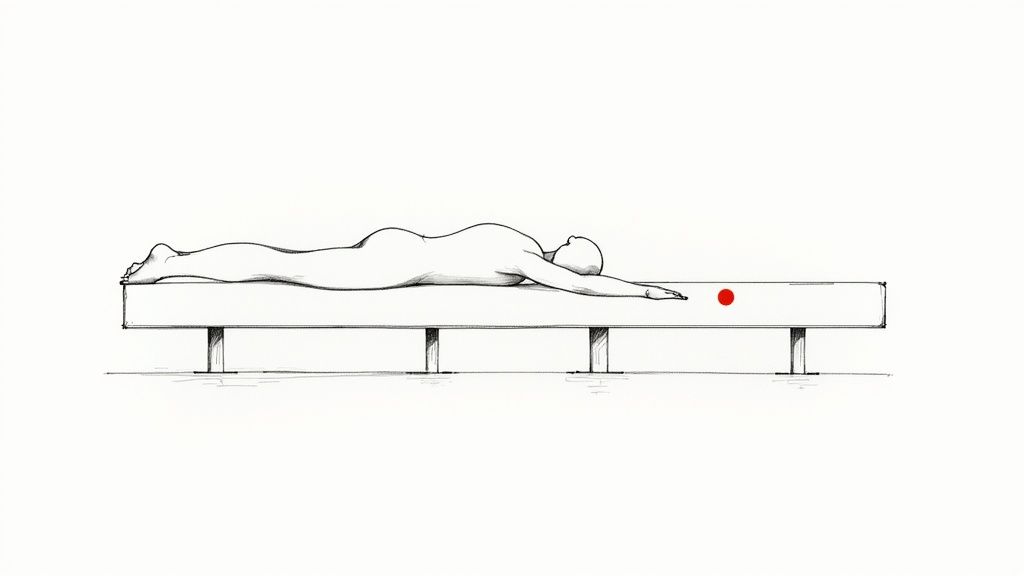
The entire journey to better mornings boils down to one simple concept: neutral spinal alignment. Picture a straight line running from the base of your skull all the way down to your tailbone. A great mattress holds that line steady all night long. If your mattress is too soft, your hips will sink, throwing that line out of whack. Too firm, and it creates a gap under your lower back, leaving it completely unsupported. Either way, you're waking up with pain.
The Foundation of Restorative Sleep
Finding that perfect middle ground is everything. A mattress that’s truly built for back pain relief does three things exceptionally well, giving you the power to heal as you sleep:
- Provides Solid Foundational Support: It acts as a stable base that maintains your spine's natural, gentle curve, regardless of your sleeping position.
- Delivers Smart Pressure Relief: It expertly cushions the high-pressure zones like your shoulders and hips, which prevents tossing and turning and helps with circulation.
- Adapts to Your Unique Shape: The best surfaces contour to your body, filling in the gaps and making sure every inch of you is properly cradled.
Think of your mattress less as a passive place to lie down and more as an active recovery tool. The right surface can genuinely reduce strain, ease pressure on your joints, and help your body heal while you sleep.
For a comprehensive approach to feeling better, it's also helpful to look at other habits and strategies. Exploring options for natural pain relief for back pain can complement the work your new mattress is doing.
Here's a quick look at how you can harness the power of the top mattress types to fight back pain.
At-a-Glance Mattress Guide for Back Pain Relief
| Mattress Type | Primary Benefit for Back Pain | Best For Sleepers Who… |
|---|---|---|
| Hybrid | Balanced support and contouring from coils and foam. | Want the "best of both worlds"—responsive support with a cushioned top. Great for all sleeper types. |
| Memory Foam | Superior pressure relief and body-hugging comfort. | Need maximum cushioning for shoulders and hips, especially side sleepers and those with sharp pain points. |
| Latex | Responsive, buoyant support that doesn't "swallow" you. | Prefer a slightly firmer, more natural feel and need durable support that won't sag. |
This table is a great starting point, but the best way for you to know for sure is to feel the difference yourself.
Our sleep experts at Miller Waldrop can guide you through top-tier options, showing you how the incredible support systems in a Serta Perfect Sleeper can equip you for a better morning. Come visit us in our Lubbock, Hobbs, or Ruidoso showrooms and let us help you find the perfect tool for your recovery.
Understanding Support and Spinal Alignment
If you're going to win the fight against back pain, you need to understand your two most powerful allies: support and pressure relief. These terms are everywhere in the mattress world, but they do very different jobs. By getting a handle on these concepts, you become a smart shopper who can see past the marketing hype and find what actually works for you.
Think of your spine as a bridge that needs to stay perfectly level all night long. Support is the structural strength that keeps that bridge from sagging. It’s the mattress’s core job to hold your body up and maintain the natural, gentle "S" curve of your spine, preventing it from collapsing into a painful hammock shape.
Here’s a critical point many people miss: support is not the same thing as firmness. A mattress can feel as hard as a rock, but if it leaves a gap under your lower back, it's failing to provide true support where you need it most.
Why Your Spine Needs Neutral Alignment
When your spine is held in a neutral position, your back muscles can finally let go and relax. If a mattress is too soft, your heavier parts—like your hips and torso—will sink in too far, putting a real strain on your lower back. On the flip side, a mattress that’s too firm will push your hips and shoulders upward, forcing your spine out of alignment and creating new aches and pains.
The sweet spot is a mattress that perfectly molds to your body's individual shape while still having a strong, stable foundation underneath. This combination ensures every inch of your back, from your neck down to your tailbone, is properly cradled.
A truly supportive mattress doesn’t force your spine straight; it respects its natural curves. It works with your body, not against it, to provide a foundation for deep, restorative healing.
When you get this balance right, you're not just sleeping. You're actively recovering.
The Role of Pressure Relief
While support is all about keeping your spine aligned, pressure relief is all about comfort. Picture the parts of your body that press down the hardest into the bed—your shoulders, hips, and even your knees. On the wrong mattress, these areas take on your entire body weight, which leads to soreness, that "pins and needles" feeling, and tossing and turning all night.
Pressure relief is the magic of spreading your body weight evenly across the whole surface. Materials like memory foam and latex are fantastic at this because they contour to your body, cushioning those high-pressure zones instead of pushing back against them.
- For Side Sleepers: This is absolutely essential. You need a surface with enough give to let your shoulders and hips sink in slightly, which is key to keeping your spine straight.
- For Back Sleepers: Pressure relief helps cushion the tailbone and shoulder blades, preventing that morning stiffness.
- For Stomach Sleepers: While it’s a bit less of a focus, it still helps by preventing uncomfortable strain on your ribs and knees.
Of course, your mattress can't do all the heavy lifting alone. Good posture and support during the day, especially if you sit for long hours, are just as important for managing back pain. It might be worth looking into the best ergonomic office chairs for back pain to build a supportive environment around the clock.
And if you suspect your current bed might be the culprit, our guide on when to replace your mattress can help you spot the warning signs. Now that you have this foundational knowledge, you're ready to look at specific mattress types that deliver this winning one-two punch of support and relief.
Exploring the Best Mattress Types for Back Pain
Okay, now you get it—support and pressure relief are the two most important ingredients for a pain-free morning. With that knowledge, you can start looking at different mattresses not just as soft rectangles, but as powerful tools designed to help your back.
Think of it like you're scouting players for your sleep team. Each mattress type brings a unique set of skills to the game, and your job is to find the one whose strengths match your needs. Let's break down how you can use the three heavyweights in the world of back pain relief: memory foam, latex, and hybrids.
The Contouring Comfort of Memory Foam
Memory foam is famous for one thing: it hugs you back. It’s known for that signature slow-sinking feeling that cradles every curve of your body. Imagine pressing your hand into soft dough—the way it holds that perfect impression is exactly what memory foam does for your shoulders, hips, and lower back.
This unique ability to contour is what makes memory foam a champion of pressure relief. Instead of creating painful pressure points, the foam absorbs your weight, allowing your hips and shoulders to sink in just enough to keep your spine perfectly straight. This is a game-changer for side sleepers, who put a ton of stress on those areas.
By eliminating those nagging pressure points, a good memory foam mattress helps you stop tossing and turning all night. It creates a quiet, still surface that finally lets your muscles relax, recover, and heal.
If you crave that deep, body-hugging comfort, memory foam is often the perfect tool for the job. To learn more about specific models, you can explore our guide on finding the best memory foam mattress for back pain.
The Buoyant Support of Latex
If memory foam is a slow, gentle hug, then latex is a responsive, supportive lift. Derived from the sap of rubber trees, natural latex has a buoyant, almost springy feel. You don't sink into it; you sleep on it.
This inherent responsiveness provides instant, dynamic support that adjusts as you move. For back and stomach sleepers, this is a massive win. It prevents your hips from sinking too far into the mattress, which is one of the most common causes of lower back pain and misalignment.
Latex also shines when it comes to durability and sleeping cool. Its natural open-cell structure promotes airflow, making it a fantastic choice if you tend to overheat at night. Plus, it's incredibly resilient, meaning it will resist sagging and body impressions for years, giving you consistent support night after night.
- Key Benefit: Responsive, uplifting support that keeps the spine properly elevated.
- Best For: Back sleepers, stomach sleepers, and anyone who prefers feeling more "on top of" their bed.
- Also Great For: Hot sleepers and folks looking for a durable, long-lasting mattress made from natural materials.
This blend of gentle contouring and active support makes latex a phenomenal all-arounder for people dealing with nagging backaches.
The Best of Both Worlds with Hybrid Mattresses
So, what if you could take the deep, pressure-relieving hug of foam and combine it with the sturdy, traditional support of an innerspring system? That’s exactly what a hybrid mattress does. This modern design is engineered from the ground up to deliver balanced performance, and it's one of the most recommended options for back pain for good reason.
A hybrid mattress is built with two key components:
- A Support Core: The foundation is made of individually pocketed steel coils. Unlike the old, interconnected springs that moved as one big unit, these coils work independently. They can provide targeted, customized support that pushes up where you need it (like your lower back) and gives way where you don't (like your shoulders).
- A Comfort Layer: Resting on top of the coils is a thick layer of premium memory foam, latex, or sometimes both. This is where the magic of pressure relief happens, as the foam contours to your body to cushion your joints and prevent soreness.
This two-part system is why hybrids are often considered the ultimate solution. You get the serious, uncompromising support your spine needs from the coils, plus the luxurious comfort you want from the foam. It’s a win-win.
In fact, the market has clearly shown that this combination works. Memory foam and hybrid mattresses are now the leading choices for back-pain relief, generating approximately $8.5–$9.0 billion in global sales between 2023 and 2024. Market analyses consistently point to hybrids as the fastest-growing and most frequently recommended type for back pain, simply because their design tackles both support and comfort head-on. You can find more details on these market trends on Dataintelo.com.
This powerful construction makes hybrids a fantastic match for nearly every body type and sleep position.
Mattress Type Feature Comparison for Back Pain Sufferers
To make things even clearer, here’s a quick rundown of how these three mattress types compare head-to-head on the features that matter most for back pain, so you can choose your best tool.
| Feature | Memory Foam | Natural Latex | Hybrid |
|---|---|---|---|
| Spinal Alignment | Good to Excellent; conforms closely to fill gaps under the lumbar spine. | Excellent; offers buoyant support that prevents hips from sinking. | Excellent; pocketed coils provide targeted, dynamic support for the spine. |
| Pressure Relief | Excellent; exceptional at absorbing impact and cushioning joints. | Good to Excellent; offers contouring with a more responsive feel. | Excellent; combines foam comfort layers with coil adaptability for superior relief. |
| Durability | Good; high-density foams are very durable, but lower-quality foams can sag. | Excellent; one of the most resilient and long-lasting materials available. | Very Good to Excellent; dependent on coil gauge and foam quality. |
| Temperature Control | Fair to Good; modern gel-infused and open-cell foams have improved airflow. | Excellent; naturally breathable material that sleeps cool. | Very Good; coils promote airflow through the core of the mattress. |
Choosing the right mattress is a personal journey, but you’re now armed with the expert knowledge to make a confident decision. Whether you need the deep contouring of memory foam, the responsive lift of latex, or the balanced performance of a hybrid, the right tool for a pain-free morning is out there.
The next step? Come visit a Miller Waldrop showroom and feel the difference for yourself. Our Sleep Experts are ready to guide you to the perfect fit.
Choosing the Right Firmness for Your Sleep Style
You’ve sorted through the different mattress types, but now we’ve arrived at the most personal—and often confusing—part of the equation: firmness. Think of it as the final calibration. It's what takes a mattress's support system and fine-tunes it specifically for your body and the way you sleep.
Finding the right firmness isn't about a simple "hard" or "soft" label. It’s about finding the one that meets your body's unique needs. This personal sweet spot is determined by two main things: your body weight and your primary sleeping position. Nailing this combination is what turns a good mattress into a great one for your back.
Matching Firmness to Your Body Weight
How much you weigh directly changes how a mattress feels underneath you. A bed that feels perfectly supportive for a 130-pound person might feel more like a soft, unsupportive hammock to someone who weighs 230 pounds.
-
Lighter Individuals (Under 150 lbs): You'll probably feel most comfortable on a softer to medium-soft mattress. A surface that's too firm won't give enough to contour to your curves, which can create new pressure points instead of relieving them.
-
Average Weight Individuals (150-230 lbs): This is where medium to medium-firm mattresses really hit their stride. They provide that ideal Goldilocks balance—enough cushioning for your joints but with a solid core to keep your spine properly aligned.
-
Heavier Individuals (Over 230 lbs): A firmer mattress is almost always the way to go for durable, long-term support. A firmer feel prevents you from sinking in too deeply, which is essential for maintaining a neutral spine and ensuring the mattress holds up over time.
How Your Sleep Position Changes Everything
Once you've factored in your weight, your go-to sleep position is the next critical piece of the puzzle. Each position puts pressure on different parts of your body and requires a different kind of support.
Side Sleepers
If you're a side sleeper, your mattress needs to have enough give to cushion your hips and shoulders. A surface that’s too firm will just push back against these areas, forcing your spine out of alignment and leading to aches. A medium-soft to medium feel is usually the sweet spot.
Back Sleepers
The main goal for back sleepers is to maintain the natural "S" curve of the spine. A medium-firm mattress is typically the hero here. It's sturdy enough to keep your hips from sinking too low but has just enough softness to conform to your lower back, closing any unsupported gaps.
Stomach Sleepers
This position can put a lot of strain on your spine, so firm support is non-negotiable. A medium-firm to firm mattress will keep your hips propped up and in line with your shoulders, preventing your lower back from arching into a painful U-shape.
This decision tree gives you a quick visual guide for choosing a mattress, based on whether you need robust support, gentle cushioning, or a blend of both.
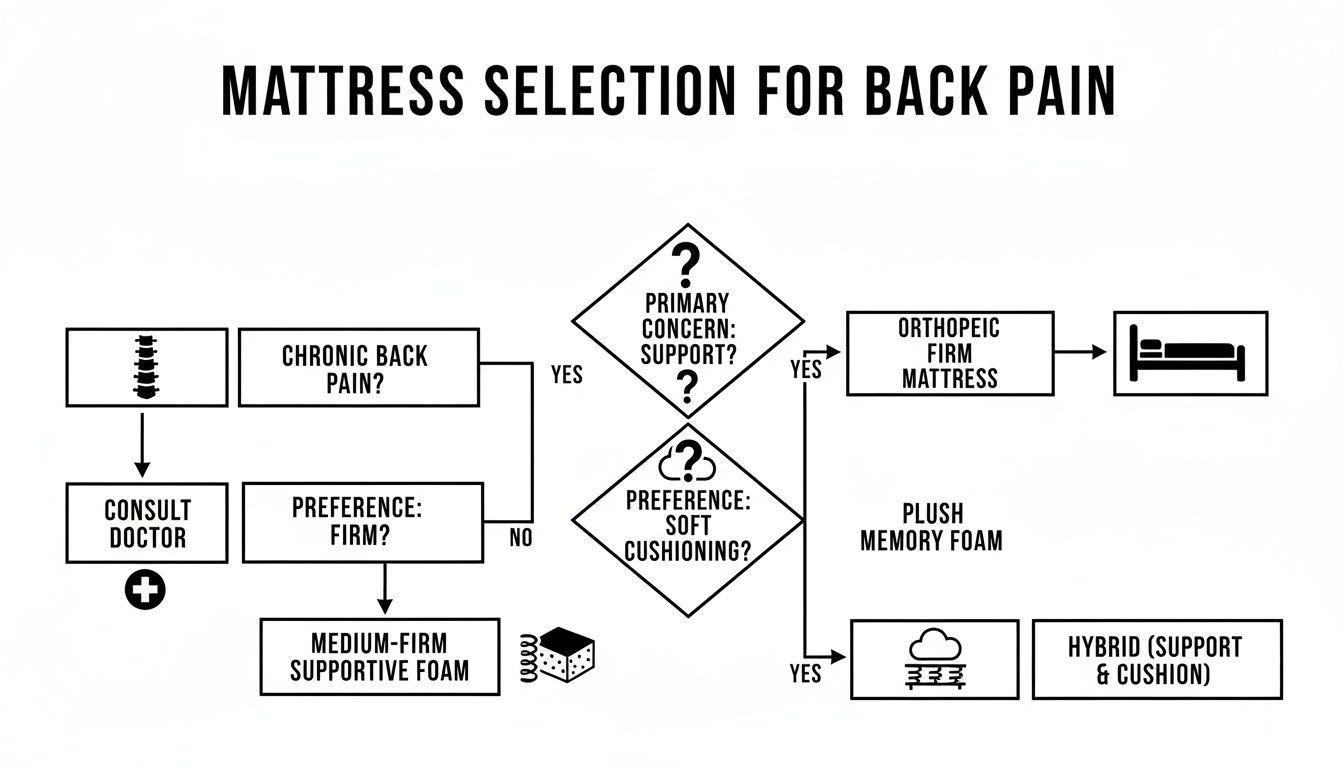
As you can see, your biggest pain points and comfort preferences point you straight toward the mattress type best equipped to solve your specific sleep challenges.
Finding the right firmness level is your secret weapon. It’s what ensures the mattress actively works to support your unique shape, rather than forcing your body to conform to it.
This isn't just our opinion—it's backed by a lot of research. Sleep experts and consumer labs have analyzed countless mattresses and keep coming to the same conclusion: medium to medium-firm ratings offer the best all-around support and pressure relief for most people dealing with back pain. These studies consistently find that a firmness level between 4 and 7 on a 10-point scale is the sweet spot for taking the strain off the lower back.
Feeling confident in this choice is so important, and we've put together a detailed resource to walk you through it. Our guide on how to choose mattress firmness goes even deeper, giving you the tools to make a smart decision.
Ultimately, though, the best way to find your perfect firmness is to feel it for yourself. At Miller Waldrop, our Sleep Experts are here to guide you through the options, letting you lie down and feel the subtle but crucial differences. Stop by one of our showrooms and let us help you find the support that will truly change your mornings for the better.
Putting It All Together: Your Mattress Buying Roadmap
You've done the hard work. You now understand how a mattress should support your spine, the difference between support and pressure relief, and how all those materials and firmness levels actually translate to a good night's sleep for your body. This is where the rubber meets the road—your practical checklist for turning all that knowledge into the right purchase.
Choosing a mattress is a real investment in your health, not just a piece of furniture. Think of this as the final step in building your personal toolkit for a life with less pain.
Smart Shopping: The Policies That Protect You
When you're ready to buy, a few key things can make or break the experience. These are your safety nets, ensuring you don't get stuck with a mattress that isn't helping your back.
-
Sleep Trials: Your body needs time to get used to a new mattress. Lying on a bed for five minutes in a store is a good start, but it's not the whole story. A proper sleep trial, which usually lasts between 30 and 120 nights, gives you the time you need to be absolutely sure it's the right one for you. Don't be shy—use the whole period!
-
Warranties: A solid warranty (look for 10 years or more) is the manufacturer's vote of confidence in their own product. It protects you from things like deep sagging or broken coils, so you can trust your mattress will keep doing its job for years.
-
Spotting Quality Materials: Keep an eye out for mattresses made with high-density foams, durable natural latex, or strong, individually pocketed coils. Better components last longer and are less likely to break down, which is essential for maintaining the consistent spinal support your back needs.
Why Trying in Person Still Matters
Online research is great for narrowing down your options, but nothing beats the real thing. You can't feel the subtle differences in contouring and support by reading a review—you have to lie down on the mattress yourself.
This is your chance to connect what you've learned with what you can actually feel. Instead of taking a guess based on a website, you can walk into a Miller Waldrop showroom in Lubbock, Hobbs, or Ruidoso and put your new expertise into practice.
The most powerful tool you have is your own body's feedback. Trying a mattress in person allows you to connect what you've learned with what you actually feel, leading to a much more confident and successful choice.
Our Sleep Experts are here to be your guides, not just salespeople. They can point you toward mattresses specifically engineered for back pain, like the incredible Tempur-Pedic ProAdapt series, which is famous for its ability to adapt to your body's unique curves for unparalleled pressure relief.
Finding Your Perfect Fit at Miller Waldrop
The world of mattresses designed for back pain is huge, but memory foam and hybrid models are the clear front-runners. In fact, these two types make up well over half of the market, and for good reason. Trusted brands like Tempur-Pedic, Serta, and Sealy have perfected these technologies to deliver the performance people with back pain rely on. You can see how these trends are shaping the market and understand why these materials are so popular.
Here at Miller Waldrop, we’ve already done a lot of the homework for you by hand-picking the best options from these top-tier brands. Our Sleep Experts are trained in the science of sleep and are ready to help you match your body type, sleep position, and specific pain issues to the perfect mattress.
Your journey to waking up refreshed and pain-free is nearly at its end. You have the knowledge, you know what to look for, and you have a team ready to help.
The only thing left to do is feel the difference for yourself. Visit a Miller Waldrop showroom today, and let our Sleep Experts help you find the mattress that will let you win back your mornings.
Still Have a Few Questions?
Even after doing all the research, it's totally normal to have a few nagging questions before you make a final decision. Let's tackle some of the most common ones our sleep experts hear, so you can feel completely confident you're on the right track to a pain-free morning.
Can I Just Get a Mattress Topper to Fix My Back Pain?
A great mattress topper can be a tempting shortcut, but it's really important for you to know what they can and can't do. If your main issue is a mattress that's just too firm, a thick memory foam topper can definitely add a layer of soft, pressure-relieving cushion for your shoulders and hips.
But here’s the catch: a topper is a bandage, not a cure. If your mattress is old and sagging in the middle, it's lost its core support. No amount of foam piled on top can fix a foundation that’s failing to keep your spine aligned. It’s like putting a fancy new coat of paint on a crumbling wall—it looks better, but the underlying problem is still there.
Think of it this way: a topper can add comfort, but it can never add support. Real, lasting relief for back pain has to come from the mattress core itself.
How Long Does It Really Take to Get Used to a New Mattress?
You've been sleeping on your old, unsupportive bed for years, so your body needs some time to recalibrate. It's a process. Expect a break-in period of anywhere from 30 to 90 days.
During this window, two things are happening: the mattress materials are softening and conforming to you, and your muscles are learning to relax into a new, healthier alignment. A couple of nights just isn't enough to know for sure. This is exactly why a sleep trial is such a powerful tool. Use that whole time to pay attention to how you feel. Are you waking up a little less stiff? Is that nagging ache starting to fade? That trial is your safety net, ensuring you’ve made the right long-term investment in your health.
Is an Adjustable Base Worth It for Back Pain?
For so many people our experts have worked with, an adjustable base is an absolute game-changer. Being able to elevate your head and legs lets you find that perfect, custom position that takes all the strain off your lower back. The "zero-gravity" setting, where your legs are raised just above your heart, can decompress the lumbar spine and bring almost instant relief.
It’s especially helpful if you’re dealing with issues like spinal stenosis or even acid reflux. An adjustable base essentially turns your bed from a simple flat surface into a personalized recovery tool. It works beautifully with memory foam, latex, and hybrid mattresses, making their pain-relieving features even more effective.
How Do I Know When It’s Officially Time to Replace My Mattress?
Your body will tell you, loud and clear. If you find yourself waking up sore and stiff every single morning, only to have the pain ease up as you move around, your mattress is almost certainly the culprit. That’s the classic sign that its support system has given up.
Keep an eye out for these tell-tale signs:
- Visible Sagging: Do you see a permanent body-shaped ditch where you sleep?
- Lumps and Bumps: Can you feel uneven spots when you run your hand over the surface?
- Better Sleep Elsewhere: Do you sleep like a baby in a hotel or guest bed, only to come home to aches and pains?
A good quality mattress is built to last about 7 to 10 years. After that, the materials just start to break down and can no longer do their job. Listen to what your body is telling you—when it starts screaming for relief every morning, it's time for a change.
At Miller Waldrop, our dedicated Sleep Experts are here to walk you through these final questions and any others you might have. We can help you connect all the dots to find one of the best mattress types for back pain that truly fits your body, sleep habits, and budget. Waking up refreshed and ready for the day is closer than you think. Come see us in our Lubbock, Hobbs, or Ruidoso showrooms and let us help you find your perfect sleep solution. Discover the Miller Waldrop difference today.