

Best Mattress Brands for Back Pain 2026


You wake up tired, turn to get out of bed, and your lower back reminds you before your feet even hit the floor. The ache eases after a hot shower or a few steps around the kitchen, but the next morning it’s back again. A lot of people in West Texas and Southeastern New Mexico live in that cycle for months before they ask the hard question: is my mattress helping me recover, or is it part of the problem?
That question matters more than most shoppers realize. A mattress isn’t just a soft place to land. It’s a piece of sleep equipment. It either keeps your body in a steady, supported position for hours at a time, or it asks your muscles and joints to fight for alignment all night long.
The good news is that choosing from the best mattress brands for back pain doesn’t require you to become a biomechanical engineer. You just need a clear way to think about support, pressure relief, mattress type, sleep position, and, in our climate, cooling. That last one gets ignored in a lot of national roundups, but anyone who’s spent a July night in Lubbock, Hobbs, or Ruidoso Downs knows heat changes the whole sleep experience.
Your Guide to Waking Up Without Back Pain
A common story goes like this. Someone blames age, work stress, an old sports injury, or long hours on their feet. All of that can matter. But they also notice something else. They sleep better in a hotel for one weekend, or they nap on a guest bed and wake up less stiff than usual. That’s often the first clue that the bed at home isn’t a neutral background detail. It’s an active part of the problem.
Back pain at night can come from several places. Tight muscles, inflammation, posture, and daytime habits all play a role. If you want a broader look at the pain side of the equation, MEDISTIK's guide to back pain offers a useful overview of common causes and relief approaches. But once you’ve ruled in that your sleep surface may be contributing, the focus shifts from “What’s the best mattress?” to “What’s the right mattress for my body?”
That’s a big difference.
The right mattress for a broad-shouldered side sleeper may feel awful to a dedicated back sleeper. A bed that feels supportive in a cool climate may sleep too warm for someone dealing with hot nights and night sweats here at home. And a mattress that seems firm in a showroom can still fail to support the lumbar area once you lie on it for a full night.
Your goal isn’t to find a mattress with the loudest marketing. Your goal is to find one that lets your spine rest in a more natural position while your pressure points stay comfortable.
If you’ve been wondering whether your bed is the reason you hurt in the morning, start with this practical read on why your back hurts after sleeping. It helps connect the dots between sleep posture, mattress feel, and the soreness that shows up before breakfast.
How Your Mattress Impacts Spinal Health
Your spine has gentle curves. A mattress should support those curves, not flatten them out and not exaggerate them. When a bed does its job well, your body can relax into it without sagging out of alignment.
That’s why two ideas matter more than anything else: support and pressure relief. People often use those words as if they mean the same thing. They don’t.

Support keeps you level
Support is what stops your heavier areas, usually the hips and midsection, from dropping too far. Think of it as the part of the mattress that holds you up.
If support is too weak, your pelvis can sink lower than the rest of your body. For many sleepers, that creates strain in the lower back. If support is too rigid in the wrong places, the mattress can push up awkwardly and leave your body tense instead of relaxed.
Pressure relief keeps you comfortable
Pressure relief is what cushions the areas that press hardest into the mattress, usually shoulders, hips, and sometimes ribs or knees depending on how you sleep. Good pressure relief spreads your weight more evenly.
When people say a mattress feels “hard” or “like the bed is fighting me,” they’re often describing poor pressure relief. The body responds by shifting, bracing, and tossing around. That breaks up sleep, which also makes pain harder to manage the next day.
Practical rule: A mattress for back pain should do two things at once. It should hold your spine in a stable line and cushion the spots that carry the most pressure.
Think about a car suspension
The easiest analogy is a truck or SUV driving a rough road. A good suspension absorbs impact, but it also keeps the vehicle steady. If it’s all stiffness, every bump rattles you. If it’s all softness, the vehicle wallows and loses control.
A mattress works the same way.
- Too stiff: your shoulders and hips don’t settle in, so the body feels jammed up.
- Too soft: the middle of the body dips and the spine bends out of a healthier resting shape.
- Balanced: the comfort layers cushion you while the support core keeps you aligned.
What neutral alignment actually looks like
Neutral alignment doesn’t mean your back is perfectly flat. It means your spine rests close to its natural shape. If someone took a photo of you lying in your usual sleep position, you’d want your body to look steady, not sharply bent at the waist or twisted through the shoulders.
A mattress can’t cure every source of back pain. But it can reduce the nightly stress that keeps irritated joints and muscles from calming down. That’s why understanding the mechanics matters so much when you start comparing brands and models.
Decoding Mattress Firmness The Goldilocks Principle
A lot of shoppers still walk into a store saying, “My back hurts, so I need the firmest bed you’ve got.” That advice has been passed around for years. It sounds sensible. It’s also often wrong.
Scientific research shows something more nuanced. Medium-firm mattresses significantly outperform firmer mattresses for back pain relief, and a systematic review found that medium-firm options led to less back pain and better sleep quality than firmer mattresses, according to this NCBI review on mattresses and sleep positioning for back pain.
Why firmer isn’t automatically better
People usually confuse firmness with support. Firmness is the immediate feel when you lie down. Support is whether the mattress keeps your body in a healthy position over time.
A board on the floor is firm. That doesn’t make it supportive in a useful sleep sense.
If a mattress is very hard, your shoulders and hips may not sink in enough. Then your spine can end up tilted or compressed because the bed isn’t allowing the body’s wider parts to settle naturally. That’s especially common for side sleepers, but back sleepers can feel it too.
The Goldilocks zone
For many adults with back pain, the sweet spot is medium-firm. Not mushy. Not rock-hard. Just enough give to cushion the body, with enough structure underneath to keep the spine from bowing.
That’s the Goldilocks principle in plain terms:
- Too soft can let the pelvis drift downward.
- Too firm can create pressure and force awkward angles.
- Medium-firm often balances contouring and lift.
Often, readers get tripped up. They test a plush top, feel immediate comfort, and assume it must be good for pain. Or they test an ultra-firm bed, feel “held up,” and assume it must be better for the back. Neither first impression tells the whole story.
A mattress can feel softer on top and still be very supportive underneath. It can also feel firm at first touch and still fail your spine once your body settles in.
A better way to judge firmness in the showroom
Instead of asking, “Is this firm enough?” ask a smarter set of questions:
- Do my hips sink much deeper than my shoulders?
- Do I feel pressure building at my shoulder, hip, or lower back?
- Can I fully relax, or am I subtly bracing my muscles?
- Does my lower back feel supported without feeling pushed upward?
Those questions get you closer to the truth than the label on the tag.
What to remember when comparing brands
Different brands label firmness differently. One company’s “firm” can feel like another company’s “medium-firm.” So don’t shop by label alone. Shop by body response.
When searching for best mattress brands for back pain, the primary goal isn’t maximum firmness. Instead, it’s a mattress that feels balanced enough to hold the spine steady and forgiving enough to let the body settle naturally.
Finding the Best Mattress Type for Your Back
Once you understand support and firmness, the next step is construction. Mattress type shapes how a bed responds to pressure, motion, airflow, and long-term comfort. Most shoppers compare three broad categories: innerspring, memory foam, and hybrid.
Here’s a simple visual way to think about them.
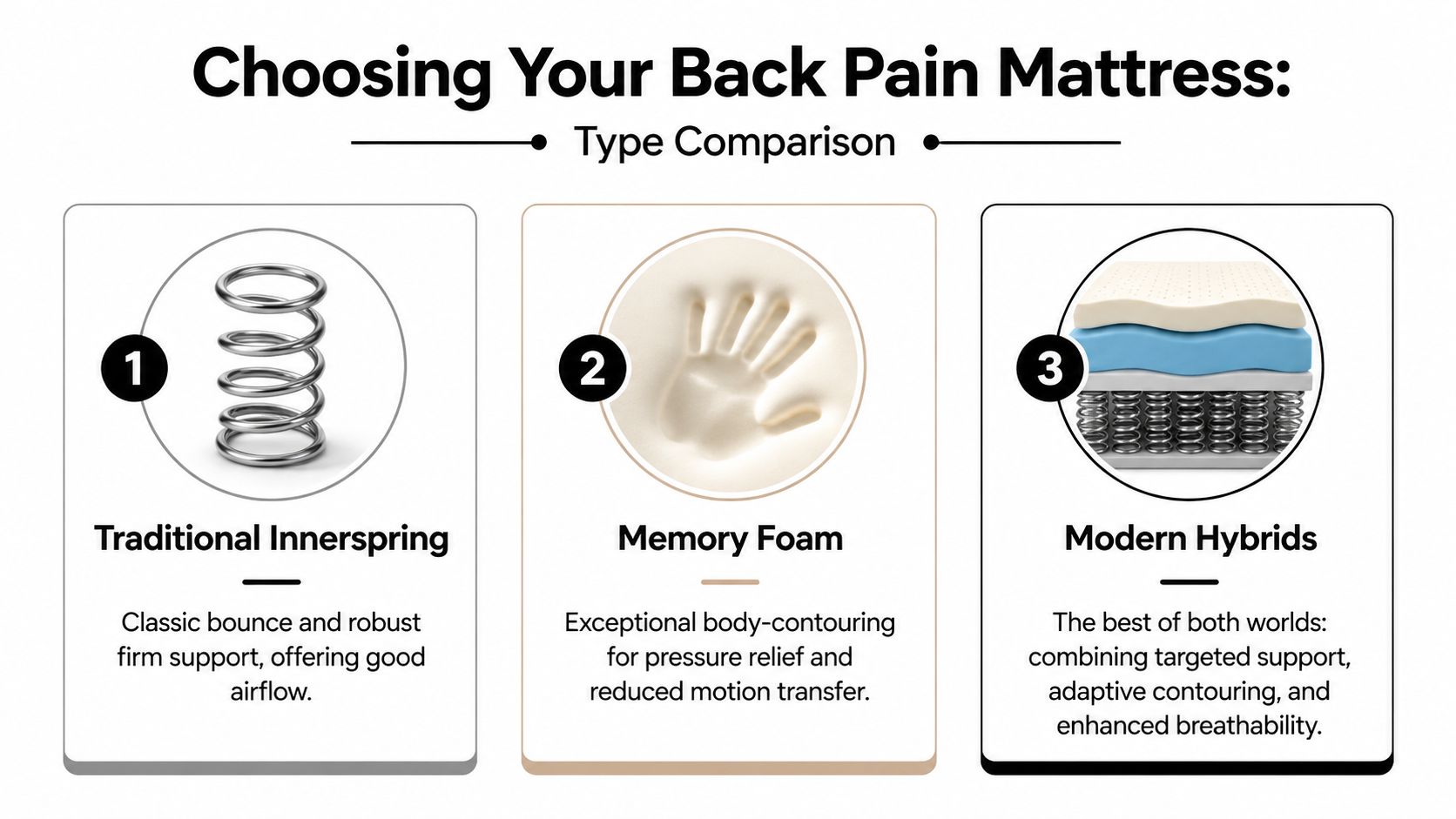
Traditional innerspring
An innerspring mattress relies mainly on coils for support, with thinner comfort materials near the top. Many people like the familiar bounce and easier movement.
For back pain, innersprings can work well when they’re built with quality support and enough surface cushioning. The challenge is that some traditional models feel supportive at first but don’t provide enough contouring for pressure points, especially for shoulders and hips.
Memory foam
Memory foam mattresses contour closely to the body. That can feel wonderful if pressure relief is your top priority. They often do a good job reducing motion transfer too, which matters if a partner’s movement wakes you.
The tradeoff is feel and airflow. Some sleepers like the hug. Others feel stuck. In a hot climate, that close-conforming feel can also become less comfortable if the materials hold warmth.
Modern hybrids
A hybrid combines a coil support core with thicker comfort layers of foam on top. That pairing is the reason so many shoppers land here. You get the underlying structure and responsiveness of coils with the pressure-relieving comfort of foam.
As of 2026, authoritative sources have identified high-performance hybrid mattresses as the top-performing category for back pain relief, combining the strengths of memory foam and innerspring designs, according to NapLab’s back pain mattress analysis.
Mattress Type Comparison for Back Pain
| Feature | Innerspring | Memory Foam | Hybrid |
|---|---|---|---|
| Core feel | Bouncy and lifted | Close contouring | Balanced contour and bounce |
| Pressure relief | Moderate, depends on top layers | Strong | Strong with more responsiveness |
| Ease of movement | Usually easy | Can feel slower | Usually easier than all-foam |
| Airflow | Often good | Often less breathable | Usually better than all-foam |
| Best fit for | Sleepers who like a traditional feel | Sleepers who want a deep cradle | Shoppers who want support plus cushioning |
Why hybrids have become the center of the conversation
The reason hybrids come up so often in discussions of best mattress brands for back pain is simple. They solve multiple problems at once. They can support the lumbar area, cushion pressure points, and allow more airflow through the coil system than many all-foam designs.
That doesn’t mean every hybrid is right for every person. Some are foam-heavy and plush. Others feel much closer to a classic innerspring. But as a category, they give shoppers the broadest path to balancing comfort, alignment, and temperature control.
If you’re dealing with mobility issues, pressure sensitivity, or a medical recovery situation, it can also help to read outside the standard retail conversation. This practical guide on finding the right medical mattress adds useful context around pressure relief and support needs.
A simple shortcut for narrowing the field
If you’re overwhelmed by brands, use this filter first:
- Choose innerspring if you want a very traditional, buoyant feel and strong airflow.
- Choose memory foam if pressure relief is your highest priority and you enjoy a close contour.
- Choose hybrid if you want the broadest mix of support, cushioning, and breathability.
For many back pain shoppers, that third path ends up being the most practical place to start.
How Your Sleep Position Determines Your Perfect Mattress
The mattress that works for your neighbor may be completely wrong for you because your body meets the bed in a different way. Sleep position changes where your weight lands and where support has to work hardest.
That’s why the best mattress brands for back pain usually offer more than one feel or construction style. The mattress isn’t just supporting a back. It’s supporting a back in a specific posture, night after night.
Back sleepers need steady lumbar support
If you sleep on your back, your goal is to keep the natural curve in the lower back supported without letting the hips sink too far. A mattress that’s too soft can create a hammock effect through the midsection. One that’s too hard can leave a gap beneath the lumbar area.
When you test a bed, pay attention to whether your lower back feels held up comfortably. You shouldn’t feel a big empty space, and you shouldn’t feel the mattress forcing your spine upward either.
A good back-sleeper fit often feels stable. Nothing dramatic. Nothing poking. Nothing collapsing.
Side sleepers need room for shoulders and hips
Side sleeping creates a different challenge. Your shoulders and hips are broader than your waist, so they need enough cushioning to settle into the mattress. If they can’t, the spine can angle sideways.
That’s why side sleepers with back pain often do better on a surface with noticeable pressure relief paired with dependable support underneath. They usually need more give than stomach sleepers, but still not so much softness that the torso drops out of line.
If that’s your position, this guide on the best mattress for side sleepers can help you think through what proper cushioning and alignment should feel like in real life.
When a side sleeper says a mattress feels “too hard,” they’re often describing pressure at the shoulder or hip, not a lack of support.
Stomach sleepers need stronger resistance
Stomach sleeping is the toughest position for many backs because it tends to pull the midsection downward. If the mattress is too soft, the pelvis can sink and increase strain through the lower back.
Stomach sleepers usually need a more supportive, less sink-prone feel. Cushioning still matters, but the bed has to resist deep sagging through the middle.
Zoned support matters here
One of the most useful innovations in premium hybrids is zoned support. Instead of giving every part of your body the same level of pushback, a zoned mattress can be firmer through the center and gentler under lighter areas.
Top-rated mattresses for back pain, including the Helix Midnight Luxe, use zoned systems to enhance lumbar support by up to 33%, according to AARP’s mattress guide for back pain. That’s the kind of design idea worth watching for when you compare premium hybrid models from brands like Beautyrest and Serta.
How to test for your position
Don’t just lie on your back for a few seconds and call it good. Test the mattress in the position you most often use.
Try this in the showroom:
- Stay put for a while: Give your body time to settle. Pressure points don’t always show up instantly.
- Notice your shoulders and hips: If you’re a side sleeper, these areas will tell the truth first.
- Check your lower back: If you’re a back sleeper, see whether the lumbar area feels supported and calm.
- Roll between positions: Combination sleepers should make sure the mattress still feels stable during movement.
What brand shoppers should look for
When you compare the best mattress brands for back pain, don’t focus only on brand reputation. Look at the design language. Terms like zoned support, reinforced center, lumbar-focused coils, or targeted support layers can signal a mattress built with alignment in mind.
That doesn’t guarantee a perfect fit. It just tells you the model is trying to solve the right problem. Your job is to see whether your body agrees.
The Secret Weapon for West Texas Sleepers Cooling Technology
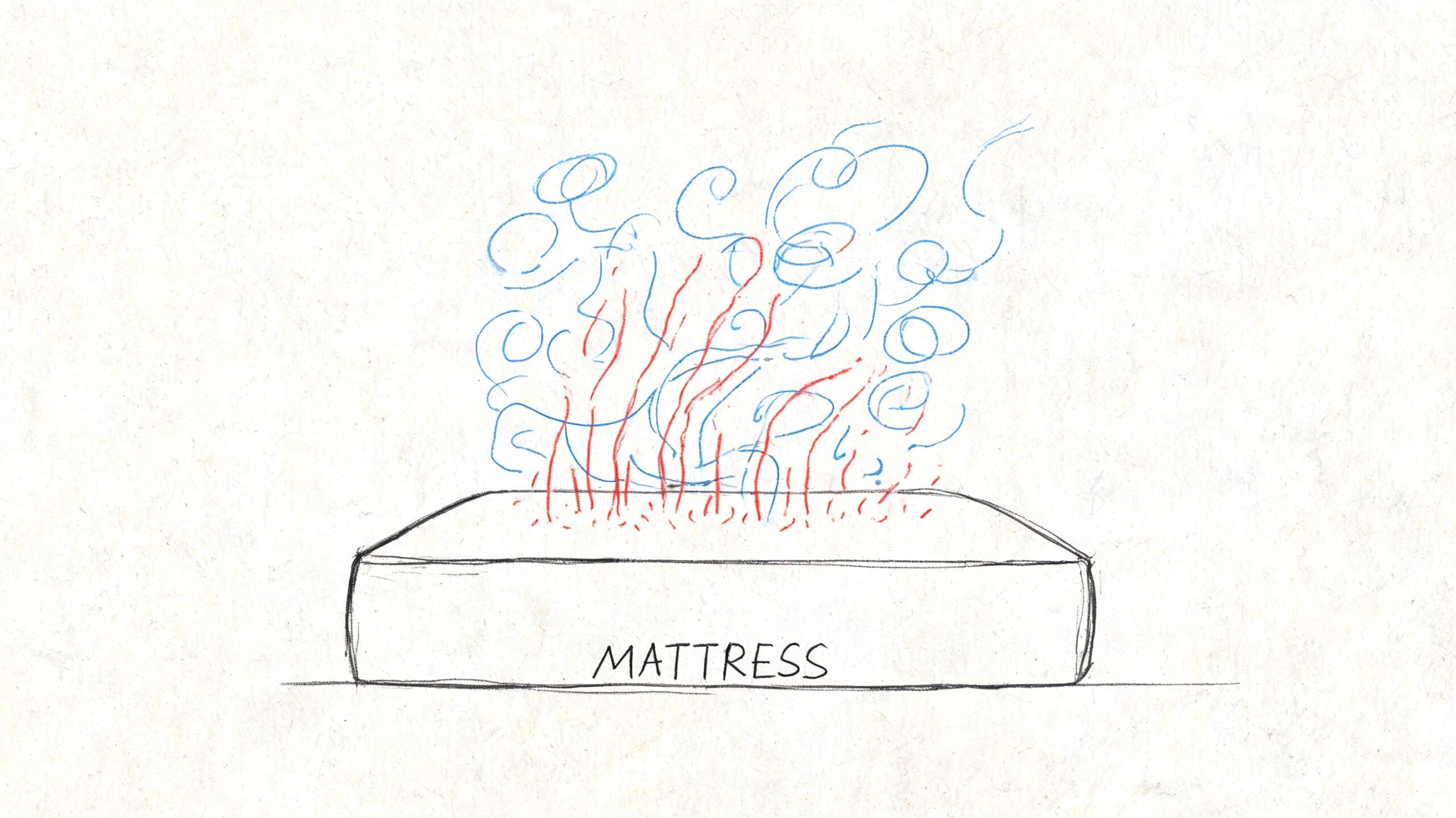
Heat changes sleep. That sounds obvious, but many mattress roundups still treat cooling like a bonus feature instead of a core part of pain management. In West Texas and Southeastern New Mexico, that’s a mistake.
If you’re sleeping hot, waking sweaty, and constantly shifting to find the cool side of the bed, your body spends the night managing temperature instead of settling into deeper rest. For someone already dealing with back pain, that broken sleep can make the next morning feel worse.
Why cooling belongs in the back pain conversation
For sleepers in hot climates like West Texas, cooling is critical. A 2025-2026 Sleep Foundation study found 68% of back pain sufferers in hot climates report worsened symptoms due to night sweats, according to the summary referenced by NCOA’s back pain mattress resource.
That tracks with what many local shoppers already know from experience. When you overheat, you wake more often. When you wake more often, muscles don’t relax the same way and restorative sleep gets chopped up.
Features that matter more than cooling buzzwords
Not every “cooling” claim means much. Focus on construction details that can help:
- Gel-infused foams: These are often used to reduce some of the heat buildup people associate with foam.
- Coil-based airflow: Hybrid mattresses allow more internal airflow than many dense all-foam designs.
- Breathable covers: The top fabric matters because it’s the part closest to your body all night.
- Less sink, more airflow: A mattress that lets you rest more on the surface can feel cooler than one that conforms closely to your body.
Local conditions change what feels comfortable
A mattress that sleeps “cool enough” in a mild climate may not feel the same in a bedroom that stays warm through a dry summer night. That’s part of why national reviews can miss the mark for local shoppers.
Someone in our region often needs two things at once. They need support for the back and a construction that doesn’t trap heat. That combination points many people toward hybrids with cooling-oriented foams and breathable top materials.
If overheating is part of your sleep struggle, it helps to compare options built for that concern. This guide to a cooling mattress for hot sleepers gives a practical framework for what to look for beyond the label.
A mattress can have excellent support and still fail you if you spend half the night kicking off covers and waking up damp and uncomfortable.
The local showroom advantage
This is one area where in-person testing matters a lot. You can feel whether a mattress has a dense, heat-holding surface or a more breathable, lifted feel. You can also compare premium hybrids from brands like Serta and Beautyrest that use gel-infused foams and cooling-focused materials in ways that don’t always stand out in online lists.
Cooling isn’t separate from back pain relief in this climate. It’s part of it.
Your In-Store Guide to Choosing the Right Mattress
A lot of back-pain shoppers lose the plot the minute they walk into a showroom. The mattress feels soft for ten seconds, firm for ten more, and suddenly every bed starts blending together. In West Texas and Southeastern New Mexico, heat adds another layer of confusion because a mattress can feel supportive at first and still leave you restless if it holds too much warmth after several minutes.
A productive showroom visit works more like a fitting than a quick tryout. You are checking how the mattress carries your spine, cushions pressure points, and feels after your body settles into it.

Start with your real sleep habits
Go in with a clear picture of what happens at home. Sleep position matters. So does where your pain shows up, how often you roll from one side to the other, and whether you tend to wake up hot.
Those details give the salesperson something useful to work with. “I have back pain” is too broad. “I’m a side sleeper with low-back stiffness, and I get hot at night” points you toward a much narrower group of mattresses.
Use a simple testing routine
Try the same sequence on every mattress you are seriously considering so your comparisons stay fair.
Lie down in your main sleep position first
Start where your body spends the most time at night.Stay there long enough for your muscles to loosen
The first few seconds can be misleading. Give your shoulders, hips, and lower back time to settle so pressure points show themselves.Turn the way you would at home
A mattress should let you change positions without a wrestling match. This matters even more if pain wakes you up and you shift often.Notice surface temperature after a few minutes
In our region, cooling is not a bonus feature. If the mattress begins to feel stuffy under your back or hips in the showroom, that feeling usually does not improve in a warm bedroom.Sit on the edge before you get up
Stable edges make it easier to stand, dress, and get in and out of bed without extra strain.
Questions worth asking on the sales floor
Good questions turn mattress shopping into a clearer process.
- What supports the lumbar area in this model?
- Does this mattress have zoned coils or another design that changes support through the middle?
- What in the top layers is adding pressure relief, and what is adding support?
- How does this model handle heat over time, not just on first contact?
- If this feels close, what would you show me next for a little more support, a little more pressure relief, or a cooler surface?
That last question is especially helpful. It moves the conversation from brand names and labels to specific feel differences you can test.
Use tools as a second opinion, not the final answer
Some stores offer pressure mapping or bed-matching technology. That can be useful, especially if your pain is hard to describe or several mattresses feel similar at first. A pressure map works like a footprint in the sand. It shows where your body is pressing harder and where a mattress may be letting you sink too much or not enough.
Still, no tool can feel the mattress for you. Use it to narrow the field, then trust what your body does over several quiet minutes on the bed.
Don’t ask, “Which mattress is supposed to be the best?” Ask, “Which mattress keeps my body most relaxed and aligned when I lie the way I sleep?”
The final gut check
Before you leave, go back to your top two or three choices and test them again. The second round is often where the right mattress becomes easier to spot.
Pay attention to the signs your body gives you. Does your lower back feel held up instead of pushed upward? Do your shoulders relax? Do you feel settled, or do you feel the urge to keep adjusting? In this climate, ask one more question before making a decision. “Could I stay comfortable on this bed through a hot night?”
The best mattress brands for back pain can give you a strong starting point. Careful testing in the showroom is what turns that short list into the right fit for your back and your bedroom.
Begin Your Journey to Pain-Free Mornings Today
A better mattress won’t fix every cause of back pain. But the right one can remove a major source of nightly strain. That’s often the turning point people feel first in the morning, when getting out of bed stops being a daily negotiation.
The clearest path is usually simple. Look for a medium-firm feel rather than assuming harder is better. Give serious attention to hybrid construction because it often balances support, pressure relief, and airflow well. Match the bed to your sleep position, especially if your shoulders, hips, or lumbar area are sensitive. And in West Texas and Southeastern New Mexico, don’t treat cooling as an afterthought. If the mattress sleeps hot, it can still be the wrong choice for your back.
That’s the heart of shopping smarter among the best mattress brands for back pain. You’re not chasing hype. You’re learning how to recognize what your body needs.
If you’re ready to test that knowledge in person, visit a showroom and take your time. Lie down the way you sleep. Ask better questions. Compare how each mattress handles support, pressure, and heat. The right bed should help you feel more settled, not more confused.
If you’re ready to turn this research into a real solution, explore Miller Waldrop Furniture & Decor and visit one of their showrooms in Lubbock, Hobbs, or Ruidoso Downs. Their non-commissioned Sleep Experts can help you compare hybrid, memory foam, and innerspring options from brands like Serta and Beautyrest, use bed-matching technology to identify pressure points, and narrow the field to the mattress that fits your body, sleep position, and cooling needs.