

Your Guide to French Style Sofas

Choosing a new sofa is a big commitment, but selecting a French style sofa is also a genuinely exciting creative process. The term itself brings to mind a whole spectrum of designs, from the opulent grace of a Parisian salon to the warm, rustic comfort of a country farmhouse. With so much variety, you’re not just buying a piece of furniture; you're finding the perfect centerpiece to tell your home's story.
Find Your Perfect French Style Sofa
This guide will empower you to explore the world of French-inspired design with confidence. It's not just about showing you beautiful sofas—it's about giving you the insight to choose a piece that truly works for your home and your family's needs.
Ultimately, this is about making your house feel more like a home. The right French style sofa does more than just fill a space. It completes it, bringing a sense of timeless elegance that makes everyday life feel just a little more special.
What Makes a Sofa “French Style”?
One of the best things about this category is its sheer diversity. While there isn't a single, rigid definition, most French style sofas share a few key traits that give them their signature character. Getting to know these details is the first step toward finding the one that speaks to you.
- Graceful Silhouettes: You’ll almost always notice elegant curves, particularly along the back and arms. Unlike many of today’s bulky sofas, French designs have a lighter, more sculpted profile.
- Exposed Wood Frames: A hallmark of classic French style is the beautifully carved wood frame, which is often visible. These details can range from simple, weathered finishes to incredibly ornate, gilded designs.
- Attention to Detail: Everything is intentional. From the iconic cabriole legs (that gentle S-curve) to decorative carvings and perfectly tailored upholstery, every element is part of a cohesive, thoughtful design.
Once you learn to spot these signature details, you're no longer just shopping for a sofa—you're developing an eye for classic design. You’re building the skill to look past a price tag and see the true quality and craftsmanship in a piece.
Whether you find yourself drawn to the sophisticated lines of a Hooker Furniture sofa or are dreaming up a custom piece all your own, our collection provides the tools to bring that vision to life. Ready to get started? Let’s dive into the different styles.
The Story Behind the Sofa: An Enduring French Legacy
To really get why a French sofa is so special, you have to look past the beautiful fabrics and carved wood. It’s not just a piece of furniture; it’s the result of a complete cultural revolution in how people lived and socialized.
Picture France in the 17th century. Seating was stiff, formal, and honestly, pretty uncomfortable. Chairs were more about showing off your status than actually kicking back and relaxing. But as the century wore on, life inside the home began to change. Conversation, intimate gatherings, and personal comfort started to matter more, and furniture designers took notice. They were tasked with creating something entirely new—pieces that were not only stunning to look at but also a joy to use.
A New Era of Livable Luxury
This shift toward comfort really picked up steam around 1670, kicking off nearly a hundred years of incredible design innovation. The first true sofa as we might recognize it emerged in France in the late 1680s. For its time, it was a technological marvel. It was the first seating designed with padding and upholstery on all sides, built for lingering, not just perching.
This single invention completely transformed the home. Formal, stuffy rooms suddenly became inviting spaces for real connection and conversation. You can dig deeper into this history with research from places like Penn Today, which chronicles how comfort became its own form of luxury. The first fully upholstered sofa was, in a way, the 18th-century equivalent of a smart home device—it fundamentally altered daily life for the better.
Where Art and Comfort Collide
Of course, this new focus on comfort didn't mean aesthetics took a backseat. This is French design, after all! Artisans masterfully married plush, inviting upholstery with exquisitely carved wood frames, turning a simple piece of seating into a functional work of art. Understanding this history gives you a real appreciation for the soul of a French sofa.
When you choose a French sofa, you're not just buying an object. You're bringing home a piece of a legacy—a story of artistry, comfort, and the simple joy of gathering with the people you love.
This philosophy of blending ornate beauty with everyday function is a cornerstone of French design. You see it everywhere, from grand furniture to the smallest decorative details, where even the styles and materials of metro frames often find that perfect balance.
Knowing the "why" behind the elegant curves and welcoming cushions is your best tool. It empowers you to select a sofa that’s more than just a place to sit—it’s a celebration of a design philosophy that has stood the test of time. Now, let’s dive into the specific styles that grew out of this incredible tradition.
Decoding the Different French Sofa Styles
Diving into the world of French sofas can feel a bit overwhelming at first. With names like Louis XV and French Provincial, it’s easy to get lost. But once you get to know the key personalities of each style, you’ll be able to spot them instantly and know exactly which one speaks to you.
Think of it as choosing a character for your living space. Are you looking for opulent, dramatic elegance? Or maybe a more refined, understated charm? Perhaps you’re drawn to the relaxed, easy-going vibe of the countryside. Each style tells a very different story, and figuring out which one you connect with is the key to finding your perfect sofa.
The Ornate Elegance of Louis XV
When most of us picture a classic "French sofa," the Louis XV style is usually what comes to mind. This is the epitome of decorative, graceful design—a true showpiece meant to command attention.
Its most recognizable feature is the cabriole leg, that iconic S-shaped curve that makes the sofa look like it's about to dance. These pieces are all about continuous, flowing lines and intricate carvings. You'll rarely, if ever, find a straight line on a Louis XV sofa. The exposed wood frames are often decorated with delicate floral or shell-like motifs, a testament to the master craftsmen of the era.
The Refined Charm of French Provincial
French Provincial is like the sophisticated, more approachable cousin of the Louis XV style. It borrows the elegant silhouettes born in the royal workshops of Paris but tones them down for a life outside the palace. The carvings are simpler, and the overall feel is refined without feeling too formal or stuffy.
Think of it this way: If a Louis XV sofa belongs in a grand ballroom, the French Provincial piece is perfectly at home in the elegant drawing room next door. It’s still beautifully dressed, but it’s designed for intimate conversation, not royal pronouncements.
This style strikes a beautiful balance between decorative flair and everyday comfort. Sofas and smaller pieces, like these elegant settees and chairs, blend fine woods with classic fabrics, making them incredibly versatile for both formal and more transitional homes.
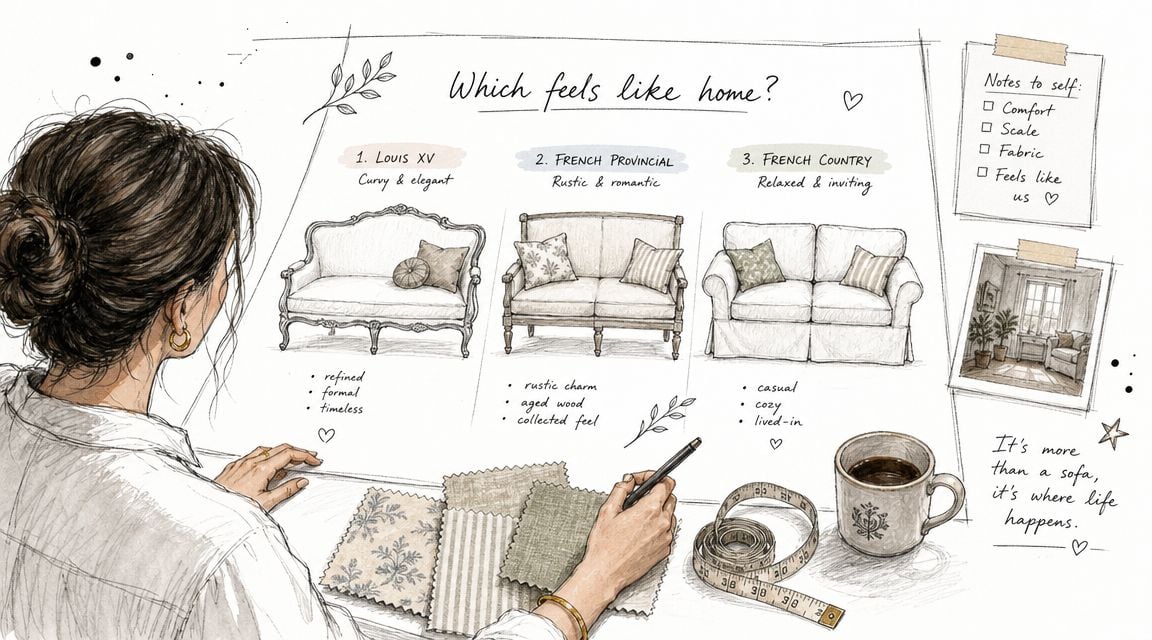
To help you quickly tell these styles apart, we've put together a handy comparison table.
Identifying Key French Sofa Styles
This table breaks down the core differences, so you can easily spot your favorite style.
| Style Feature | Louis XV | French Provincial | French Country |
|---|---|---|---|
| Silhouette | Continuous curves, ornate, no straight lines | Graceful curves, more restrained, balanced | Simple, straight lines, sturdy and functional |
| Legs | Cabriole legs, highly decorated | Cabriole or straight legs, simpler carving | Straight or modestly curved legs, often simple |
| Wood Frame | Exposed, gilded or polished, ornate carving | Exposed, natural or painted finish, refined carving | Often painted and distressed, minimal carving |
| Overall Vibe | Formal, opulent, dramatic, a showpiece | Refined, elegant, sophisticated but approachable | Casual, rustic, comfortable, welcoming |
Seeing the key features side-by-side really clarifies how a few design tweaks can completely change the personality of a piece.
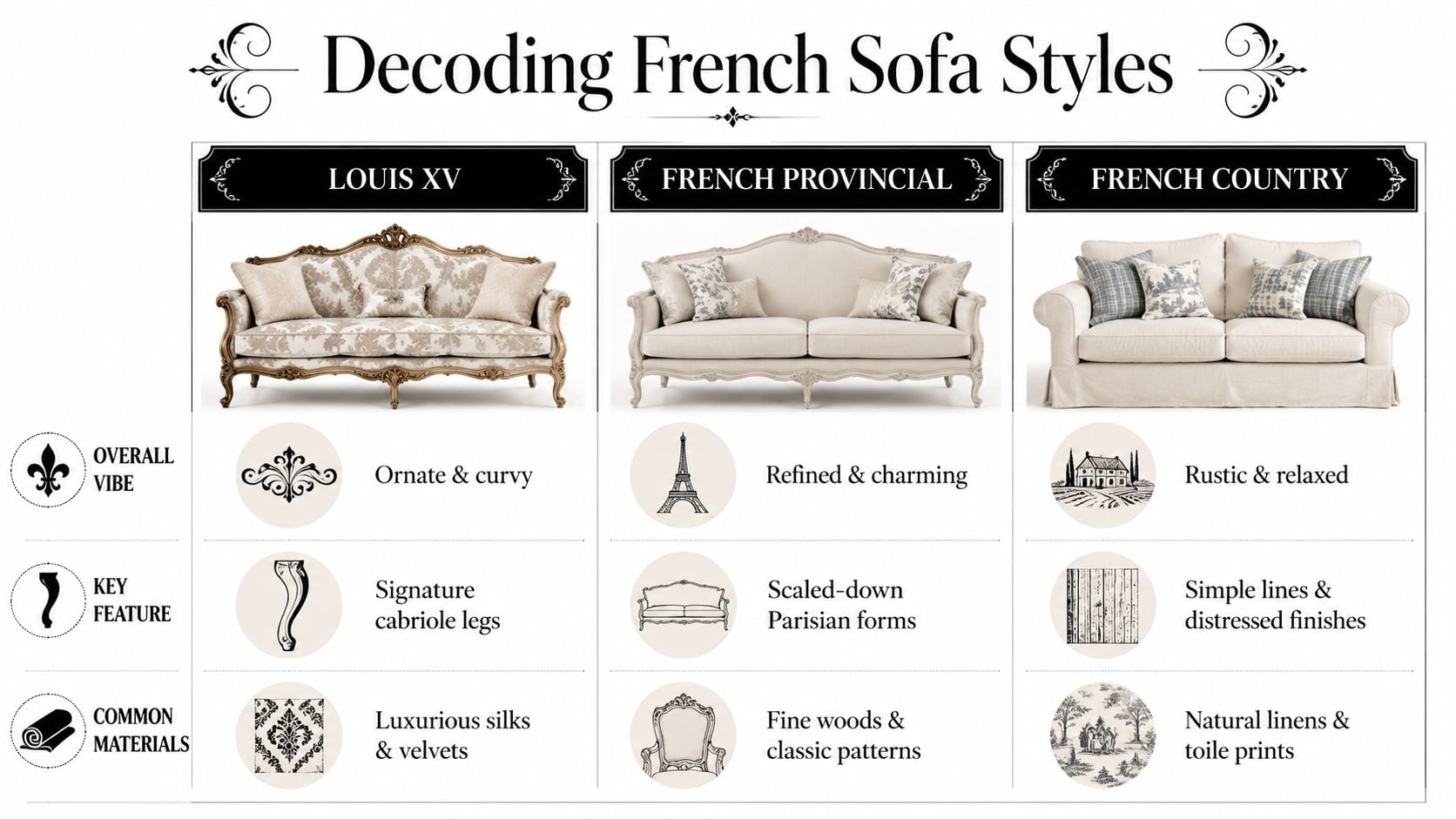
This visual guide perfectly illustrates how the silhouette, materials, and overall mood distinguish one style from another.
The Relaxed Appeal of French Country
Last but not least, we have the French Country style. This one is all about capturing the warm, welcoming atmosphere of a farmhouse in Provence. Of the three, it's the most casual and laid-back, putting comfort and the simple beauty of natural materials first.
You'll recognize it by a few key traits:
- Simple Lines: The shapes are much more straightforward, with less emphasis on ornate decoration and more on practical, sturdy forms.
- Natural Materials: Upholstery is often made from natural linen, cotton, or classic fabrics featuring iconic toile prints.
- Distressed Finishes: The wood frames are typically painted and then lightly distressed to give them a charming, well-loved look right from the start.
Now that you can tell these beautiful styles apart, you’re ready to move on to the next step. Let’s talk about choosing the right materials and upholstery to bring your vision to life.
Choosing the Right Materials and Finishes
A French sofa's story isn't just told by its silhouette—the materials are what truly make it sing. Think of the wood finish and upholstery as the final, crucial layers that define its entire personality. This is where you get to decide if your sofa will be a dramatic, formal statement piece or a relaxed, inviting spot for everyday life.
Getting these details right ensures your sofa is not just beautiful, but perfectly suited to how you actually live.
The Language of Upholstery
The fabric you select is arguably the biggest decision you'll make. It determines the sofa’s look, its feel, and just how well it will hold up over time.
- For Formal Elegance: Nothing says opulence quite like silk or velvet. Velvet, with its deep, rich color and plush feel, is a natural fit for the ornate curves of a Louis XV sofa. It creates a piece that feels both luxurious and historically grand. If you go this route, getting familiar with velvet sofa care and styling tips will help you keep it looking stunning.
- For Relaxed Living: If your home is a busy place filled with kids, pets, and friends, you need something that can keep up. High-performance linens and durable cotton blends give you that breezy French Country vibe without the worry. These fabrics are designed to be lived on, often softening and becoming even more inviting over time.
We know that balancing beauty with practicality can be tricky when it comes to fabrics. Here’s a detailed guide on how to choose upholstery fabric that will empower you with all the information you need.
Expressive Wood Finishes
The exposed wood frame is a hallmark of French design, and its finish can completely transform the sofa's character. You can take the exact same carved frame and give it two totally different personalities just by changing the finish.
A gilded or high-gloss painted finish amps up the drama, leaning into the formal, palatial roots of the Louis XV style. This turns the sofa into a dazzling focal point. On the other hand, a distressed or natural wood finish brings it back down to earth, giving it the rustic, approachable warmth you'd find in the French countryside. It's a fantastic way to make an elegant shape feel more casual and welcoming.
The real beauty here is that you're in the driver's seat. Whether you're dreaming of a show-stopping velvet settee for your formal living room or a durable linen sofa for family movie nights, the right combination is out there. Our design experts are always here to help you navigate all the options to find that perfect balance for your home.
How to Make a French Sofa Work in Your Home
So, you’ve fallen for the charms of a French sofa. It’s easy to do. But bringing this kind of statement piece home can feel a bit intimidating. How do you make sure it looks like it truly belongs, rather than feeling out of place? The secret isn’t to build a museum around it, but to weave it into the fabric of your real, lived-in home.
Let's start with the most important part: scale and proportion. This is the first thing we discuss with our clients, because getting it right is everything. In many of the beautiful, spacious homes here in West Texas and New Mexico, it's tempting to go big. But an ornate, curvy Louis XV sofa, for example, needs a surprising amount of breathing room so its lines can really sing. In a cozier space, a more restrained French Provincial sofa can provide that elegant anchor without overwhelming the room.
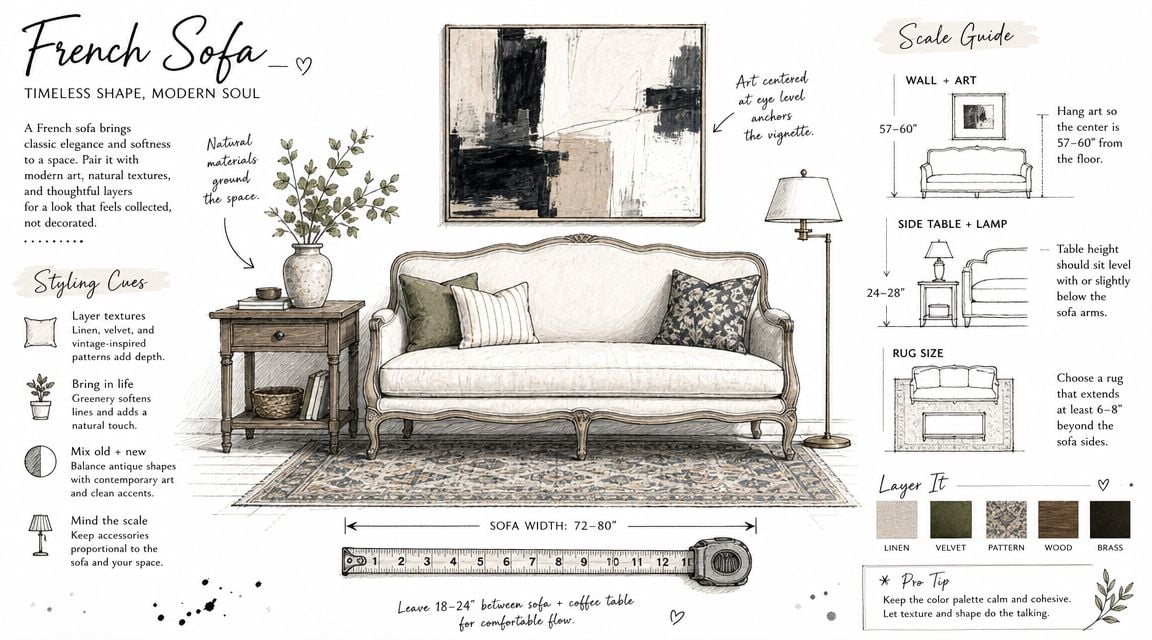
Before you fall in love, take out the measuring tape. Think about the sofa's footprint, of course, but also its "visual weight." A piece with a heavy, dark wood frame will feel much larger than one with a delicate, painted finish. For a deeper dive on this, our guide on how to arrange living room furniture has some great practical tips.
Master the Art of the Mix
Here’s where the fun really begins. The most compelling rooms are those that mix styles with confidence. A French sofa is the perfect foundation for creating a look that feels personal and collected over time—not like it came straight out of a box. The goal is to create interesting contrasts that make everything in the room pop.
Here’s how you can do it:
- Juxtapose with Modern Art: Hang a bold, abstract painting above a classic, camelback sofa. The tension between the old-world curves and the contemporary art is electric. It makes both pieces feel more intentional and powerful.
- Layer in Natural Textures: Keep a formal, silk-upholstered sofa from feeling too precious by pairing it with a chunky jute rug or a rustic, reclaimed wood coffee table. Toss on some casual linen pillows. These earthy elements add warmth and make the space feel inviting.
- Add Sleek Counterpoints: Don’t be afraid to place your curvy French sofa next to a pair of sharp, modern accent chairs or a minimalist metal-and-glass side table. This kind of pairing really highlights the sofa's unique silhouette while keeping the room feeling fresh and current.
Think of your French sofa as the classic, timeless piece in your wardrobe—like a beautiful trench coat or a strand of pearls. You can dress it up or down. By surrounding it with modern art, rustic textures, and clean-lined furniture, you’re creating an outfit for your room that is uniquely you. It’s about telling your story, not just following trends.
If you're staring at your living room and just can't see how the pieces fit together, that's completely normal. Sometimes you just need another set of eyes. That’s what our design team is here for. Stop by one of our showrooms in Lubbock, Hobbs, or Ruidoso, and let's talk. We can help you solve the puzzle and bring your vision to life.
Your Partner in Creating Timeless Interiors
This is where all the inspiration and ideas come together. You've explored the history, learned to spot the differences between a Louis XV and a French Provincial sofa, and have a good sense of what will work in your own home. Now for the best part: finding that perfect sofa that will anchor your room and become a cherished part of your family’s life for years.
We see ourselves as your partner in this creative journey, providing the tools and expertise you need to bring your home's story to life.
Your Design Journey, Realized
Choosing a major piece like a French style sofa is a big decision. Maybe you have a very specific custom piece in mind, or perhaps you just need a second opinion to make sure a sofa you love will truly work with your existing decor. Whatever you need, we're here to help.
If you’re looking for a little more guidance on blending styles and making the most of your space, getting an expert's perspective can be a game-changer. This guide for your home renovation has some fantastic advice on working with designers.
Your home should be your sanctuary, and the furniture you choose is the final, creative touch. Our only goal is to help you make that choice with confidence and joy, so the piece you bring home is one you'll love forever.
Here are the tools we offer to support you every step of the way:
- Curated Showrooms: Come visit us in Lubbock, Hobbs, or Ruidoso Downs to actually see and touch the furniture. There's nothing like experiencing the quality firsthand. Our selection is hand-picked from top brands so you can see different takes on the French style.
- Knowledgeable Staff: Our team lives and breathes design. We’re ready to chat about everything from fabric durability to the nuances of different wood finishes. We want you to feel completely confident in your investment.
- Custom Order Options: Can't find exactly what you’re dreaming of on our floor? No problem. Let's talk about custom orders and create a one-of-a-kind French sofa that is 100% you.
Your perfect sofa is out there. We invite you to explore our online collection of sofas or stop by one of our showrooms today. Let’s find that final piece to complete your beautiful, timeless home.
A Few Questions We Hear Often About French Sofas
Thinking about bringing a French sofa into your home? It’s a big decision, and you probably have a few questions. We get it. Here are some of the most common things people ask us, with straightforward answers from our design team.
Can a French Style Sofa Really Work in a Modern Home?
Yes, and it’s a look we absolutely love. The secret isn't about making everything match; it's about creating an intentional, beautiful contrast. A classic French sofa, with all its curves and personality, can become a stunning centerpiece in an otherwise clean and modern room.
Imagine this: your ornate, beautifully carved sofa set against a simple wall, paired with a sleek, minimalist coffee table and some contemporary art. That contrast is what makes the room feel so dynamic and sophisticated. The sofa isn't just furniture—it's the star of the show, telling a story that feels both fresh and timeless.
What Is the Difference Between French Provincial and French Country?
It's easy to get these two mixed up, but they have very different vibes. Think of it as the difference between a sophisticated city apartment and a cozy countryside cottage.
French Provincial is the more refined of the two. It was born from the desire of wealthy families in France's provincial cities to have furniture that mimicked the opulent styles of Parisian high society. You’ll see those elegant curves and detailed carvings, but they're often a bit more restrained and scaled-down than a formal Louis XV piece from a palace.
French Country, on the other hand, is all about rustic charm and comfort. It’s the style of a rural farmhouse. The lines are simpler, the wood might have a distressed or painted finish, and the fabrics are chosen for their durability and welcoming feel—think classic toile prints or soft, lived-in linen. It’s less about formality and more about creating a warm, inviting atmosphere.
How Do I Care for a French Style Sofa?
This is a fantastic question to ask before you buy, because the right care really depends on the materials you choose.
- The Wood Frame: The beautiful exposed wood just needs a little love. Regular dusting with a soft, dry cloth is a must. For a finished frame, a high-quality wood polish used sparingly can help keep its luster, but always check the manufacturer's recommendations first.
- The Upholstery: Your fabric choice dictates the care. Some of those gorgeous, high-pile velvets are best left to professional cleaners to avoid crushing the texture. On the other hand, many performance linens and cotton blends are surprisingly resilient and can often be spot-cleaned.
The best approach? Be honest about your lifestyle. Choosing a fabric that fits your daily life is the surest way to keep your sofa looking beautiful for years to come.
At Miller Waldrop, we believe your questions are an essential part of creating a home you'll love. Our team is always here to offer guidance and help you find the perfect piece. To see how these stunning styles can transform a space firsthand, we invite you to visit our showrooms or explore our collection online.