

How to Arrange Living Room Furniture for Any Space

Arranging your living room can feel like a high-stakes game of Tetris, but you're in control. Forget the guesswork and the back-breaking effort of shuffling furniture around endlessly. The secret to a truly great layout isn’t about luck; it’s about empowering yourself with a solid plan.
When you start with a clear strategy—one that considers how you live, where people will walk, and what the room’s main job is—you create a space that just works. It’s comfortable, functional, and feels right. You have the power to transform this space into the heart of your home.
Your Blueprint for a Better Living Room
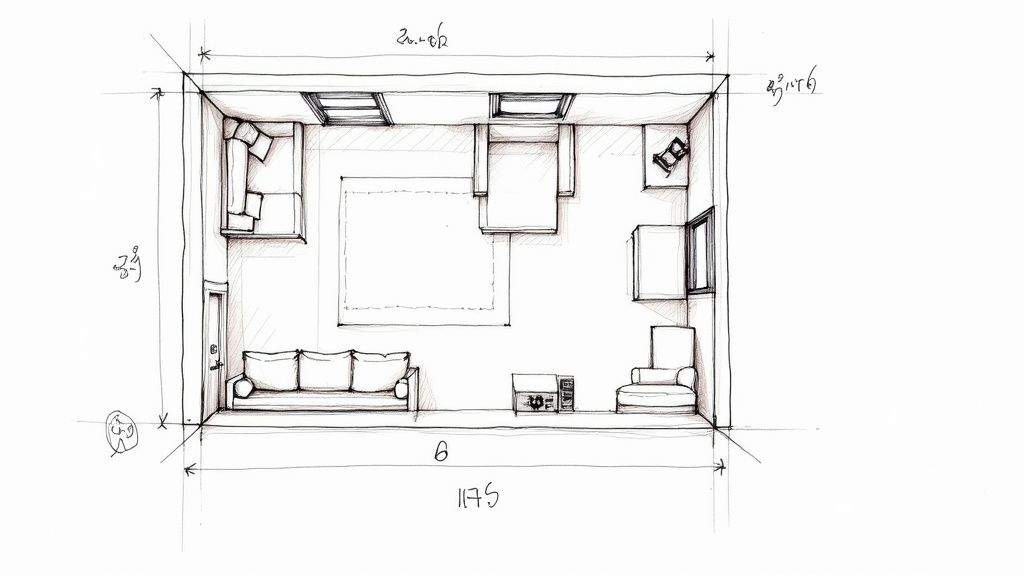
Before you even think about moving that sofa, your most valuable tool is a simple floor plan. This isn't about firing up complex design software. It’s about creating a clear vision for your space on paper (or a tablet) first. This simple step is your first victory, saving you from the frustration of trial and error.
Think of this planning phase as setting the stage for your success. It's where you make the big-picture decisions that prevent common design problems, like choosing a sectional that overwhelms the room or creating an awkward bottleneck right by the door.
First, What’s This Room For?
Before anything else, get crystal clear on how you actually use your living room. The answer will become the guiding principle for your entire layout. Is it the go-to spot for family movie nights? A more formal space for hosting friends? Or is it a hardworking, multi-purpose room for relaxing, working, and playing?
The room's primary purpose will guide every single choice you make.
- For entertaining guests: You’ll want to create cozy conversation zones with comfortable seating and plenty of surfaces for drinks and snacks.
- For a media hub: Your layout will naturally revolve around the television, ensuring everyone has a great view without straining their neck.
- For busy family life: Your focus might shift to durable furniture and wide, open pathways that give kids room to move.
Understanding the room's core function helps you zero in on the key pieces you need. You can explore a curated list of living room essentials to get a better sense of which foundational items will support your family's lifestyle.
Get Out the Tape Measure and a Pencil
Next up, it’s time to get specific. Knowing your room's exact dimensions is non-negotiable, so grab a tape measure. Jot down the length and width of the room, but don’t stop there. Note the location and size of every window, doorway, and permanent feature, like a fireplace or built-in shelving.
A quick sketch on a piece of paper is almost always more effective than just trying to picture it in your head. It lets you experiment with different furniture arrangements risk-free, making sure everything fits perfectly before you lift a finger.
This simple act of measuring puts real-world boundaries on your creative ideas. If you discover your living room is on the cozy side, looking into some clever small living room storage ideas can be a game-changer for maximizing your layout and keeping clutter at bay.
To help you get started, here's a quick reference for the core principles we just covered. Think of it as your cheat sheet before you start arranging.
Living Room Layout Quick-Start Guide
| Principle | What It Means | Why It Matters |
|---|---|---|
| Define the Purpose | Decide the room's main activities: entertaining, relaxing, media, or family life. | This dictates the type and arrangement of furniture you'll need for optimal function. |
| Measure Everything | Get exact dimensions of the room, windows, doors, and architectural features. | Provides the real-world constraints you must work within, preventing mistakes. |
| Sketch It Out | Create a simple floor plan on paper to test different furniture placements. | Saves you the physical work and frustration of moving heavy items multiple times. |
Ultimately, this planning stage is your strategy for success. It swaps uncertainty for confidence and gives you a clear path to a living room that not only looks fantastic but also feels perfectly suited to your life. With this blueprint in hand, you're ready to create a space you'll love walking into every single day.
Find Your Room's Focal Point
Every great living room has a hero—a single feature that grabs your attention and gives the space a clear purpose. This isn't just decorator fluff; it's the anchor that all your other furniture decisions will revolve around. By identifying this first, you turn a random collection of furniture into a room that feels intentional and put-together.
Some rooms make it easy. They come with a built-in star, like a classic fireplace, a massive picture window with a great view, or even charming built-in bookshelves. If you’ve got one of these, you're already halfway there. Your main job is to arrange your primary seating to face it, which instantly creates a sense of order.
What If Your Room Has No Obvious Centerpiece?
Don't worry if your living room is just a plain box. This is your opportunity to take charge. Without a pre-existing feature dictating the layout, you get to decide what the room's energy will be about. You can create a focal point that perfectly matches your style.
Here are a few proven ways you can create a focal point from scratch:
- The Media Wall: For most of us, the TV is the heart of the living room. Instead of just plopping it on a stand, you can make it a deliberate feature. A stylish media console, flanked by shelving or a bit of backlighting, can turn the TV into a true design element.
- A Statement Art Piece: Nothing says "sophisticated" like a massive piece of art or a thoughtfully curated gallery wall. You can position your main sofa directly across from it. This not only draws the eye but also sets the stage for a great conversation spot.
- The Accent Wall: This is a designer's go-to trick for a reason. Painting one wall a bold, contrasting color or covering it in a unique wallpaper instantly gives the room a visual anchor. Everything you place against that wall will feel more important.
Make Your Focal Point Work for Your Life
The focal point you choose needs to do more than just look good—it has to support how you actually live in the room. A layout designed for cozy movie nights is going to look completely different from one built for hosting and lively conversation.
If your family gathers for streaming marathons and video games, making the media center the star of the show just makes sense. From there, you'll want to arrange your seating for the best possible view. For a deep dive into getting this part perfect, check out our complete guide to finding the optimal TV positioning; it's packed with tips on ideal height and distance.
On the other hand, if you'd rather have a space that encourages people to talk to each other, a beautiful coffee table or that statement piece of art should be your focal point. In that case, you’ll arrange your seating to face inward, promoting connection and easy conversation.
Ultimately, locking in a clear focal point is your secret weapon for a layout that just works. It simplifies every other decision, creates a natural flow, and gives your living room that professionally designed feel. Once you’ve picked the star of the show, arranging the supporting cast becomes so much easier.
Arrange Furniture for Connection and Flow
Once you’ve locked in your focal point, it’s time to arrange the furniture. This is where you can truly shape how the room feels and functions. Many people make the mistake of pushing every piece of furniture flat against the walls. It’s an easy trap to fall into, but it almost always creates a cold, impersonal “waiting room” vibe.
The good news? You can fix this with a simple, classic designer trick: floating your furniture.
When you pull your sofa and chairs away from the walls, even by just a few inches, and group them together, you create instant intimacy. It’s a subtle shift that makes a massive difference, turning a static space into one that feels intentional and encourages people to actually connect.
This infographic breaks down a few ways to think about arranging your furniture around that central anchor.
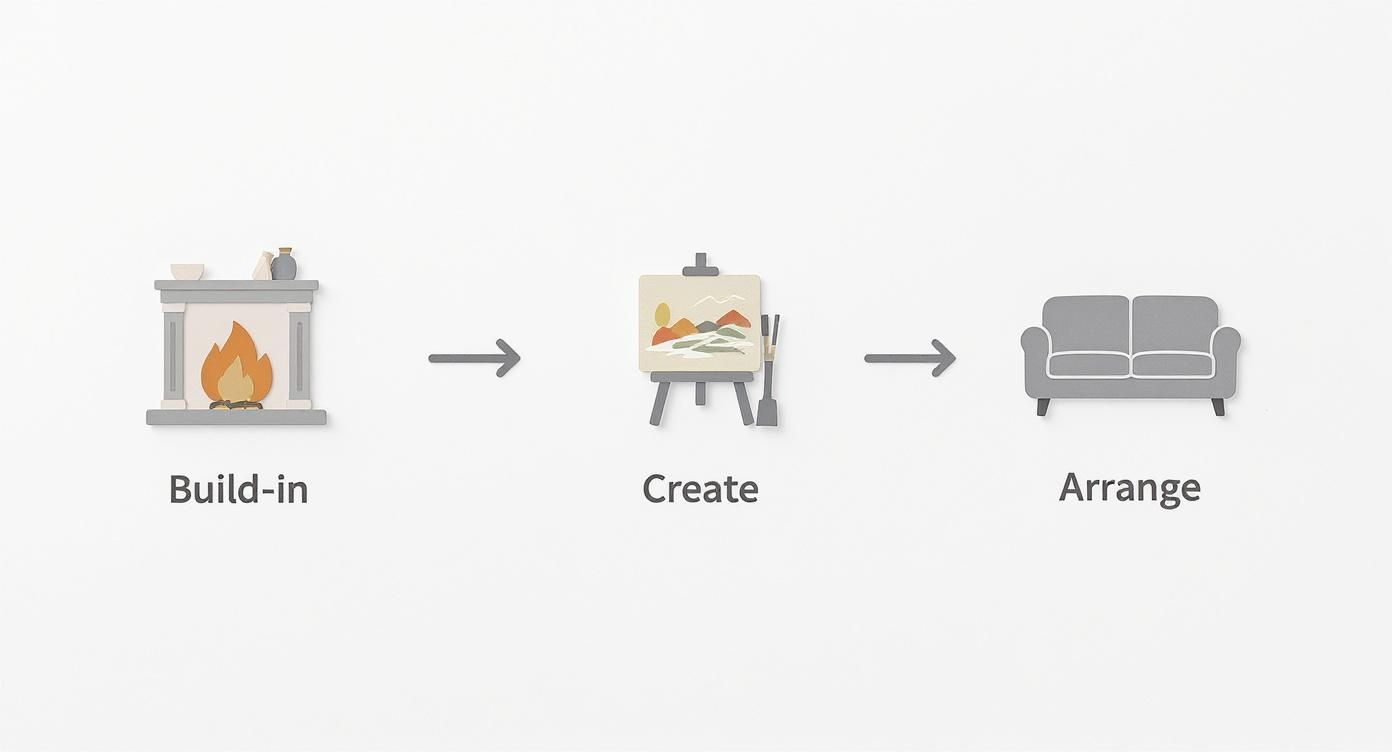
As you can see, it’s all about working with what you have—whether it's a built-in feature or a grouping you create yourself—to define the room’s purpose.
Create Conversational Groupings
A great living room should make conversation feel effortless. To achieve this, you need to place your main seating pieces close enough for people to chat comfortably without having to raise their voices. A good rule of thumb is to keep sofas and chairs between 4 and 10 feet apart. Any closer and it feels cramped; any farther and you lose that feeling of connection.
- In larger rooms, you have the freedom to create multiple conversation zones. You could have your main seating area around the fireplace, then a smaller, more intimate grouping—maybe two armchairs and a small table—by a window for reading or quiet chats.
- For smaller spaces, one well-defined grouping is all you need. An L-shaped sectional or a sofa directly facing two chairs is a classic setup that works every time.
This is exactly why your choice of sofa is so important. The global market for living room furniture was valued at over USD 226 billion in 2023, and sofas accounted for nearly a third of that. That stat really drives home the sofa’s role as the anchor piece that dictates the rest of your layout. You can find more insights on the global living room furniture market and see just how central this one piece is.
Pro Tip: The secret to making a floating arrangement feel grounded is a large area rug. The rug should be big enough for at least the front legs of your sofa and all of your chairs to sit on it. This simple addition visually ties the entire grouping together, creating one cohesive zone.
Place Tables for Ultimate Convenience
A beautifully arranged room is only successful if it's also practical. Every single seat should have a convenient surface within arm's reach to set down a drink, a book, or a remote. This is where coffee tables and side tables go from being accessories to essential players in your layout.
You’ll want to position your coffee table about 14 to 18 inches from the sofa. That's the sweet spot—close enough to easily reach but far enough to give you legroom and a clear path to walk through. By the same token, every armchair or open end of a sofa should have its own side table.
By focusing on these practical details, you’re not just placing furniture anymore. You're thoughtfully building a functional, comfortable, and inviting space. Here’s how you can choose the perfect sofa to serve as the foundation for your family’s ideal layout.
Map Out Clear Pathways for Movement
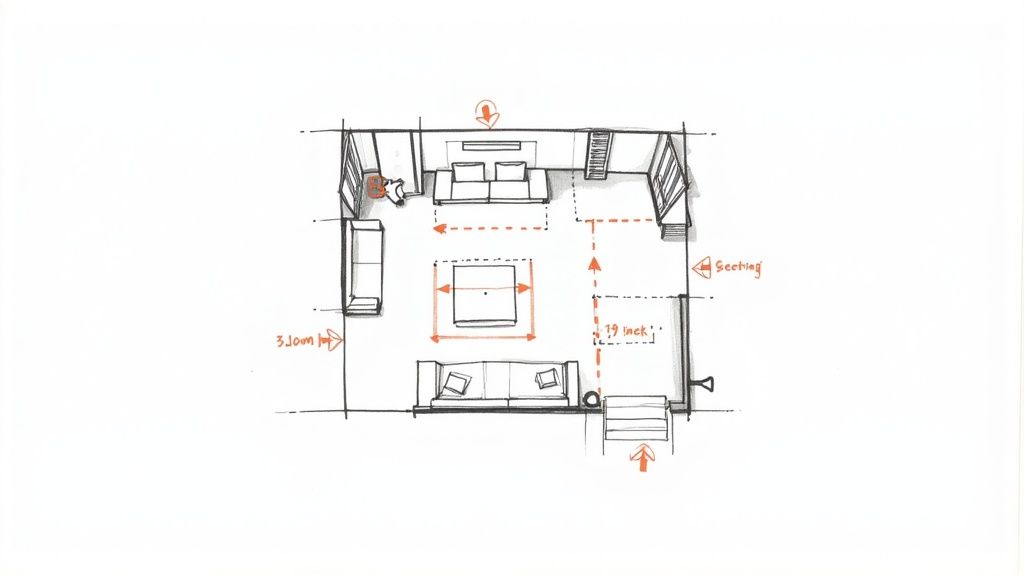
One of the biggest tells of a well-designed living room is how you move through it. Can you walk from the doorway to the sofa without a second thought? This effortless movement, what designers call traffic flow, is the unsung hero of a comfortable space. When you get it right, your room feels intuitive and relaxing. Get it wrong, and it’s a frustrating obstacle course.
Take a moment and think about the natural paths people take in your living room. There’s usually a well-worn route from the main entry to the sofa, or from the seating area to a sunny window or an adjacent room. Your job is to keep these invisible lanes clear.
Give Your Furniture Room to Breathe
The golden rule here is to leave enough space for people to walk comfortably. For a main thoroughfare—like the path from the hall to the kitchen—aim for 30 to 36 inches of clear walking space. This prevents that awkward side-shuffle you have to do in a cramped room.
For smaller pathways, like the gap between your coffee table and the sofa, you can tighten things up a bit. About 14 to 18 inches is the sweet spot. It’s close enough to set down a drink but far enough that you won't bang your shins.
A great layout doesn't just allow for movement; it actively guides it. By arranging your furniture thoughtfully, you can direct traffic around your conversation areas, not straight through them. This simple shift keeps the core of your room calm and uninterrupted.
Think about the last party you hosted. Could guests mingle and move around without bumping into each other? That’s the magic of good traffic flow in action.
Tackling Common Traffic Flow Problems
Every room has its quirks. Maybe your main walkway slices right in front of the fireplace, or you have so many doors it feels more like a hallway than a living room. You can solve this—there's almost always a creative solution.
Here are a couple of scenarios you might face:
- The Cross-Room Dash: If a major path cuts between your seating and the TV, you can often fix this by pulling the entire furniture grouping away from the wall. Even a few extra inches can create a dedicated walkway behind the sofa, minimizing disruptions.
- The Awkward Corner Entry: When a door opens into a corner, you can use furniture to create a subtle "landing strip." A slim console table or a tall bookshelf placed against the adjacent wall helps define the path, guiding people along the wall instead of through the middle of your space.
By prioritizing how you move through your living room, you’re designing a space that truly works for everyday life. It's about more than just looking good; it's about feeling effortless.
If you’re having trouble finding pieces that fit your layout without creating a bottleneck, we're here to help you find the tools for the job. You can explore our collection of living room furniture to find options that work with your room's scale, or stop by one of our showrooms for personalized advice on creating a layout with perfect flow.
Balance the Scale of Your Furniture
Have you ever walked into a room where something just felt off? You can’t quite put your finger on it, but the whole space feels a bit jarring. Nine times out of ten, the problem is a mismatch in scale and proportion.
This is a common design challenge. You might fall in love with a big, plush sofa at the showroom, only to find it completely swallows your small living room, making the space feel cramped and claustrophobic. The opposite is just as bad—a tiny loveseat and a couple of delicate chairs can look totally lost and out of place in a large, open-concept room with high ceilings. Getting the scale right is how you create that effortless, harmonious feeling.
Mastering Visual Weight
The secret lies in understanding visual weight. This has nothing to do with how many pounds a piece of furniture weighs, but everything to do with how heavy it looks. A dark, solid-wood armoire, for instance, has far more visual weight than a sleek glass console table of the exact same dimensions. The trick is to spread that perceived weight around the room evenly.
Think of it like balancing a seesaw. You wouldn’t put all the heavy items on one end. Apply that same logic to your furniture:
- Your Anchors: Start with your biggest pieces, like the sofa or sectional. These are the heavy hitters.
- The Counterweights: Balance them out with other substantial items on the opposite side of the room, like a pair of armchairs or a solid coffee table.
- The Finishing Touches: Finally, fill in the gaps with visually lighter pieces. Think side tables with slender legs, floor lamps, or art. Even things like incorporating large indoor plants can add visual weight and need to be factored into the overall balance.
Play with Heights to Create Interest
A room where everything sits at the same low height can feel incredibly flat and uninspired. You can create vertical interest to make the space feel dynamic and complete.
This is easier than it sounds. Simply introduce pieces of varying heights. A tall bookshelf, a striking arc floor lamp, or even a large piece of art hung a little higher than expected can work wonders. These elements naturally draw the eye upward, making the room feel more spacious and thoughtfully designed.
Getting the scale right starts long before you start moving furniture around. It begins with the tape measure. Accurately measuring your room and the pieces you plan to buy is the single most important step in creating a room that feels right.
This need for a perfect fit is a big reason why modular furniture has become so popular. In fact, the global market for it hit around USD 81.3 billion in 2023. Homeowners, especially in smaller urban spaces, want furniture that adapts to their room, not the other way around.
Finding that perfect-fit sofa for your family is the ultimate goal. Versatile pieces like a modular sectional are fantastic because they let you customize the size and configuration, giving you a tailored solution that brings harmony to your living room. Our design experts can help you select pieces that create the perfect balance—and our guide on how to measure furniture is the perfect place to start.
Common Living Room Layout Questions
Even the best-laid plans can hit a snag. Sometimes a room's unique quirks—an awkward shape, a poorly placed doorway, or an off-center fireplace—can make standard design advice feel impossible to apply. Let's tackle some of the most common questions that pop up when arranging living room furniture.
Think of this as the final fine-tuning. These adjustments are what take a layout from "good enough" to genuinely great, solving those small but nagging issues that can throw off the whole room.
What Do I Do with a Long, Narrow Room?
This is probably the single most common layout challenge. The trick to conquering a long, narrow room is simple: divide and conquer. Don't try to furnish the entire length as one continuous space. Instead, break it up into smaller, distinct zones.
- Create a main seating area: Float your sofa and a couple of chairs in the middle of the room. This carves out a primary conversation zone that feels anchored and intentional.
- Establish a secondary zone: Use the remaining space at one end for something else entirely. This could become a cozy reading nook with an armchair and a floor lamp, or a compact home office with a slim desk.
- Define the zones with rugs: Placing different area rugs in each zone is a brilliant way to visually separate them. It makes each space feel purposeful and distinct without putting up a single wall.
How Do I Handle an Open-Concept Space?
Open-concept layouts are fantastic for their sense of freedom, but that same openness can make them feel chaotic and undefined. Your goal is to create a sense of order and separation, and your furniture is the best tool for the job.
Your sofa is your secret weapon here. By placing it with its back to the dining area or kitchen, you instantly create a visual boundary. It’s a clear signal that says, "the living room starts here." To really cement this, place a console table behind the sofa. This acts as a stylish, practical "half-wall," adding storage and a surface for decor without closing off the room. You get to keep that airy, connected feeling while giving each area its own clear identity.
Should I Place Furniture in Front of a Window?
It feels like breaking a cardinal rule, doesn't it? But sometimes, it's the best—or only—option you have. If you need to place furniture in front of a window, you can do it strategically.
The key is to choose low-profile pieces. A sofa or chair with a low back won't completely obstruct the view or block all that precious natural light.
Your living room should serve your needs, not the other way around. Don't be afraid to break a traditional "rule" if it results in a layout that is more comfortable and functional for your family's daily life.
This is a perfect example of why seeing furniture in person is so valuable. Research shows that living room pieces account for about 35.5% of all residential furniture sales, and a huge number of people still prefer to shop in-store. It gives them a chance to physically judge the size, scale, and comfort, making it much easier to visualize how a piece will actually work with their windows and walkways. You can discover more insights about furniture buying habits and see how this hands-on approach leads to smarter layouts.
By thinking through these specific challenges, you're building the confidence to solve any layout puzzle. You now have real strategies for handling long rooms, open spaces, and tricky windows, making sure your living room works just as beautifully as it looks.
At Miller Waldrop Furniture & Decor, we believe your home should be a source of comfort and joy. Our design experts are here to help you find the perfect pieces that fit your space and your life. From a versatile Flexsteel sofa that can anchor your room to the finishing touches that bring it all together, we're your partners in creating a home you love. Stop by one of our showrooms today to get started.