


A Homeowner’s Guide to the Flush Mount Ceiling Light


A lot of homeowners start the same way. They stand in a hallway, bathroom, guest room, or older bedroom and look up at a dated ceiling light that doesn't do enough. It may hang awkwardly, cast dull light, or make the whole room feel shorter than it is.
That's where a flush mount ceiling light usually enters the conversation. It sits close to the ceiling, keeps the room open, and can solve a very practical design problem without looking like an afterthought. The challenge isn't just finding one that fits. It's choosing one that gives the room the right amount of light, suits the ceiling shape, and feels at home with the furniture and finishes already in place.
Table of Contents
- The End of Low-Ceiling Lighting Woes
- Flush Mount vs Semi-Flush Mount Explained
- How to Size and Place Your Flush Mount Light
- Choosing the Right Brightness and Light Quality
- Finding a Style That Complements Your Home
- Installation Basics and Long-Term Care
- Let Our Experts Help You Light Up Your Life
The End of Low-Ceiling Lighting Woes
A common lighting problem shows up in homes with standard-height ceilings. A pendant feels too low. A chandelier feels out of scale. A builder-grade dome gives off light, but not much character. The room ends up feeling cramped and unfinished at the same time.
Flush mount ceiling fixtures solve that problem because they stay tight to the ceiling and preserve headroom. That's why they show up so often in practical rooms where clearance matters most. They're often used in hallways, closets, small bedrooms, and bathrooms, where a hanging fixture can get in the way or make the room feel crowded.
One reason shoppers get stuck is that flush mounts can seem simple on the surface. People often assume the decision starts and ends with style. In reality, a good choice balances three things at once: ceiling height, light output, and visual fit with the room.
A flush mount should do two jobs well. It should protect the openness of the room and make the room easier to live in.
That's why a small hallway and a primary bedroom rarely need the same ceiling light, even if both have low ceilings. The right fixture for a narrow circulation space may disappear into the ceiling. The right fixture for a bedroom may need to work harder, spread light more evenly, and support lamps or sconces nearby.
This is also where many homeowners feel relieved. They don't need a dramatic fixture in every room. Sometimes the smartest move is the least obtrusive one, provided it's chosen with intention.
A flush mount ceiling light can be that quiet problem-solver. It can also be a polished design detail when the shape, finish, and brightness are chosen with the room's actual needs in mind.
Flush Mount vs Semi-Flush Mount Explained
Flush and semi-flush lights often get mixed together because both sit close to the ceiling. The difference matters more than it seems, especially in rooms where ceiling height is already working hard.
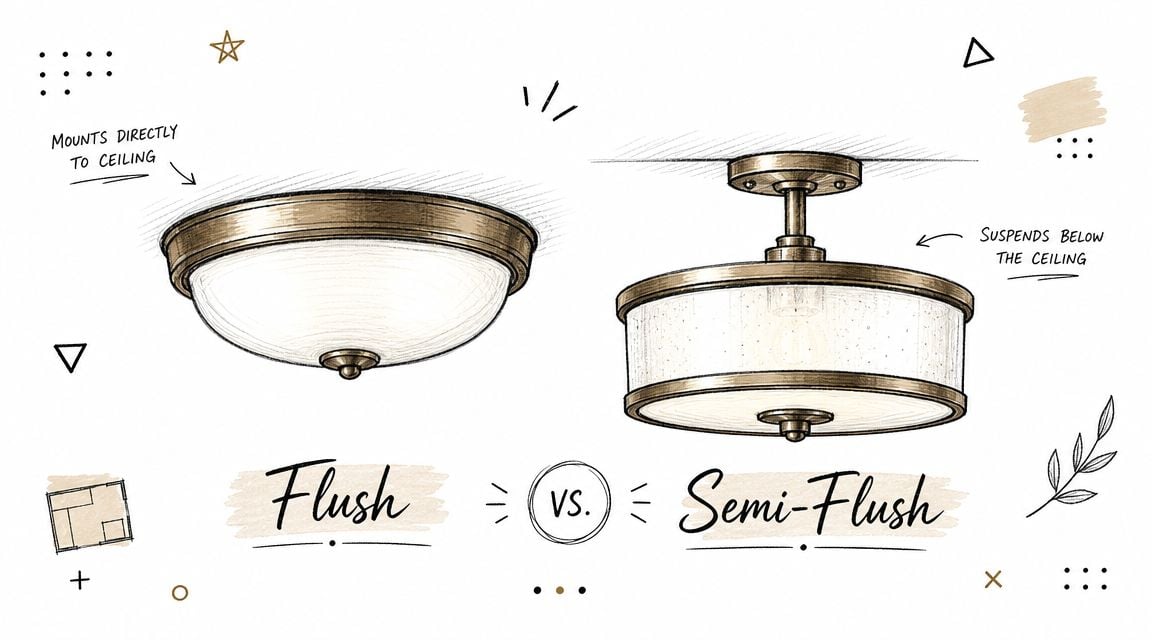
A simple way to picture the difference
A flush mount sits tight against the ceiling, almost like a cap fitted closely overhead. A semi-flush mount drops down slightly and leaves a small gap between the fixture and the ceiling.
That small gap changes both the look and the light. A semi-flush often sends some illumination upward and outward, which can make a room feel airier. A flush mount, by contrast, keeps the profile compact and is usually the better answer when headroom is the first concern.
Historically, flush mount ceiling lights became a mainstream residential solution in the mid-20th century for spaces like hallways, kitchens, and bathrooms, reflecting a move toward compact, practical overhead lighting in everyday homes, as outlined in this history of ceiling light design.
For homeowners wondering where each type belongs, the decision often comes down to traffic flow. If people walk directly under the fixture, tighter to the ceiling is usually safer and visually calmer. If the room has a little more breathing room and needs more decorative presence, semi-flush can make sense.
For more room-wide lighting ideas, this article on putting your living room in the best light helps connect ceiling choices with the rest of a lighting plan.
Flush Mount vs. Semi-Flush Mount At a Glance
| Feature | Flush Mount | Semi-Flush Mount |
|---|---|---|
| Position | Sits directly against the ceiling | Hangs slightly below the ceiling |
| Clearance | Maximizes headroom | Needs a bit more vertical space |
| Light direction | Primarily downward and outward | Often washes light upward and outward too |
| Best use | Low ceilings, compact rooms, busy walkways | Standard-height rooms that need more visual presence |
| Overall feel | Clean, quiet, practical | Decorative, dimensional, a little dressier |
Practical rule: If the room feels short or people will walk right beneath the fixture, flush mount usually makes the safer choice.
How to Size and Place Your Flush Mount Light
A flush mount can be beautiful and still look wrong if the size is off. The most common mistake is choosing a fixture that's too small, especially once it's installed in an open bedroom or larger multipurpose space.
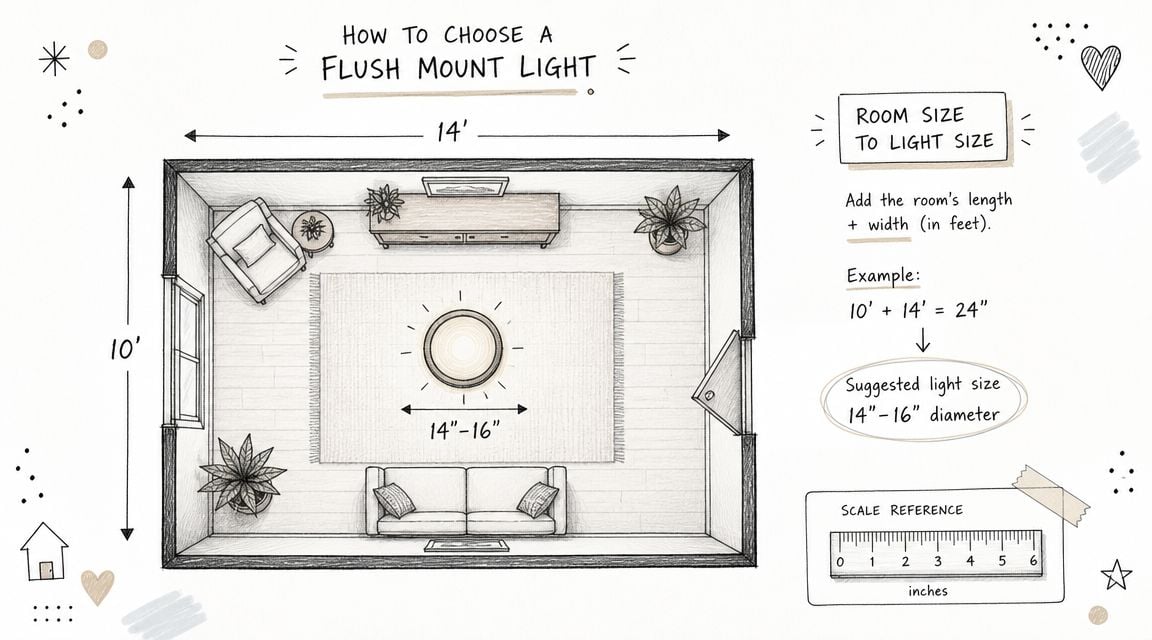
Start with the room size
Flush mount fixtures are generally a strong fit for 7- and 8-foot ceilings, while rooms with taller ceilings often have more flexibility. For sizing, a common guideline is to choose a fixture 12 to 24 inches wide for rooms of 100 square feet or less, and many flush mounts commonly land around 13 inches wide, especially for compact rooms such as closets and bathrooms, according to this flush and semi-flush sizing guide.
That tells a homeowner something useful right away. Smaller flush mounts aren't wrong. They're built for smaller rooms and narrower jobs.
To estimate room size before shopping, this quick guide on how to calculate square feet of a room can make the math easy.
A simple way to think through sizing:
- Measure the room first. A fixture should relate to the size of the room, not just the empty spot in the ceiling.
- Match the fixture to the job. A closet and a guest bedroom don't ask the same thing from overhead light.
- Notice furniture placement. A bed, vanity, or hallway runner changes how centered lighting feels.
Placement changes how the room feels
Centered placement is common, but it isn't the only option. In a hallway, the light usually wants to follow the path of travel. In a bedroom, the fixture often looks best centered in the room rather than centered over the bed alone. In a bathroom, the flush mount may support vanity lighting rather than carry the whole space by itself.
Here's where readers often get confused. They assume fixture width solves every problem. It doesn't. Width handles visual proportion first. Light performance is a separate question, and that deserves its own decision.
A well-sized fixture looks intentional from the doorway. It doesn't feel tiny, and it doesn't crowd the ceiling.
When placement and size work together, the fixture feels settled in the room. That quiet sense of balance is what makes a flush mount look designed rather than merely installed.
Choosing the Right Brightness and Light Quality
Many lighting decisions falter when a homeowner finds a fixture that looks right, installs it, and then realizes the room still feels dim. The fixture fits the ceiling, but it doesn't fully light the space.
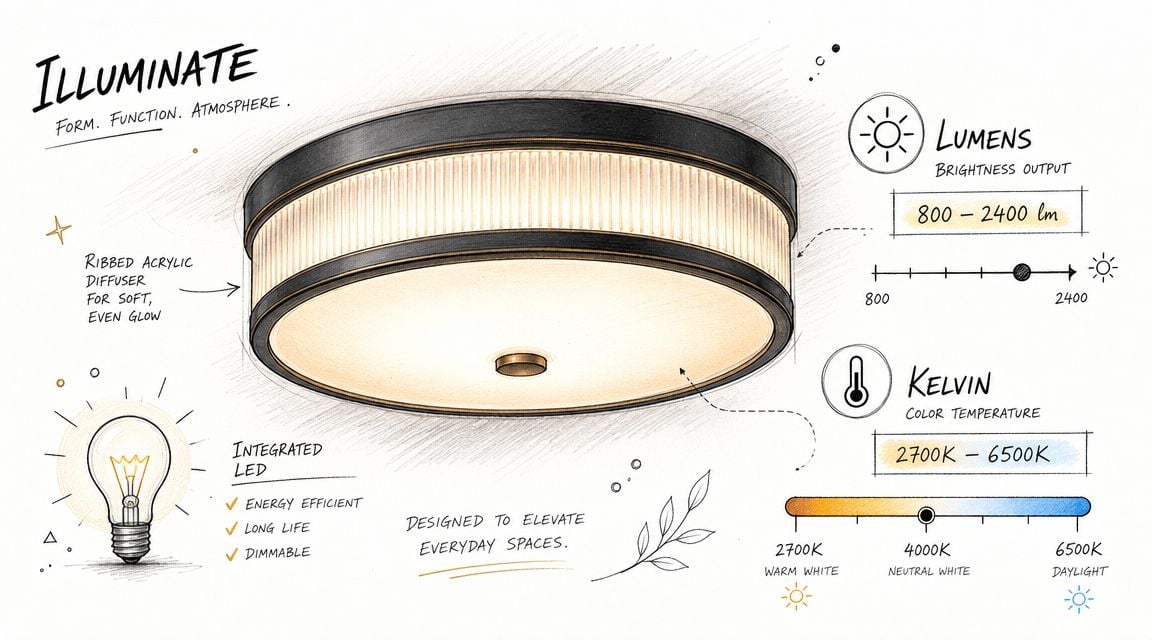
Why diameter alone is not enough
One design source notes that a single flush mount may provide only about 25% of the light needed in a room, which is why spaces over 100 square feet often need a fixture wider than 24 inches or multiple lights to avoid under-lighting the area, as explained in this discussion of flush mount light output and sizing.
That's an important shift in thinking. A flush mount ceiling light is not automatically the whole lighting plan just because it sits in the center of the ceiling.
In a long bedroom, one central fixture may leave the corners dull. In a larger living area, the overhead light may need support from table lamps, floor lamps, or wall lighting. Even in smaller rooms, brightness can feel uneven if the shade diffuses too much light or directs it poorly.
What to look for in everyday language
Three terms help shoppers judge whether a fixture will work:
- Lumens tell how bright the light is.
- Kelvin describes whether the light feels warmer and softer or clearer and crisper.
- CRI refers to how accurately colors appear under that light.
A bedroom usually feels more comfortable with a softer, calmer look. A kitchen or task-heavy area often needs clearer, stronger illumination. A bathroom sits somewhere in the middle, depending on whether vanity lighting handles the detail work.
For readers planning the whole home, a helpful companion resource is this homeowner's guide to outdoor lights, which shows how different lighting needs change once the setting moves outside.
A useful rule is to ask one question before buying. Is this fixture the main source of light, or is it one layer in the room? Once that answer is clear, the right brightness becomes much easier to judge.
If a room needs comfort, visibility, and flexibility, layered light usually works better than asking one ceiling fixture to do everything.
For sleep-focused rooms, this article on creating a sleep sanctuary through lighting, temperature, mattress, and bedding helps connect light quality with how the room feels at night.
Finding a Style That Complements Your Home
A flush mount often becomes the ceiling's handshake. You notice it right away when you walk into the room, and your eye uses it to make sense of everything around it.

Because the fixture sits close to the ceiling, its shape, finish, and diffuser are easy to read. A plain white drum can make a room feel quiet and well-composed. A glass-and-metal fixture with more detail can add personality even before you notice the sofa, art, or rug. That is why style selection is not only about taste. It also affects how balanced the whole room feels.
Match the fixture to the room's visual language
A good rule in our showroom is to look at the room's lines first.
Rooms with clean silhouettes, flat-front cabinetry, and simple trim usually look best with flush mounts that have crisp geometry and restrained detailing. Traditional rooms often welcome curved glass, warmer finishes, or a shape that feels a little more decorative. Rustic and transitional spaces usually benefit from texture, visible material contrast, or a fixture with more visual presence. In polished or dressier interiors, sculptural forms and refined metallic finishes can work beautifully.
If you are still sorting out style labels, I PAINT STUFF on modern vs contemporary gives a helpful explanation of why two fixtures can look similar at first glance but create very different moods.
Finish deserves the same care. Your ceiling light does not need to match every metal in the room piece for piece. It should relate to the finishes nearby, such as cabinet hardware, mirror frames, table bases, or door levers. That relationship is what makes a space feel intentional instead of pieced together over time.
Style and light effect should work together
This is the part shoppers often miss.
A fixture can match the decor and still disappoint once it is turned on. Frosted glass tends to soften and spread light. Clear glass shows off the bulb and can feel sharper or more decorative. Metal shades direct light more purposefully, which can create drama but may leave parts of the room dimmer if the fixture is expected to do all the work.
So when you evaluate style, look at the fixture both as an object and as a light source. The shade material works like a lamp shade on a table lamp. It changes the mood, the spread, and sometimes even how large the room feels after dark.
Pay close attention to ceiling shape
Ceiling height is only one part of the story. Ceiling angle matters too.
Many homeowners assume any low-profile fixture will work in any room with limited height, but sloped or vaulted ceilings can change everything. A standard flush mount may sit awkwardly, cast light unevenly, or leave the fixture looking slightly off balance. In those cases, the right answer may be a slope-compatible ceiling fixture, recessed lighting, or a combination of ceiling and wall lighting that suits the architecture better.
This fosters confidence. You are not only choosing a fixture that fits under the ceiling. You are choosing one that works with the ceiling, sends light where the room needs it, and still looks right in daylight.
The right flush mount should feel like part of the room's architecture, not a last-minute attachment to the ceiling.
Installation Basics and Long-Term Care
Once the fixture is chosen, most homeowners want to know what happens next. The good news is that many modern flush mounts are built to work with standard ceiling infrastructure.
What installation usually involves
Modern integrated LED flush mount fixtures are often designed to install on standard 3-inch or 4-inch junction boxes, and some slim models use 12.5 watts to produce 850 lumens, roughly the light output class of a 75-watt incandescent lamp, according to this integrated LED flush mount specification sheet.
That low-profile construction is one reason these fixtures work so well in tighter rooms. They can stay close to the ceiling without giving up useful ambient light.
Homeowners who want to understand the wiring side before hiring help may find this guide on how to install ceiling lights useful as background reading. It helps explain the process at a high level.
Easy care habits that help fixtures last
Maintenance is usually straightforward, but materials matter.
- For glass shades, dust first and wipe gently so residue doesn't build up and dull the light.
- For metal finishes, use a soft cloth and avoid harsh cleaners that can damage the surface.
- For integrated LED fixtures, check the product details before purchase so there's a clear understanding of whether the light source is built in or replaceable.
A dimmer is often worth considering too, especially in bedrooms, hallways, and multipurpose rooms. It gives the fixture more than one job, bright when needed and softer when the room wants a calmer mood.
Let Our Experts Help You Light Up Your Life
A flush mount ceiling light works best when it solves more than one problem at once. It should respect the ceiling height, suit the room's shape, deliver enough useful light, and feel consistent with the home's style. When those pieces line up, the room feels easier to use and more finished.
That's why the right choice rarely comes from style alone. A polished fixture in the wrong size can disappear awkwardly. A bright fixture in the wrong color temperature can make a bedroom feel harsh. A low-profile light on the wrong ceiling shape can look off from day one.
Homeowners and renters don't need to guess their way through that process. A showroom visit helps turn abstract questions into visible answers. Side-by-side comparisons make scale easier to judge. Finish samples make coordination less stressful. A broader room discussion often reveals whether the ceiling light should stand alone or support lamps, sconces, or other layers.
For shoppers in West Texas and Southeastern New Mexico, that kind of guidance can be especially helpful when furnishing an entire bedroom, hallway, bath, or living space at once. Lighting decisions affect how furniture reads, how colors show up, and how comfortable the room feels day to day.
The goal isn't to chase a trend. It's to choose confidently, with a fixture that fits the way the room is used.
Homeowners who are ready to compare lighting styles, coordinate finishes, and get help matching a fixture to the room can explore Miller Waldrop Furniture & Decor. Their showrooms in Lubbock, Hobbs, and Ruidoso Downs offer furnishings, decor, and design guidance that can help turn a lighting question into a room that feels complete.