

Sectional Sofa vs Two Sofas: Which Is Right for You?


A family has just moved into a new home, and the living room looks large enough for almost anything. Then the tape measure comes out. One wall could accommodate a sectional, but the hallway to the kitchen needs to stay open. Two sofas would create a balanced conversation area, yet the family wants everyone together for movie nights. The choice between a sectional sofa vs two sofas quickly becomes a decision about circulation, comfort, replacement, delivery, and long-term adaptability, not just appearance.
The right arrangement depends on how the room works today and how it may need to work later. A renter may value furniture that can move to another room. A growing family may prioritize shared lounging. A household that entertains formally may prefer independent seating that can be repositioned. The comparison below provides a practical starting point before the detailed analysis.
| Decision factor | Sectional sofa | Two separate sofas |
|---|---|---|
| Room footprint | Commonly spans 94–156 inches overall, depending on configuration (size guidance) | Each standard sofa is roughly 78–90 inches wide and 36–40 inches deep (size guidance) |
| Seating range | Small configurations seat 4–5, standard configurations seat 5–6, and large configurations seat 6–7+ | Two typical sofas can provide approximately 6 seats in total |
| Best social pattern | Shared lounging, family gatherings, and television viewing | Face-to-face conversation, symmetry, and multiple seating zones |
| Rearrangement | Limited if fixed, considerably better if modular | Each sofa can move or be replaced independently |
| Delivery challenge | Pieces may move separately, but every module must be measured | Two separate bodies can reduce the risk of one oversized obstruction |
| Lifecycle value | Cohesive appearance, with modular replacement potential in suitable designs | Incremental replacement and easier room-to-room adaptation |
Introduction to Sofa Arrangement Choices
The first question shouldn't be which sofa looks more impressive in a showroom. It should be what the household asks the living room to do from morning through evening.
A family may use the room for quiet reading during the day, homework in the afternoon, and shared viewing at night. Two sofas can face one another for conversation and then move apart when the room needs a clearer path. A sectional can create one unified zone where children, guests, and adults gather without a visible gap between seats. Neither arrangement wins automatically. Each solves a different circulation and behavior problem.
The room has to support real movement
Furniture placement affects how people enter the room, reach nearby doors, approach a coffee table, and move between seating and other parts of the home. A sectional may use a corner efficiently, but its return or chaise can become a physical barrier if it projects into a walkway. Two sofas may occupy more separate locations, yet their independent shapes can make it easier to preserve a direct route.
The decision also carries a future cost. A fixed sectional may look unified for years, but replacing one worn area can be difficult if the entire piece is designed as a single visual unit. Two sofas allow one piece to be upgraded without immediately changing the other, which can spread out household spending and preserve a familiar layout.
Three questions clarify the choice
Before shopping, households should answer:
- How does the room function? Casual lounging favors a connected seating zone, while formal conversation often benefits from opposing or angled sofas.
- How stable is the floor plan? A long-term home with a settled layout may suit a traditional sectional. A rental, move, or multipurpose room may reward independent pieces.
- Which limitation is harder to accept? A sectional can constrain circulation and delivery planning. Two sofas can require more deliberate styling and placement.
The best choice is the one that protects the room's most important function without creating a problem that becomes expensive to correct later.
Understanding Sectional Sofas and Two Sofas
A sectional sofa is a connected seating arrangement built from multiple sections. Common formats include L-shapes, U-shapes, chaise layouts, and modular systems. Traditional sectionals generally maintain a set form, while modular versions use separate pieces that can be rearranged, moved to another room, or replaced individually (modular sectional explanation).
Two sofas are independent seating pieces, usually arranged opposite one another, at a right angle, or in separate zones. Their key structural advantage is separation. Each sofa can be rotated, moved, reupholstered, sold, or replaced without forcing the entire seating plan to change.
A category shaped by flexibility
Sectional seating has a long design lineage reaching back to the 19th century. Modern modular versions gained major recognition in the 1940s, when Harvey Probber introduced the first modular sectional, a development that helped establish flexible seating as a distinct design direction (sectional sofa history).
That history matters because the current decision isn't merely contemporary style versus traditional style. It reflects a continuing shift toward furniture that can respond to changing rooms and households. The same history source reports that more than one-third of consumers were considering adding a sectional to their shopping list in the coming year, while 17% had already purchased one within the past year (market and history context). Among purchasers, three-piece sectionals represented 36%, followed by two-piece configurations at 28% and four-piece configurations at 18% (configuration data).
The important distinction is fixed versus modular
A fixed L-shaped sectional creates a strong anchor. It establishes one main seating direction and can make a room feel intentional with fewer separate objects to coordinate. A modular sectional behaves differently. Its individual units can be rearranged as the room changes, narrowing the gap between a connected sectional and two independent sofas.
Two sofas remain the more straightforward option for households that want maximum placement freedom without relying on connectors or a compatible modular system. They also create a more formal visual rhythm, particularly when matching upholstery, arms, and proportions are used.
This distinction prevents a common buying mistake. A shopper who wants sectional comfort but expects to move frequently shouldn't evaluate only standard fixed designs. A modular option may address the actual need, while two sofas remain preferable when independent replacement and room-to-room use matter more than a unified silhouette.
Comparing Layout and Space Requirements
The biggest layout difference is predictability. A standard sofa generally measures about 78–90 inches wide and 36–40 inches deep, while sectional layouts commonly span 94–156 inches overall and may reach 120–168 inches wide, depending on configuration (sectional dimensions). The same guidance indicates that a sectional footprint can expand by 30% or more compared with placing two standard sofas, so an arrangement that looks reasonable on paper may consume more usable floor area once circulation is included.
A two-sofa setup offers more predictable individual dimensions. A sectional requires the buyer to account for the full length, return, chaise, corner, and orientation. The question isn't only whether the furniture fits between two walls. It must also leave a comfortable route around it.
Clearance determines whether the room feels usable
A sectional should leave at least 30 inches for regular walking paths and 36 inches for high-traffic routes. The recommended distance between a sectional and coffee table is 14–18 inches (sectional arrangement guidance). Those clearances turn a floor plan into a practical test. If the chaise blocks the main route or the coffee table sits too far away for comfortable reach, the sectional's apparent seating advantage may not translate into better daily use.
A two-sofa arrangement can preserve circulation through independent placement, but it needs its own discipline. Sofas facing each other may create a clear conversation zone while narrowing the passage behind one of them. Sofas placed at a right angle can work well in a square room, but the corner between them must remain accessible rather than becoming dead space.
For additional planning ideas, households can review these sectional sofa layout ideas before selecting a configuration.
Footprint comparison
| Configuration | Typical dimensions | Recommended clearance |
|---|---|---|
| Single standard sofa | 78–90 inches wide, 36–40 inches deep (dimension guidance) | Preserve the room's main walking route, with wider clearance where traffic is frequent |
| Small sectional | 95–110 inches by 62–70 inches | At least 30 inches for regular paths and 36 inches for high-traffic routes (arrangement guidance) |
| Standard sectional | 110–130 inches by 70–90 inches | Check both the long wall and return, then retain the recommended path clearances |
| Large sectional | 130–150 inches by 90–110 inches | Use only when the full footprint leaves circulation and table access intact |
| Two sofas | Two separate sofas, each commonly 78–90 inches wide (size guidance) | Measure each placement, the central conversation zone, and every route around the pieces |
The hidden insight is that floor area and usable floor area aren't the same. A sectional may consolidate seating along two walls, but its return can control the room's only practical route. Two sofas may occupy more visual territory while allowing a better path because each piece can shift independently.
Evaluating Seating Capacity and Flexibility
Capacity should be measured in two ways, not one. The first is the number of people who can sit. The second is whether those seats support the way people use the room.
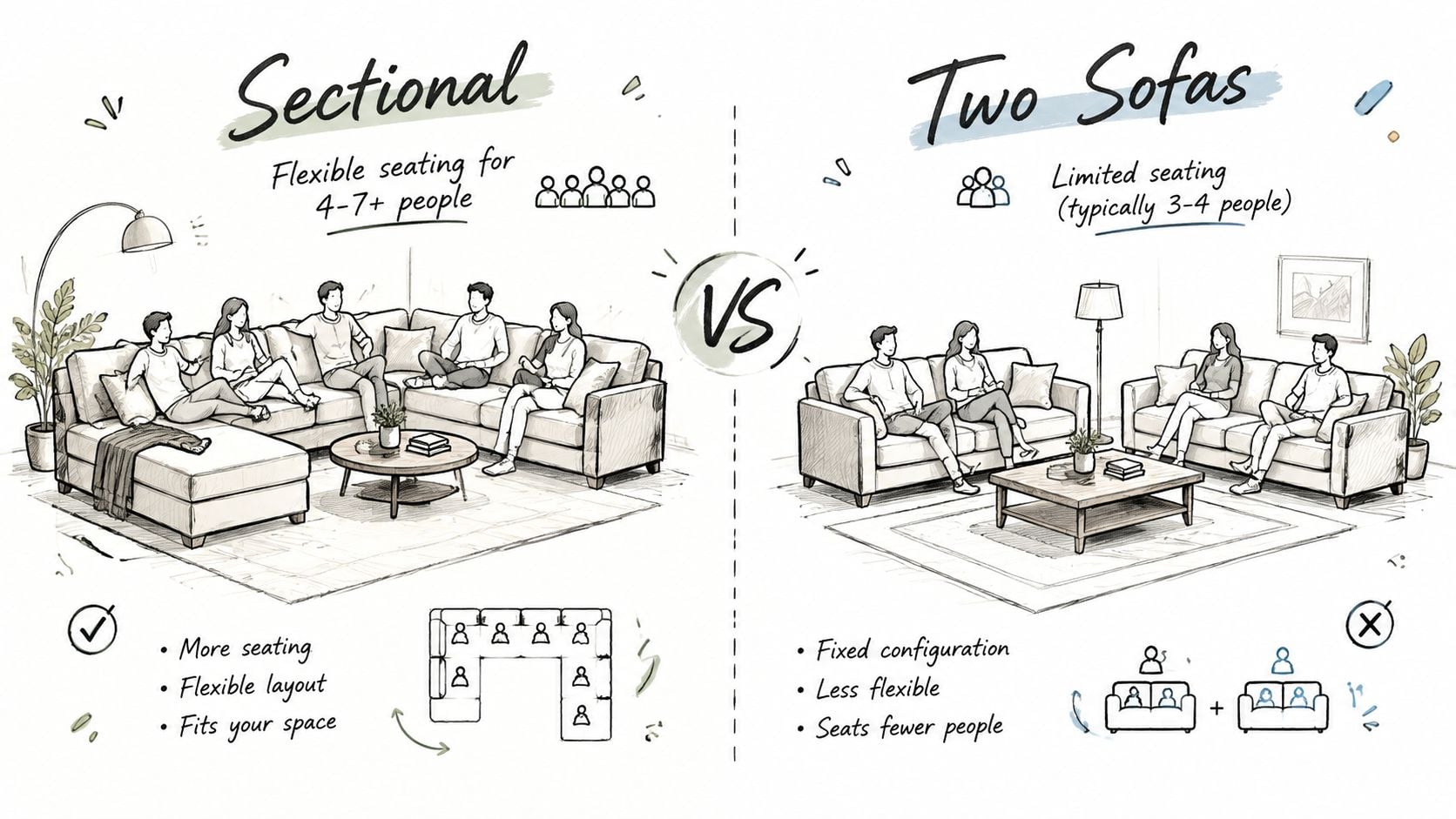
A small sectional measures approximately 95–110 inches by 62–70 inches and seats 4–5 people. A standard sectional measures 110–130 inches by 70–90 inches and seats 5–6 people. A large sectional measures 130–150 inches by 90–110 inches and seats 6–7+ people. Two separate sofas typically seat three people each, creating approximately six seats in total while preserving independent placement.
Seating count doesn't describe seating behavior
A sectional encourages a shared center. People can sit close together, stretch along a chaise, or orient toward the same screen. That makes it a natural fit for casual family use, shared viewing, and gatherings where occupants want to feel part of one group.
Two sofas divide the room's seating into independent surfaces. People can face one another more directly, create a quiet reading side, or leave one sofa available while another is used for conversation. This arrangement can feel more structured, which helps when the living room must serve guests and everyday household activities at the same time.
Modularity changes the comparison
Traditional sectionals typically keep occupants within one fixed geometry. A modular sectional can be rearranged into different forms, such as a longer sofa, a corner arrangement, or a more enclosed configuration, depending on its construction. That flexibility can also allow individual pieces to move into another room after a relocation.
Two sofas still provide the clearest replacement strategy. If one becomes worn, the household can address that sofa alone. If the room changes, each piece can be repositioned without dismantling a connected frame. Buyers who expect frequent changes should compare modular construction directly with independent sofas rather than treating every sectional as equally flexible.
For room planning, a living room furniture dimensions guide can help translate seating goals into realistic placement decisions.
Analyzing Style Options and Long-Term Adaptability
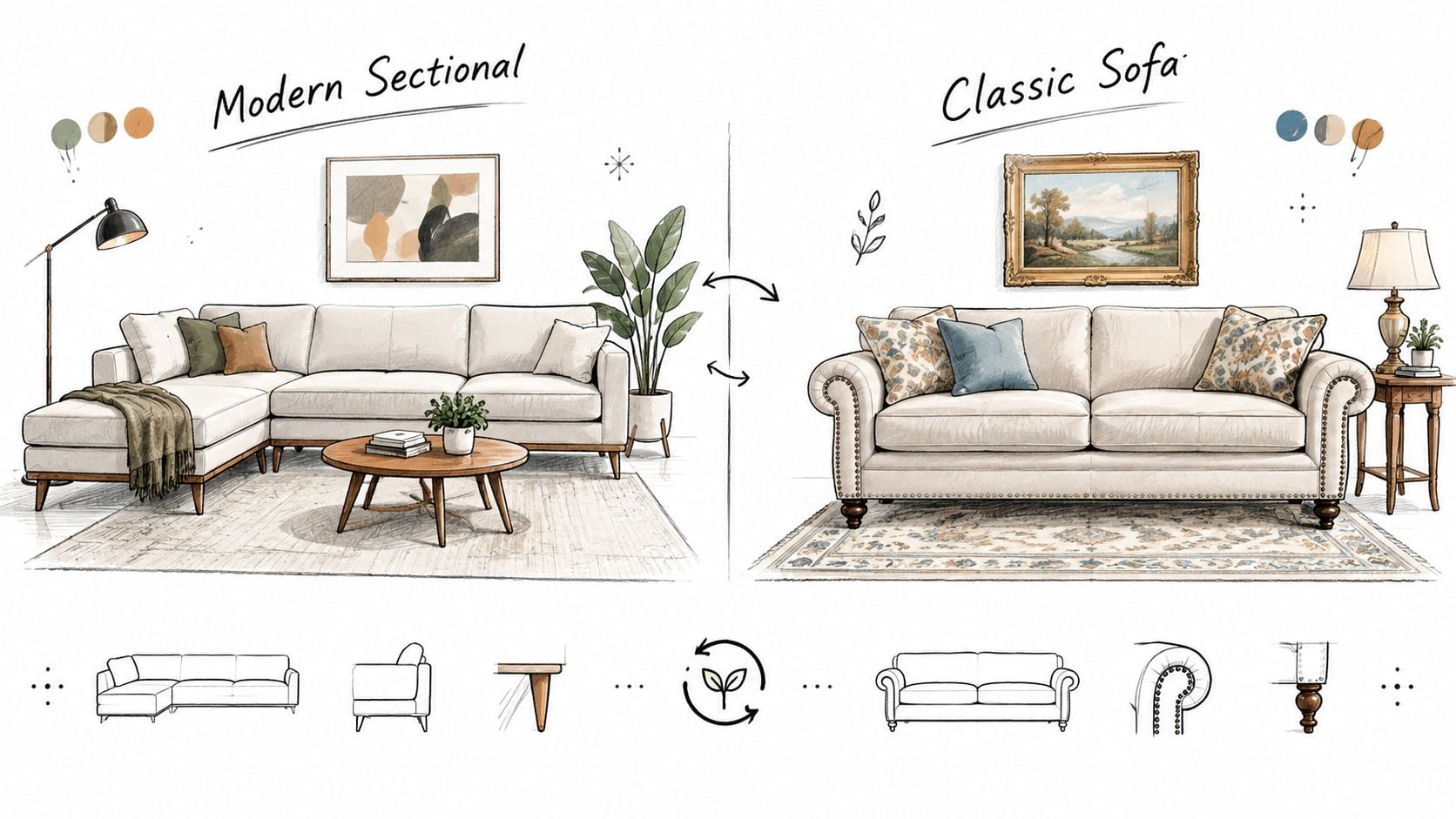
Style affects the first impression, but adaptability determines whether the arrangement continues to work after the room, household, or upholstery changes. A sectional usually creates one unified visual statement. Two sofas create a paired composition, which can feel balanced and formal when the pieces match or intentionally coordinate.
That difference becomes more important when furniture wears unevenly. Two sofas can be replaced or upgraded one at a time, while a sectional often functions as a single visual unit. If one area of a fixed sectional shows damage, the household may face a broader design problem because a replacement section must match the existing proportions, fabric, and finish (lifecycle comparison).
Upholstery is part of the furniture system
Easy-clean fabric, removable covers, and customizable modules can change the long-term equation. A modular sectional with replaceable pieces may adapt well to children, moves, and multipurpose rooms. Two sofas with durable, maintainable upholstery can be even easier to manage because each piece can be moved away from walls and cleaned independently.
Maintenance should be planned before delivery, not after the first spill. Households comparing fabric options can use these couch cleaning tips to understand how routine care fits into the ownership plan. The useful question is whether the selected upholstery can be cleaned in the places where people sit, stretch, eat, and gather.
The strongest design may be a future-proof design
A fixed sectional suits a settled room where one cohesive anchor is more valuable than rearrangement. Two sofas suit a household that expects the living room to evolve, especially when one piece may eventually move to a guest room, office, or another property.
Modular sectionals occupy the middle ground. They preserve a coordinated look while allowing sections to be rearranged or replaced, provided the manufacturer supports those changes. Buyers should ask whether modules are sold separately, whether covers or cushions can be ordered later, and whether the connection system permits the layouts the household may need.
The hidden lifecycle cost is loss of optionality. A lower-maintenance sofa isn't necessarily the one with fewer parts. It may be the arrangement that gives the household more practical choices when a move, repair, room conversion, or style change arrives.
Assessing Cost Delivery and Installation Factors
The purchase price is only one part of the investment. A meaningful comparison includes the number of frames and cushions, upholstery quality, optional configuration, maintenance requirements, replacement strategy, delivery access, and the effort required to position the furniture safely.
Two sofas can be purchased together for a coordinated look or separately as the household's budget allows. That staged approach can reduce the immediate commitment, although matching later depends on continued availability and consistent materials. A sectional packages the seating area into one visual decision, which can simplify selection but make a later partial replacement more difficult if the design isn't modular.
Delivery favors pieces that can be checked individually
Sectional delivery has a specific advantage and a specific risk. Separate modules may be easier to carry through narrow doors, hallways, and stairs, but the complete layout becomes harder to verify because every component must fit its route and work together once assembled. Delivery guidance identifies corner units as frequent limitations, with corner pieces commonly measuring around 35–40 inches square, and recommends measuring each component, including diagonal depth, rather than relying only on the assembled dimensions (sectional delivery guidance).
Two sofas can reduce the chance of one large corner obstruction because each sofa travels independently. They still need a complete access plan. A doorway that accepts one sofa may not provide a safe angle for the second, and stairs can introduce turns that floor measurements don't reveal.
A detailed guide to measuring for a sectional couch helps households record door openings, hallway widths, stair turns, and the diagonal depth of each piece before ordering.
Protect the room during placement
Installation can mark flooring even when the furniture fits. Moving heavy seating across hardwood requires controlled lifting, clear pathways, and suitable protection. Households preparing for delivery can review guidance on furniture pads for hardwood floors before the delivery team arrives.
The practical checklist is short:
- Measure every access point: Include entry doors, interior doors, hallways, stair landings, and sharp turns.
- Record component dimensions: Treat each sectional module, especially the corner, as a separate delivery object.
- Clear the route: Remove lamps, tables, artwork, and other obstacles before the scheduled arrival.
- Confirm the final placement: Mark the footprint on the floor so the crew can identify the intended orientation without guesswork.
- Protect finished surfaces: Use appropriate pads and avoid dragging frames across hardwood or other vulnerable flooring.
The arrangement that costs less to transport may still cost more if it damages flooring or requires an unexpected change in placement. Delivery planning belongs in the buying decision from the start.
Decision Checklist and Next Steps
A clear decision comes from ranking constraints rather than choosing a shape first. The following checklist turns the sectional sofa vs two sofas question into a sequence of practical tests.
Start with the room
Measure the usable zone, not only the walls. Record the space available after accounting for doors, windows, vents, media equipment, and built-in features. A sectional's overall span and return must fit without treating a walkway as leftover space.
Mark circulation before shopping. Reserve at least 30 inches for regular walking paths and 36 inches for high-traffic routes, using the spacing guidance cited earlier. Keep the coffee table 14–18 inches from the sectional when that arrangement is selected (clearance guidance).
Test both orientations. Use painter's tape or paper outlines to mark a sectional and two sofas on the floor. Walk the route carrying a laundry basket, opening doors, and approaching the seats from the directions household members use.
Score the household's behavior
A sectional deserves priority when shared lounging, a unified viewing area, and corner use matter most. Two sofas deserve priority when face-to-face conversation, formal balance, or independent movement matters more. A modular sectional deserves closer attention when the household wants a connected look without giving up every future layout option.
Capacity also needs context. A large sectional can offer 6–7+ seats, while two typical sofas offer approximately six seats, but a seat that blocks circulation or remains uncomfortable for the room's main activity isn't useful capacity.
Evaluate ownership before ordering
Ask whether individual cushions, covers, or modules can be replaced. Check the upholstery care instructions and decide whether the fabric suits children, pets, food, sunlight, and frequent use. Consider whether one sofa may need to move to another room later, or whether the living room layout is likely to remain stable.
Then complete the delivery test. Measure each sectional component diagonally, confirm stair and hallway access, and identify floor-protection requirements. Two sofas need the same route review, but their independent bodies may offer more placement options if the original plan changes.
Miller Waldrop Furniture & Decor can help shoppers compare living room furniture, sectional configurations, fabrics, and custom-order options through personalized design guidance. Households in Lubbock, Hobbs, and Ruidoso Downs can bring room measurements to a showroom, test seating in person, and use the retailer's curated brand selection and delivery support to turn a floor-plan decision into a workable living room.
Miller Waldrop Furniture & Decor offers sofas, sectionals, custom configurations, and personalized design assistance for households comparing comfort with long-term flexibility. Visit Miller Waldrop Furniture & Decor with room measurements and circulation priorities to explore options that fit the way the living room needs to function.