

Burnt Orange Sectional Furniture: Styling & Buying Guide

You're probably here because you've looked at one too many gray sofas, one too many beige sectionals, and one too many “safe” living rooms that feel polished but forgettable. You want warmth. You want personality. You want a room that feels collected and lived in, not copied from a showroom vignette.
Then the doubt creeps in. A burnt orange sectional furniture choice feels bold enough that it can trigger all the usual questions. Will I get tired of it? Will it fight with my floors? Will it still work if my pillows, rug, or paint color change later? Those are smart questions, and they're exactly the ones more shoppers should ask before they buy a statement piece.
Embracing a Bolder, Warmer Living Space
A burnt orange sectional usually appeals to people who are done decorating around fear. They're tired of picking the least risky option and ending up with a room that feels flat. The shift isn't really about choosing a louder color. It's about choosing a home that reflects how you want to feel when you walk into it. Warmer, more relaxed, more personal.
The hesitation is understandable. Bold upholstery gets judged harder than neutral upholstery because it has to carry more visual weight. But that's also why it works. A sectional is often the largest piece in the room, so when you want the space to feel inviting, the sofa should do some of that work instead of leaving everything to the accessories.
Why this color feels less risky than people think
Most advice about bold furniture stops at inspiration. It tells you burnt orange looks beautiful, then leaves out the part buyers care about most, whether it will still feel right after the novelty wears off. That's the real decision point.
The useful contrarian view is this: burnt orange often ages better than expected because it behaves like an earthy neutral. It works with walnut, black metal, cream, and olive, so it can move between mid-century, rustic-modern, and softer contemporary spaces without looking stranded. That long-range flexibility is part of what gives it staying power, as discussed in this burnt orange sectional example for home decor inspiration.
If your floors are part of the hesitation, solve that first. Before choosing upholstery, take time to determine your flooring color so you can see whether your room leans warm, cool, or mixed. That single step prevents a lot of expensive second-guessing later.
A bold sectional works best when the rest of the room supports it instead of competing with it.
What confidence looks like in practice
Confidence doesn't mean buying the brightest thing in the room and hoping for the best. It means knowing why the color works, what materials will support it, and how to build around it with intention.
That's where burnt orange sectional furniture earns its place. Done well, it doesn't scream for attention. It grounds a room, adds depth, and makes a living space feel warmer before you even add art, pillows, or lamps.
Why Burnt Orange Is a Timeless Design Choice
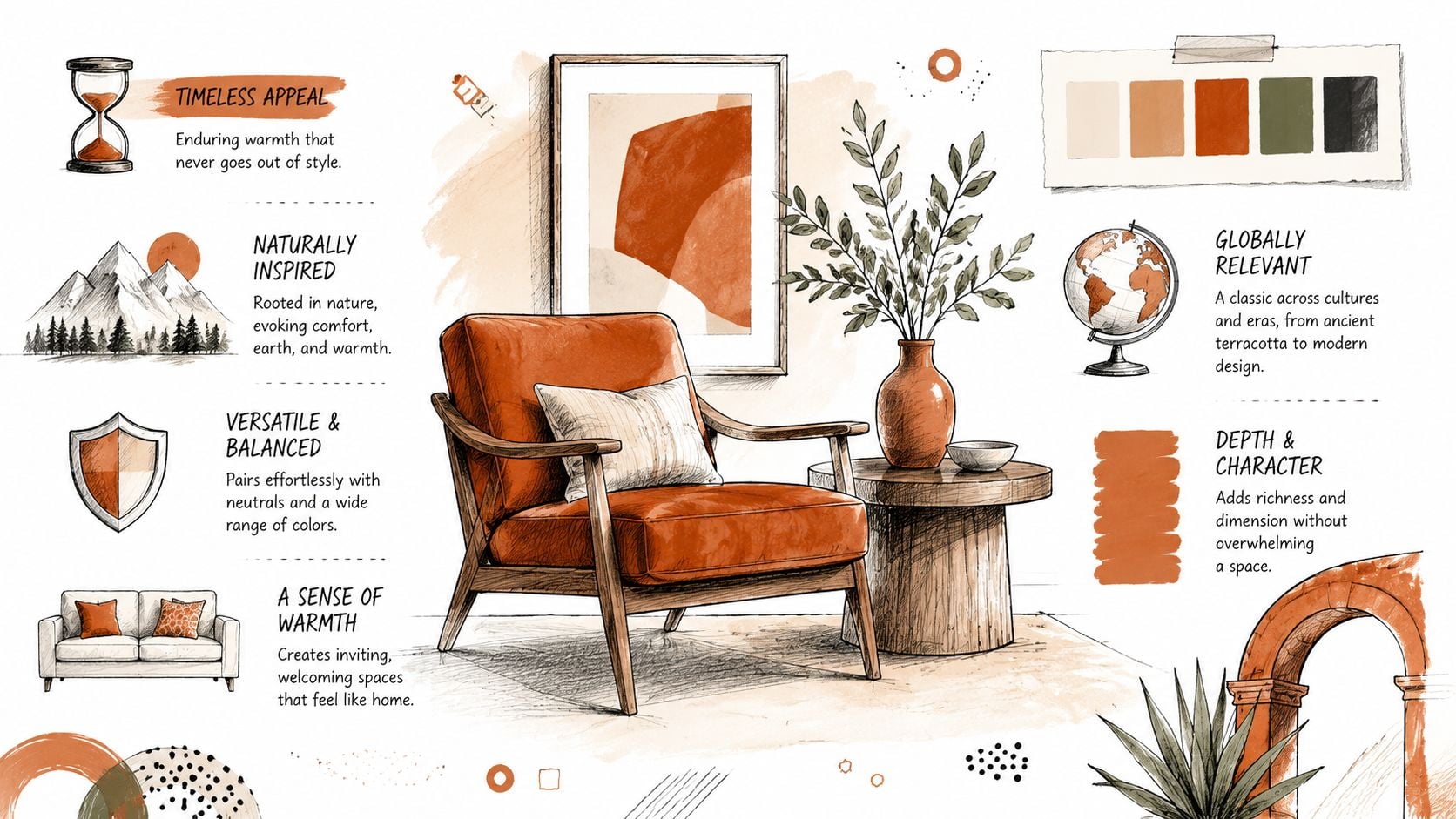
Burnt orange has history behind it, and that matters. Colors with staying power tend to return because they answer the same emotional need every time people grow tired of colder, flatter interiors. Burnt orange does that especially well because it brings warmth without becoming sugary or precious.
A documented design cycle supports that instinct. Homes & Gardens notes that “over 50 years have passed since its first popularity,” tying today's revival back to the 1970s and the return of warm earth tones in interiors. That long cycle is a strong reason to see burnt orange as a recurring classic rather than a one-season novelty in home furnishings, as covered in this Homes & Gardens feature on the return of the burnt orange sofa.
The color has roots, not just buzz
The 1970s gave burnt orange a strong visual identity, but today's rooms use it with more restraint. Instead of pairing it with every other saturated tone in the room, designers now let it anchor cleaner silhouettes, natural woods, matte black accents, and quieter textiles. That shift is why the color feels fresh again.
Burnt orange also solves a problem many large living rooms have. Big open spaces can look disconnected when the main seating fades into the background. A sectional in this tone adds warmth and visual mass, which helps the room feel settled.
Why it stays sophisticated
Some bold colors are hard to live with because they have a sharp edge. Burnt orange doesn't. It sits closer to rust, clay, terracotta, and amber than to a loud citrus orange, so it reads as grounded rather than flashy.
That's why it works across multiple styles:
- With walnut wood, it feels rooted and classic.
- With cream upholstery accents or walls, it feels soft and sophisticated.
- With black metal, it picks up a sharp, architectural edge.
- With olive or deep green, it leans earthy and layered.
If you like testing color relationships before you commit to furniture, looking at adjacent finishes can help. Even a niche resource like UK orange vinyl for home decor can be useful for seeing how orange-based tones behave with different surfaces and surrounding materials.
Design takeaway: Burnt orange works when it's treated as an earthy foundation, not as a novelty accent.
That distinction is everything. If you style it like a gimmick, it will date quickly. If you treat it like a deep, warm neutral, it can carry the room for a long time.
Finding Your Perfect Fit and Layout
The fastest way to ruin a good sectional purchase is to fall in love with the color and ignore the footprint. Sectionals command space. They affect how you walk through the room, where side tables can sit, whether your rug looks undersized, and whether delivery day turns into a headache.
Recent burnt orange sectional listings show why measuring matters. One modular velvet sectional is listed at 112.4" W × 72.4" D × 34.3" H with a 21" seat height, while another right-facing velvet sectional is 101" × 84" × 31.8" with assembly required. Those dimensions show how easily a sectional can stretch past the visual size people estimate in their heads, and why planning for room fit and delivery paths matters from the start, as shown in this burnt orange modular sectional listing.
Measure the room before you shop the silhouette
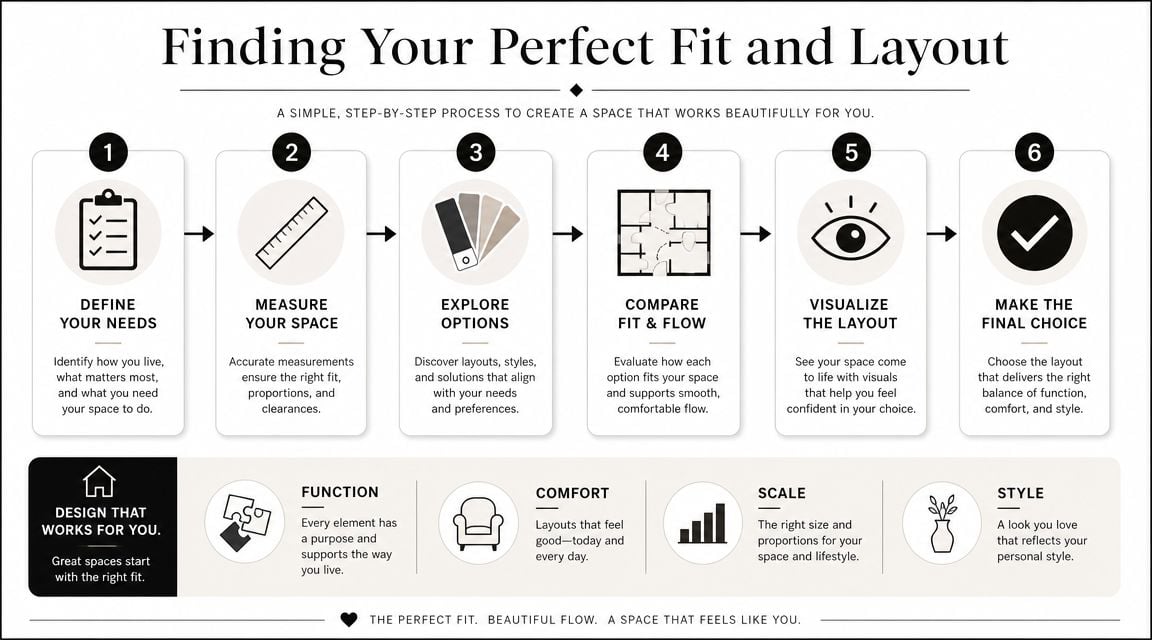
Start with the actual envelope the sectional can occupy, not the whole room size. Measure wall span, fireplace offsets, window trim, floor vents, and any doors that swing into the space. Then mark the sectional footprint with painter's tape.
Pay close attention to depth. A piece that's over 70 inches deep in one direction can look comfortable online and feel massive in person if the room already carries a coffee table, accent chairs, or a media console.
Use a simple planning sequence
A clean process saves a lot of regret.
- Mark the wall side first. This tells you the maximum width your sectional can take without crowding windows or built-ins.
- Add the return or chaise depth next. That's usually where traffic problems begin.
- Walk the room. Don't just look at the tape. Physically move through the paths you use every day.
- Check seated comfort. Seat heights around 18 to 21 inches are a useful reference point because they align with standard ergonomic seating and are often easier on knees than very low lounge seating, based on the product dimensions noted above.
- Plan the delivery route. Measure entry doors, stair turns, and hallway corners before you assume modular means easy.
Practical rule: A sectional should support movement through the room, not force everyone to walk around it like an obstacle.
Match the configuration to how you live
Layout isn't only a math problem. It's a behavior problem too.
An L-shaped sectional is often the easiest answer for rooms that need one strong seating zone without closing off the space. A chaise sectional works well when one person tends to stretch out daily but you don't want the room to feel too boxed in. A modular sectional makes sense if you move often, host irregularly, or want the option to rework the arrangement later.
For more room-planning ideas that help translate measurements into a livable setup, this guide to designing a living room with a sectional is a practical next step.
Common mistakes to avoid
- Buying for the photo, not the floor plan. Wide sectionals photograph beautifully and still fail in real rooms.
- Ignoring height and arm bulk. A low back can keep a room open, while oversized arms can make a sectional feel heavier than its dimensions suggest.
- Forgetting side-table function. If nobody has a place to set a drink or a lamp, the layout isn't finished.
The best sectional layouts feel obvious once they're in place. That usually means the buyer did the measuring work first.
Choosing Fabrics and Construction for Real Life
A burnt orange sectional has to do more than look beautiful in the showroom. It has to survive movie nights, weekend lounging, pets claiming corners, and kids who somehow always find the lightest throw pillow with sticky hands. For these reasons, construction matters more than trend.
Many current burnt orange sectionals pair velvet upholstery with a solid hardwood or eucalyptus frame and sinuous springs. That combination matters for practical reasons. Velvet gives the color depth, hardwood or eucalyptus improves structural stability, and sinuous springs help distribute body weight more evenly than simpler support systems, as shown in this burnt orange sectional construction example.
What the material stack tells you
When I evaluate a sectional for long-term use, I look from the inside out. The frame tells you whether the piece can handle repeated load. The suspension tells you how the seat will support bodies over time. The upholstery tells you how much maintenance the look will require.
Velvet deserves special mention with burnt orange because it enhances saturation better than many flatter fabrics. That's the upside. The trade-off is that velvet can show shading, pressure marks, and nap changes with daily use.
Burnt Orange Sectional Fabric Comparison
| Fabric Type | Best For | Feel | Maintenance Level |
|---|---|---|---|
| Velvet | Statement rooms, rich color depth, formal-casual mix | Soft, plush, light-reflective | Moderate to high |
| Performance fabric | Busy households, easier day-to-day upkeep | Varies by weave, often smoother or textured | Moderate |
| Leather | Long-term patina, easy surface wipe-down, tailored spaces | Supple to firm depending on finish | Moderate |
A buyer who loves the look of burnt orange often gravitates to velvet first, and for good reason. It makes the color look fuller and more dimensional. But if the sectional sits in the busiest room in the house, the right choice depends on whether you enjoy a lived-in nap pattern or prefer a more visually uniform surface.
What works and what doesn't
What works:
- Solid wood or eucalyptus framing if the sectional will get daily use.
- Sinuous spring support when you want consistent seat support without a hammock feel.
- Semi-firm seating for households that use the sofa for both lounging and upright conversation.
What doesn't work as well:
- Buying by color alone and ignoring the support system underneath.
- Choosing delicate-looking upholstery when the room functions as the family hub.
- Expecting velvet to hide wear patterns the way a heavily textured woven fabric might.
If you're comparing options and want a broader primer, this guide on how to choose upholstery fabric helps connect fabric type to actual household use.
Velvet rewards the buyer who loves depth and softness. It's less forgiving for someone who wants a perfectly uniform finish every day.
For maintenance support, especially if you already own upholstered furniture and want professional care, a service like dry clean upholstery in Kennesaw shows the kind of specialized cleaning approach worth looking for locally.
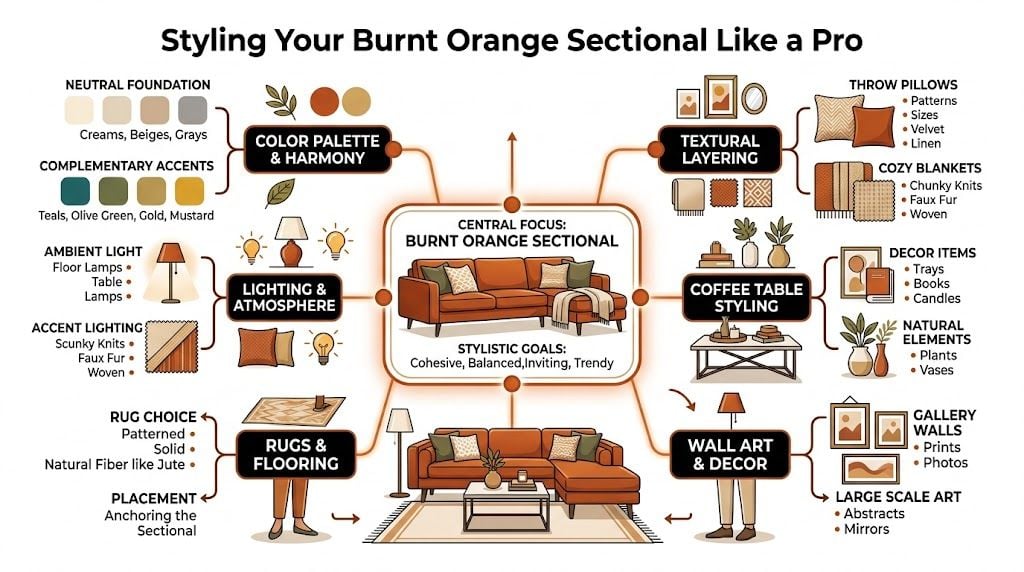
Styling Your Burnt Orange Sectional Like a Pro
Once the sectional is in the room, the goal shifts. You're no longer asking whether burnt orange can work. You're deciding what story the room tells around it.
The easiest mistake is over-decorating. A burnt orange sectional already carries color, presence, and emotional warmth. It doesn't need ten competing accents to prove the point. It needs support.
A clean, layered formula
One of the most successful ways to style burnt orange sectional furniture is to split the room into roles. Let the sectional handle color. Let the rug handle grounding. Let the pillows and art handle personality.
Here are three styling directions that work consistently well.
The walnut and cream room
This version feels timeless and easy to live with. Use a cream or oatmeal rug, walnut wood tables, and a few textured pillows in ivory, camel, or muted rust. Add linen drapery and a ceramic lamp with a soft matte finish.
The sectional becomes the warm anchor instead of the loudest object in the room. This is the setup I recommend most often to homeowners who want a statement piece without a high-maintenance visual result.
The olive and black room
This look adds edge without cooling the room too much. Pair the sectional with olive pillows, black-framed art, and dark bronze or matte black accent tables. A vintage-style rug with faded warm and green tones pulls the palette together.
This is especially strong in homes that already have black windows, dark hardware, or iron lighting. The orange keeps those darker elements from making the room feel severe.
Don't match the sectional to every accessory. Repeat its warmth in smaller doses and let contrast do the rest.
The navy and charcoal room
This direction feels a little moodier and more refined. Use deep navy in art, a throw, or an accent chair. Charcoal can show up in a rug pattern, lamp base, or side table. Keep one major balancing element light, such as cream walls or pale drapery, so the room doesn't get too dense.
If you need help building a room-wide scheme around a strong sofa color, this resource on a color palette for living room can help you map out supporting tones before you shop accessories.
The pieces that matter most
Some accessories do more work than others.
- Rug choice: A rug should calm the sectional, not challenge it. Look for muted pattern, soft cream, faded terracotta, olive, or charcoal.
- Pillows: Mix solids with subtle pattern. Boucle, linen, and woven textures pair well because they soften the richness of the upholstery.
- Accent chairs: Cream, camel, olive, or wood-framed chairs usually integrate more smoothly than another bold color.
- Lighting: Warm bulbs and table lamps with natural or ceramic finishes help the sectional feel intentional at night, not isolated.
The rooms that fall apart usually make one of two mistakes. They either go too neutral and leave the sectional unsupported, or they pile on too many saturated colors and turn the room noisy. The sweet spot is contrast with restraint.
Your Partner in Creating a Home You Love
A burnt orange sectional is one of those purchases that benefits from real guidance. Not because the choice is too difficult, but because the right answer sits at the intersection of layout, comfort, upholstery, and style. A strong piece deserves a strong process.
That's where an experienced furniture store becomes useful. Not as a place that pushes a look, but as a place that helps you test one against your room, your habits, and your long-term plans. Sectionals are especially dependent on details that don't show up well on a product page, things like arm scale, seat feel, fabric hand, and how the overall silhouette sits with the rest of your furniture.
What helps most when choosing a statement sectional
The most valuable support usually comes down to a few practical tools:
- In-store testing so you can compare upright seating versus deeper lounging comfort
- Design guidance that helps you balance a bold sofa with flooring, rugs, and existing casegoods
- Custom options if you need a specific configuration, fabric, or finish to make the room work
- Delivery coordination so a large sectional arrives with fewer surprises
For shoppers who want to compare sectional styles and configurations in one place, Miller Waldrop Furniture & Decor sectional seating options are one practical resource to browse alongside your room measurements and inspiration images.
Why a local furniture partner matters
A multi-generational store tends to approach furniture differently. The advice is usually more grounded in how people live, especially in homes with family traffic, open living areas, and mixed-use rooms. That matters in West Texas and Southeastern New Mexico, where living spaces often need to feel comfortable, durable, and welcoming at the same time.
Miller Waldrop has served Lubbock, Hobbs, and Ruidoso Downs for over 70 years as a fourth-generation family-owned furniture business, with curated showrooms, design help, custom order options, a Low Price Promise, and flexible financing available through its stores and services. That kind of continuity matters when you're buying a large piece you expect to live with for years.
A good sectional should make your home feel more like yours. The right support helps you get there with fewer mistakes.
If you're ready to choose a sectional that brings warmth, comfort, and personality into your living room, Miller Waldrop Furniture & Decor can help you compare styles, explore configurations, and make a confident decision for your space. Visit a showroom in Lubbock, Hobbs, or Ruidoso Downs, or browse online to find the sectional that fits the way your family really lives.