


Best Outdoor Rugs for West Texas & NM Patios

A lot of outdoor rugs look good in a product photo and fall apart in real life. In West Texas and Southeastern New Mexico, that usually shows up fast. The sun is relentless, dust settles into every texture, and a dry week can turn into a hard rain with very little warning.
That's why choosing from the best outdoor rugs starts with performance, not pattern. Style still matters. But if the rug can't handle heat, grit, moisture, and steady foot traffic, it won't feel like a smart buy for long.
Outdoor rugs became a true home category because they solve three practical problems at once: protecting surfaces, improving safety, and adding style, according to Consumer Reports' outdoor rug buying guide. That same guide also points out how broad the category has become, from 4×6 rugs around $100 to $200 to premium 8×10 options around $800. The takeaway is simple. You're not shopping one product. You're choosing from a range of materials, constructions, and design levels.
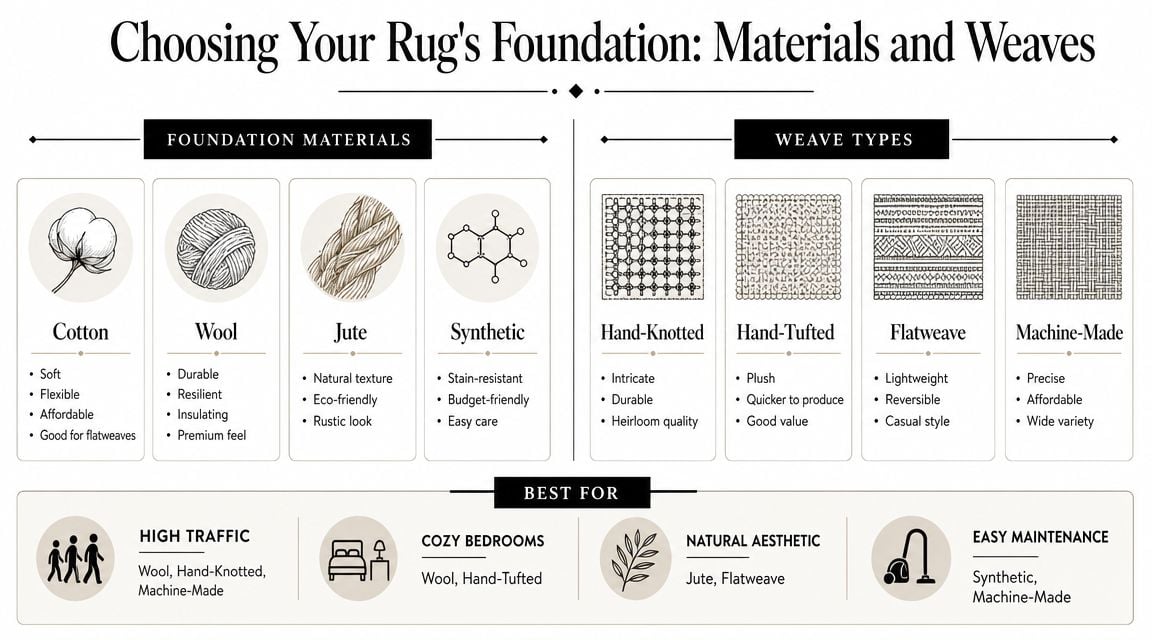
Choosing Your Rug's Foundation Materials and Weaves
The most important decision isn't color. It's fiber and construction.
If you think of outdoor rugs like outerwear, polypropylene is the rain jacket and polyester is the fleece. Both can work. One is built for exposure. The other is often chosen because it feels a little softer and looks rich in color.
Why polypropylene usually wins outdoors
For most outdoor settings, solution-dyed polypropylene, often called olefin, is the strongest technical choice, because the fiber has low moisture uptake. That helps limit mold and mildew, speeds drying, and supports dimensional stability in wet or humid conditions, as explained in Furn's guide to the best outdoor rug materials.
That material advantage shows up in everyday life:
- Rain cleanup stays simple because water tends to stay near the fiber surface instead of soaking deep in.
- Spills are less intimidating because many messes clean up with mild soap and water.
- Sun exposure is less punishing when the rug is solution-dyed, since color runs through the yarn rather than sitting only on the surface.
If your patio is uncovered, if kids run in from the yard, or if the rug is going near a pool, polypropylene usually makes the most sense.
Practical rule: If the rug will live in open weather, start with solution-dyed polypropylene and only talk yourself out of it if you have a very specific design reason.
Where polyester fits better
Polyester has a place. It often delivers a softer hand and strong color clarity, which makes it appealing in covered outdoor rooms where comfort matters more than weather punishment.
The trade-off is moisture handling. Polyester can be a good option under a roof, on a screened porch, or in a protected sitting area. It's less convincing in a fully exposed space where the rug gets repeated wetting, long dry heat, and dust packed into the fibers.
Why weave matters as much as fiber
Even a good fiber can disappoint in the wrong construction. Chairish recommends low-pile, flatwoven construction for outdoor use because it improves drainage, shortens dry time, and traps less debris, which lowers odor and mildew risk and makes maintenance easier, especially for polypropylene rugs that are easy to hose off, as noted in Chairish's outdoor rug guide.
A quick way to read product descriptions like a pro:
| Construction | What it does well | What to avoid |
|---|---|---|
| Flatweave | Dries faster, cleans easier, handles traffic well | Won't feel plush |
| Low-pile power-loomed | Still practical, a bit more softness | Can hold more dust than a flatter weave |
| Higher pile or textured loop | Better for softness in protected spaces | Holds debris and moisture longer |
What works and what doesn't
Some outdoor rugs fail because shoppers buy them like indoor rugs with a tougher label. That usually leads to frustration.
What works:
- Tight, low construction that sheds dust and dries quickly
- Synthetic or recycled performance fibers
- Simple cleaning requirements you'll keep up with
What doesn't work:
- Deep pile in exposed weather
- Natural-fiber looks in wet areas
- A soft feel as the top buying priority on an uncovered patio
The best outdoor rugs earn their keep by making your life easier, not by asking for extra protection every weekend.
Built to Last Rugs for the West Texas and SE New Mexico Climate
A rug that performs in a mild climate can struggle here. West Texas and Southeastern New Mexico ask more of every outdoor material. Sun fades weak color. Wind drives dust into open weave. Then a sudden storm tests how fast a rug can drain and dry.
That's why local climate should narrow your choices quickly.
What our climate punishes first
The first failure point is usually UV exposure. A rug might still be structurally sound, but if the color washes out early, the whole patio starts to look tired. In places with hard sun, UV resistance isn't a bonus feature. It's part of basic durability.
The second issue is texture. Dust gets everywhere in this region, so shaggy surfaces and looser constructions become a maintenance project. A flatter, tighter weave gives dirt fewer places to hide and makes sweeping or hosing far more realistic.
A good outdoor rug for this region should look easy to own before you buy it. If you can already imagine dirt packed into the surface, keep shopping.
What tends to last better here
Jaipur Living notes that outdoor rugs typically last five to seven years with proper placement and care, while also emphasizing that climate plays a major role. The same guide points out that UV resistance is critical in high-sun markets and that tightly woven, close-knit constructions that repel water and dry quickly are important where moisture is part of the picture, as explained in Jaipur Living's outdoor rug guide.
That lines up with what works on patios from Lubbock to Hobbs to Ruidoso Downs:
- Solution-dyed polypropylene for open exposure
- Flatwoven or close-knit surfaces for easier dust removal
- Tighter construction where summer storms can leave standing moisture
- Patterns with some movement so every footprint doesn't announce itself
If you're planning the whole patio, it helps to look beyond the rug too. Hardscape color, shade structures, and plant placement all affect how the rug reads visually and how much exposure it takes. For ideas that pair well with high-sun outdoor spaces, you can browse Northern Arizona landscaping inspiration, especially if you're trying to create a cohesive desert-friendly look.
The local trade-off most shoppers miss
A very soft rug can feel inviting in the showroom. On an exposed patio, softness often means more texture, and more texture usually means more cleanup.
In this climate, the smartest choice is often the rug that feels a little more structured than plush. It may not mimic an indoor living room rug under bare feet, but it will stay cleaner-looking, dry faster, and hold its shape better through the season.
The Art of Placement Sizing Your Outdoor Rug Correctly
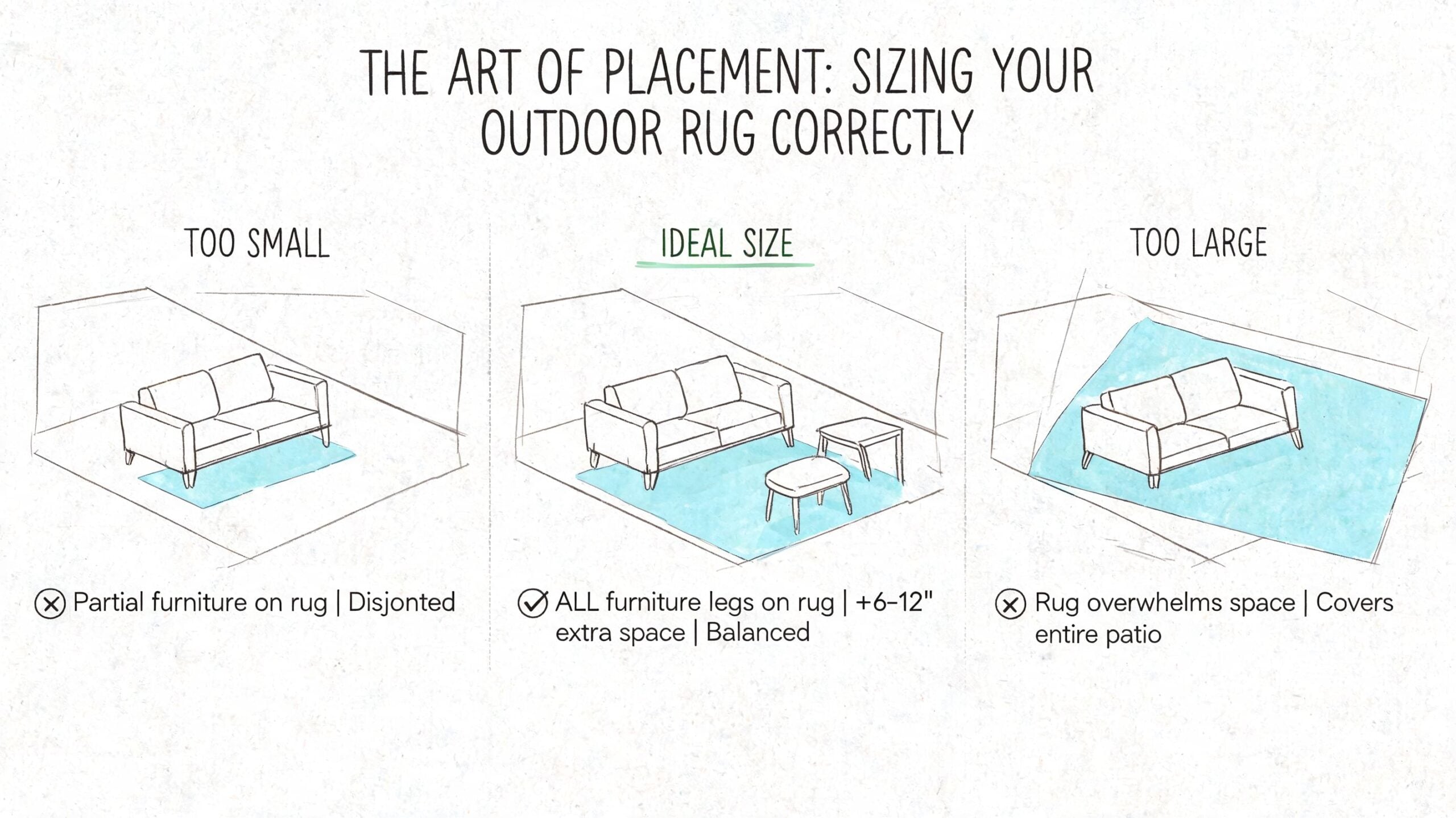
A well-sized rug makes a patio feel finished. A too-small rug makes even good furniture look disconnected. Most sizing mistakes come from choosing a rug that fits the empty space instead of the furniture grouping.
For outdoor rooms, the rug should support how people move through the space. That matters more than centering it perfectly on the slab.
Dining areas need more room than you think
The most common dining mistake is buying a rug that fits under the table but not the chairs. When someone pulls a chair back and its legs catch the rug edge, the whole setup feels awkward.
Use this rule. The rug should be large enough that all dining chairs stay on the rug even when pulled out. If you're working with a four-person table, many shoppers end up more comfortable with an 8×10 than a smaller option, because it gives the chairs room to function instead of just room to exist.
Before ordering, measure carefully. Miller Waldrop's guide on how to measure for an area rug is a practical reference if you want to double-check dimensions before committing.
Conversation areas can be anchored two ways
Lounge groupings are more flexible. Usually, one of these layouts works best:
- All legs on the rug for a larger patio where you want the seating area to feel fully unified
- Front legs on the rug when you need a balanced look without covering too much floor
Both can look right. The decision depends on the size of the patio and the scale of the furniture.
If the furniture feels like it's floating, the rug is too small. If the rug swallows the walking space, it's too big for the zone.
How to handle balconies and narrow patios
Small spaces need restraint. One of the most helpful placement rules comes from AreaRugs, which advises leaving 12 to 18 inches of bare floor around the rug's edges to create a border effect that keeps the area from feeling cramped, as noted in their guide to outdoor rugs for small spaces.
That border matters on apartment balconies, side patios, and long narrow porches. It gives the eye a break and helps the rug define the sitting zone without making the footprint feel crowded.
A few placement choices make compact spaces work harder:
| Space type | Usually works best | Usually feels off |
|---|---|---|
| Narrow patio | Rectangular rug aligned with furniture | Oversized rug edge-to-edge |
| Small balcony | Partial anchor under a chair set | Rug bigger than the seating area needs |
| Conversation corner | Front legs on with visible border | Tiny rug under only the coffee table |
Round rugs can work under a bistro set or in a tucked-away corner, but rectangular rugs are often easier to place well. They create clearer lines and usually make compact outdoor spaces look more intentional.
Defining Your Outdoor Style with Color and Pattern
A patio can feel finished on paper and still look unsettled once the furniture is in place. The rug usually decides that final layer. It can quiet a busy mix of materials, or it can bring needed color to a seating area that feels flat.
Decide whether the rug should lead or support
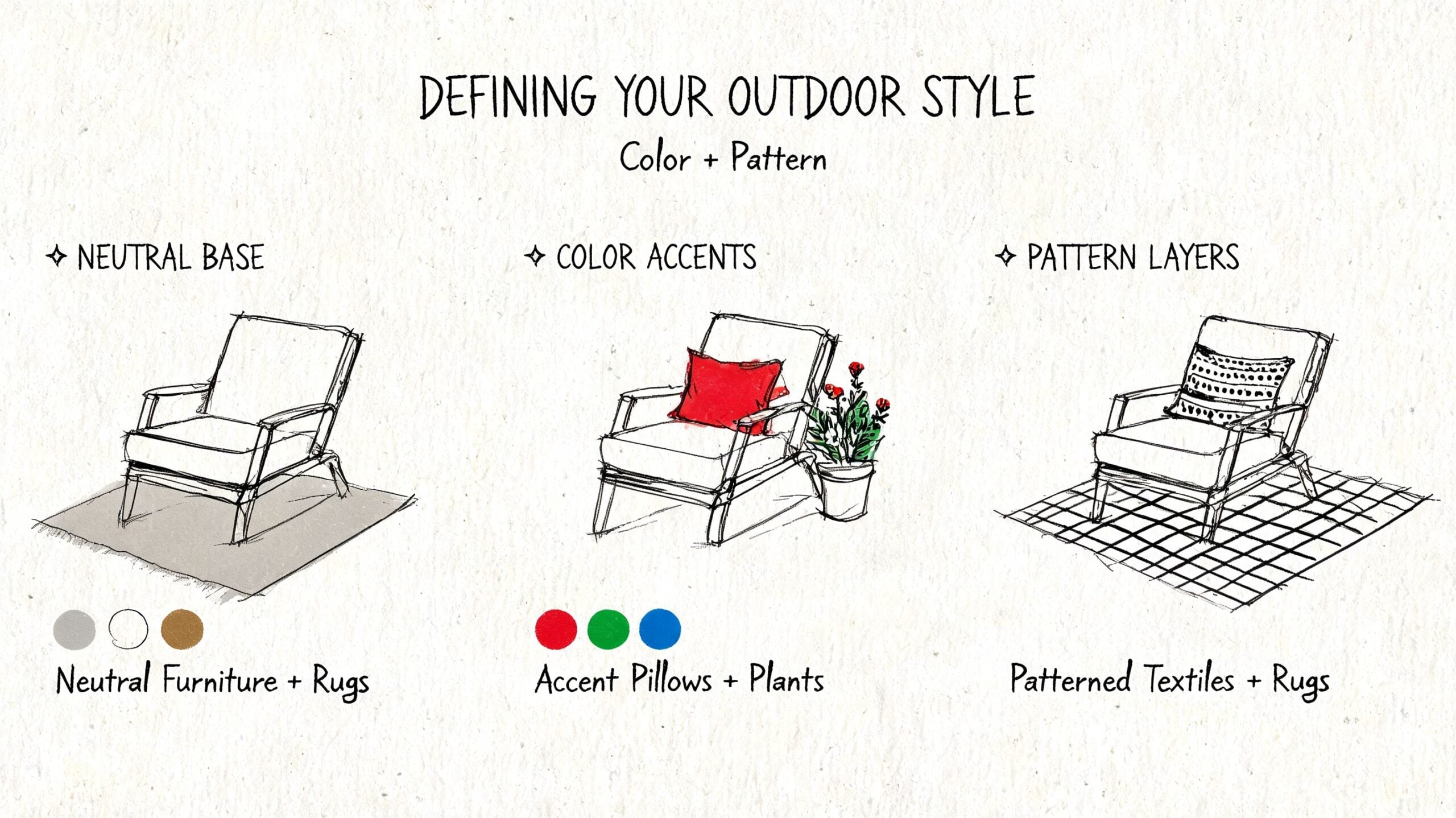
Start by judging what already has visual weight. A wrought-iron dining set, bold cushions, or patterned tile usually calls for a quieter rug. Simple furniture with clean lines can handle more movement underfoot, whether that comes from a stripe, a geometric, or a soft medallion pattern.
I tell clients to make one element do the talking. If the rug carries the color story, let the rest of the space stay disciplined. If the furniture and accents already have character, choose a rug that settles the area instead of competing with it.
Two approaches work well:
- Neutral foundation with color added through pillows, pottery, and planters
- Statement rug that gives a restrained seating group more personality
What holds its look better in West Texas and Southeastern New Mexico
Our region is hard on pretty things. Windblown dust, strong sun, and day-to-day traffic can make the wrong color choice look worn long before the rug is worn out.
Mid-tone colors and patterns with variation usually age better here. They hide the dust that shows up between cleanings and soften the appearance of footprints, pet traffic, and grit tracked in from the yard. Warm gray, sand, faded blue, rust, and mixed ivory tones tend to be forgiving without looking dull.
Very dark rugs often show every bit of dust. Very light rugs can start to look tired in exposed areas, especially near grilling zones, back doors, and high-traffic seating groups.
Pattern has a job outdoors. It helps the space stay presentable between cleanings.
Tie the patio to the house
The best-looking outdoor rooms feel connected to the home's interior style. A Spanish or Tuscan-influenced home usually looks right with earthy colors, softened patterns, and texture that feels grounded. A more contemporary home often benefits from cleaner stripes or simple geometric designs.
For homeowners drawn to old-world warmth, Miller Waldrop's guide to Tuscan-style decorating ideas for layered, earthy spaces offers direction that carries outside naturally, especially with terracotta tones, wrought-look details, and warm neutrals.
A good outdoor rug should look like it belongs to your home and your climate. In West Texas and Southeastern New Mexico, that usually means choosing color and pattern with the same care you gave the material.
Keeping Your Rug Beautiful Maintenance and Cleaning Tips
A patio rug in West Texas or Southeastern New Mexico can look tired fast if dust, caliche, sprinkler residue, and windblown grit are allowed to sit. The good news is that outdoor rug care is usually simple. The right routine keeps the rug looking clean without turning maintenance into a weekend project.
Low-profile outdoor rugs are easier to live with because debris stays closer to the surface instead of settling deep into the weave. That means faster sweeping, quicker rinsing, and fewer problems after summer storms or a stretch of windy days.
Routine care that fits real outdoor living
For many households, regular care comes down to a few basic habits:
- Sweep or shake out loose dirt before it gets worked into the fibers
- Vacuum with suction only if needed so the rug is cleaned without being pulled or distorted
- Rinse with a hose when dust, pollen, pet mess, or muddy footprints start to build up
- Blot spills promptly and use mild soap and water for spot cleaning when the material allows it
In this climate, frequency matters more than intensity. A quick cleaning every so often is usually better than letting buildup sit for months and trying to scrub everything out at once.
Drying is the part many homeowners miss
Moisture trapped under the rug causes more trouble than the rain itself. Covered patios are especially prone to this because shade slows evaporation, and heavy furniture can pin part of the rug in place.
After rain or a full rinse, straighten the rug and let air reach both sides if possible. If one corner stays damp under a chair leg or dining table, that is often where odor starts first. Full drying protects both the rug and the surface beneath it.
Let the rug dry completely before resetting the furniture.
A seasonal reset helps rugs last longer
A deeper cleaning at the start of spring and again after the heavy-use season pays off in our region. Hose the rug down, wash problem areas with mild soap if needed, and allow it to dry all the way through before laying it flat again. Rotate it if one edge faces stronger sun, catches more foot traffic, or sits closest to the grill.
Homeowners furnishing the whole space should also look at protection plans for the pieces around the rug. Miller Waldrop explains those options clearly on its Guardsman furniture warranty and protection plan page, which is helpful if your patio setup includes upholstered seating, dining pieces, or nearby indoor furnishings that see heavy family use.
Good maintenance is practical, not fussy. If the rug suits the space and the climate, basic care goes a long way.
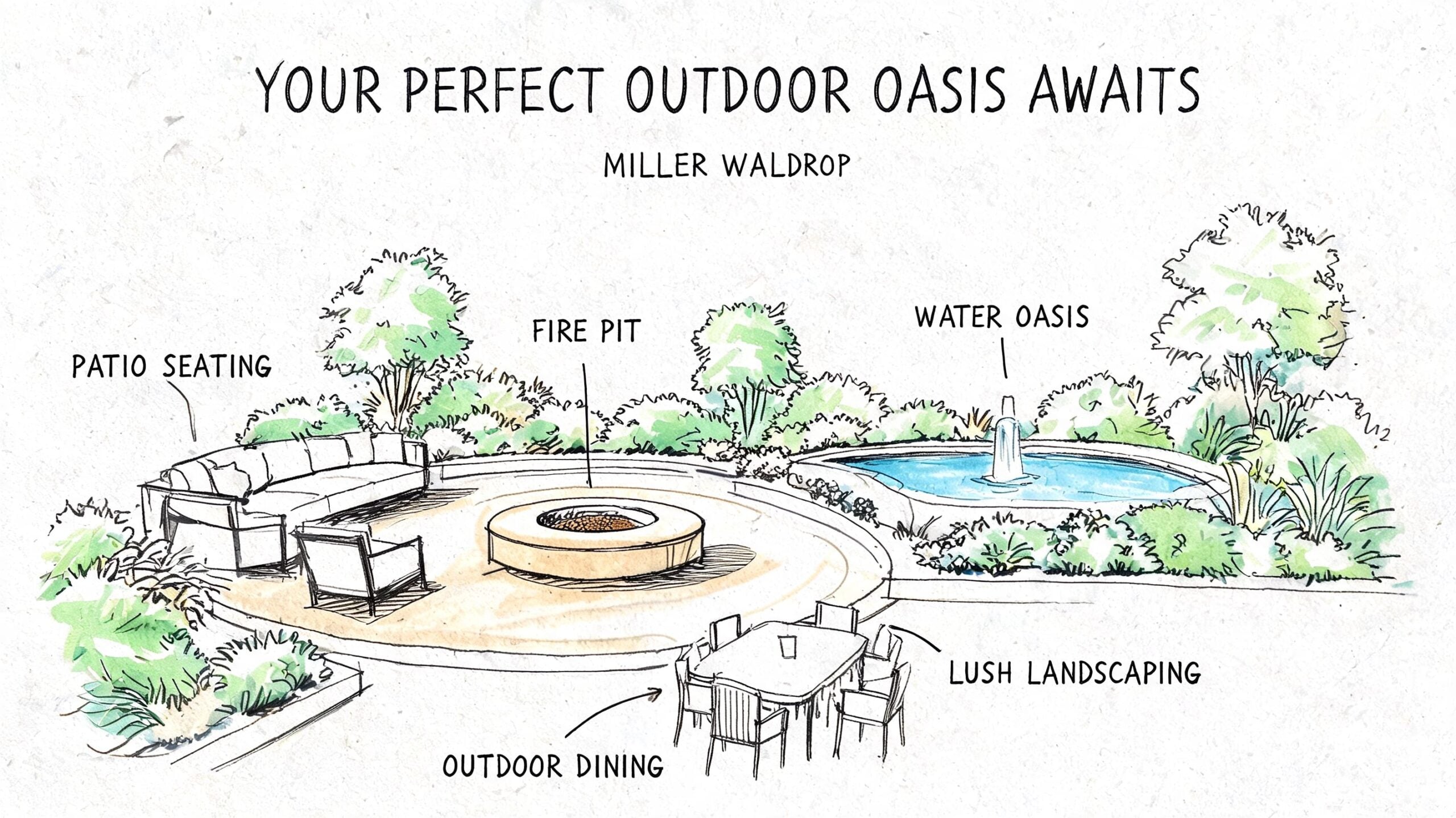
Your Perfect Outdoor Oasis Awaits at Miller Waldrop
Choosing among the best outdoor rugs gets much easier when you narrow the decision in the right order. Start with material. Look hard at construction. Size the rug to the furniture, not just the patio. Then use color and pattern to finish the mood you want.
That process keeps you from overspending on the wrong look or settling for a rug that won't hold up where you live.
A simple checklist before you buy
If you want a rug that works in West Texas or Southeastern New Mexico, check these points first:
- Material comes first and exposed patios usually do best with solution-dyed polypropylene
- Construction should stay low and tight so it dries quickly and cleans without fuss
- Size should follow the furniture layout so chairs and seating feel grounded
- Pattern should support daily living by hiding dust and traffic better than a flat solid
- Placement should match exposure because even strong rugs perform better when they aren't fighting avoidable moisture traps
That's the practical side. The design side is just as important. The right rug softens concrete, brings warmth to a seating group, and makes the patio feel like a real room.
Why seeing rugs in person helps
Outdoor rugs are one category where texture tells the truth. A product description can say “soft,” “durable,” or “flatwoven,” but your hand and your eye will tell you more in a few seconds. You can see whether the pattern is too busy, whether the tone works with your furniture, and whether the weave looks easy to live with.
For shoppers who want to compare options in person, Miller Waldrop's rug selection offers a place to start online before visiting a showroom. That can be especially helpful if you're trying to coordinate a rug with seating, accent tables, or a broader room-to-patio update.
The right help shortens the process
A lot of customers already know what they don't want. They don't want a rug that fades too fast, looks undersized, or feels impossible to clean. Turning that into the right final choice is easier when someone can look at the whole patio with you, including scale, exposure, and style direction.
That kind of guidance matters whether you're furnishing a compact balcony in Hobbs, a family patio in Lubbock, or a mountain retreat space near Ruidoso Downs. The details are different, but the goal is the same. You want an outdoor space that feels finished, functions well, and keeps looking good through real life.
If you're ready to choose an outdoor rug that fits your climate, your layout, and your style, visit Miller Waldrop Furniture & Decor. Bring your patio measurements, a few photos, and the questions you've been sorting through. Their team can help you compare materials, see textures in person, and pull together an outdoor space that feels comfortable, durable, and unmistakably yours.