

Furniture Design Made Simple for West Texas Homes

A homeowner in West Texas can stand in an empty living room with moving boxes stacked against the wall and still feel the room getting complicated. The sofa has to face the television without blocking the walkway. The coffee table needs to work for children, pets, and guests. Afternoon sun can change how upholstery and finishes look, while a room that seemed spacious on paper can feel crowded after delivery.
That situation is the starting point for furniture design. It isn't the search for attractive pieces. It's the process of matching furniture to the room's proportions, climate, light, traffic patterns, comfort needs, and daily routines. The right choices make a home easier to use. The wrong ones create small frustrations that repeat every day.
Furniture design also operates at a substantial business scale. One widely cited industry outlook places the global furniture market at over USD 440 billion, while another estimate places it at USD 786.1 billion in 2025 and projects it to reach USD 1,334.1 billion by 2033 at a 7.0% CAGR. Asia Pacific held 38.5% of global revenue in 2025, a reminder that furniture design connects aesthetics with manufacturing, materials, urbanization, and worldwide consumer demand. For a homeowner, that broad market becomes a much more personal question: which piece will make this particular room work?
Why Furniture Design Matters in Every Room You Live In
The empty living room may look like a blank canvas, but it's a set of practical questions. Where will people walk from the entry to the kitchen? Will children play on the rug? Will a dog jump onto the sofa? Can several friends sit comfortably during a game, or will everyone end up leaning against the walls?
A furniture designer solves those questions through placement, scale, comfort, material selection, and visual balance. A deep sectional may feel inviting in a large open room but overwhelm a smaller ranch home. A tall bed can make a bedroom with a low ceiling feel compressed. A pale sofa may look calm in a showroom yet demand more maintenance in a busy household.
Function comes before decoration
A room's purpose should determine its largest pieces. Living rooms need clear circulation and seating that supports conversation. Bedrooms need restful proportions, accessible storage, and a mattress that fits the sleeper before decorative furniture enters the plan. Dining rooms need enough clearance for chairs, serving, and movement. Home offices need a work surface and chair that support the body through ordinary tasks.
This approach also protects the budget. A homeowner who measures first is less likely to pay for a return, modification, or replacement caused by a poor fit. A homeowner who considers sunlight and household use can choose finishes and fabrics that age more gracefully.
Practical rule: A beautiful piece that interrupts movement or causes discomfort is not successful furniture design.
The room should support the people in it
West Texas and Southeastern New Mexico homes often need furniture to perform several jobs at once. A living room may host family television time, children's activities, weekend visitors, and quiet reading. A dining table may serve meals during the week and paperwork or remote work between gatherings. Furniture that adapts to those patterns provides value beyond its appearance.
Intentional choices also shape mood. Rounded forms can soften a hard-lined room. Wood can add warmth to a space with tile floors. Open shelving can make a compact room feel lighter, while closed storage can reduce visual noise.
Furniture design is therefore a form of everyday problem-solving. It connects the way a room looks with the way residents move, rest, work, host, clean, and live in it.
The Core Elements of Furniture Design Explained Simply
Furniture design balances several decisions at once. The most useful vocabulary includes form, function, materials, ergonomics, and proportion. Each term describes a different way a piece either supports or frustrates the people using it.
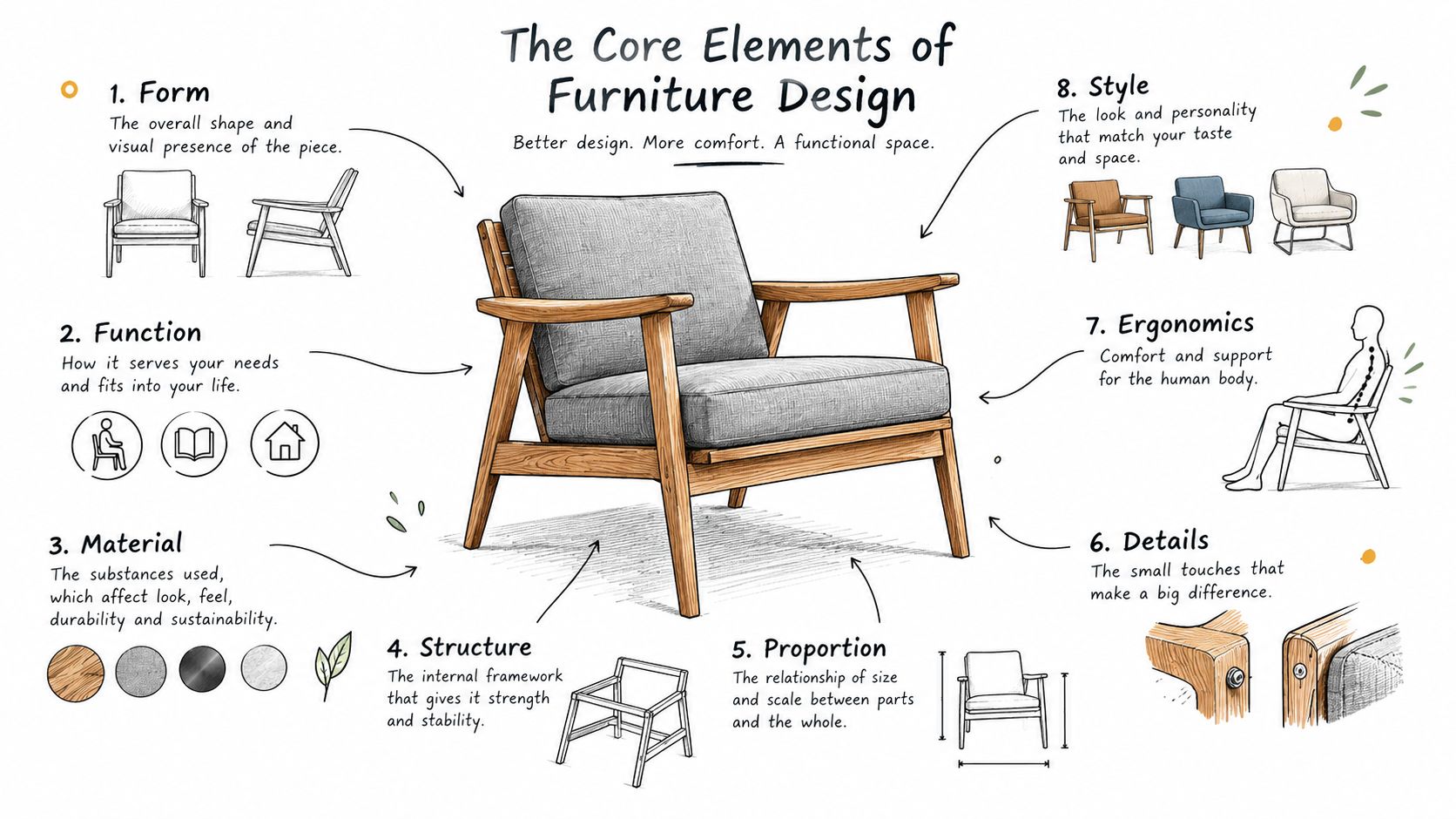
Form gives the piece its identity
Form is the visible shape and silhouette. A chair with a high back feels different from one with a low, open profile, even before anyone sits down. Form works like posture in a person. A relaxed posture suggests informality, while a straight, structured posture feels more formal.
Form includes curves, edges, leg shapes, back height, arm width, and the relationship between solid and open areas. In a West Texas living room, a substantial form can anchor a large space, while a lighter profile may help a compact room feel less crowded.
Function defines the job
A table needs to hold objects at a usable height. A media cabinet needs to support equipment, manage storage, and fit the wall. A bedroom chest needs drawers that open fully without colliding with nearby furniture.
Function is similar to a tool in a drawer. A tool earns its place by solving a task efficiently. Furniture does the same through storage, seating, sleeping, eating, working, or dividing space.
Materials determine how a piece ages
Materials influence touch, maintenance, repair, and appearance over time. Solid wood may develop character as it ages. Upholstery can feel soft and inviting but may need careful fabric selection in a home with pets. Metal can create a crisp visual accent, although its performance depends on its construction and finish.
Materials aren't only a style decision. They're part of the ownership experience.
Ergonomics connects furniture to the body
Ergonomics asks whether furniture fits the user rather than forcing the user to adapt to it. ISO 26800:2011 defines ergonomics around fitting the task, environment, and users' physical characteristics, while office specifications commonly reference ISO 9241-5:2024, ANSI/HFES 100, and BIFMA G1 (ergonomic design guidance).
Practical examples include adjustable seat height, lumbar support, reachable controls, and a work surface that allows comfortable posture. Guidance commonly frames accommodation from the 5th percentile female to the 95th percentile male, covering roughly 90% of users (ergonomic design guidance).
Proportion keeps the room in balance
Proportion describes how a piece relates to the room and nearby objects. A large sectional beside a small table can look unbalanced and function poorly. A narrow nightstand next to a broad bed may lack useful surface area.
A chair can be attractive, well built, and perfectly finished, yet fail if it's uncomfortable or oversized for the room. Furniture design succeeds when all of these elements support one another.
Major Furniture Styles and How to Tell Them Apart
Style becomes easier to identify when shoppers look past color and ask how a piece is shaped, built, and finished. A showroom may contain blended styles, but the following comparison gives each family a recognizable starting point.
| Style | Defining Features | Easy Visual Cue |
|---|---|---|
| Traditional | Symmetry, formal details, dark or rich woods, shaped arms | Turned legs, carved details, patterned upholstery |
| Modern | Clean lines, restrained ornament, exposed legs, purposeful geometry | Straight profiles, open bases, simple hardware |
| Transitional | Classic proportions combined with simpler detailing | Familiar silhouettes with quieter finishes |
| Farmhouse | Practical shapes, painted finishes, approachable materials | Plank-like surfaces, simple hardware, relaxed upholstery |
| Rustic | Raw wood character, visible texture, hand-hewn appearance | Knots, irregular edges, distressed or natural finishes |
| Contemporary | Current shapes, mixed materials, evolving color and form | Sculptural profiles, contrasting textures, unusual bases |
Read the details, not just the label
Traditional furniture often reveals itself through symmetry and decorative legs. Modern pieces tend to show more open space beneath the frame and fewer ornamental details. Transitional furniture can bridge both rooms, making it useful when existing pieces come from different periods.
Farmhouse and rustic styles are sometimes confused. Farmhouse usually appears more intentionally finished and practical, often with painted surfaces or straightforward silhouettes. Rustic design emphasizes the character of the material itself, such as visible grain, knots, and irregular texture.
Contemporary style changes more quickly because it reflects current shapes and combinations. A contemporary sofa may use a sculptural curve, an unusual leg, or mixed upholstery materials. Those features can be compelling, but they deserve evaluation for comfort and long-term flexibility.
For shoppers considering media furniture, a clear modern TV cabinet guide can help clarify how storage, screen placement, cable management, and clean-lined form work together. The same principle applies throughout the room: style should reinforce the job of the furniture.
Most homes don't need one pure style. A transitional sofa can sit with rustic wood, or modern storage can balance traditional seating. Before browsing, readers can name two style families they're drawn to, then use the comparison in how to mix furniture styles to create a coherent combination rather than collecting unrelated pieces.
Materials and Construction That Make Furniture Last
Furniture that lasts depends on what happens beneath the finish. Visual inspection can reveal scratches, uneven seams, or loose hardware, but standardized testing examines whether a piece can handle repeated use. Methods including ISO 7173:2023, EN 1728, ANSI/BIFMA X5.1, and ANSI/BIFMA X5.4 apply static loads, cyclic loading, and impact-type tests to components such as seats, backs, arms, and legs (furniture durability testing).
Those tests matter because fatigue often begins at joints, fasteners, welded connections, or bonded areas. A chair can survive a brief load and still weaken under repeated sitting if its joints lack reinforcement or its frame lacks stiffness.
| Material | Typical Lifespan | Repairability | Climate Suitability in West Texas and New Mexico | Price Tier |
|---|---|---|---|---|
| Solid hardwood | Long when properly constructed and maintained | High | Strong, with attention to seasonal movement and finish care | Higher |
| Plywood | Long when well sealed and correctly assembled | Moderate to high | Strong for many structural applications | Mid to higher |
| MDF | Moderate, especially when protected from moisture | Moderate | Suitable for dry interiors and sealed surfaces | Mid |
| Particleboard | Variable, with vulnerability at fasteners and moisture exposure | Limited | Best in carefully protected, low-moisture applications | Entry |
| Metal | Variable by gauge, welds, coating, and design | Moderate | Suitable when finishes resist wear and corrosion | Mid to higher |
| Upholstery | Variable by fabric, cushion construction, and use | Moderate | Performance depends on sunlight, dust, pets, and cleaning | Mid to higher |
Construction details reveal value
Solid hardwood isn't automatically superior if the joints are weak. Mortise-and-tenon joints and properly fitted dowels can provide strong structural connections. Staples may work for some applications, but a frame that depends on staples where a stronger joint is needed may not tolerate repeated stress as well. Corner blocks, frame thickness, and reinforcement deserve attention.
Upholstery has its own construction language. Suspension may use eight-way hand-tied systems, sinuous springs, or webbing. Each system can perform well when properly designed, but the surrounding frame and attachment points remain critical. Cushion foam, wrapping, and the way the seat is supported all affect whether cushions remain comfortable or develop premature impressions.
Climate changes the questions shoppers should ask
West Texas and Southeastern New Mexico homes can experience intense sunlight, dust, and shifts in indoor conditions. A wood piece needs a finish that supports maintenance and allows the material to perform as intended. Upholstery needs a fabric selected for the household rather than chosen only from a color card.
For painted surfaces and cabinetry, a resource such as best kitchen cabinet paint can help explain why preparation and finish selection matter. Furniture shoppers can apply the same logic by asking about surface preparation, protective coatings, repair options, and care instructions. More practical guidance on expected ownership can be found in how long furniture should last.
Ask at the showroom: What part of this piece is most likely to wear first, and how can that component be repaired or replaced?
Designing Room by Room for Real Life
A styled photograph shows a finished moment. A workable room must support hundreds of ordinary moments, including carrying laundry, opening drawers, navigating around children, and sitting down after a long day.
Living rooms need a movement plan
Start with the sofa, sectional, or primary seating. The television should be visible from the main seats without forcing every chair into a single rigid line. Walkways around major furniture should remain approximately 30 to 36 inches wide for practical movement.
Sofa depth should relate to the room and the people using it. A deep sofa can invite lounging, but it may feel oversized in a lower-ceilinged or compact room. A narrower seat can preserve circulation and make conversation easier. A room with children or pets may benefit from performance-oriented upholstery and tables with softened edges.
A homeowner can bring this checklist to a showroom:
- Measure first: Record wall lengths, door swings, windows, vents, and television location.
- Map movement: Mark the path between entries, kitchen access, seating, and outdoor doors.
- Test the seat: Sit fully back, place both feet comfortably, and check whether the depth supports the intended posture.
The living room layout guide offers a useful planning reference before furniture enters the room. For outdoor areas connected to the living space, an AI outdoor patio design resource can help organize ideas around seating, circulation, and entertaining.
Bedrooms should begin with sleep
The mattress determines the bed's practical height and comfort, so it should be considered before selecting a frame. Nightstands need to sit within easy reach of the bed, with enough surface for lighting, water, and personal items. Storage beds can help smaller ranch homes where closets don't provide enough capacity, but drawers require clearance to open fully.
A bedroom checklist includes:
- Begin with the sleeper: Choose the mattress and support needs before decorative pieces.
- Check reach zones: Confirm that nightstand height and drawer access work from bed.
- Control visual noise: Use closed storage where clothing and personal items would otherwise crowd the room.
Dining rooms require clearance and resilience
A dining table should support ordinary meals and occasional gatherings. Allow approximately 90 cm, or 36 inches, behind each chair for pulling out the chair and moving around the table. Leaf extensions can expand capacity for holidays without requiring a large everyday footprint.
Finishes matter in family dining areas. A surface should tolerate spills, sticky fingers, and regular cleaning without making every meal feel risky. Shoppers should ask how the finish should be cleaned and whether future touch-ups are possible.
Offices must fit the worker
A home office chair should provide lumbar support and adjustable arms when those features suit the user. Desk depth should accommodate the monitor, keyboard, writing space, and the user's preferred viewing distance without pushing the chair into a walkway. Cable management keeps the workspace safer and visually calmer.
The office checklist is straightforward: adjustability, reach, screen placement, legroom, and power access. Furniture that supports the body and the task will usually remain useful longer than a desk chosen only for its appearance.
2026 Furniture Trends Worth Following and a Few to Skip
Trend coverage for 2026 emphasizes longevity, craftsmanship, sculptural forms, rich woods, tactile finishes, modularity, and comfort. Those directions can serve real homes, but only when shoppers separate lasting design improvements from novelty.
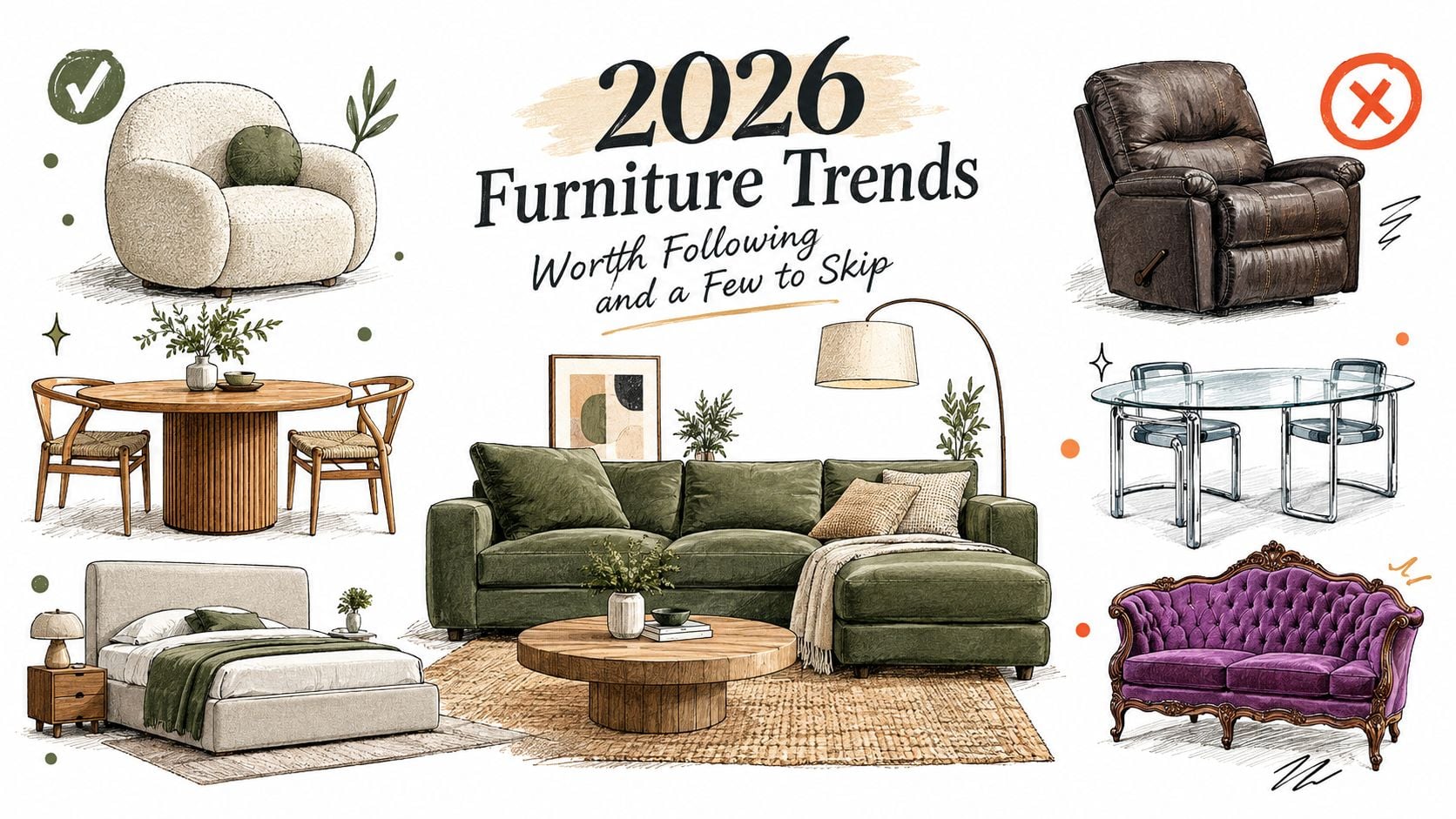
Trends that solve practical problems
Curved silhouettes deserve consideration. Softer edges can make a busy room feel calmer and reduce the sharp corners that create problems in active households. The curve should still provide proper support and fit the room's scale.
Tactile upholstery can add warmth. Bouclé, performance velvet, and other textured fabrics create visual depth. In dusty areas or homes with shedding pets, the useful question isn't whether a fabric is fashionable. It's whether the weave, treatment, and cleaning instructions suit the household.
Modular seating earns its place. A sectional that can be rearranged may adapt as a family grows, a room changes purpose, or a homeowner moves. Modular furniture can also reduce replacement churn when only one component needs to change.
Sleep-focused bedrooms are a strong direction. Cooling materials, blackout layering, supportive mattresses, adjustable bases, and restrained nightstands prioritize rest over display. Trend reporting also points toward comfort-first and data-driven comfort design.
Trends that need a durability test
Ultra-thin metal legs can look light and elegant, but they deserve testing on uneven tile or floors that receive heavy daily traffic. High-gloss lacquer shows scratches and fingerprints more readily than forgiving matte or textured finishes. Fast-fashion accent chairs built around staples rather than stronger joinery can become expensive replacements.
The best trend is the one that improves daily use while remaining repairable and adaptable. Curves, texture, modularity, and sleep support pass that test when construction, scale, and care requirements also make sense.
Putting It All Together with Curated Local Help
A practical furniture design decision can follow four steps:
- Define the room's job. Decide whether the space prioritizes conversation, television, sleep, meals, work, storage, or several functions at once.
- Set a realistic budget. Reserve more attention for pieces that carry daily loads, such as sofas, beds, dining tables, and office chairs.
- Choose one or two style families. Use the comparison above to identify a direction without forcing the home into one pure category.
- Test construction and comfort. Sit in the piece, inspect joints and hardware, ask about fabrics and finishes, and consider how sunlight, dust, pets, and children will affect care.
A curated local showroom can turn those decisions into a manageable selection of collections instead of an overwhelming room full of possibilities. For households in Lubbock, Hobbs, Ruidoso Downs, and nearby communities, local guidance can also account for delivery logistics, room measurements, custom fabrics, finishes, and configurations. Miller Waldrop Furniture & Decor offers curated furnishings, design assistance, custom-order support, and mattress expertise that can help translate a room plan into usable pieces.
Before a visit, shoppers should bring room dimensions, doorway measurements, photos taken in daylight, and a short list of priorities. A consultation becomes much more productive when the household arrives ready to discuss function, comfort, construction, and style together.
Miller Waldrop Furniture & Decor offers curated living room, bedroom, dining, home office, and mattress selections, along with design guidance for fabrics, finishes, configurations, and room planning. Visit Miller Waldrop Furniture & Decor with room measurements and photos to begin choosing furniture that fits the way a West Texas or Southeastern New Mexico home is lived in.