

How to Plan a Room Layout Like an Interior Designer


Before you move a single piece of furniture or start browsing for that perfect sofa, you hold the power to create a truly functional and beautiful space. A great room layout doesn't happen by accident. It’s built on two simple but crucial foundations: accurate measurements and a clear vision for how you want to live in the space.
Getting this right from the start is the key to creating a room that not just looks good but truly feels right and functions for you and your family. You are the hero of your home's story, and this plan is your first step to victory.
Start with Your Space and a Clear Purpose
Think of your room's layout as its job description. What is its main role? Is this living room meant to be a bustling hub for family movie nights, a quiet retreat for reading and conversation, or a flexible space that needs to do a bit of everything? Answering this question honestly is your guide for every decision that follows, empowering you to choose the right tools for the job.
Measure Twice, Furnish Once
Let's get practical. Your first heroic task is to measure everything—and I mean everything. You are creating a detailed map of your space, noting every feature that will influence where your future furniture can (and can't) go. This isn't just a chore; it's the professional-grade first step to mastering your domain.
Before you start planning, you need a complete picture of your room's dimensions. Here’s a quick checklist of the measurements you absolutely can't skip.
Essential Room Measurement Checklist
| Measurement | Why It Matters | Pro Tip |
|---|---|---|
| Room Dimensions (L x W) | This is your foundational canvas. It determines the overall scale of furniture you can consider. | Measure wall-to-wall in at least two different spots to account for any irregularities. |
| Windows & Doors | Informs furniture placement to avoid blocking light, views, or entryways. | Note which way doors swing! A door that swings inward can completely change your layout plans for that wall. |
| Permanent Fixtures | Fireplaces, built-ins, and radiators are immovable objects you must design around. | Measure their exact location, including their distance from the nearest corner and how far they jut out from the wall. |
| Ceiling Height | Crucial for selecting properly scaled tall furniture (like bookcases) and statement light fixtures. | A standard ceiling is 8 feet, but don't assume. Knowing the exact height helps you create vertical interest. |
Taking these measurements seriously is the most powerful thing you can do for your own home. It’s the strategy that prevents costly mistakes and future frustration.
Since our founding in 1952, we've seen countless design trends come and go, but the need for a solid plan has never changed. It all starts with those precise measurements. For instance, you should always allow a minimum of 32-36 inches of clearance for major walkways and doorways. In fact, we've found that a well-executed floor plan can reduce furniture returns by an incredible 40-50%. It’s proof that a little planning saves a lot of hassle.
Define Your Room’s Primary Mission
With your measurements in hand, it’s time to get clear on the room's purpose. This isn’t just about what you'll do in the room, but how you want to feel. To make the space truly your own, think about how you can style a living room that feels like you, blending your personal taste with everyday comfort.
A room without a clear purpose often becomes a room without a point of view. It collects mismatched items and lacks a sense of cohesion because it hasn't been given a job to do.
This simple graphic breaks down the first steps of any good room plan: measure the space, define its function, and then map out specific zones for different activities.
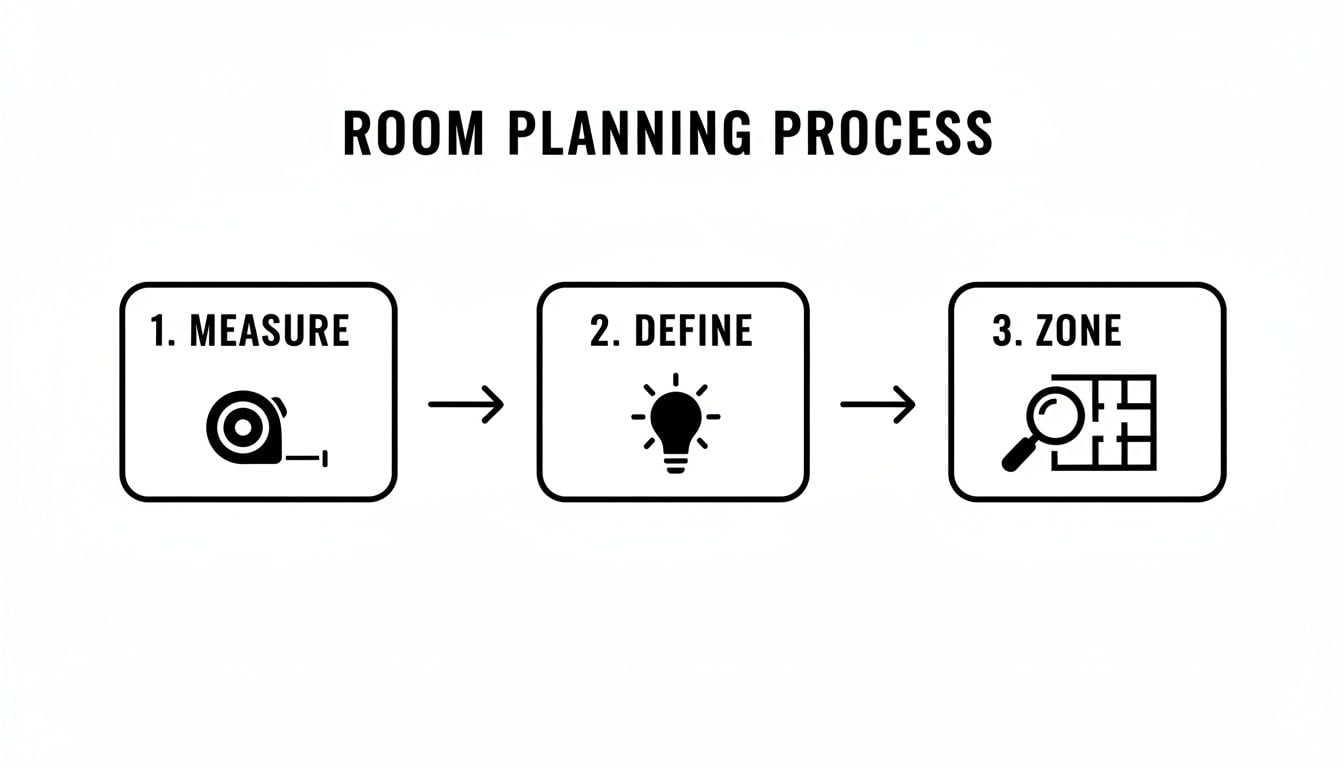
Following this order ensures your final layout is grounded in the reality of your space and the real needs of your household.
Create Your Activity Zones
The truth is, most rooms wear multiple hats. By creating "zones," you can assign specific activities to different areas, making the whole space more functional. A large living room, for example, might be broken down into:
- A conversation zone with a sofa and armchairs arranged to encourage interaction.
- A media zone with seating oriented toward the television for comfortable viewing.
- A quiet reading nook tucked into a corner with a comfy chair and a good lamp.
This idea is even more powerful in smaller rooms where every square inch counts. We explore this further in our guide to furniture design for small spaces. Zoning helps you make the most of what you have and ensures your layout actively supports your daily life, rather than getting in the way of it.
Get the Flow Right: Pathways and Focal Points
You know that feeling when you walk into a room and it just feels… off? Even a big room can feel cramped and awkward if you find yourself weaving around furniture just to get from one side to the other. The problem isn't the size of the room; it's the traffic flow.
Think of your room as having invisible hallways that guide you through the space. A great layout carves out clear, comfortable paths that make moving around feel completely natural. This is the secret to a room that’s not just beautiful, but truly livable.
Carving Out Your Pathways
This is where your tape measure really earns its keep. For any main walkway—like the path from a doorway to the sofa, or from one end of the room to the other—you need to leave at least 30 to 36 inches of clear space. This isn't some arbitrary number; it's the real-world clearance needed to walk comfortably without turning sideways or bumping into things.
For smaller, secondary paths, like the space between your sofa and the coffee table, you can get away with a bit less. Aim for 14 to 18 inches here—just enough to access seating easily without the table feeling like it's miles away.
- Protect the main arteries. Any path that leads to an exit or connects two busy areas needs to be wide and totally clear.
- Don't create bottlenecks. Watch out for sharp corners or furniture arrangements that force everyone to squeeze through one tiny spot.
- Think about daily use. Where will you walk with a load of laundry? How will guests get to their seats? Plan for real life.
Finding (or Creating) Your Focal Point
With your pathways mapped out, it's time to find the room's star player: the focal point. This is the one thing your eye is naturally drawn to when you enter. It anchors the entire design and gives the space a clear sense of purpose.
Sometimes, the architecture does the work for you with a built-in feature:
- A beautiful fireplace and mantel.
- A massive picture window with a stunning view.
- A wall of custom bookshelves.
If your room is more of a blank canvas, no problem. You get to create the focal point yourself. A vibrant accent wall, a dramatic piece of art, or a show-stopping piece of furniture can easily command attention and serve as the anchor for your entire layout.
The trick is to choose one dominant feature to be the hero of the room. Your furniture should then play a supporting role, arranged to celebrate that focal point, not compete with it. This is how you create a layout that feels intentional and balanced.
Let Your Furniture Serve the Focal Point
Once you know your focal point, arranging the furniture becomes much simpler. It’s no longer about just filling space; it's about creating a conversation around that central feature. Your main seating should always be oriented toward it.
For a living room centered on a fireplace, you might place a sofa directly across from it, with a pair of armchairs on either side to form a cozy, U-shaped gathering spot. If your focal point is the TV, here's how you can select the perfect entertainment center to serve as the anchor you build around, ensuring every seat has a great view.
By directing your furniture toward a single, powerful element, you bring an immediate sense of order and harmony to the space. It’s what makes a room feel both professionally designed and perfectly natural.
When you're ready to find that perfect piece to complete your vision, we're here to help. Bring your floor plan and measurements into our showrooms in Lubbock, Hobbs, or Ruidoso Downs, and our design experts will help you put it all together.
Choosing and Placing Your Furniture with Confidence
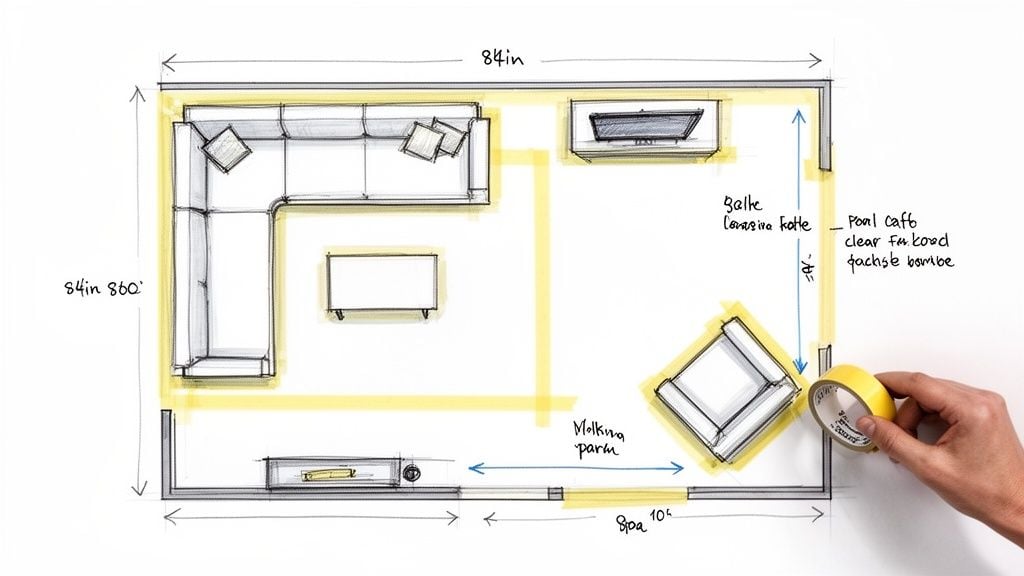
Now for the fun part. After all the measuring and mapping, this is where you bring the room to life. With your floor plan in hand, you can finally start selecting the furniture that will define your space—not with guesswork, but with genuine confidence.
This isn't just about filling an empty room. It's about choosing pieces that perfectly fit the scale of your space and, more importantly, the way you actually live.
The Pro Trick for Visualizing Furniture in Your Space
Here’s a secret weapon that designers have been using for years: painter’s tape. Before you even think about buying a sofa or coffee table, grab a roll and tape out its exact dimensions right on your floor.
This simple act is incredibly powerful. It lets you physically walk around the "furniture" and get a gut feeling for its scale. You’ll know instantly if a walkway is too narrow or if that dream coffee table will completely overpower the room. It’s the closest you can get to test-driving a layout without moving a single heavy object.
Key Spacing Guidelines for a Livable Layout
A room that feels right just flows. That effortless feeling isn't an accident; it's the result of smart spacing. These aren't rigid rules carved in stone, but they are time-tested guidelines that make a room comfortable and functional.
- Sofa to Coffee Table: Leave 14 to 18 inches between your sofa and coffee table. This gives you enough legroom while keeping your drink or the remote within easy reach.
- Conversation Distance: Arrange chairs and sofas that face each other no more than 8 feet apart. Any farther, and you'll find yourselves having to shout across the room to hold a conversation.
- Side Table Placement: An end table should be right next to the arm of a sofa or chair, just an inch or two away. For height, aim for it to be level with or just slightly below the height of the armrest.
Designer Takeaway: The goal is to create natural gathering spots. Your furniture groupings should feel intimate and self-contained, making it easy for people to connect without feeling closed in.
Here's How You Can Choose the Perfect Sofa for Your Family
The sofa is almost always the anchor of the living room—the biggest investment and the hardest-working piece of furniture. The key is finding one that truly supports your lifestyle, whether that means hosting big family get-togethers or carving out a personal spot to unwind.
Be honest about how you live. Do you need a massive sectional for movie nights with the kids? Or would a single, incredibly comfortable recliner serve you better as your personal escape after a long day?
The right sofa can be a game-changer. For example, a durable and spacious Flexsteel sectional creates an instant hub for a busy family, standing up to years of daily life. When you choose furniture that matches your real-world needs, you set your room up for success.
A Retail Design Secret You Can Use at Home
Ever noticed how some stores are just easier to walk through than others? Many use a "Racetrack Plan" to guide shoppers in a natural loop, a strategy that can increase merchandise exposure by up to 30%. You can dig into the psychology behind this in articles on furniture store design strategies.
You can absolutely apply this logic at home.
For homeowners in West Texas and Southeastern New Mexico, this means placing your largest items—like sofas and sectionals from trusted brands like Flexsteel—along the walls. This opens up a clear pathway through the middle of the room, freeing up 15-20% more walkable space. It’s a simple move that makes any layout feel more spacious and intuitive—a principle we’ve honed over 70+ years of designing homes.
When you’re ready to find that perfect anchor piece, we’re here to help. Bring your measurements and your painter’s-tape-tested plan into our showrooms in Lubbock or Hobbs. Our design experts would love to help you bring it all together.
Defining Your Space with Lighting and Rugs
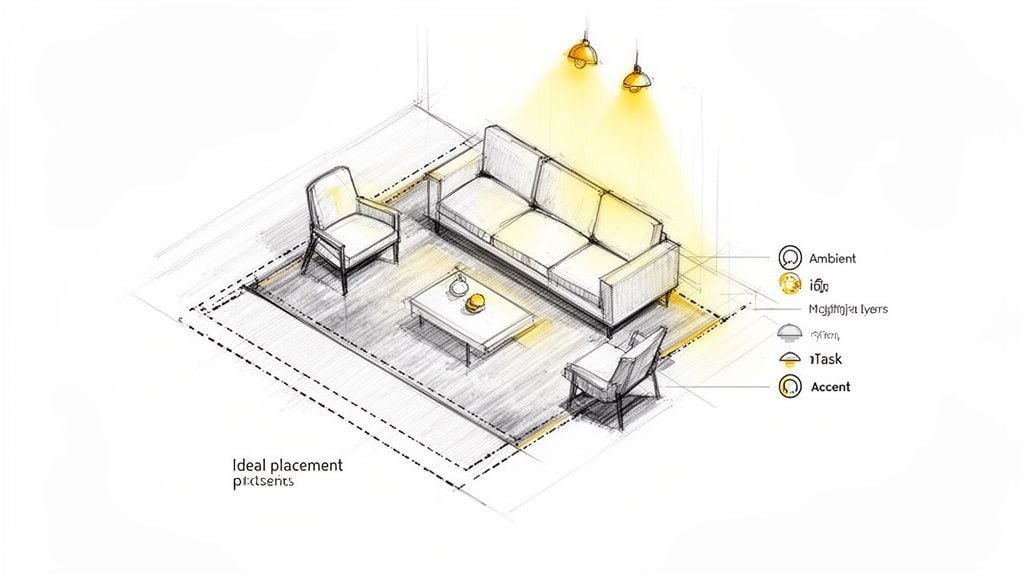
You can have the most thoughtfully placed furniture, but if you stop there, the room will always feel a little incomplete. The real secret to a professionally designed space lies in the final layers: lighting and area rugs. Think of them as the tools that transform a functional floor plan into an inviting, cohesive room.
These elements aren't just decorative. They are powerful tools for defining zones, creating ambiance, and anchoring all the individual pieces into a single, harmonious picture.
Layering Light for Function and Mood
Relying on a single overhead light often leaves a room feeling flat and unwelcoming. Your strategy should be to think in layers, blending three different types of light to build a dynamic and versatile atmosphere that you control.
Ambient Light: This is your room’s general illumination, the foundation of your lighting plan. It’s usually provided by a ceiling fixture, like a chandelier or flush-mount light. Its main job is to fill the space with a soft, uniform glow, making it easy to navigate.
Task Light: Just like it sounds, this is focused light for getting things done. It’s the floor lamp you read by, the pendant over your kitchen island, or the desk lamp in your home office. Task lighting is essential for reducing eye strain and making daily activities more comfortable.
Accent Light: This is where your personality shines. Accent lighting is used to draw attention to the things you love—a beautiful piece of art, an architectural feature, or a display of collectibles. Picture lights and uplights are perfect for this, adding depth and visual interest.
When you combine these three layers, you get total control over the mood. You can switch on everything for a lively get-together, dim the lights for a cozy movie night, or spotlight a single area to create a quiet, relaxing moment.
An expertly lit room feels more spacious and inviting because your eye is drawn around the space, noticing different points of interest. It's a subtle but powerful technique for making your layout feel more intentional and complete.
Using Rugs to Anchor Your Layout
An area rug does so much more than add a pop of color. It's a foundational tool for grounding your furniture and carving out distinct zones within a room. In an open-concept living area, a rug can visually create a "room within a room," clearly defining the conversation area from the dining space.
The single biggest layout mistake to avoid with rugs is choosing one that’s too small. A little rug floating between your furniture pieces makes the whole arrangement feel disconnected and can actually shrink the feel of the room.
For a living room, your rug should be large enough that at least the front legs of the sofa and all the chairs in the grouping are sitting on it. This simple rule instantly creates a unified, grounded space that looks and feels intentional. Getting the scale right is a non-negotiable part of knowing how to plan a room layout that works. For a deeper dive, check out our complete guide on how to measure for an area rug.
Once you have your floor plan nailed down, finding the perfect lighting and the right rug is the next exciting step. This is where our design experts at Miller Waldrop can be your guide. Bring your layout ideas to our showrooms in Lubbock or Hobbs, and we’ll help you find the exact pieces you need to bring your vision to life.
Using Digital Tools for Foolproof Room Planning
Have you ever fallen in love with a dining set or sofa, only to spend days worrying if it will actually fit in your room? That moment of hesitation is completely normal, but you no longer have to rely on guesswork. Digital room planners are the secret weapon that designers and savvy homeowners use to take the stress out of the equation.
These tools let you experiment with your layout risk-free. You can drag and drop furniture, play with different arrangements, and see exactly how your space will function in 2D or 3D before spending a dime. It’s a powerful way to move from "I hope this works" to "I know this works."
Visualize Your Space With Precision
The real benefit of a digital plan is getting an accurate sense of scale and flow. Imagine placing that beautiful Hooker dining set you’ve been eyeing into a virtual model of your dining room. You can instantly see how much clearance you have for chairs and foot traffic—a simple step that prevents so many costly mistakes.
It's no surprise that while 70% of shoppers worry about furniture fit, using these visual tools can cut purchase delays by 50% and even reduce returns by 30-40%. We use this same technology in our design service to show you exactly how a new piece will look and feel in your home before you commit. It’s all about building confidence in your decisions.
Bring Your Digital Plans To Life
Once you’ve settled on a digital layout you love, you can take it a step further. A 2D floor plan is your blueprint, but adding real-world visuals bridges the gap between a simple diagram and the final look. Using photos of the actual furniture you're considering is a fantastic way to do this. We dive deep into this technique in our guide on making smarter buying decisions with online furniture photos.
A digital plan empowers you to become the architect of your own space. It gives you the freedom to test bold ideas, refine your layout, and ensure every piece you choose serves a purpose and fits perfectly.
Advanced Visualization For The Ultimate Preview
For anyone who wants a truly photorealistic glimpse into the future, rendering software is the answer. These advanced programs take your basic floor plan and simulate realistic lighting, shadows, and textures, giving you an incredibly accurate preview of your finished room.
- For the DIY enthusiast, there are many free and accessible options for creating lifelike images of a layout.
- Professionals like us use high-end software to present clients with a detailed and inspiring vision of the final project.
If you’re interested in trying this yourself, you can explore different kinds of free render software for SketchUp to transform your plans into stunningly realistic images.
Think of these tools as your design partners. Whether you're mapping out a simple bedroom refresh or a complex open-concept living area, they provide the clarity you need to move forward. When you’re ready to turn that digital plan into a beautifully furnished reality, we’re here to help. Bring your layout to our showrooms in Lubbock or Hobbs, and let's find the perfect pieces together.
Bringing Your Perfect Room Layout to Life
You’ve done the heavy lifting. All that measuring, sketching, and planning has given you a solid blueprint for a room that truly works for your life. This isn't just a drawing on paper; it's a road map to a space that feels right.
With your plan in hand, you've moved past the guesswork. You now have the confidence of a designer, ready for the most exciting part of the process: finding the pieces that will turn your vision into a comfortable, beautiful reality.
Your Next Step to a Beautiful Home
Now, where do you go from here? Whether you’re on the hunt for one final piece or you’d like a second pair of eyes on your layout, think of us as your partners in this final, crucial stage. Our services and products are the tools you need to win the day.
Here’s how you can make your plan a reality and choose furniture that your family will love for years to come:
- Bring Your Plan to Us: Come into one of our showrooms with your measurements and floor plan. Our design staff can help you find pieces that fit your scale, your style, and your budget perfectly.
- Experience the Quality: A photo can't tell you how comfortable a plush Ashley Furniture sofa really is or let you test the smooth motion of a recliner. Seeing furniture in person is all about confidence in your choice.
- Get an Expert Opinion: Our team lives and breathes this stuff. We can look over your layout, offer practical suggestions you might not have considered, and guide you through our collections to find exactly what you need.
You’ve created the map; now let us help you find the treasure. Your thoughtfully designed plan deserves furniture that is just as considered and well-crafted.
We invite you to visit us in Lubbock or Hobbs to take the next step. Let’s work together to transform your brilliant layout into the welcoming, functional room you and your family deserve.
Putting It All Together: Your Top Layout Questions Answered
Even the most carefully crafted plan can hit a snag. In our experience, a few common questions pop up time and time again as homeowners start moving things around. Let's tackle some of the ones we hear most often in our showrooms.
How Much Space Should I Leave Between Furniture?
This is a big one, and getting it right is the secret to a room that feels comfortable, not cramped. The goal is to create easy-to-navigate pathways.
- Major Walkways: Think about the main routes into and through the room, like from the doorway to the sofa. You'll want to leave 30 to 36 inches of clear space. Anything less and it will feel like you're squeezing through.
- Tighter Gaps: For the space between your coffee table and the sofa, you can get a little closer. Aim for 14 to 18 inches—enough room for your legs, but close enough to easily set down a drink.
What if My Room Is an Awkward Shape?
Oddly shaped rooms can feel like a design challenge, but you can see them as an opportunity. Instead of fighting the architecture, lean into it. The key is to stop thinking of it as one big, awkward space and start seeing it as a collection of smaller, functional zones.
Use a distinct furniture grouping to create a conversation area here, and maybe an area rug and a comfy chair to carve out a reading nook over there. A long, narrow living room might be perfect for a media zone at one end and a small game table at the other. When you give each part of the room a purpose, the "awkwardness" suddenly looks intentional and clever.
How Do I Choose a Focal Point if I Don’t Have One?
Many rooms don't come with a built-in "wow" factor like a fireplace or a stunning view. No problem—you can create your own. A focal point is simply the spot where you want the eye to land first when someone walks in.
A strong focal point gives a room a sense of purpose and direction. By creating one, you provide an anchor for your entire furniture arrangement, making placement decisions much simpler.
This could be a large, dramatic piece of art that sets the room's color palette. It might be an accent wall painted a bold color or covered in beautiful wallpaper. Even a single, impressive piece of furniture, like a stunning media console or an artisan bookshelf, can command attention and give your layout the anchor it needs.
You've done the hard work, and now you have a real plan for creating a space you'll truly love. At Miller Waldrop Furniture & Decor, our passion is helping you bring that vision to life. Bring your floor plans and questions to our showrooms in Lubbock, Hobbs, or Ruidoso. Our design experts are ready to help you find the perfect pieces to complete your layout. You can also explore our collection online at https://www.millerwaldrop.com.