

Best King Size Mattress for the Money: A Buyer’s Guide


You’ve probably done what most king mattress shoppers do first. Open five tabs. Compare three “best mattress” lists. Read reviews that all sound confident, yet somehow leave you less certain than when you started.
One model is called luxury firm. Another is medium-firm. A third promises hotel comfort, cooling, pressure relief, and motion isolation all at once. Then you get to checkout and realize the advertised price may not include setup, haul-away, or the simple reality that a mattress can test well in a lab and still feel wrong under your shoulders, hips, or lower back.
That’s where people in West Texas and Southeastern New Mexico often get stuck. The question isn’t just which bed is cheapest. It’s which one gives you the best king size mattress for the money once you factor in comfort, fit, delivery, durability, and whether you’ll still like it six months from now.
After helping neighbors shop mattresses for years, I can tell you this: the best value usually comes from slowing down and looking at the whole purchase, not just the sticker. A king is a major investment. It affects your sleep, your back, your partner’s sleep, and how your bedroom feels every night.
A quick side-by-side makes that easier.
| What to compare | Why it matters | What a smart shopper looks for |
|---|---|---|
| Initial price | It sets your budget, but it’s only the starting point | Compare price alongside delivery, setup, and extras |
| Mattress type | Construction changes support, cooling, and feel | Match the build to your body and sleep habits |
| Firmness fit | The wrong firmness can ruin a good mattress | Test with your normal sleep position in mind |
| Motion control | Important for couples in a king | Look for foam comfort layers or well-built hybrids |
| Edge support | A king should feel usable corner to corner | Strong edges help you use the full surface |
| Ownership costs | Hidden fees can erase a low online price | Ask about haul-away, setup, and local service |
| Personal fitting | Reviews can’t measure your pressure points | In-person testing removes a lot of guesswork |
Your Guide to Finding True Mattress Value
A lot of shoppers come in thinking they need the mattress with the biggest advertised discount. By the end of the conversation, they usually realize they need a bed that solves a specific problem.
Sometimes it’s a couple sleeping on the edge because the middle sags. Sometimes it’s a hot sleeper who’s tired of waking up in a warm pocket of foam. Sometimes it’s a back sleeper who bought a mattress online that sounded supportive but lets their hips dip too far at night.
That’s why “value” can’t mean price alone. A king mattress is too important, and too expensive, to judge by one number on a screen.
What value really looks like
The best value mattress does four things well:
- Fits your body well enough to support real sleep
- Holds up over time instead of feeling worn too soon
- Includes services that reduce hassle and surprise costs
- Works for both sleepers if you share the bed
A bargain mattress that leaves your shoulders numb or your lower back tight isn’t a bargain. Neither is a premium mattress that sounds impressive on paper but never feels right in your room.
Practical rule: If a mattress only looks like a deal before you add delivery, setup, and removal, it may not be the best deal.
The strongest buyers I meet aren’t the ones who memorize every mattress buzzword. They’re the ones who ask better questions. What supports my spine? What sleeps cooler in our climate? What keeps my partner from feeling every turn? What does this really cost by the time it’s in my bedroom and the old one is gone?
A better way to shop a king
The most reliable approach is simple. First, narrow by construction. Then narrow by firmness. Then test for your own body, not an average sleeper in a review.
That shift matters because king shoppers usually aren’t buying for one person in one position. They’re buying for two adults with different builds, habits, and comfort preferences. National rankings can be useful benchmarks, but they don’t know whether you sleep on your side with shoulder pressure, whether your spouse runs hot, or whether you need stronger edge support for getting in and out of bed.
When you shop that way, the search gets calmer. You stop chasing the “best” mattress on the internet and start finding the best one for your room, your body, and your budget.
How to Define Value Beyond the Price Tag
A king mattress can look affordable online and still cost more than you expected by the time everything is done. That’s why I tell shoppers to think in terms of total cost of ownership, not just list price.
For many buyers in our region, that’s where the value story starts.
Pillar one is total cost of ownership
The true cost includes delivery, setup, old mattress removal, and the convenience of having the bed placed correctly the first time. In West Texas and Southeastern New Mexico, bundled local services can matter more than online markdowns. Regional consumer data cited by NapLab’s mattress roundup notes that bundled services can save shoppers $200-500 per purchase, and 68% of Southwest buyers prioritize these services over pure online discounts.
That’s a major difference in a king purchase.
If you’re comparing two mattresses that seem close in price, ask these questions before you decide:
- What does delivery include. Front-door drop-off is not the same as full setup.
- Who removes the old mattress. If nobody does, you still have a disposal problem.
- Are there local service advantages. A local purchase can reduce friction when something needs attention.
- Will taxes, accessories, or frame needs change the final bill. A “deal” can get expensive fast.
Pillar two is durability
The next part of value is how long the mattress stays comfortable and supportive. A king sees a lot of use, especially for couples. Material quality matters here, but so does construction.
A mattress with weak edge support often starts to feel smaller because you stop trusting the perimeter. A mattress with poor support under the hips can feel comfortable for ten minutes and wrong for eight hours.
When I’m helping someone compare options, I look for practical signs of durability:
| Sign of durability | What it usually tells you |
|---|---|
| Consistent edge support | The mattress is more likely to feel stable across the full width |
| Balanced comfort layers | You get cushioning without losing support |
| Quality coil support in hybrids or innersprings | Better lift, airflow, and long-term structure |
| A feel that matches your weight and sleep style | Less chance of early dissatisfaction |
A mattress doesn’t have to feel hard to be durable. It has to keep you aligned without breaking down where your body needs support most.
Pillar three is warranty clarity
A long warranty sounds reassuring, but shoppers should still ask what it covers. The useful question isn’t “How many years?” It’s “What counts as a defect, and what conditions keep the warranty valid?”
That includes proper support underneath the mattress and basic care. A protector and the right foundation aren’t glamorous topics, but they matter.
Pillar four is how you feel every morning
This is the part people skip because it doesn’t fit neatly in a comparison chart. Yet it’s the most important part of value.
If a mattress helps you fall asleep easier, change positions without fighting the bed, wake up with less stiffness, and share a king without constant motion disturbance, that’s value. If it doesn’t, the sale price doesn’t rescue it.
Choosing Your Mattress Type Innerspring Hybrid or Foam
A lot of confusion disappears once you understand the three main builds. Most king shoppers are really deciding between innerspring, hybrid, and foam, even if brands use different names to dress them up.
The trick is not asking which type is best in the abstract. The better question is which construction solves your sleep problem with the fewest compromises.
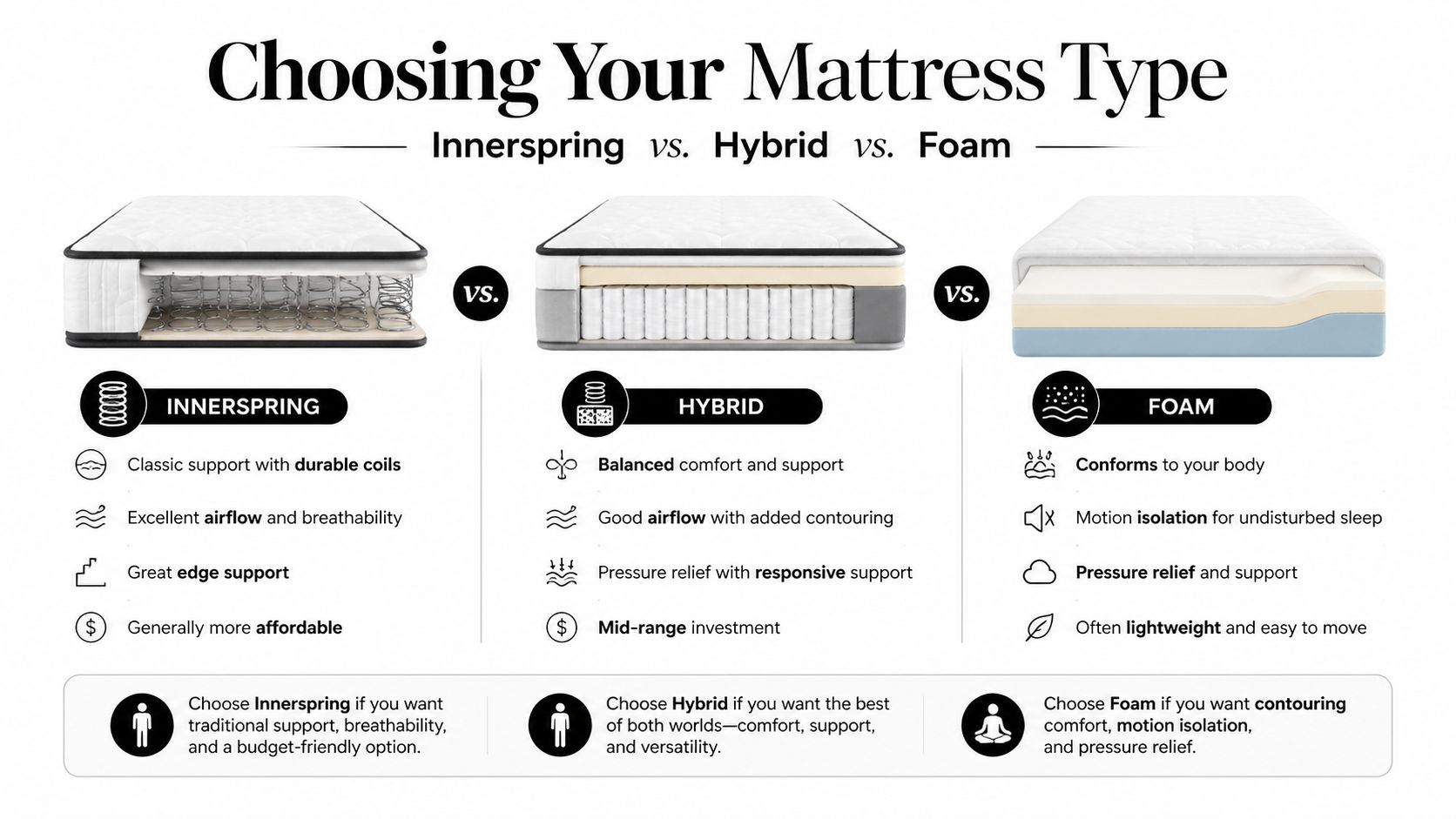
Innerspring feels traditional and breathable
An innerspring is the closest thing to the mattress many people grew up with, though modern versions can feel far more refined. You generally get a lifted, buoyant feel with strong airflow and easier movement across the surface.
That makes innerspring a practical choice for shoppers who:
- Sleep warm and want more airflow through the bed
- Dislike sinking in and prefer to sleep more on top of the mattress
- Want a familiar feel with bounce and straightforward support
- Need easier movement when changing positions or getting out of bed
The trade-off is pressure relief. If you have sensitive shoulders or hips, a basic innerspring may not cushion enough unless it has a thoughtfully built comfort layer on top.
If you want a clean explainer on coil-driven construction, this hybrid and innerspring mattress guide does a good job of laying out the practical differences. For a broader look at how support and contouring compare, this innerspring vs memory foam mattress article is also useful.
Hybrid usually gives the broadest value
For many people shopping for the best king size mattress for the money, hybrid is the sweet spot. A hybrid combines coil support with foam comfort layers, so you get more pressure relief than a basic innerspring without giving up the airflow and structure that many couples want in a king.
That’s why hybrids show up so often in value conversations. They can serve a wide range of sleepers well.
Here’s where they tend to work best:
| Sleeper need | Why hybrid often fits |
|---|---|
| Couples | Better balance of support and motion control |
| Hot sleepers | Coils allow more airflow than many all-foam designs |
| Combination sleepers | Easier repositioning than slower foam beds |
| People wanting one mattress to do many things well | Hybrids often offer the most balanced performance |
Not every hybrid feels the same. Some are foam-forward and softer. Others lean springier and firmer. That’s why “hybrid” is a category, not a comfort guarantee.
Foam specializes in contour and motion control
Foam mattresses appeal to shoppers who want the bed to shape itself more closely around the body. If your shoulder digs in when you sleep on your side, or if you wake up every time your partner turns over, foam can be very appealing.
What foam often does well:
- Pressure relief for shoulders and hips
- Motion isolation for light sleepers sharing a king
- A quieter, less bouncy surface
- A close-contouring feel that many side sleepers love
What foam doesn’t always do well is airflow or ease of movement. Some people feel hugged in a good way. Others feel stuck.
If you roll a lot at night, a mattress that feels cozy for five minutes can feel frustrating by 3 a.m.
What works and what usually doesn’t
I’d sum it up this way.
Innerspring works well when you want breathability, bounce, and a more traditional sleep surface. It usually doesn’t work as well for someone who needs deep contouring.
Hybrid works well when you want a balanced mattress that handles support, cooling, and couple-friendly performance without leaning too far in one direction. It usually disappoints only when a shopper expects every hybrid to feel the same.
Foam works well when pressure relief and motion control are your top priorities. It usually doesn’t work for people who hate sink, sleep very hot, or want a lot of bounce.
The best category is the one that matches the feel you naturally settle into, not the one with the flashiest marketing.
Why Your Sleep Style Determines Your Ideal Firmness
Firmness gets oversimplified all the time. People ask for soft, medium, or firm as if those words mean the same thing across every brand. They don’t. The “right” firmness, however, depends on how your body meets the mattress.
A great king mattress in the wrong firmness can still be a bad purchase.

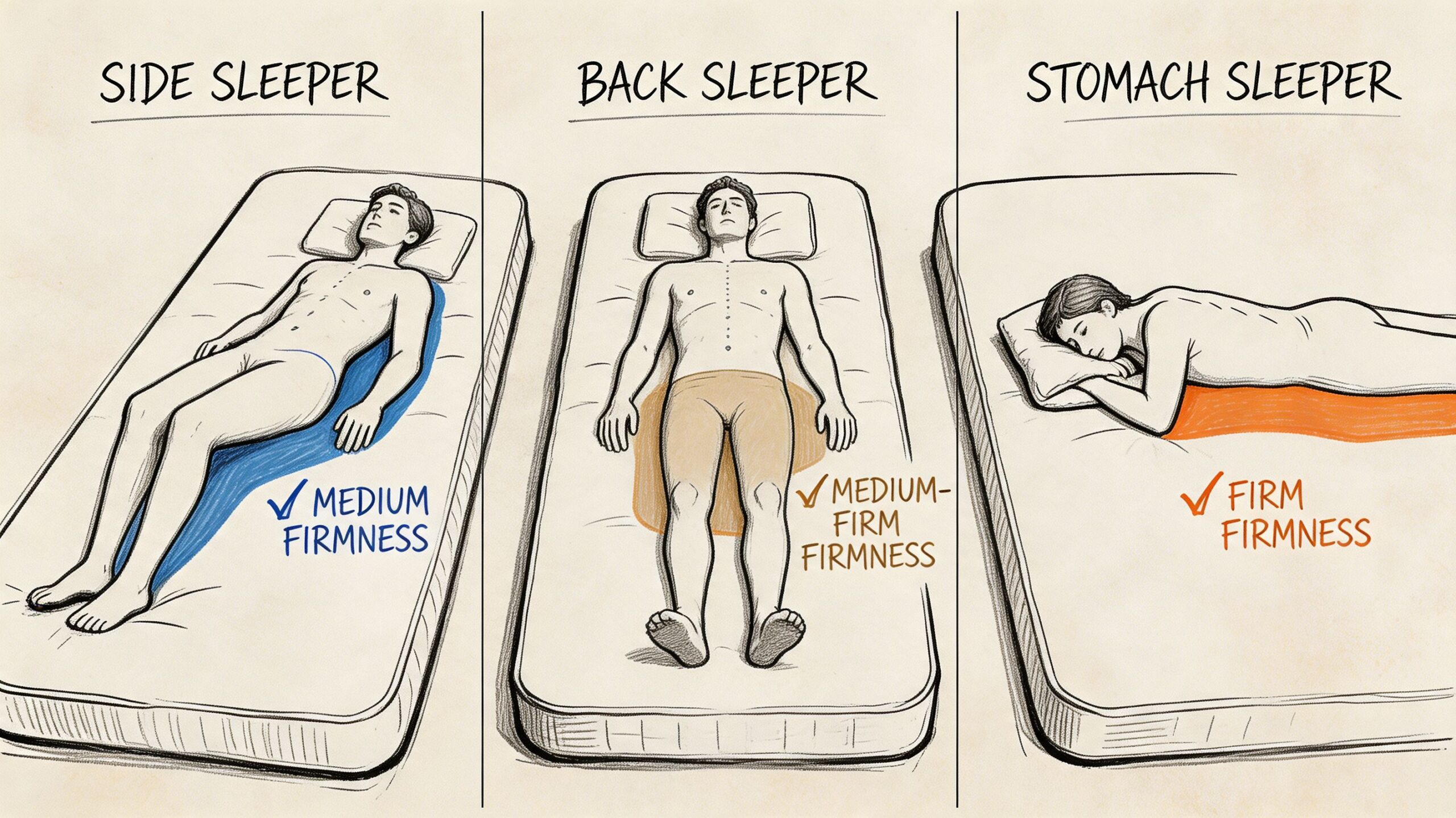
Side sleepers need room for shoulders and hips
If you sleep on your side, your mattress has to do two things at once. It has to cushion pressure points and keep your spine from bending out of line.
When a side sleeper chooses a mattress that’s too firm, the usual complaint is shoulder pressure. Sometimes it shows up as numbness in the arm. Sometimes it’s hip soreness. In a showroom, that mattress can feel “supportive.” After a full night, it can feel punishing.
Back sleepers need balanced support
Back sleepers usually do best with a surface that supports the lower back without letting the hips sink too far. Many medium-firm models are well-suited to this need. They offer some contouring, but they still keep the body level enough to prevent strain.
The key word is balanced. Too soft and the pelvis drops. Too firm and the lower back may feel unsupported because the mattress doesn’t fill the body’s natural curves well.
Stomach and combination sleepers complicate the picture
Stomach sleepers usually need a firmer, flatter feel to keep the midsection from bowing into the bed. Combination sleepers need a mattress that lets them move easily between positions without fighting the surface.
That’s where one-size-fits-all online firmness advice starts to fail. According to regional polling cited by Mattress Clarity’s king mattress review page, 42% of king-size mattress buyers experience pressure mismatches from generic firmness guidance. The same source notes that local experts using high-tech bed-matching systems reach 92% satisfaction, compared with 78% for self-selected online purchases.
Those numbers tell the story. The need isn't for more opinions. It's for better fitting.
Pressure mapping changes the process
Pressure-mapping technology helps remove the guesswork by showing where your body carries load and where a mattress is either pushing back too hard or not supporting enough. For couples, it’s even more useful because two people can like the same mattress for completely different reasons.
This matters in a king because the challenges are greater. You’re often solving for:
- Different body types
- Different sleep positions
- Different comfort preferences
- Shared motion sensitivity
If you’re a combination sleeper, this guide to the best mattress for combination sleepers is worth reading before you start testing beds. It helps you notice movement, support, and pressure relief in a more practical way.
The right firmness doesn’t feel impressive for thirty seconds. It feels quietly correct after you’ve been lying there long enough for your body to settle.
What to pay attention to when testing
When you lie on a mattress, don’t just bounce on it and stand up. Stay there long enough to notice what your body does.
Check for these signs:
- Shoulders pinching on your side means the surface may be too firm
- Hips dropping on your back or stomach often means too soft
- Difficulty rolling or repositioning may point to too much sink
- A “floating” feeling without pressure often means the support is close to right
That’s how sleep style turns firmness from a marketing word into a useful buying tool.
Top Value King Mattresses at Miller Waldrop
Once you know how to judge value, certain mattresses rise to the top faster. Not because they win every online ranking, but because they fit real sleepers with real priorities.
National review sites can still provide helpful benchmarks. For example, the Saatva Classic is highlighted by Tom’s Guide as a top-rated king-size value option, earning a 5/5 score in its 2026 expert retests, with notes about edge support, temperature neutrality, motion isolation, free white-glove delivery, a 365-night trial, and a lifetime warranty in that roundup from Tom’s Guide’s best king size mattress guide. The DreamCloud Classic Hybrid is also positioned as a strong value benchmark, with mattress testing cited by Sleep Doctor noting less than 2% motion transfer, a 365-night trial, and a lifetime warranty in its roundup of value-focused mattresses.
Those are useful reference points. But benchmarks aren’t the same as personal fit.
Best for shoppers who want balanced hybrid value
If you want the broadest mix of support, cushioning, and cooling, start with a Beautyrest or Serta hybrid. This category tends to make the most sense for couples shopping a king because it gives enough structure for support without feeling stiff or flat.
A well-fitted hybrid often works best when you need all of these at once:
- Decent motion control
- Reliable edge support
- Pressure relief without a trapped feeling
- Airflow that suits warmer sleepers
One model worth exploring is the Beautyrest Black mattresses collection. In practical terms, this line often appeals to king shoppers who want a more refined hybrid feel with stronger support and upgraded comfort layers.
Best for couples bothered by movement
Motion isolation matters more in a king than many shoppers expect. A king gives more room, but if the mattress transfers movement poorly, distance alone won’t solve the problem.
Sleep Doctor’s benchmark discussion of online hybrids notes that options like the DreamCloud Hybrid can reduce motion transfer to less than 2% in testing. That’s strong. But the same source also notes that a properly fitted Beautyrest or Serta hybrid can provide superior personalized pressure relief, and that a premium in-store model like the Beautyrest Black, when matched to a couple’s weights and sleep styles, can virtually eliminate motion transfer for a comparable investment.
That’s the difference between comparing products and solving sleep.
Best for hot sleepers in our climate
West Texas and Southeastern New Mexico shoppers often come in with one complaint first. “I sleep hot.”
For them, I’d usually steer away from thick, slow foam if cooling is the top priority. A breathable innerspring or a cooling-focused hybrid generally gives a safer answer. The open coil structure helps, and many better hybrids pair that airflow with comfort layers that don’t smother you.
If you already like your mattress but your neck and upper shoulders still feel tense, pairing the right bed with the right pillow can finish the job. A cervical-support option like this SunnyBay neck pillow can be worth considering, especially for back and side sleepers who need better head-and-neck alignment.
Best for shoppers focused on smart spending
Sometimes the best king size mattress for the money isn’t the cheapest model in the room. It’s the one that gives you the fewest compromises at a price you can live with.
Here’s a simple way to think through common shopper profiles:
| Shopper type | Best fit direction | Why |
|---|---|---|
| Budget-conscious couple | Entry or mid-level hybrid | Better balance than many low-cost all-foam kings |
| Hot sleeper | Innerspring or cooling hybrid | More airflow, easier temperature management |
| Side sleeper with pressure points | Foam-forward hybrid or pressure-relieving foam | More contouring around shoulders and hips |
| Back sleeper wanting durability | Supportive hybrid or firm innerspring | Better structure under hips and lumbar area |
| Combination sleeper | Responsive hybrid | Easier turning and repositioning |
The smart move is to treat online favorites like Saatva and DreamCloud as measuring sticks, then test whether a fitted Serta or Beautyrest gives you a better answer for the same problem. In many cases, it does.
The Power of a Test Drive for Your Sleep
You can learn a lot from reviews. You can learn even more from lying on the right mattress for long enough to feel what your body does on it.
That’s the part online shopping can’t replace. A king mattress isn’t just a product. It’s a surface your body uses every night for years. Testing it in person changes the decision from a gamble into a measured choice.

Lab data is useful, but it stops short
Top online options can perform well in testing. As noted in Tom’s Guide’s benchmark coverage, the Saatva Classic scores highly for edge support and temperature neutrality. That kind of data matters. It gives shoppers a solid baseline.
But lab results still can’t account for your exact shoulder width, hip pressure, lower back curve, or the way you and your partner share a king. The in-store advantage is that a Sleep Expert can start with known performance strengths, then fine-tune the recommendation based on how the mattress interacts with your body in real time. That’s the final step from “good” to “right.”
What a real test drive should include
A useful mattress test drive is more than sitting on the edge and saying, “Feels nice.”
Try this instead:
- Lie in your normal sleep position and stay there long enough to relax
- Roll to your second-most common position if you’re not a one-position sleeper
- Bring your partner into the test if you share the bed
- Notice the edge support when sitting and when lying near the side
- Pay attention to heat buildup after a few minutes, not just first touch
If you want a practical preview of that shopping process, this guide on how to shop for mattress walks through what to look for when you’re testing in person.
Good mattress shopping replaces hope with evidence. You feel the support, see the fit, and stop guessing.
Why this matters more with a king
A king is usually bought for shared sleep, not solo trial-and-error. That raises the stakes. One person may want pressure relief. The other may want stronger support and less motion. An in-person test drive lets you solve for both at once.
It also puts service back into the equation. Delivery, setup, and haul-away aren’t side details. They’re part of the buying experience and part of the value.
The best purchase is the one you understand before it reaches your bedroom.
Your Actionable Mattress Buying Checklist
Take this list with you when you shop. It’ll keep you focused on fit and value, not showroom noise.
Before you go
- Know your main sleep position. Side, back, stomach, or combination changes what firmness will feel right.
- List your real complaints. Shoulder pressure, lower back pain, overheating, partner movement, or edge collapse all point to different solutions.
- Set a full budget. Include the mattress, base if needed, protector, and delivery-related costs.
While you test
- Wear comfortable clothes. You’ll notice pressure points better.
- Spend real time on each mattress. Don’t rush from bed to bed.
- Test with your partner. A king should solve shared sleep problems, not create new ones.
- Try your normal positions. Don’t judge a mattress only while sitting upright.
Questions worth asking
- What kind of support system does this mattress use
- How does it handle motion, edge support, and cooling
- What does the warranty cover
- What delivery and removal services are included
- What financing options are available if you want to spread out the cost
If price is the sticking point, ask directly about a Low Price Promise and available financing. Those tools can make a better-fit mattress realistic without forcing you into the wrong bed just to hit a number.
If you’re in West Texas or Southeastern New Mexico, the smartest next step is to visit a showroom in Lubbock, Hobbs, or Ruidoso Downs and test your top options with an expert who can match the mattress to your body, not just your browser history.
Answering Your Top Mattress Questions
King or California King
A standard king is wider, while a California king is narrower and longer. If you want more shoulder room for two adults, a standard king is usually the better fit. If one or both sleepers are taller and need more legroom, a California king may make more sense.
Is an adjustable base worth it
It can be, especially if you read in bed, snore, deal with reflux, or want easier upper-body or leg elevation. The key is making sure the mattress is compatible and that you’ll use the features. For some shoppers, an adjustable base adds comfort every night. For others, it becomes an expensive extra they rarely touch.
How do you protect a new mattress
Start with a quality protector and the proper support underneath the bed. Keep the mattress on the foundation or base the manufacturer recommends. Rotate it as advised for more even wear, and don’t ignore spills or moisture. Protecting the mattress isn’t just about cleanliness. It also helps preserve the comfort and support you paid for.
If you’re ready to stop guessing and start narrowing down the best king size mattress for the money, visit Miller Waldrop Furniture & Decor. You can test king mattresses in person, compare trusted brands like Beautyrest and Serta, ask about the Low Price Promise and financing options, and get help from a Sleep Expert who’ll match the bed to your body, sleep style, and budget.