

How to Choose Your Perfect Mattress Firmness for Ultimate Sleep


When it comes to unlocking a great night's sleep, choosing the right mattress firmness is the single most important decision you can make. It's all about equipping yourself with the perfect balance of support for your spine and cushioning for your pressure points.
The right mattress empowers your body to rest in its natural alignment, based on your sleep style and weight. This guide will give you the tools and knowledge to find your perfect match, turning a confusing choice into a confident investment in your well-being.
Your Roadmap to Finding the Perfect Firmness
Let's be honest, mattress shopping can feel overwhelming. But once you understand the principles of firmness, you'll hold the key to truly restorative sleep.
Most mattresses are rated on a 1-10 scale, with 1 being incredibly soft and 10 feeling like a rock. But here’s the secret: that number is subjective. What feels like a "7" to a 200-pound side sleeper might feel like a "5" to a 130-pound back sleeper. At the end of the day, your body is the only expert that matters.
Your goal is to find a mattress that keeps your spine in a straight, neutral line all night long.
- Too soft? Your hips will sink too low, creating a "hammock" that strains your lower back.
- Too firm? Your shoulders and hips won't be able to sink in at all, leading to painful pressure points and throwing your spine out of alignment.
Think of this guide as your personal roadmap. We'll move past the generic advice and give you the tools to understand why a certain firmness level is the right choice for your specific needs.
Here's how you can take control of your sleep health:
- Discover how your go-to sleep position dictates the support you need.
- Understand the direct connection between your body weight and how a mattress feels.
- Learn which firmness levels can help ease common aches and pains.
- See why the materials inside, like those in a Tempur-Pedic ProAdapt Medium Hybrid Mattress, completely change the feel and benefits.
By the time you're done reading, you'll be empowered to choose a mattress that's a true investment in your health. And when you're ready to put your new knowledge to the test, our Sleep Experts at Miller Waldrop are here to help you find that perfect fit.
How Your Sleep Position Defines Your Needs
To find the right mattress, the single best clue you have is the way you sleep. Your body instinctively knows its most comfortable resting position. Your mission is to find a mattress that supports this natural instinct, keeping your spine in a straight, neutral line from your neck down to your hips.
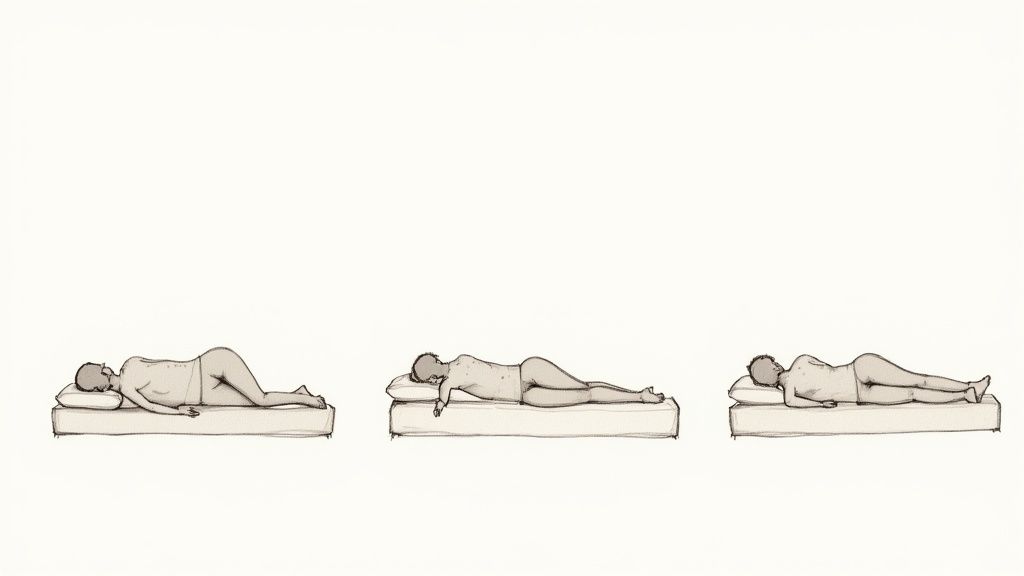
If your mattress has the wrong firmness for your sleep style, it forces your spine into unnatural curves. This is often the culprit behind waking up with stiffness, aches, and the feeling that you've been fighting your bed all night.
The secret is to match the firmness level to the unique pressure points of your preferred position. When you get this right, you enable your muscles to finally relax completely, opening the door to truly deep, restorative sleep.
The Side Sleeper's Sanctuary
If you’re a side sleeper, you’re in good company—it's the most common way people sleep. When you lie on your side, you concentrate all your weight on your widest points: the shoulders and hips.
A mattress that’s too firm becomes a problem. It won't let your shoulders and hips sink in, creating painful pressure points and bowing your spine upwards. You'll wake up with a sore shoulder or aching hip.
Conversely, a mattress that’s too soft creates a different issue. Your hips and shoulders will sink too deeply, creating a hammock-like curve that strains your spine in the other direction.
This is exactly why you, as a side sleeper, will likely find your best rest on a soft to medium-firm mattress, which usually lands between a 3 and 6 on the 1-10 firmness scale. This sweet spot delivers the perfect blend of:
- Pressure Relief: Just enough cushioning to let those hips and shoulders sink in, taking the pressure off.
- Contouring Support: The surface gently fills in the space around your waist and torso, keeping your spine perfectly straight.
Achieving that balance is everything. For a deeper dive, you can explore our guide on finding the best mattress for side sleepers. And for more tips on overall alignment, DubsLabs offers a great resource on How to Sleep Comfortably on Your Side.
Finding Balance for Back Sleepers
Sleeping on your back is a fantastic way to support your spine since it distributes your weight evenly. Your challenge, however, is to maintain the natural, gentle "S" curve of your spine.
If the mattress is too soft, your hips will sink lower than the rest of your body, creating an unnatural arch in your lower back that often leads to pain. A rock-hard mattress isn’t the solution either; it won’t give at all, leaving a gap between your lower back and the mattress, which means zero support where you need it most.
Your ideal solution as a back sleeper is a medium-firm mattress, which typically falls in the 5 to 7 range. This firmness level is strong enough to keep your hips from sinking but has just enough give to support your lower back.
This isn’t just an opinion—it's backed by science. Researchers have measured how mattress firmness impacts sleep quality. One comprehensive study found that medium-firm mattresses consistently led to the best results, with people reporting the least discomfort and highest sleep efficiency. You can feel confident knowing it's the optimal choice for most people.
Firm Support for Stomach Sleepers
Stomach sleeping is the riskiest position for your neck and spine. The main danger is your midsection sinking into the mattress, forcing your spine to arch and your neck to twist at an awkward angle.
To fight this gravitational pull, you need a surface that props your hips up, keeping them aligned with your shoulders. This is where a firm to extra-firm mattress (around a 7-9 on the scale) becomes your most important tool for healthy sleep.
A firm surface provides the critical uplift for your torso and pelvis, preventing that dangerous sinkage. It might not feel as "cushy" at first, but it provides the non-negotiable spinal support you need to wake up without pain. For a stomach sleeper, choosing the right firmness is the most powerful step you can take for healthier alignment.
Matching Firmness to Your Body Weight
After sleep position, your body weight is the next critical factor in finding your ideal mattress. It comes down to physics—the more you weigh, the more pressure you exert on the mattress. A bed that feels perfectly supportive to a 120-pound person might feel like a hammock to someone who weighs 220 pounds.
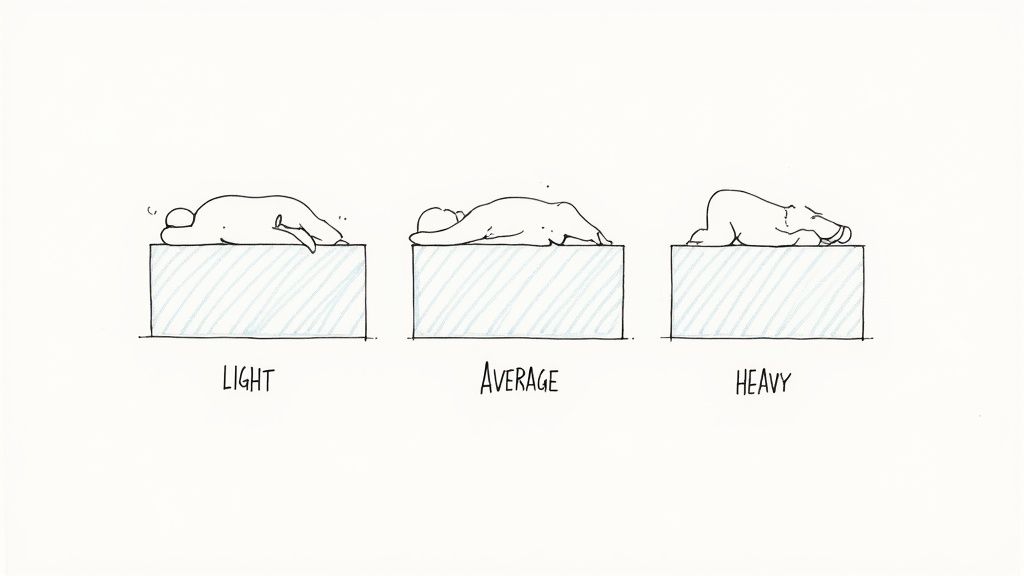
Getting this right is the key to choosing a mattress that will support you for years, not just feel good for a few nights. You're looking for a surface that’s strong enough to keep your spine straight but has enough give to avoid creating painful pressure points.
Here's how you can find the right match for your body.
For Lighter Sleepers (Under 130 lbs)
If you weigh less than 130 pounds, you've probably noticed that most mattresses feel firmer to you than advertised. That’s because your body doesn't sink in as much, so you don't always get to experience the plush comfort layers the way they were designed.
An overly firm bed can be a real problem. It won't let your shoulders and hips contour properly, which is especially tough for side sleepers.
That’s why you'll likely find your sweet spot with a soft to medium-soft mattress, somewhere in the 3-5 range on the 1-10 firmness scale. This softness empowers your body in two key ways:
- Better Pressure Relief: A softer surface allows your joints to sink in just enough to prevent that morning stiffness.
- True Contouring: The mattress can properly cradle your frame, filling in the gaps around your waist and lower back to keep your spine aligned.
Without that give, you’ll feel like you're just lying on top of the bed instead of being comfortably nested in it.
The Sweet Spot for Average Weight Sleepers (130-230 lbs)
If you fall into this weight range, you’re in a great position—you have the widest variety of options to choose from. Your body weight is enough to engage the supportive core of most mattresses without the risk of "bottoming out." This gives you the freedom to focus more on your preferred sleep style and what feels best to you.
Most people in this category find their ideal match in a medium to medium-firm mattress, typically a 5 to 7 on the firmness scale. This range is the industry standard for good reason. It hits that perfect balance between supportive push-back and comfortable cushioning.
While mattress choice is deeply personal, global studies reveal a clear winner. An Ipsos survey of international travelers showed that 50% of respondents prefer medium mattresses. In the U.S., men sometimes lean slightly firmer and women slightly softer, but "medium" remains the most popular and accommodating choice for the majority of people.
Essential Support for Heavier Sleepers (Over 230 lbs)
For anyone weighing over 230 pounds, your number one priority should be support—unwavering, robust support. A mattress that's too soft will cause your hips and midsection to sink too deeply, throwing your spine completely out of alignment. This is a fast track to chronic lower back pain.
As a heavier sleeper, you will almost always find the best support from a firm to extra-firm mattress, usually rated between a 7 and 9. This level of firmness provides the resistance needed to distribute your weight evenly and prevent that damaging sinkage.
When you're shopping, you can empower yourself by looking for mattresses built with reinforced coils or high-density foams. These are specifically engineered for durability and long-term support. For a more detailed guide, you can find more information in our article on choosing the right mattress for your body type.
Finding Relief for Aches and Pains
Waking up sore is more than just an annoyance; it’s a clear sign your mattress is failing you. For many of us, a bed isn't just for sleeping—it's a critical tool for managing discomfort and helping our bodies recover overnight. The wrong firmness can make issues like back, hip, or shoulder pain even worse, turning your bedroom into a place you dread.
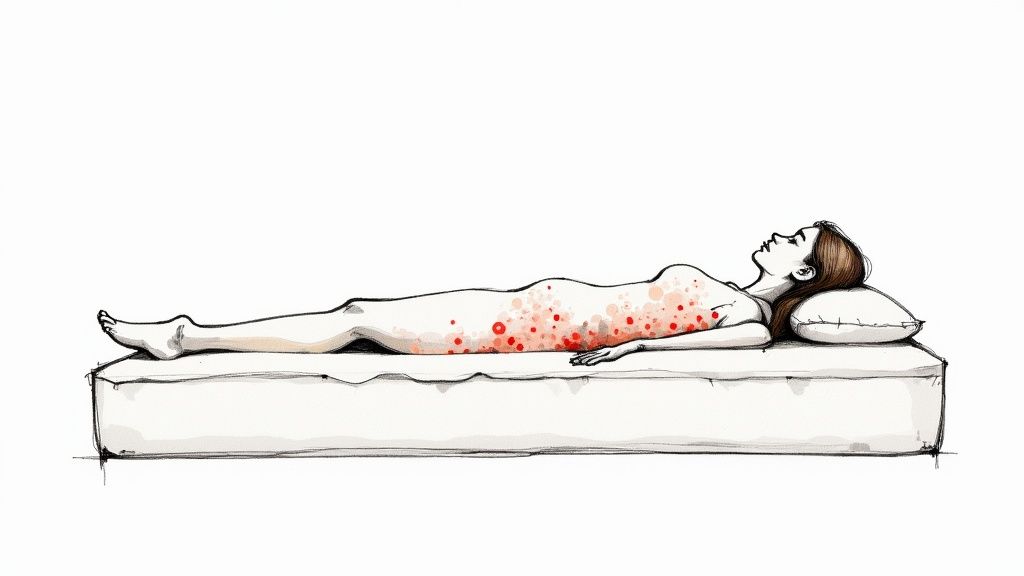
But here's the good news: you can absolutely choose a mattress that provides therapeutic support. The key is to find a surface that works with your body, not against it, giving you relief exactly where you need it.
Addressing Lower Back Pain
Let's clear up an old myth: a rock-hard, extra-firm mattress isn't the cure-all for back pain. In fact, it can sometimes make things worse. While a mattress that’s too soft lets your hips sink and throws your spine out of whack, one that’s overly firm creates painful pressure points and leaves the curve of your lower back completely unsupported.
For years, experts and studies have consistently pointed to a medium-firm mattress as the sweet spot for relieving lower back pain. It truly is the gold standard, offering that perfect blend of contouring comfort and solid support to keep your spine in a healthy, neutral position all night long.
A mattress in the 5-7 range on the firmness scale is sturdy enough to keep your hips from sagging but has just enough give to cushion your body. This balance is exactly what your lower back muscles need to fully relax and recover.
Easing Hip and Shoulder Pain
If you're a side sleeper who regularly wakes up with a throbbing shoulder or an aching hip, your mattress is almost certainly too firm. When you lie on your side, all your body weight gets concentrated on those two small areas. A rigid surface just pushes right back, causing that familiar pain and stiffness.
To get the relief you deserve, you need a mattress that cradles those pressure points.
- Softer is Your Friend: A soft to medium-soft feel (around a 3-5 on the scale) lets your shoulder and hip sink in just the right amount to take the pressure off.
- Contouring is Key: That little bit of sinkage allows the mattress to fill in the gap around your waist, which keeps your spine straight instead of awkwardly curved.
- Don't Forget Alignment: The goal is to find cushioning without sacrificing support. You want a bed that gives way at your widest points but still holds up the rest of your torso.
If your current mattress is the culprit behind a sore back and shoulders, you could also explore mattress topper solutions for hard mattresses as a temporary fix.
Considerations for Specific Conditions
Beyond general aches, the right mattress can be a game-changer for managing chronic conditions. Think of it as part of your daily wellness routine—one that has a direct impact on your comfort and overall quality of life.
For instance, if you have sciatica, you can prevent irritation of the sciatic nerve by choosing a medium-firm mattress that keeps your hips from sinking too low. Likewise, if you have arthritis, you can dramatically reduce morning stiffness and pain by selecting a mattress that offers gentle, even support without creating pressure points.
Ultimately, your body is the best judge. By understanding how to match firmness to your specific pain points, you're taking a huge step toward better health. When you’re ready to find that perfect balance, our Sleep Experts at Miller Waldrop are here with personalized advice and our advanced bed-matching technology to help you win the day.
How Mattress Materials Shape the Feel
You’ve nailed down your ideal firmness based on sleep style, weight, and health needs. That’s a huge step. But there’s one more piece to the puzzle that completely changes how a mattress feels: what’s inside it.
A “medium-firm” innerspring and a “medium-firm” memory foam bed offer two totally different experiences. Getting this final detail right is the difference between a good mattress and one that feels like it was made just for you. Each material has its own personality, shaping how the mattress supports and cradles your body.
Here’s how you can match the construction to the feel you’re looking for.
The Classic Bounce of Innerspring
Most of us grew up sleeping on innerspring mattresses. They’re built on a foundation of steel coils, which creates that familiar, springy, and responsive feel. When you lie down, you get immediate push-back and support.
This design gives innerspring a distinct character:
- An "On-the-Bed" Feel: Innerspring mattresses keep you elevated on the surface, rather than letting you sink in. This is perfect if you toss and turn at night and hate feeling trapped in your mattress.
- Support-Focused Firmness: A firm innerspring feels incredibly solid. It's less about hugging your curves and more about providing a rock-solid base that keeps your spine perfectly aligned.
Thanks to all that open space between the coils, they also happen to be one of the best options for airflow, which is great news for anyone who tends to sleep hot.
The Deep Contouring of Memory Foam
Memory foam, an innovative material developed by NASA, is all about that slow-sinking, body-hugging sensation. It reacts to your body heat, softening and molding to your exact shape to provide incredible pressure relief.
With memory foam, firmness feels different:
- An "In-the-Bed" Feel: This material gives you a deep, cradling feeling, almost like you’re sleeping in the bed instead of on it. Side sleepers find this especially beneficial, as it provides amazing cushioning for shoulders and hips.
- Pressure-Relieving Firmness: Even a "firm" memory foam bed has a lot of give. The firmness comes from the denser support layers underneath, which stop you from sinking in too deep while the top layers work their magic.
And people love it. A Market.us News report found that memory foam is the second most popular mattress type, chosen by 22% of all adults. It’s clear that its unique comfort has a huge following.
The Responsive Lift of Latex
Latex offers a fantastic middle ground between contouring and responsiveness. It doesn’t have that slow-moving feel of memory foam; instead, it bounces back almost instantly. It gently cradles you to relieve pressure points but has a buoyant lift that makes moving around effortless.
Here’s what you can expect from latex:
- A "Floating" Sensation: People often say sleeping on latex feels more like floating on the mattress than sinking into it.
- Supportive Cushioning: It conforms to your body but provides a more generalized, uplifting support compared to the targeted hug of memory foam. This makes it a winner for back sleepers and anyone who finds it tough to get out of bed.
Hybrids: The Best of Both Worlds
Just as the name suggests, hybrid mattresses combine the best features of different materials into one dynamic package. The standard recipe is a core of supportive, pocketed innerspring coils topped with generous layers of memory foam, latex, or sometimes both.
This construction is exactly why they’re so popular. You get the classic bounce and cooling airflow from the coils, combined with the pressure relief and contouring of foam. It’s a balanced design that works for a massive range of sleepers.
Hybrids can feel very different depending on their comfort layers. A model like the Tempur-Pedic ProAdapt Medium Hybrid Mattress uses advanced foam for deep contouring, while a hybrid with latex on top will feel much more buoyant. To really get a handle on this design, you can explore our guide on what a hybrid mattress is.
Putting Your Knowledge to the Test
You've done the research and now have a powerful understanding of what you need in a mattress. Now comes the exciting part: moving from theory to reality and actually trying some out. Walking into a showroom armed with this knowledge is a game-changer. You're no longer just guessing; you're making a truly informed decision.
Your goal here is to test mattresses the right way. This means more than just a quick sit on the edge or a push with your hand. You need to lie down for at least 10-15 minutes in the position you actually sleep in. Give your body time to relax and settle in. This is the only way you'll get a real feel for how the mattress supports your spine and relieves pressure.
Ask yourself: Does my lower back feel supported, or is there a gap? Are my shoulders and hips sinking in comfortably without feeling strained? Your body will give you the answers if you just listen.
The In-Store Experience
When you visit our showroom, think of it as the final, most important step of your research. Our Sleep Experts are there to guide you, not to pressure you. They can answer your questions and help you find options that fit the profile you've already built.
To get the most out of your time in the store:
- Mimic Your Sleep Style: If you're a side sleeper, lie on your side. Back sleeper? Settle in on your back. It sounds obvious, but it’s the only way to know if a mattress will actually work for you night after night.
- Move Around a Bit: Toss and turn like you might at home. A great mattress should let you change positions easily, without that "stuck in quicksand" feeling.
- Bring Your Partner: If you share your bed, you absolutely have to test mattresses together. This lets you feel how much motion travels from one side to the other and ensures the firmness works for both of you.
From Showroom Floor to Your Bedroom
While trying a mattress in the store is crucial, the real test is sleeping on it at home. It can take some time for your body to fully adjust to a new sleeping surface, especially if your old one was unsupportive. This is exactly why an in-home sleep trial is so important—it gives you weeks, not minutes, to be sure you've made the right choice.
Do you prefer a mattress that gives you a gentle "hug," one that has some springy bounce, or something that feels perfectly balanced? This simple preference is a huge clue.
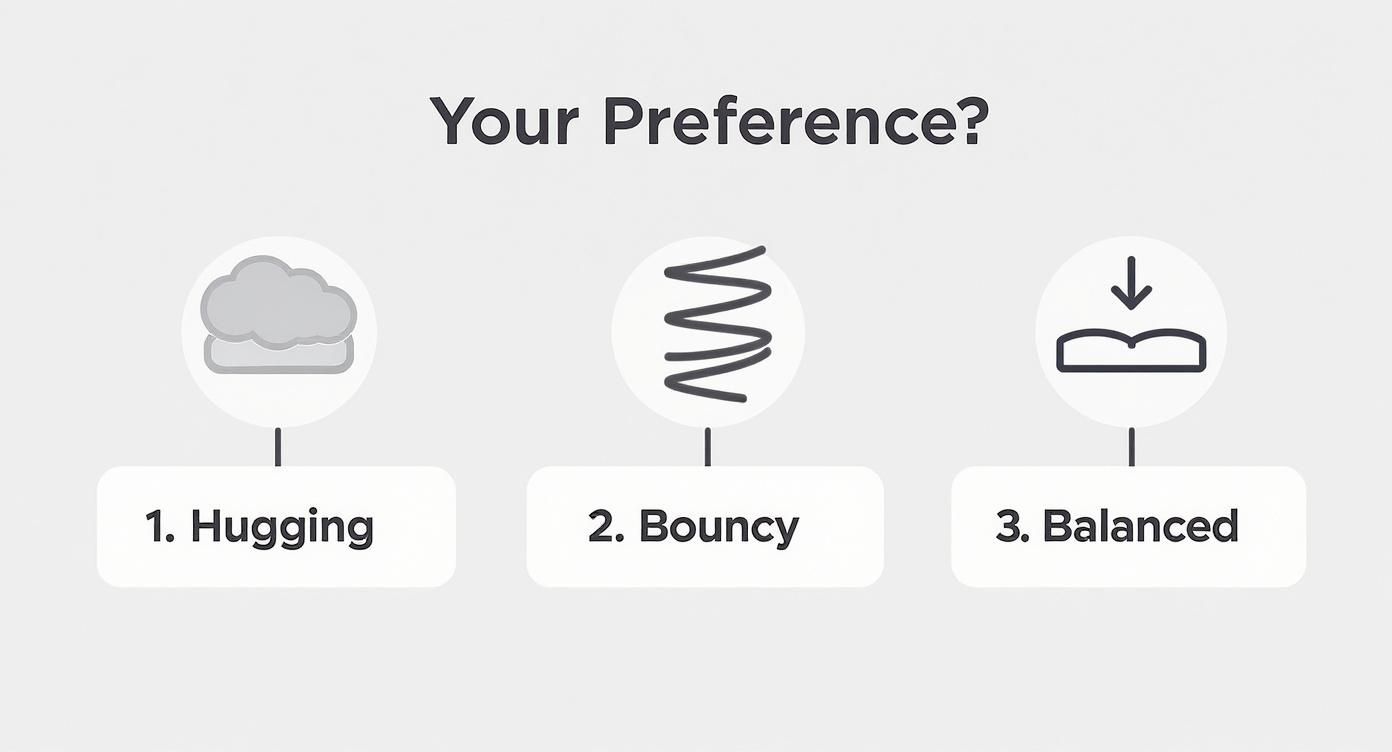
Knowing whether you're drawn to the deep contouring of memory foam, the classic lift of an innerspring, or a hybrid that blends both will quickly narrow down your options.
Here at Miller Waldrop, we help you take the guesswork out of the equation. We combine your hands-on testing with our bed-matching technology, which maps your body's specific pressure points. This blend of your personal feedback and objective data points us directly to the perfect mattress for you. Come on in, put what you've learned to the test, and let's find the sleep you've been dreaming of.
Still Have Questions About Mattress Firmness?
Even when you've done all your homework, a few questions always seem to pop up right when you're about to make a decision. That's completely normal. Let’s tackle some of the most common ones we hear to help you finalize your choice with confidence.
"I Have Back Pain. Should I Just Get the Firmest Mattress Possible?"
This is probably the biggest myth in the mattress world. While it's true that a mattress without enough support will let your spine sag, an overly firm one can be just as bad for back pain.
Think about it: a rock-hard surface creates major pressure points on your hips and shoulders and leaves the natural curve of your lower back completely unsupported. Your muscles have to work all night to hold you up, which is the exact opposite of what you want.
In reality, most studies and our own experience point to a medium-firm mattress as the sweet spot for back pain relief. It provides that essential, robust support while still having enough give to cushion your joints and contour to your body's shape.
"My Partner and I Can't Agree on a Firmness. What Do We Do?"
You're not alone—this is an incredibly common dilemma. When two people with different bodies, weights, and sleep habits share a bed, finding a single mattress that works for both can feel impossible. But you definitely don't have to settle.
Here are a few great ways you can solve this problem:
- Go for a Split King: This is the gold-standard solution. A Split King is essentially two separate Twin XL mattresses in one frame, allowing you and your partner to each pick your ideal firmness. No more compromising.
- Focus on Motion Isolation: If you can agree on a general firmness, look at materials like memory foam or latex. They are fantastic at absorbing movement, so you won't be woken up every time your partner tosses and turns.
- Find the "Happy Medium": A good medium-firm mattress is often the most successful compromise because it's designed to accommodate a wide range of sleep styles and body types.
"How Long Will It Take Me to Get Used to a New Mattress?"
Give your body some time to recalibrate. You should plan for an adjustment period of anywhere from 30 to 90 days.
If your old mattress was sagging and unsupportive, your body has likely gotten used to being in a poor sleeping posture. The new, correct support might feel a little strange at first, but it's a good thing. This break-in period is exactly why sleep trials are so important—they give you the time to be 100% sure the mattress is right for you in the long run.
At Miller Waldrop, our Sleep Experts are here to help you put your knowledge into action. We use our advanced bed-matching system to take the guesswork out of the process, ensuring you find the perfect tool for your best sleep. Explore our collection of top-brand mattresses today and start your journey to truly restorative sleep.