


How to Store Earrings to Prevent Tangles and Damage

A lot of bedrooms have the same quiet frustration. A favorite pair of studs disappears into the back of a drawer, hoops catch on a scarf, and a special occasion pair turns up with one post bent and the other missing its back. The problem usually isn't the jewelry. It's the storage system, or the lack of one.
The good news is that learning how to store earrings well doesn't require a bigger home or a complicated routine. It requires a better match between the collection, the furniture already in the room, and the way those earrings are worn. A well-planned drawer, a lined tray, or a dedicated box can turn a daily scramble into a calm part of getting ready.
A beautiful bedroom works harder when every piece has a job. Earrings don't have to live as clutter on a nightstand or a tangled pile in a catch-all dish. They can become part of a more polished, functional space that feels easier to live in every day.
From Tangled Mess to Treasured Collection
Most earring clutter starts the same way. A pair comes off at the end of a long day and lands on a dresser top. Another gets dropped into a small dish. A few more end up in a drawer, loose, next to a watch, bobby pins, and receipts. After a few weeks, the collection doesn't feel curated anymore. It feels like work.
That kind of storage causes real damage. A critical common pitfall is jumbling earrings together in open air or plastic bags, which traps moisture and causes rapid tarnishing. Storing earrings flat in separate soft pouches or compartmentalized trays helps prevent scratches and tangling, and it can cut untangling time by approximately 75% compared to loose drawer storage, according to this earring storage demonstration and care guidance.
Practical rule: If a pair can slide, hook, or rub against another pair, the setup is working against the collection.
A better approach starts with a simple shift in mindset. Earring organization isn't just about tidiness. It's part of bedroom design. It protects pieces that get worn often, keeps favorites visible, and removes friction from the morning routine.
For readers who also struggle with chain tangles, this helpful guide to keeping jewelry untangled pairs nicely with an earring system because the same principle applies across jewelry categories. Separate pieces store better, last longer, and stay easier to wear.
What works in real rooms
Some of the best systems are also the quietest visually.
- A lined drawer tray keeps everyday studs and hoops hidden but easy to reach.
- Soft pouches inside a top drawer work well for delicate pairs that scratch easily.
- A small lidded box on a dresser suits a short daily rotation without creating visual clutter.
The strongest storage solutions don't ask the bedroom to do more. They ask each drawer, tray, and surface to do its job better.
Choosing Your Earring Storage Strategy
The right storage method depends on two things first. How many pairs need a home, and what kinds of earrings are in the mix. A collection made up mostly of tiny studs needs a different system than one filled with long dangles or oversized statement pieces.
Capacity matters more than many people expect. A large collection can hold approximately 300 individual pairs when arranged in a standard 150-compartment acrylic organizer, and that benchmark shows why dividers matter. Items stored without dividers have a 40% higher rate of being unusable, according to this high-capacity organizer example.
Start with three questions
Before choosing a tray, box, or rack, evaluate the collection like a designer would.
What gets worn weekly
Everyday pairs should be the easiest to reach. Special occasion pieces can go deeper into the storage plan.What shape dominates
Studs need secure separation. Dangles need room. Hoops need enough width that they aren't squeezed into narrow slots.How much furniture space is available
A shallow top drawer supports different solutions than a narrow vanity surface or a tall armoire interior.
Earring Storage Method Comparison
| Method | Best For | Pros | Cons |
|---|---|---|---|
| Drawer compartmentalization | Medium to large collections, everyday access | Hidden, orderly, easy to sort by type or color, integrates well into bedroom furniture | Needs drawer space and inserts that fit properly |
| Vertical hanging display | Long dangles and highly visual collections | Easy visibility, keeps some pieces from overlapping when spaced well | Can expose jewelry to air and dust, not ideal for every earring type |
| Contained jewelry box | Small to medium collections, delicate pieces | Protective, portable, polished look on a dresser or vanity | Can become crowded if the collection grows quickly |
Hanging isn't automatically the best answer just because earrings have hooks. Visibility helps, but protection matters more.
One useful companion resource for readers storing multiple jewelry types is this piece on keeping Cuban link chains safe. It reinforces a smart design principle. Different forms need different storage behavior, and one container rarely serves every category well.
The best match for most bedrooms
For most homes, drawer-based compartmentalization offers the best balance of access, protection, and visual calm. It uses furniture already in the room, keeps the collection out of dust and sunlight, and makes the bedroom feel less busy. Hanging displays still have a place, and jewelry boxes can be excellent, but the most flexible strategy usually starts inside the furniture.
Turn Your Dresser into an Organization Hub
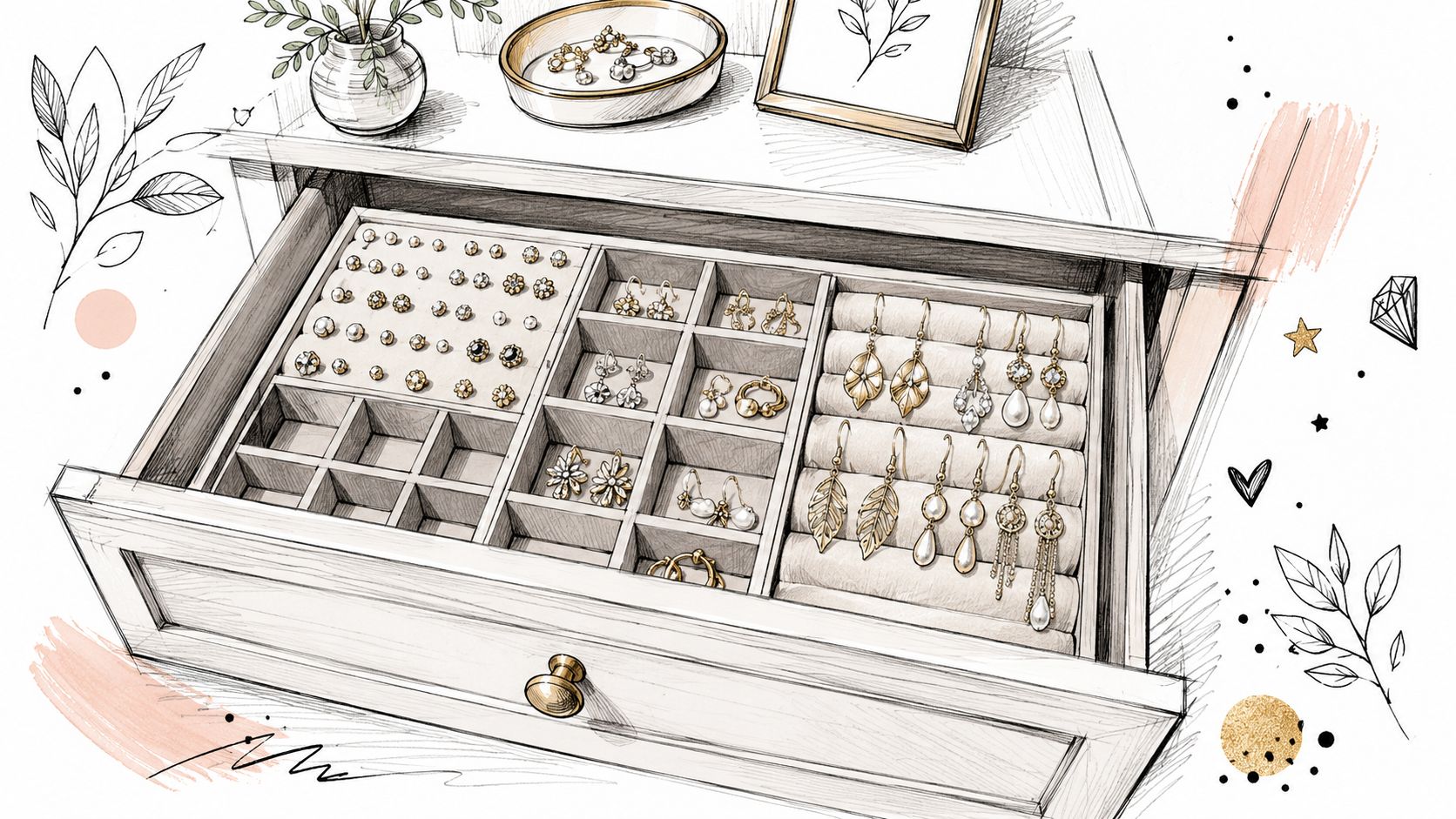
A dresser can do more than hold folded clothes. With the right insert, one drawer becomes a jewelry zone that feels custom, quiet, and easy to maintain.
Repurposed household items like ice cube trays and egg cartons have been used since the mid-20th century to organize earrings, and by 2023, over 50% of online searches for earring storage involved repurposing kitchen items, as noted in this overview of practical earring storage ideas. That tells an interesting story. People want storage that's affordable and adaptable, even when the room itself is furnished with more refined pieces.
Build a drawer that feels intentional
The best jewelry drawer doesn't need to look makeshift. It needs layers.
- Use a soft base layer with velvet or fabric-lined inserts so metal pieces don't scrape against wood.
- Create zones for studs, hoops, dangles, and sentimental pieces so the drawer supports the way the collection is used.
- Leave breathing room between sections. A packed drawer is harder to maintain than one with a little open space.
A shallow tray near the front of the drawer works well for daily pairs. A deeper section toward the back can hold larger pieces, spare backs, or a small pouch for occasional favorites.
Smart DIY ideas that still look polished
Repurposing works best when it's edited carefully.
An ice cube tray can separate smaller pairs in a hidden drawer. An egg carton can help during sorting or seasonal rotation. A small ceramic dish can serve as a same-day catch-all, but it shouldn't become permanent storage for the full collection.
A bedroom looks more finished when the organizing tools match the furniture instead of fighting it.
Readers planning a more substantial bedroom setup can explore bedroom sets with storage as the foundation for a calmer routine. Extra drawer depth, better case goods, and purposeful storage furniture make this kind of organization easier to maintain over time.
Placement matters inside the drawer
A top drawer usually works best because it stays accessible. If the dresser has multiple small drawers, reserve one for jewelry only. Mixing earrings with chargers, cosmetics, and paper clutter usually undoes the system within weeks.
For many bedrooms, the dresser isn't just a storage piece. It's the structure that makes the room function better every day.
Solve Storage for Difficult Earring Types
General advice often falls apart when the collection includes awkward pieces. Tiny studs vanish. Long dangles knot around each other. Heavy statement earrings strain their own posts if they're stored the wrong way.

One of the biggest mistakes is assuming every pair should hang. That doesn't hold up for heavier pieces. Jewelry care guidance indicates that statement earrings over 50g should be stored flat in padded, deep compartments to prevent post bending and back slippage, according to this guidance on organizing earrings by type.
Tiny studs need structure
Studs are easy to lose because they're small and visually quiet.
A foam or velvet-lined insert with small holes keeps each pair secure and separated. This setup also makes matching pairs easier to spot at a glance, especially in a bedroom drawer where speed matters during the morning routine.
Long dangles need vertical or separated space
Dangle earrings can work in a vertical organizer if each pair has enough room and nothing drags across the next piece. If space is tight, individual soft compartments or pouches are often safer than forcing several pairs onto one hanging bar.
The goal isn't just to prevent knots. It's to preserve finish, shape, and ease of wear.
Heavy statement earrings need a different answer
Common advice needs correcting. Heavy earrings don't belong on a delicate hanging tree just because they're dramatic.
Store high-mass earrings flat, cushioned, and supported from underneath. Let the compartment carry the weight, not the post.
Deep padded sections help absorb pressure. If the backs are loose, keep each pair in its own compartment so the components stay together. This kind of setup protects the jewelry and the organizer at the same time.
A one-size-fits-all system rarely stays functional for long. The best storage setup respects what each pair asks of the space.
Preserve Your Jewelry and Prevent Tarnish
Good organization solves access. Good preservation solves longevity. A beautiful pair of earrings can still lose its finish if it lives in the wrong environment.
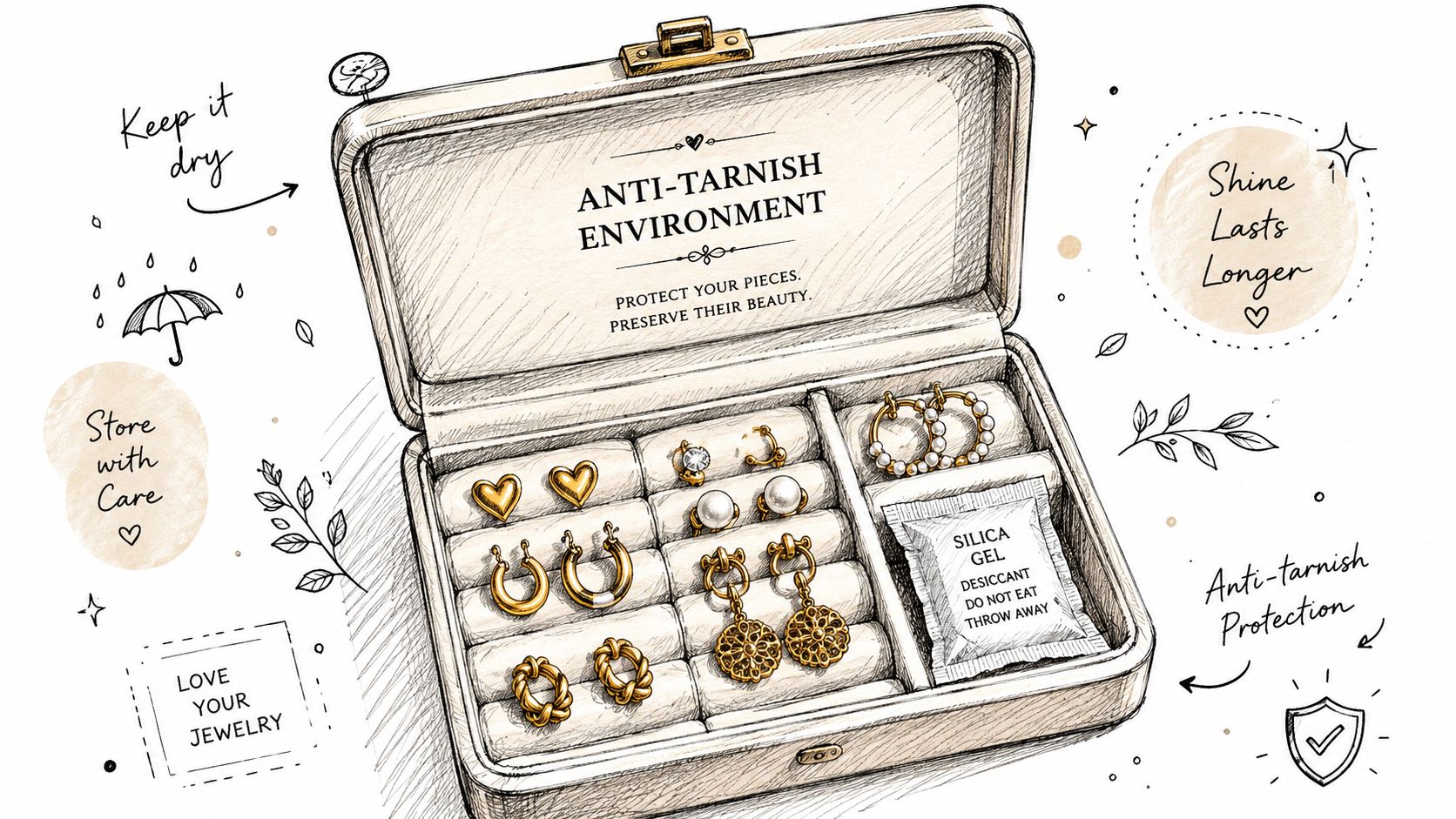
The ideal storage environment for earrings calls for humidity between 45–55%, along with containers lined with anti-tarnish cloth or anti-tarnish strips with activated charcoal, which are cited as the most effective prevention method in this guide to jewelry storage and tarnish control. That's one reason bathroom storage causes problems so often. The room may be convenient, but it's usually not stable.
What to avoid
Some placements almost guarantee extra wear.
- Bathroom counters and drawers expose jewelry to moisture swings.
- Window-adjacent surfaces invite sunlight and heat.
- Loose plastic storage can hold moisture where it shouldn't sit.
Readers who wear silver often may also find this explanation of how 925 sterling silver tarnishes helpful for understanding why environment matters so much from one room to the next.
A better preservation routine
A simple routine protects both everyday and special occasion pieces.
- Wipe earrings before storing them so oils, sweat, and product residue don't sit on the metal.
- Use lined compartments or a dedicated box instead of leaving pairs exposed on a hard surface.
- Add anti-tarnish support with cloth lining or appropriate strips inside the container.
- Keep the storage area dry and stable rather than moving pieces from room to room.
Jewelry lasts longer when the storage environment stays boring. Stable air, low moisture, and soft separation beat decorative clutter every time.
For readers who want a dedicated enclosed option, an antique wood jewelry box can bring both protection and character to a bedroom setup. A good box doesn't just store earrings. It creates a controlled, consistent home for them.
Create Your Beautifully Organized Space
A strong earring storage system should do three things well. It should keep pairs together, protect finishes and posts, and fit naturally into the bedroom instead of looking like an afterthought. That's why the best answer usually isn't a random organizer bought in a rush. It's a solution shaped around the furniture, the routine, and the collection itself.
A lined drawer works beautifully for many homes. A dedicated box adds protection and polish. Special pieces need specialized treatment, especially when they're delicate, oversized, or easy to lose. Once the right home exists for each type, getting ready feels simpler and the room feels more settled.
For readers who want to take organization beyond jewelry alone, a customized closet organizer solution can help tie the whole bedroom together so storage feels intentional from drawers to wardrobe space.
The win isn't just finding a matching pair faster. It's creating a bedroom that supports daily life with less friction and more beauty. That kind of order doesn't feel strict. It feels calm.
If a bedroom needs better storage, better flow, or furniture that helps everyday routines run more smoothly, Miller Waldrop Furniture & Decor is ready to help. With over 70 years of family-owned service in West Texas and Southeastern New Mexico, the team helps shoppers find quality pieces that solve real design problems beautifully. Visit a showroom, explore options online, or connect with their staff for guidance on creating a more functional, comfortable home.