

Beds Made in USA: An Honest Buyer’s Guide for 2026


You're probably doing one of two things right now. You're scrolling product pages full of badges and buzzwords, or you're standing in a mattress department staring at labels that all sound reassuring and somehow still tell you almost nothing.
That confusion is fair. “Made in USA” sounds simple. It isn't. On a bed, that phrase can mean the difference between a frame that stays solid for years and one that starts creaking far too soon. It can also mean the difference between buying something built with real accountability and buying a marketing story.
If you want beds made in usa because you care about durability, cleaner sourcing, supporting domestic jobs, or just getting better value for your money, you need more than a flag graphic on a tag. You need a practical way to separate the genuine article from the watered-down version.
Why "Made in USA" Matters More Than Ever
A lot of people start with emotion. They want to support American workers. That's valid, but it's not the whole story. The bigger reason to care is that your bed takes abuse every single day. Weight, movement, dry air, shifting temperatures, kids jumping on it, dogs claiming one corner, and years of use all expose weak construction fast.
The domestic production base behind this category is larger than many shoppers realize. The US mattress manufacturing industry generates $9.3 billion in 2026 and employs over 75,000 people, which tells you there is real manufacturing depth behind the beds and mattresses you see in showrooms, not just imported product with American branding slapped on it (mattress industry data).
A bed isn't a trendy purchase
You can get away with a trendy lamp. You can even make peace with a sofa that looked better online than it does in your house. A bed is different. You spend a huge part of your life on it, and when it's wrong, you feel it every day.
That's why broad market noise matters less than product truth. If you want context on where the category is headed, this breakdown of trends in the US mattress market is useful because it helps explain why shoppers are seeing more choices, more claims, and more mixed messages than before.
A “Made in USA” label only matters if it leads to better construction, clearer sourcing, and fewer headaches after the sale.
Why local trust still matters
Beds made in usa aren't just a national story. They're a local one. In communities where people care how a product holds up in a real house, not a staged photo, local knowledge has value. Families have been leaning on stores with long roots for a reason. They want guidance from people who've seen what lasts and what comes back broken.
If you want that kind of grounded perspective, the history behind this family-owned furniture store shows why multi-generational experience still matters in a category where quality can be hard to judge at first glance.
Decoding the "Made in USA" Label
Here's the plain truth. Not every patriotic phrase means the same thing. Some labels carry real weight. Others are mostly marketing.
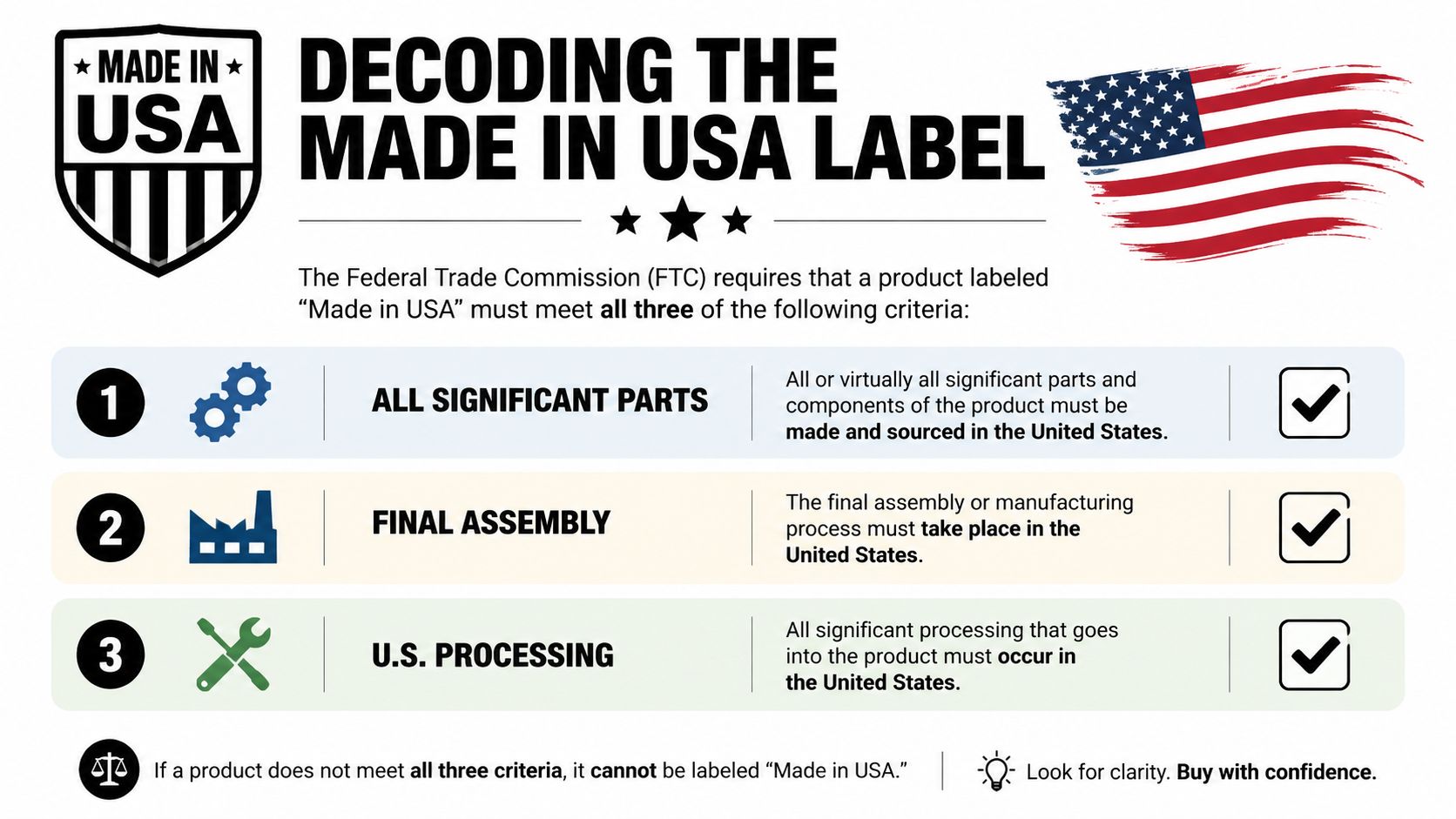
The Federal Trade Commission standard is the one that matters most. For a product to carry the official claim, “all or virtually all” of it must be made in the United States. That's the benchmark shoppers should care about, not softer wording that sounds similar but means less.
The easiest way to think about it
Treat it like a home-cooked meal.
If someone tells you the pie is homemade, you expect more than just putting store-bought filling into a crust in their kitchen. You expect the important work and the important ingredients to come from the home kitchen. Beds are the same way.
If the wood, steel, foam, or major components come from somewhere else, then “Made in USA” deserves a harder look.
What the labels usually signal
- Made in USA means the product should meet the FTC's stricter standard.
- Assembled in USA with foreign parts means the final put-together happened here, but major pieces may not be domestic.
- Designed in USA tells you almost nothing about where the bed was built.
- Crafted in America may sound nice, but you still need to ask what materials were used and where they came from.
That last point matters because supply chains are often murky. There is often little transparency about whether components like wood or steel are domestically sourced or assembled in the US from imported parts, and that distinction matters if you want authentic American craftsmanship (supply chain transparency concerns).
Practical rule: If the tag sounds proud but vague, ask a blunt question. “Where were the frame, hardware, and major materials sourced?”
Questions worth asking in the store or online
Don't ask, “Is this American made?” That's too easy to answer loosely.
Ask these instead:
- Where was final assembly done?
- Are the frame materials domestic or imported?
- Was the hardware sourced in the US?
- Is the mattress itself made here, or just the cover and assembly?
- Can the seller show the exact wording used on the product label?
A serious retailer or manufacturer won't dance around those questions. If they do, that's your answer.
What I'd avoid
I'd be careful with products that lean hard on imagery and soft on specifics. If a page talks about heritage, craftsmanship, and values but never clearly says where major parts come from, I wouldn't pay a premium for it. Good American-made product usually doesn't need smoke and mirrors.
The Tangible Benefits of American-Made Beds
Beds made in usa either earn their price or don't, with the payoff becoming obvious in the materials, the build, the comfort, and how the product ages in your home.
Better odds of getting a bed that lasts
A bed built under tighter standards usually shows it where it counts. Joinery feels tighter. Upholstery sits flatter. Hardware feels less flimsy. Slats and support systems feel more intentional instead of barely adequate.
That doesn't mean every imported bed is junk or every domestic bed is perfect. It means you're more likely to find accountability when the product is built closer to home and the brand's reputation depends on consistency.
Cleaner decision making for long-term value
A lot of shoppers focus too much on the ticket price and not enough on useful life. That's a mistake. The cheap bed that starts shifting, bowing, or squeaking early is expensive in all the worst ways. You pay once in money and then again in frustration.
There's also a sustainability angle that gets overlooked. 54% of Americans now buy mattresses online, and that has increased demand for products people can verify and trust. At the same time, over 75% of a mattress is recyclable, yet only 5% is, which is a strong argument for buying quality and keeping it longer instead of treating sleep products like disposable goods (mattress buying and recycling trends).
Why it matters in daily life
Here's what people notice with a better-built bed:
- Stronger support: Less movement, fewer creaks, and better stability getting in and out of bed.
- More confidence in the materials: You're not left guessing as much about what's underneath the fabric.
- Fewer replacement regrets: You're less likely to feel like you bought twice because the first bed didn't hold up.
- A smarter match for your mattress: A solid frame and foundation help the mattress perform the way it's supposed to.
Buying a good bed isn't about showing off. It's about removing one more source of daily irritation from your house.
The mattress and the bed belong in the same conversation
People often separate the mattress from the bed frame as if one matters more than the other. That's not how comfort works in a real home. A strong mattress on a weak support system is still a compromised setup.
If you want a grounded look at that side of the equation, this guide on why investing in a high-quality mattress is essential for your long-term health is worth reading because the mattress and the structure under it need to work together.
How to Verify Claims and Find Your Perfect Bed
This part is simple. Don't reward vague claims with your money.
The FTC standard matters because when a bed legitimately meets the official threshold, you're usually looking at stronger quality control. The same verified data also notes that some compliant American-made beds have shown durability of over 20 years under heavy loads with less than 1% frame warp, which is the kind of practical performance shoppers care about (FTC standard and durability context).
Use a checklist, not a gut feeling
A nice showroom, a pretty product page, and a polished salesperson can all distract you. Use a checklist instead.
| What to Look For | What It Means | Red Flag to Watch For |
|---|---|---|
| Clear “Made in USA” wording | The maker is standing behind a specific claim | Vague phrases like “American craftsmanship” with no details |
| Component sourcing details | The company is willing to discuss wood, steel, foam, or hardware origin | No answer on where major materials come from |
| Final assembly location | Helps confirm where the product was actually built | The seller only repeats brand slogans |
| Product tag or manufacturer statement | Gives you something concrete to verify | Online copy that avoids exact label wording |
| Consistent answers across listing and store staff | Suggests a well-documented product line | Different answers from different people |
My in-store rule
Ask one direct question and one annoying question.
The direct question is, “Does this meet the FTC standard for Made in USA?” The annoying question is, “Which major parts are not domestic?” That second question flushes out the truth quickly.
Match the bed to how you actually sleep
Verification is only half the job. The right bed also has to fit your life.
- If you move a lot at night, prioritize frame stability and a mattress that controls motion well.
- If you're furnishing a guest room, don't overspend on bells and whistles. Spend on support and reliability.
- If you use an adjustable base, confirm the bed and mattress are compatible before you fall in love with the look.
- If you sleep hot or your room gets dry, focus on breathable materials and sturdy support, not fluffy marketing language.
The best bed for you is the one that still feels like a smart decision after the excitement of buying it wears off.
For shoppers who want to compare comfort, support, and fit more methodically, this guide on how to shop for a mattress gives you a practical framework that pairs well with the verification checklist above.
Your Local Advantage for West Texas and New Mexico
National bed content often assumes every buyer lives in the same climate, shops the same way, and cares about the same things. That's nonsense. What works in a humid coastal market isn't always what makes sense in West Texas or Southeastern New Mexico.
Mainstream coverage also misses a real need in this region. For buyers here, durability against dust, temperature swings, and low humidity deserves more attention, and there's a real need for expert guidance on beds built for those local conditions (regional buyer needs).
Regional conditions change what matters
If you live in Lubbock, Hobbs, or Ruidoso Downs, you already know your home puts different stress on furniture than a glossy catalog admits. Dry air can be hard on materials. Dust gets everywhere. Temperature shifts can expose shortcuts in construction faster than you'd like.
That means your decision criteria should be more practical than fashionable.
What I'd prioritize in this region
- Stable bed construction: Look for frames and foundations that feel planted, not lightweight.
- Easy-to-live-with upholstery and finishes: Dust happens. Pick materials you won't resent maintaining.
- Support for real households: Kids, pets, guests, and multi-use rooms all argue for sturdier choices.
- Adjustable comfort where needed: For aging family members or people with mobility concerns, practical function matters more than trend appeal.
A good local test beats online guesswork
You can learn a lot online. You still can't feel edge support, frame stability, or motion transfer through a screen. Local shopping has one major advantage. You get to test a bed the way you will use it.
Sit on the edge. Roll to the middle. Lie still for a minute. Shift positions. If the bed feels unstable in a store, it won't improve at home.
Specific products worth considering
Two names many shoppers recognize for domestically produced sleep products are Beautyrest and Serta. They're familiar because they've been in real homes for years, not because they have the flashiest branding. If you want to start browsing with a product-specific lens, the Beautyrest collection is a practical place to compare comfort levels and mattress types.
For shoppers who need more flexibility, especially older adults or anyone wanting easier entry and exit, I'd also look at adjustable bases. They solve a real sleep problem. They're not a gimmick when matched correctly.
A bed that fits your climate, your body, and your household beats a “luxury” bed that only looks good on a product page.
Conclusion An Investment in Quality Sleep
Buying beds made in usa should be a standards decision, not a slogan decision. If the label is real, the sourcing is clear, and the construction is solid, you're usually making a better long-term investment for your home.
The smartest approach is straightforward. First, learn what the label means. Second, judge the bed by practical value, not patriotic packaging. Third, verify the claim with direct questions about materials, assembly, and documentation. Then test the bed like a person who has to live with it, not like a shopper trying to get the trip over with.
That matters even more in our part of the world. Regional conditions expose weak construction. Households here also tend to value usefulness over hype. That's a good instinct. Keep it. A dependable bed should feel stable, support your mattress properly, fit the way you sleep, and still make sense after the sales language fades from memory.
If you take one thing from this guide, let it be this. You don't need to become a manufacturing expert to buy well. You just need to ask sharper questions, ignore fuzzy marketing, and choose a bed built with enough honesty to stand up to daily life.
Sleep is personal, but a good buying process isn't complicated. Look for clarity. Look for structure. Look for proof. Then choose the bed that helps your home run better, night after night.
If you want help comparing Serta, Beautyrest, mattresses, bed frames, and adjustable sleep options without the usual pressure, visit Miller Waldrop Furniture & Decor. Their team serves West Texas and Southeastern New Mexico with the kind of practical guidance that helps you verify claims, test comfort in person, and choose a bed that fits your home for the long haul.