


Design Your Perfect Living Room Furniture Layout

A lot of living rooms don't have a furniture problem. They have a layout problem.
The sofa is decent. The chairs are fine. The rug may even be beautiful. But the room still feels awkward. People walk through the seating area instead of around it. The TV dominates everything, even when the family wants conversation. The walls are lined with furniture, yet the center of the room feels strangely empty.
That's common in homes across West Texas and Southeastern New Mexico, especially where living rooms need to work hard. One room might need to handle movie night, visiting with neighbors, a quiet reading corner, and the everyday traffic coming in from the kitchen or entry. That's why a good living room furniture layout isn't about memorizing a few decorating rules. It's about using a repeatable process that fits the room, the home, and the people who use it.
Before choosing pillows and lamps, it helps to think like a designer. A solid layout gives every later decision a place to land. For readers who enjoy the finishing side of decorating, these tips for styling a living room pair well with a strong floor plan, because styling works best after the room functions well.
Table of Contents
- Your Blueprint for a Better Living Room
- Map Your Space Like a Professional
- Define Your Room's Purpose and Flow
- Scale and Place Your Anchor Furniture
- Sample Layouts for Common Scenarios
- Complete the Room with Layers and Light
Your Blueprint for a Better Living Room
A room can feel off for years because the problem looks bigger than it is. Homeowners often assume they need a new sofa, more seating, or a larger rug, when the problem is that the room never had a clear plan. Once the layout is corrected, many spaces start to feel calmer, more open, and easier to use with the furniture already in place.
That's why seasoned designers start with process, not impulse. They don't begin by asking which accent chair looks prettiest. They begin by asking what the room needs to do, what must stay clear, and which piece should lead the arrangement.
A comfortable room usually feels natural because someone solved the circulation first.
In practical terms, that means treating the room like a puzzle with a sequence. First comes the map. Then the room's purpose. Then the anchor furniture. Only after those decisions are settled do the finishing layers start to make sense.
For many households, this shift is a relief. Layout feels intimidating when it's framed as talent. It becomes manageable when it's framed as a workflow. That's also why professional guidance can help at the right moment. Readers who want a clearer view of how a designer turns rough ideas into a workable plan can look at the interior design process steps and see how the decisions build on one another.
What works and what doesn't
- What works: starting with measurements, identifying the room's main use, and placing large pieces with intention.
- What doesn't: moving furniture around by feel alone, buying a new piece before understanding scale, or assuming every seat must touch a wall.
- What works: planning for real life, including kids, guests, pets, and traffic between rooms.
- What doesn't: copying a photo without considering the room's shape, doors, windows, or daily routines.
A strong living room furniture layout gives the room structure. After that, decorating gets easier because each layer supports something that already works.
Map Your Space Like a Professional
A living room usually goes sideways at the same moment. The sofa is halfway across the rug, someone realizes the chair blocks the walkway, and the whole plan starts feeling expensive and frustrating. A measured sketch prevents that kind of guesswork.
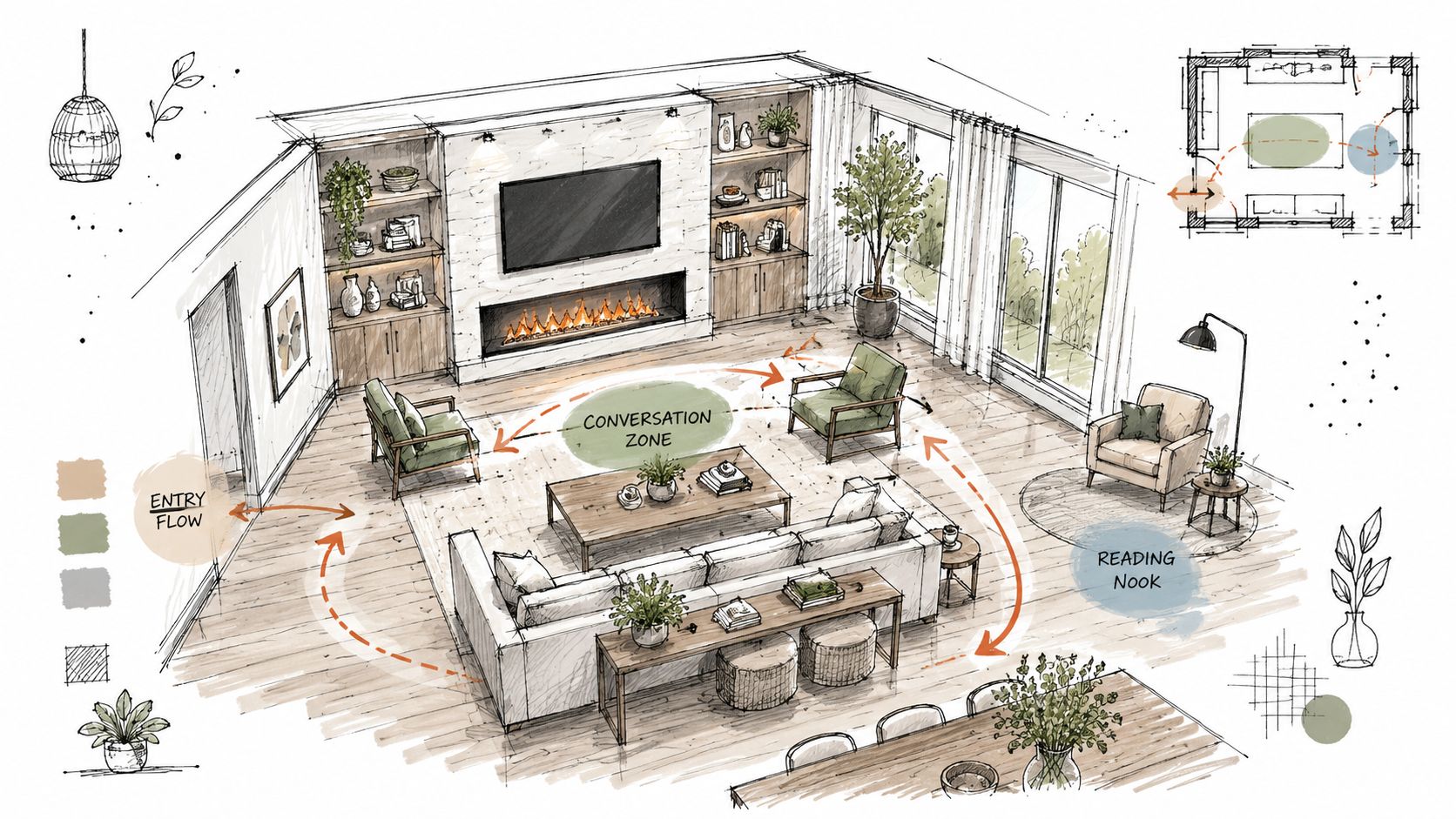
Design best practices recommend planning circulation before moving furniture so the room can be tested on paper first. In many West Texas and New Mexico homes, that matters even more because living rooms often have wide openings, corner fireplaces, long walls, or direct sightlines into dining spaces. A layout that looked fine in your head can break down fast once traffic patterns get involved.
Start with the room you actually have
Good floor plans are plain, practical documents. They answer placement questions before you spend a morning shoving furniture from one wall to another.
Measure the walls first. Then mark the features that control what can go where.
- Openings: every door, archway, cased opening, and pass-through
- Fixed features: fireplaces, built-ins, windows, alcoves, and odd corners
- Utilities: outlets, switches, vents, and floor plugs
- Vertical details: ceiling height, low windows, beams, and where tall pieces may feel too heavy
Those details change the plan more than people expect. I have seen a sofa fit the wall on paper and still fail in the room because it covered a vent, crowded a doorway, or left no good place for lighting.
Draw a sketch that helps you make decisions
The sketch does not need design-school polish. Graph paper works. Painter's tape on the floor works. A simple scaled drawing works well because it lets you test options while your back is still fresh.
This is the professional workflow homeowners can use on their own. Draw the shell of the room. Add openings and fixed elements. Drop in the large pieces to scale. Then study what happens around them. That process turns layout from a talent issue into a solvable problem.
Sofa dimensions are one of the first places mistakes show up. Use outside measurements, not just seat width, and compare your plan against a sizing reference like The Sofa Cover Crafter's dimensions guide before you buy or rearrange.
A quick paper test can answer the questions that matter most:
- Can someone cross the room without cutting through the main seating area?
- Do doors, drawers, and recliners have enough room to open fully?
- Does the furniture create a clear zone, or does it leave pieces floating without purpose?
That last question is where many layouts improve. In a Spanish-style home, the right answer may be pulling seating toward the fireplace instead of pushing everything to the walls. In a newer open-plan home, it may mean using a sofa and pair of chairs to shape a conversation area without blocking the path to the kitchen.
A room map gives you options. It also makes the showroom more useful, because you can judge whether a piece belongs in your home instead of hoping it will somehow work once it arrives.
Define Your Room's Purpose and Flow
A family room in Lubbock may need to handle Friday night football, weekday homework, and a straight shot to the patio. A formal sitting room in Santa Fe may center on conversation and a kiva fireplace. Good layout starts once that job is clear.
Rooms that try to serve every purpose equally usually feel unsettled. The chairs are angled halfway to the TV, halfway to each other. The coffee table lands in the walking path. Nobody is fully comfortable because the room never made a decision.
Choose the job before choosing the layout
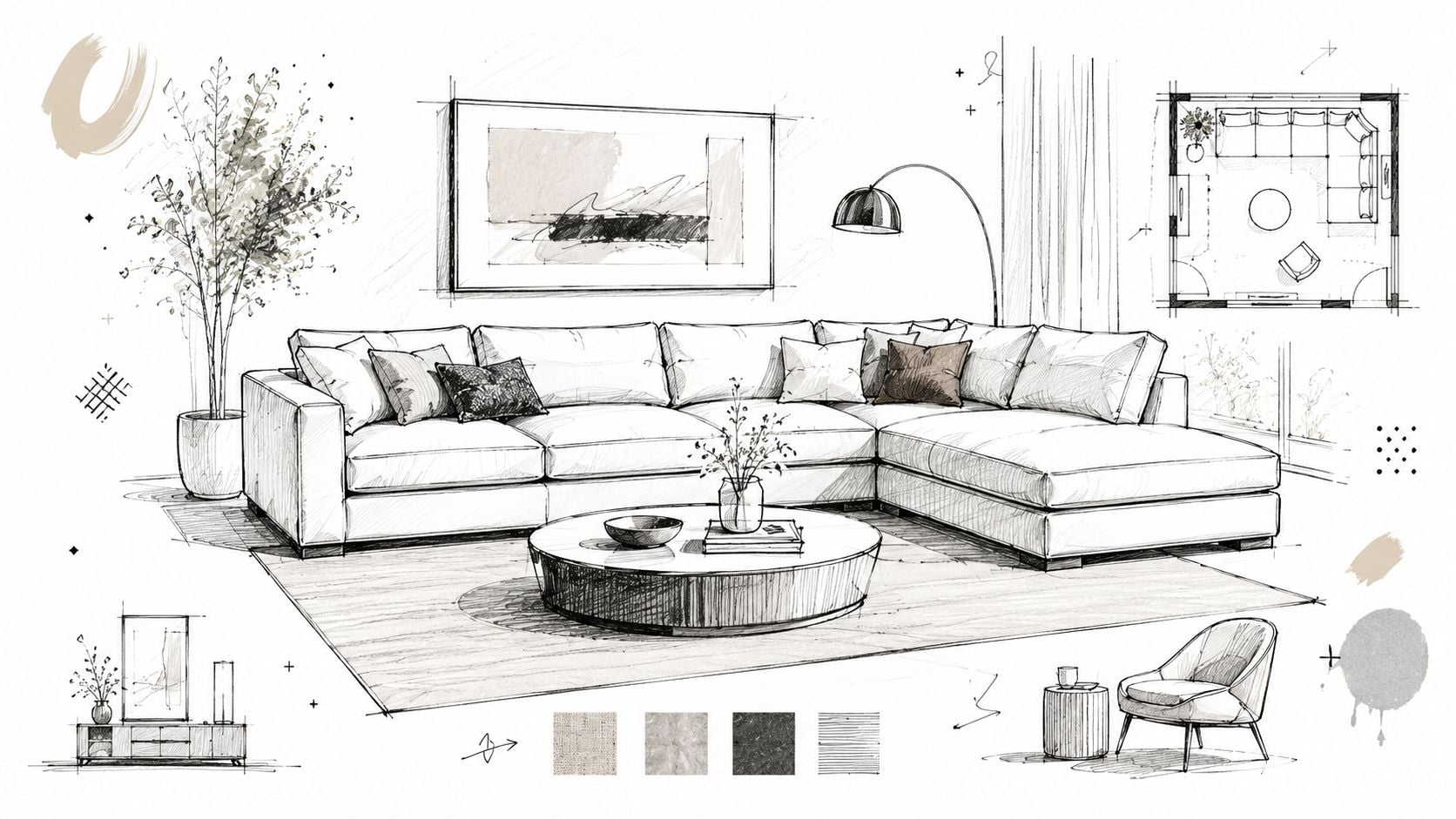
Start by naming the room's lead function. One purpose should guide the arrangement, even if the room handles several uses during the week.
For example:
- Conversation-first rooms work better when seats face each other with a shared table surface between them.
- TV-first rooms need clean sightlines and seating that does not force everyone to turn their necks.
- Fireplace-first rooms should give the hearth visual priority, especially in older Spanish or Territorial homes where the fireplace is part of the architecture.
- Multi-use rooms need one clear leader and a few supporting roles, not equal weight for every activity.
That choice saves time later. It also makes shopping easier, because you can judge whether a piece supports the room's job instead of asking it to solve every problem at once. If you need help sorting out realistic sizes before you commit, this guide to living room furniture dimensions gives useful benchmarks for sofas, chairs, and tables.
Protect the paths people actually use
Flow is the part homeowners often feel before they can name it. The room may look fine in a photo and still be irritating every day.
Protect the routes people use without thinking. From the kitchen to the sofa. From the front door to the hallway. From a favorite chair to the lamp or drink table. In many West Texas and New Mexico homes, the living room also connects to a dining area, fireplace wall, or outdoor space, so circulation has to stay open without making the seating feel scattered.
One rule I come back to often is simple. The best seat in the room should not sit in the main travel lane.
Open plans need extra discipline here. Closed rooms usually have clearer boundaries, but open rooms can lose their shape fast if every edge is treated like a shortcut. In those spaces, a sofa, pair of chairs, or console can define where people gather and where they pass through.
Use a practical decision filter
Before you commit to a layout, run the room through three questions:
- What happens here most often?
- What feature deserves attention first?
- Which path needs to stay easiest every day?
That order matters. A fireplace may be beautiful, but if the room is used for nightly TV viewing, the layout has to respect both. A large sectional may seat everyone, but if it blocks the route to the back patio, the room will feel clumsy no matter how good it looks.
Professional layout work is rarely about memorizing rules. It is about making clear choices in the right order. Once the purpose and flow are settled, the furniture has a much better chance of landing where it belongs.
Scale and Place Your Anchor Furniture
A living room usually starts making sense once the largest piece is in the right spot. In many homes, that piece is the sofa. In others, it is a sectional that has to handle TV time, visiting, and everyday family traffic without making the room feel crowded.
That is why anchor furniture deserves its own step in the workflow. If the scale is off, every other decision gets harder. A sofa that is too deep can shrink the usable room. A sectional that is too long can force awkward side tables and undersized chairs. Even a coffee table that looks fine in the store can feel stranded once it sits in front of a full-size sofa.
Let the sofa set the standard
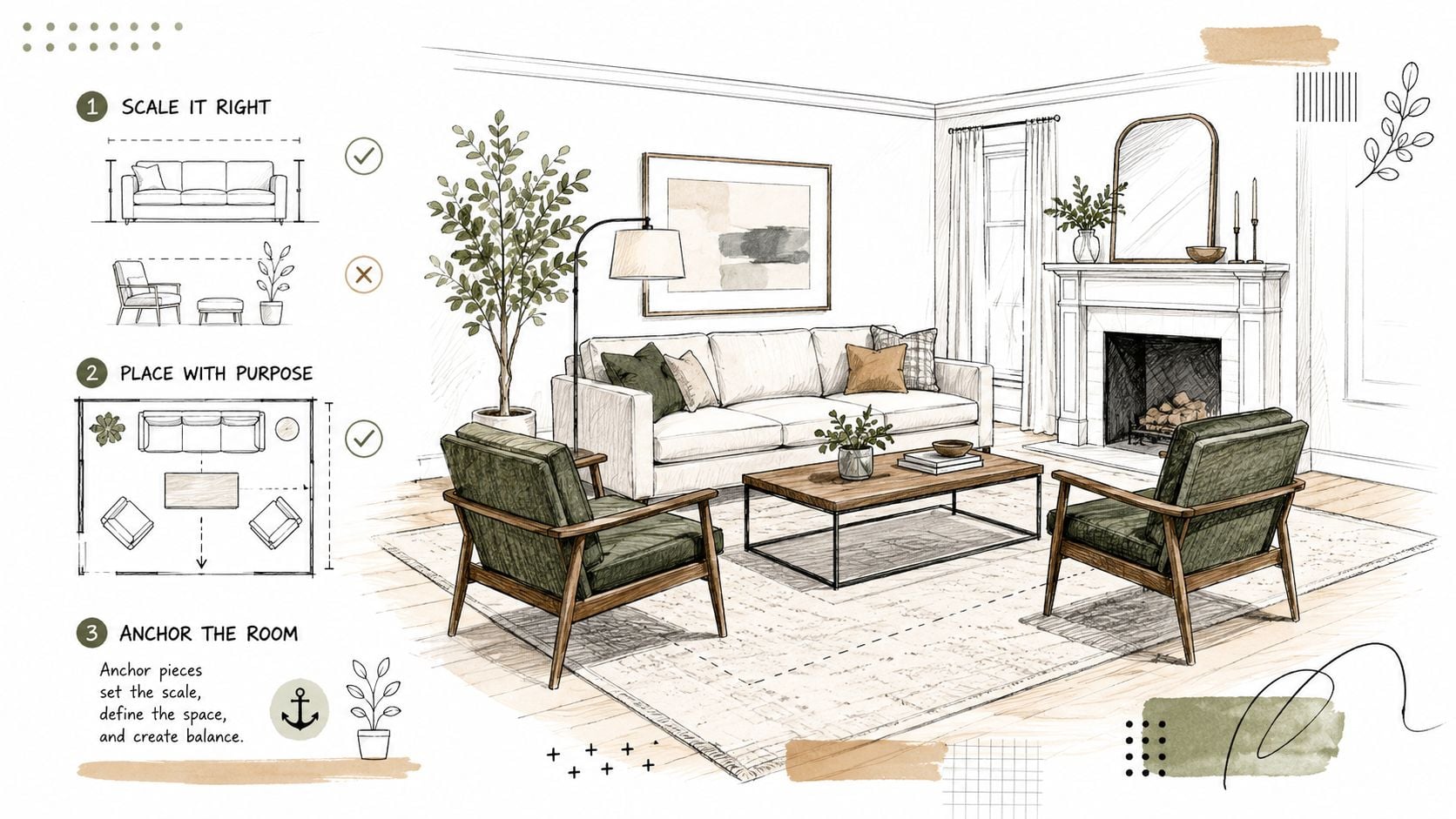
Start by sizing the sofa to the wall or seating zone it anchors. A good rule is to keep it visually substantial without letting it consume the span. In practice, that often means choosing a sofa that feels comfortably shorter than the wall behind it, with enough room left for breathing space, end tables, or a floor lamp.
Then size the table to the seating, not to the room. Coffee tables usually look and work better when they relate clearly to the sofa length and seat height. The goal is simple. People should be able to reach the table easily, set down a drink without stretching, and walk around it without turning sideways.
I also advise clients to test one move before they rule it out. Pull the sofa a little off the wall. In a long ranch-style room in West Texas or a newer open-plan home in eastern New Mexico, that small shift often gives the seating group more shape and keeps the room from feeling like furniture was parked around the edges.
Furniture needs a little air around it.
A homeowner sorting through depths, arm styles, and overall footprints can use this living room furniture dimensions guide to compare pieces before buying. That kind of check saves people from the common mistake of choosing by appearance first and floor plan second.
Use proportion to build the rest of the group
Once the anchor piece is set, the supporting pieces need to match its scale and purpose. Balance matters more than perfect symmetry. Two identical chairs are sometimes right. In plenty of real rooms, one swivel chair and one stationary chair do a better job because they solve different needs without making the arrangement feel stiff.
Here are the checks I use most often:
- Connection: every main seat should feel part of one conversation area, not pushed to the perimeter like overflow seating.
- Reach: side tables and drink tables need to sit where a person can use them.
- Weight: a heavy recliner, broad-arm chair, or chunky leather piece needs enough visual presence across from it to keep the room from tipping to one side.
- Function: if the room serves both TV viewing and conversation, angle or swivel seating can keep the arrangement flexible without requiring a full sectional.
This is also the stage where furniture selection and layout planning meet. Miller Waldrop Furniture & Decor helps homeowners compare seating styles, custom options, and room sizes so the pieces fit the plan they have already worked out, instead of forcing the room to adapt after the fact.
Common anchor mistakes
| Mistake | Why it fails | Better move |
|---|---|---|
| Oversized sofa in a tight room | It crowds the seating zone and makes nearby pieces harder to place | Choose a sofa with a trimmer depth or shorter length |
| Tiny coffee table with a full-size sofa | It feels disconnected and is less useful day to day | Scale the table to the main seating group |
| Every piece pushed to the walls | The center feels empty and the seating lacks shape | Float key pieces inward to create a defined gathering area |
| Too many same-size seats | The room loses hierarchy and starts to feel flat | Let one main piece lead, then support it with varied seating |
Good layouts rarely happen by accident. They come from choosing one anchor piece first, sizing it accurately, and letting the rest of the room answer that decision.
Sample Layouts for Common Scenarios
A good layout solves a specific problem. In a ranch house outside Lubbock, that problem might be a long room with one solid wall for the TV. In a Santa Fe-style home, it might be a living area that has to respect vigas, a fireplace, and a main walkway at the same time. The right starting pattern gives the room order before you start swapping pieces around.
Use these layouts the way a designer would use them. Start with the room shape, match it to the pattern that fits the job, then adjust for how your household lives. That approach saves time and keeps you from forcing a beautiful sofa into the wrong plan.
Living Room Layout Templates
| Layout Type | Primary Goal | Key Furniture Placement | Best For |
|---|---|---|---|
| Conversation circle | Talking and visiting | Sofa faces chairs, table centered, TV treated as secondary | Formal living rooms, visiting spaces |
| TV plus conversation hybrid | Shared viewing without losing connection | Main sofa faces focal wall, swivel or angled chairs soften the setup | Family rooms, everyday use |
| Floating sectional zone | Define a seating area inside a larger room | Sectional sits off the walls and creates its own boundary | Open-concept homes |
| Narrow-room cross layout | Make the room feel wider | Seating arranged across the width instead of only along the length | Long, narrow living rooms |
| Two-zone layout | Separate activities cleanly | Main seating in one zone, desk or reading nook in another | Large rooms, L-shaped spaces |
How to choose the right template
A conversation circle suits rooms where people gather to visit first. Place the sofa opposite a pair of chairs or a loveseat so faces are easy to see and the center table is useful from every seat. This layout works especially well in older homes with a fireplace, large front window, or another architectural feature that deserves attention.
A TV plus conversation hybrid is the workhorse plan for real family living. The sofa still acknowledges the screen, but the side seating turns inward enough for people to talk without feeling like they are lined up in a waiting room. In my experience, this is often the best answer for households that want one room to handle movies, company, and everyday downtime without constant rearranging.
A floating sectional zone helps large rooms feel settled. Instead of letting every piece drift to the perimeter, the sectional creates a defined living area in the middle of the space. This pattern is common in open-concept homes across West Texas and New Mexico, where one large room may connect living, dining, and kitchen functions. A console behind the sectional can add storage and a place for lighting while keeping the seating area visually contained.
A narrow-room cross layout is worth trying in long living rooms that feel like hallways with furniture. Running everything down the length usually makes that problem worse. Turning the seating group across the room can restore balance and make conversation easier because the seats are closer together.
A two-zone layout works when the room already wants to split into separate uses. One end can hold the main seating group, while the other becomes a reading corner, game table, or compact desk area. The key trade-off is restraint. Each zone needs enough furniture to feel intentional, but not so much that the room starts reading as crowded.
Smaller rooms need even tighter editing. If every piece has to work hard, these decorating ideas for small living rooms can help you choose a layout that leaves breathing room without giving up comfort.
Once the furniture pattern is set, floor coverage matters too. Homeowners comparing wood, tile, or mixed flooring can use this guide to find the right rugs for your floors, especially when the rug needs to support the layout instead of just filling empty space.
Complete the Room with Layers and Light
A layout can be technically correct and still feel unfinished at 7 p.m. when the room is too dark to read, the rug is undersized, and nobody has a place to set down a drink. That last layer is what turns a furniture plan into a living room people use.
The goal is support. Rugs define the seating area. Tables make each seat practical. Lighting gives the room range, so it works for conversation, reading, TV time, and quiet evenings without relying on one harsh overhead fixture.
Anchor the seating with a rug
The rug should hold the furniture group together. In most living rooms, that means a size large enough for at least the front legs of the main seating pieces to rest on it. A rug that only sits under the coffee table leaves the arrangement looking disconnected, even when the furniture placement is right.
That choice gets more important in West Texas and New Mexico homes, where hard flooring is common and large rooms can feel echoey without some softness underfoot. Homeowners trying to find the right rugs for your floors should weigh durability, texture, floor protection, and how the rug fits the furniture footprint.
Material matters too. A low-pile rug usually handles traffic and chair movement better in a busy family room. A thicker rug can add comfort, but it may interfere with some coffee tables or make a smaller room feel heavier than it needs to.
Use lighting to support the way the room works
Good lighting follows the seating plan. A reading chair needs focused light at shoulder height or slightly above. A sofa floating in the room often needs lamps on a console or end tables so the center of the room does not go dim after sunset. A neglected corner can become a useful seat once it has the right light beside it.
Most well-finished living rooms use three kinds of light:
- Ambient light: overall illumination for the room
- Task light: focused light for reading, hobbies, or a side chair
- Accent light: softer light that adds depth and helps the room feel settled
I tell homeowners to test lighting from every main seat, not just from the doorway. A room can look balanced when you walk in and still fail the minute someone sits down with a book or tries to visit without squinting.
Small pieces finish the job. Side tables need to sit close enough to reach comfortably. A console behind a floating sofa can make the back of the seating area look intentional and give lamps a proper home. Accessories should add texture and personality, but they should never crowd the circulation paths you worked out earlier.
A strong living room layout is more than furniture in the right places. It is a room that feels grounded, useful, and comfortable from morning through evening.
For homeowners ready to move from ideas to a workable plan, Miller Waldrop Furniture & Decor offers living room furniture, custom-order options, and design support that can help turn a measured layout into a room that fits the way the household lives.