


Ashley Furniture Credenza: How to Choose the Right One


Sarah has a tape measure in one hand and a furniture search open on her phone. The Lubbock first-time homeowner is standing beside an empty 72-inch dining-room wall opposite the kitchen entrance, trying to decide whether a credenza will solve the space or crowd it. The inherited buffet already feels too tall and too dark against the new paint, but the word “credenza” still sounds like a design term rather than a practical purchase.
That uncertainty is common. An Ashley Furniture credenza can store serving pieces, hide household clutter, support lamps and art, or function as a home-office return. The right choice depends less on the catalog photo than on the wall, the traffic path, the objects going inside, and the delivery plan. Readers who want to explore how furniture scenes can be visualized before purchase may also find this guide to batch scene generation for e-commerce useful.
By the end, Sarah should be able to judge whether a credenza fits the room, the workflow, and the budget before visiting a showroom. The same method works for a new mover in Hobbs, a renter furnishing an entryway, or a property manager preparing a flexible office.
Picture the Credenza Working in Your Room
Sarah's empty wall needs to do three jobs. It must hold the serving pieces that currently have nowhere to go, give the dining room enough visual weight to feel finished, and avoid interfering with the daily path between the kitchen and the table. A credenza succeeds only when it handles all three.
Her first question shouldn't be which finish looks attractive online. It should be what the cabinet needs to hold. If the contents include platters, table linens, small appliances, or barware, adjustable shelves and enclosed doors matter more than decorative legs. If the wall sits in a passage, a shallower silhouette may be safer than a deep cabinet with protruding hardware.
Start with the wall, not the product page
A credenza gives a long, low wall a job. In a dining room, it can act as a serving station. In an entryway, it can collect keys, bags, and mail. In a home office, it can hide files, electronics, and supplies while keeping the main desk clear.
Ashley's broad furniture catalog makes that flexibility useful. Ashley traces its origins to 1945, when Carlyle Weinberger founded the company in Chicago as a sales organization. The business later became Ashley Furniture Industries in 1976, after Arcadia Furniture and Ashley Furniture were combined, as documented in this company history. That long development helps explain why Ashley-branded casegoods appear in coordinated collections across retail channels rather than as isolated pieces.
Sarah's 72-inch wall doesn't automatically call for the longest cabinet available. The furniture must leave visual breathing room, preserve the kitchen route, and match the scale of the dining table. A showroom advisor can help her compare those tradeoffs in person instead of asking a phone photograph to answer every question.
The practical promise
A good ashley furniture credenza isn't just a storage box. It becomes a working surface, a visual anchor, and a way to control clutter without adding another tall piece to the room.
The decision becomes much simpler when the buyer settles three points first:
- Wall responsibility: Decide whether the unit stores dining goods, office equipment, media components, or entryway items.
- Traffic protection: Measure the walking route, door swings, and nearby chairs before choosing depth.
- Ownership tolerance: Decide whether the buyer can handle assembly, delivery coordination, and damage resolution without local assistance.
Sarah doesn't need to become a furniture specialist. She needs a measured wall, a clear storage list, and an honest idea of how much setup she wants to manage.
What a Credenza Actually Does
A credenza is a low, relatively long storage cabinet. The category overlaps with sideboards, buffets, accent cabinets, and media consoles, which is why product labels can feel inconsistent. Ashley collections may use different names for a similar horizontal silhouette, depending on whether the piece is marketed for dining, living, or office use.
The distinctions still help. A sideboard is often deeper and more focused on serious serving storage. A buffet commonly combines drawers and cabinets for plated meals and linens. A credenza tends to sit lower, run shallower, and emphasize broad concealed storage, sometimes with sliding doors rather than swinging fronts. A media console prioritizes television support and cord access, while a home-office credenza may prioritize adjustable shelves and equipment storage.
Ashley's product language can blur those boundaries. Buyers should judge the construction and layout rather than rely on the label alone. Furniture product lifecycle planning, the kind of work discussed in furniture PLM solutions, helps explain why product families can share silhouettes while serving different room functions.
Three jobs happen at once
A credenza earns its floor space when it performs three practical jobs.
- It anchors a wall. A long, low cabinet gives an empty wall a horizontal line and helps nearby furniture feel arranged rather than scattered.
- It hides clutter. Closed fronts keep cables, paperwork, dishes, games, and household supplies out of sight.
- It creates a display surface. The top can support a lamp, framed art, a serving tray, or a television, depending on the room and the model.
That combination makes a credenza more versatile than a purely decorative console. It can also reduce the need for several small storage pieces that create a piecemeal look.
Practical rule: Choose the credenza by the job it must perform every day, then choose the finish that supports the room.
For shoppers comparing options, the hutch and credenza collection provides a useful starting point for seeing how storage pieces relate to dining furniture. The final decision still requires checking shelf adjustability, door clearance, cable needs, and the usable depth inside the cabinet.
A credenza also changes how a room feels. The right one makes a wall useful without making it busy. The wrong one becomes a low obstacle, a dust shelf, or an awkward cabinet that stores less than its footprint suggests.
Materials, Finishes, and What They Mean for You
Construction matters more than the finish name printed beside a product photograph. Two credenzas can both look like wood while behaving differently during delivery, assembly, and daily use.
Ashley credenzas commonly use a mixed-material strategy. One Signature Design by Ashley example combines solid wood frames, elm veneer, and MDF substrate, while another uses pine wood, veneer, and engineered wood with a distressed finish and two adjustable shelves, according to the Beckincreek credenza specifications. Those materials aren't automatically a weakness. Engineered substrates can remain flatter and more predictable than wide all-solid-wood panels, especially across a broad cabinet.
Read the material stack honestly
The visible face determines much of the look, while the substrate affects stability and assembly behavior. Real wood veneer can provide a more natural grain pattern than a printed surface. MDF and other engineered panels offer a consistent base for veneer or paint. Solid wood frames can strengthen the areas that carry hinges, legs, and case connections.
That mixed approach makes practical sense for a wide casegood. Seasonal movement in all-solid wood can contribute to door-rub or alignment issues, while a stable substrate helps preserve flatter panels. Adjustable shelving also spreads storage across several bays, which is useful when the cabinet will hold office equipment, binders, or media components rather than only lightweight décor.
Finish changes the buying experience as well. A dark walnut laminate can look polished from across a room but reveal a more uniform pattern up close. A wire-brushed oak veneer usually brings more visible variation and texture. Painted MDF creates a clean appearance, but exposed corners deserve care because chips are easier to notice on a painted edge.
Assembly and longevity
Many flat-packed casegoods rely on cam-lock hardware and similar connectors. Those fasteners can work well when panels align correctly and the installer tightens each connection properly. More substantial lines may use doweled joints or stronger metal-to-metal connections in structural areas, but a photograph of hardware doesn't prove that every joint uses the same method.
A buyer planning to keep the credenza for years should inspect the details that hands touch:
- Door alignment: Uneven gaps usually signal an adjustment or assembly issue.
- Shelf support: Strong, well-spaced supports matter more than a decorative back panel.
- Top construction: Veneer over a stable substrate can provide a useful balance of appearance and predictability.
- Edge treatment: Sealed edges resist everyday wear better than exposed, sharp panel edges.
A modestly styled cabinet with solid alignment and sensible materials will usually age better than a dramatic finish hiding weak construction.
The correct match depends on the planned use. A lightly used entry cabinet can justify a value-oriented construction. A dining credenza that opens daily, or an office unit carrying equipment, deserves closer attention to hinges, shelves, panel stability, and finish durability.
Right Size, Right Room
A credenza can look balanced in a showroom and oversized at home. Measuring the wall is only the beginning. The buyer also needs the walking clearance, doorway route, nearby furniture, and height relationships.
Ashley examples commonly occupy an executive-office footprint of approximately 60 inches wide, 18 to 22 inches deep, and 30 to 30.75 inches high, with reported weights from about 85 to 98 pounds, depending on configuration and materials, as shown in this home-office furniture specification document. That footprint works well for many dining rooms and offices, but it can overwhelm a narrow hall.
Use a tape-measure checklist
Before shopping, the buyer should record:
- Wall length: Measure the usable wall, excluding trim, doors, and openings.
- Available depth: Mark the maximum cabinet depth without interfering with chairs or circulation.
- Walking path: Leave a comfortable route in front of the piece, especially between a kitchen and dining area.
- Door and drawer travel: Open nearby doors, drawers, and the credenza fronts on the floor plan.
- Vertical clearance: Check window sills, outlets, artwork, and the bottom edge of a wall-mounted television.
- Delivery route: Measure the entry door, hallway turns, stair access, and elevator or porch approach if relevant.
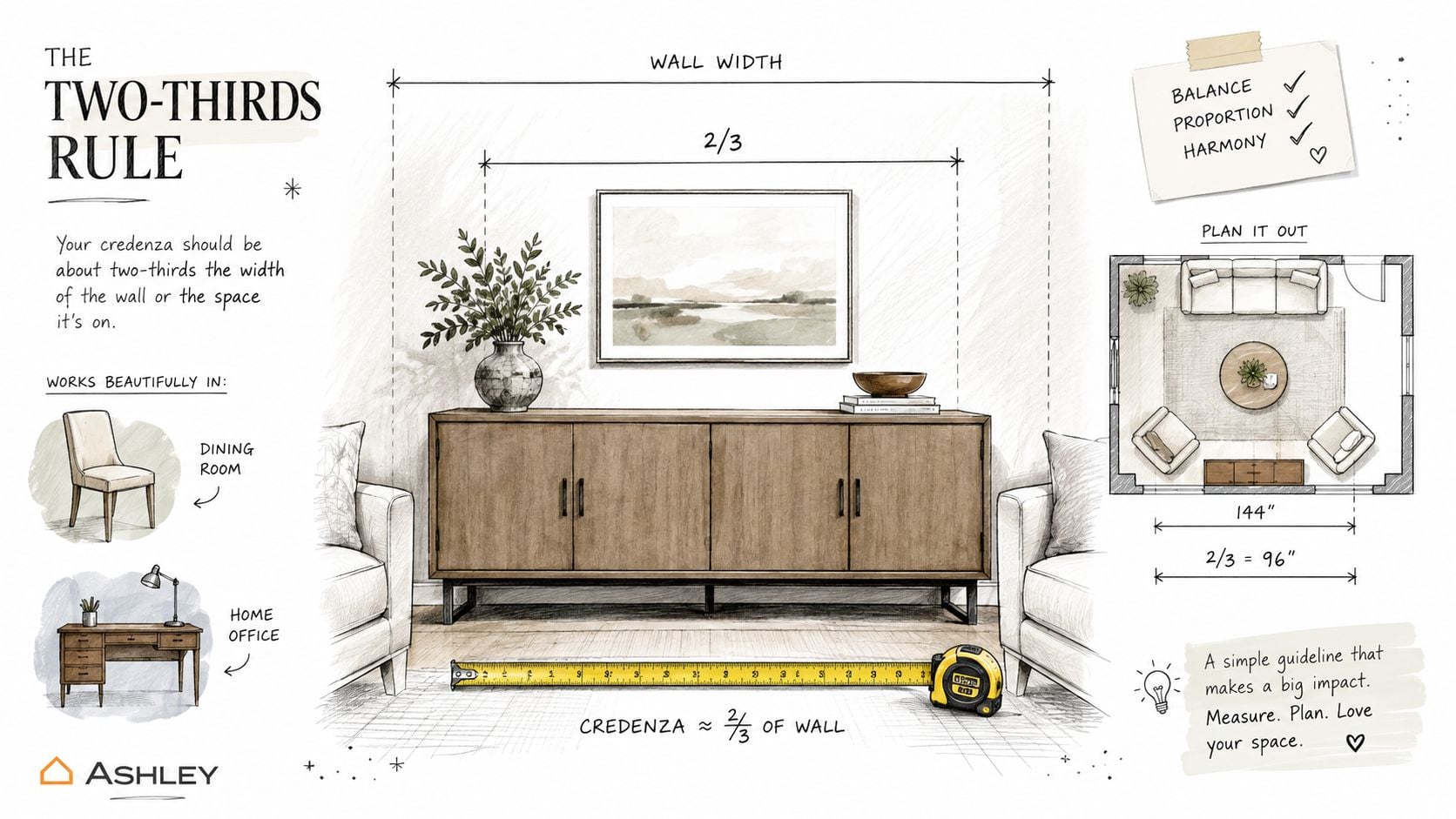
For wall proportion, the two-thirds rule offers a useful starting point. A credenza should generally occupy about two-thirds of the wall rather than touching both corners. The rule isn't a command, but it prevents a long cabinet from swallowing the architecture.
Match depth to traffic
Console-depth pieces around the shallower end of the common range preserve circulation. Deeper units provide more interior volume and can better support substantial equipment, but they need a more generous room. The dining room furniture with storage collection can help buyers compare storage formats before committing to a footprint.
A 30-inch height can work naturally beside a desk or beneath a display surface, but window and television placement still control the final choice. If the unit dominates the wall, the correct answer isn't a larger room accessory. It's a smaller footprint, a shallower cabinet, or a sideboard with a lighter visual base.
Comparing Popular Ashley Credenza Models
Model names matter less than the relationship between width, storage layout, finish, and intended room. The three anchors below illustrate how buyers can compare an Ashley Furniture credenza without getting distracted by staged décor.
The requested model-level details, including exact dimensions, drawer counts, door counts, finishes, weights, and hardware differences for Hammis Brown, Alisdair, and Starmore, aren't included in the verified product data available for this guide. Those specifications can vary by listing and collection, so they shouldn't be guessed from a product photograph. A showroom advisor should confirm the current spec sheet before an order is placed.
Ashley Credenza Model Comparison
| Spec | Hammis Brown (Mid-Century) | Alisdair (Whitewashed Storage) | Starmore (Home Office) |
|---|---|---|---|
| Best design direction | Warm mid-century styling | Light, casual storage styling | Traditional home-office styling |
| Primary use | Dining or living-room storage | Hall, dining, or living-room storage | Office storage or media support |
| Exact width | Confirm current listing | Confirm current listing | Confirm current listing |
| Exact depth and height | Confirm current listing | Confirm current listing | Confirm current listing |
| Drawer and door count | Confirm current listing | Confirm current listing | Confirm current listing |
| Finish family | Brown wood tone | Whitewashed wood tone | Office-oriented wood finish |
| Weight | Confirm current listing | Confirm current listing | Confirm current listing |
| Main check before purchase | Top material and hardware | Finish consistency and door fit | Shelf layout and cord needs |
How to choose among the styles
Hammis Brown is the logical direction for a dining wall that needs warmth and a lower mid-century profile. The risk is visual heaviness if the room already contains dark wood, so the wall color, rug, and dining chairs should provide contrast.
Alisdair suits a brighter, more relaxed interior. Its whitewashed family can help an entryway or dining room feel less dense, but buyers should inspect finish consistency and corner protection because pale finishes show edge damage clearly.
Starmore makes the strongest case for a home office or hybrid media zone. Ashley's office-oriented credenza construction can include adjustable shelving, which supports equipment and supplies more flexibly than drawers alone. Buyers should confirm cable management, shelf clearance, and the actual top surface before placing electronics.
The Janismore Credenza offers a verified reference point for this category. It measures 60 inches wide, 18 inches deep, and 30.13 inches high, and the listing describes open storage with two adjustable shelves. It uses acacia solids, elm veneer, and engineered wood substrate, according to the Janismore Credenza product listing.
The best model is the one whose storage layout matches the room's work. Finish family comes second. Hardware feel, shelf adjustability, and delivery weight should be confirmed before the buyer treats a showroom favorite as a final selection.
The Hidden Costs Most Shoppers Miss
The sticker price isn't the full price of a credenza. Ownership begins with freight, handling, assembly, placement, and the possibility of dealing with damage after delivery.
Neutral industry information identifies online furniture returns as materially higher than in-store returns, with reported rates of around 24.5% online compared with 8.72% in-store, and identifies assembly as a recurring source of negative reviews and return friction for kit products, as discussed by furniture ownership and return guidance. Those figures are industry context, not a guarantee about one Ashley product or one retailer.
Delivery changes the decision
A broad casegood may arrive flat-packed or as a heavier assembled unit. The final handling plan affects whether the buyer needs two adults, whether stairs create a problem, and whether the package can reach the intended room without damage. Threshold delivery, room placement, and white-glove service can carry different charges, so buyers should ask for the complete delivery path rather than assuming the checkout total answers everything.
Assembly deserves the same direct attention. Cam-lock panels, doors, shelves, and hardware may look simple in a product photo, but rushed installation can create misaligned fronts, loose connections, or damaged edges. The buyer should decide whether the household will assemble the unit, hire help, or choose a delivery option that includes setup.
Return friction deserves a plan
A credenza isn't easy to box again after it has been assembled. Packaging may be discarded, the unit may be too heavy to move, and a return can require coordination with the retailer or carrier. A media-use credenza may also require power accessories and careful cable planning, which adds to the setup even when those items aren't part of the furniture purchase.
The sensible budget includes:
- Delivery handling: Confirm the service level and room placement before purchase.
- Assembly responsibility: Establish who will build, level, and adjust the cabinet.
- Damage procedure: Photograph the carton and product immediately if a problem appears.
- Use accessories: Plan for cable routing and electrical protection when electronics sit on or inside the unit.
- Replacement risk: Consider whether a slightly stronger construction is preferable to replacing a budget piece after avoidable wear.
The value question isn't whether the cabinet is affordable today. It's whether the total ownership process fits the buyer's schedule, physical space, and tolerance for follow-up.
Why Buying Local Changes the Experience
An online listing can show a finish, but it can't show how the finish responds to the buyer's lighting. It also can't let the shopper test a drawer glide, check door alignment, or compare the cabinet's depth against nearby chairs.
A Miller Waldrop Furniture & Decor showroom visit gives the buyer a practical decision point before payment. The shopper can bring wall measurements, a room photograph, and a finish sample from existing furniture. Staff can place those references beside Ashley catalog options and help identify which silhouette belongs in the room rather than just which photograph looks appealing.
A useful showroom appointment
The consultation should answer specific questions:
- Room fit: Does the width respect the wall and leave the circulation route clear?
- Finish relationship: Does the wood tone work with flooring, dining chairs, trim, and lamps under actual showroom lighting?
- Storage function: Will shelves, drawers, doors, and openings hold the intended items?
- Delivery route: Can the cabinet reach the room through the home's doors, halls, and turns?
- Service expectations: What happens if hardware is missing, a panel arrives damaged, or a finish defect appears?
The showroom isn't just a place to browse. It connects the Ashley catalog to the buyer's actual living room. That connection is especially useful for movers who haven't yet learned how the new home's scale and lighting change furniture choices.
Miller Waldrop coordinates furniture shopping through showrooms serving Lubbock, Hobbs, and Ruidoso Downs, giving local buyers a place to discuss ordering, availability, and delivery logistics in person. The furniture store information can help shoppers identify the appropriate location and plan a visit, although the buyer should confirm current showroom details directly.
Local accountability has practical value
A damaged credenza creates less uncertainty when the buyer knows where to take the issue. A regional furniture dealer can help document the condition, identify missing parts, communicate with the warehouse, and coordinate the next step instead of leaving the shopper to manage every conversation alone.
Before ordering: Bring the wall measurement, a room photo, nearby finish samples, and a list of must-have features. Those four items make the consultation more productive.
The right showroom experience doesn't eliminate every delivery problem. It gives the buyer a clearer plan for preventing fit mistakes and resolving issues when they occur.
Your Next Step Toward the Right Credenza
A successful purchase comes down to three decisions:
- Measured footprint: Confirm the usable wall, depth, clearance, and delivery route.
- Chosen style family: Decide whether the room needs warm mid-century character, a lighter whitewashed look, or office-focused storage.
- Confirmed delivery path: Establish assembly, placement, damage handling, and service expectations before the order is finalized.
The next move can be simple. Browse the current Ashley credenza selection on the Miller Waldrop website, book a free in-store design consultation at the Lubbock, Hobbs, or Ruidoso Downs showroom, or walk in with measurements and finish swatches. A photo of the room helps staff judge scale, while a list of required features, such as file drawers, adjustable shelves, or cord management, keeps the conversation focused.
A credenza should solve a room problem, not create a new one. See the piece in person, verify the fit, and confirm the delivery plan before committing.
Miller Waldrop Furniture & Decor offers Ashley furniture selections, design guidance, and local support for shoppers choosing storage that fits their rooms and routines. Visit Miller Waldrop Furniture & Decor with room measurements and photos, then get help selecting and ordering the credenza that makes sense for the space.