

Custom Dining Tables: The Complete Buyer’s Guide

You've found a table you love, measured the dining room, and still can't tell whether six chairs will leave enough space to move around it. That uncertainty is exactly where custom dining tables earn their value. The right piece isn't merely attractive. It accommodates the household's routines, supports everyday wear, and gives the room a proportion that feels intentional rather than crowded.
A custom order also creates decisions that showroom shopping tends to hide. Wood moisture content affects stability, surface hardness affects durability, and a fashionable shape can change how comfortably guests sit. The strongest choice balances room dimensions, construction, maintenance, and personal style instead of treating appearance as the only priority.
The Heart of Your Home Awaits
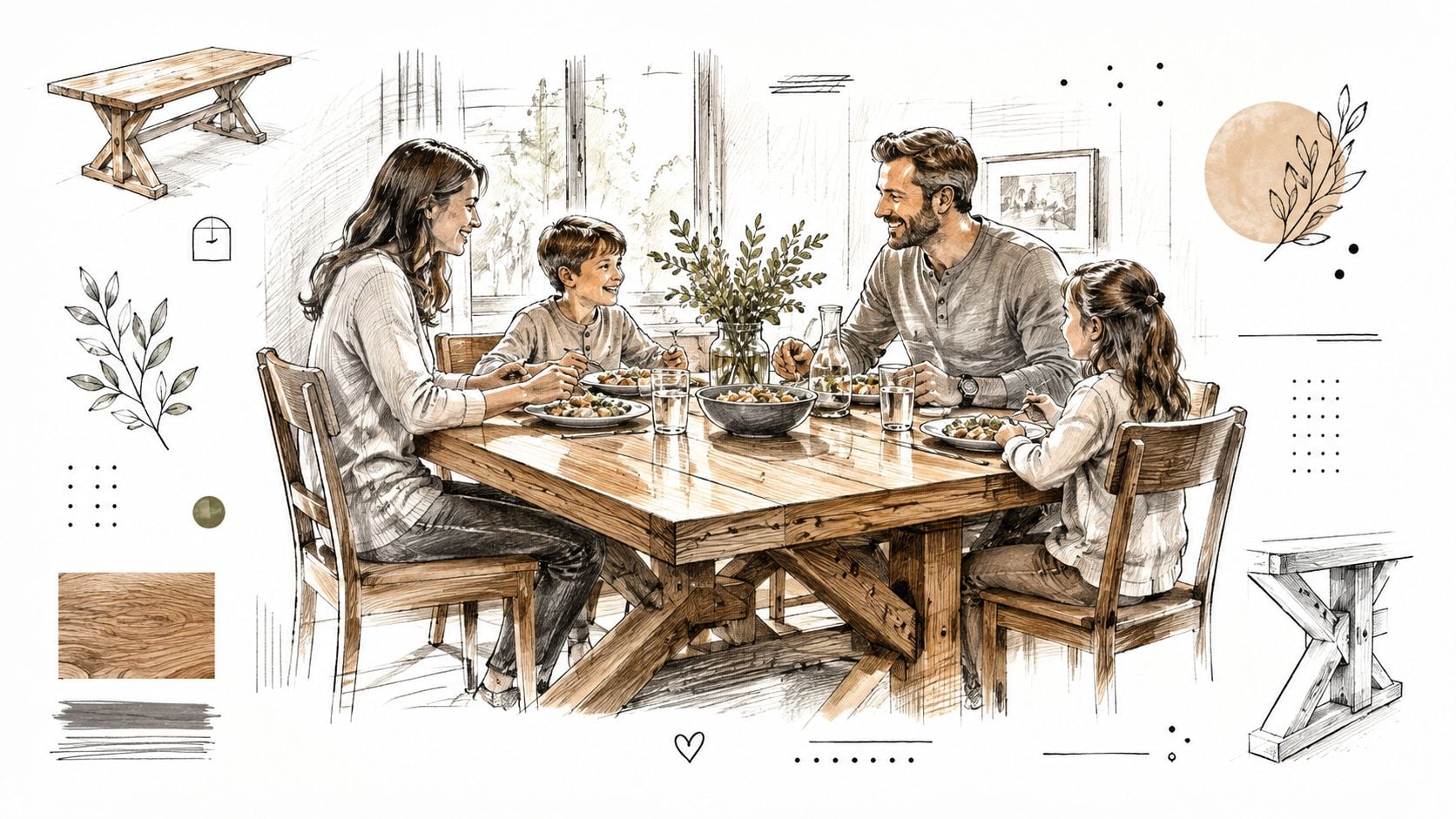
A dining table earns its place through daily use. Breakfast before school, homework after work, holiday dishes, board games, and long conversations all test the same surface. In a narrow room, the design must also support an ordinary family dinner and a larger gathering without blocking circulation.
That need for flexibility has a long history. Dedicated dining rooms became more common in Europe during the 18th century. By the Georgian period, roughly 1714 to 1830, cabinetmakers were producing permanent dining tables as a distinct furniture category. Improved domestic architecture and imported Caribbean mahogany helped establish the table as a defined part of the dining room. Extension and leaf systems addressed a practical constraint: households needed a smaller footprint for daily meals and more seating for formal dinners. The history and development of custom dining tables explains how flexibility became part of the category's purpose.
Beauty has to support the routine
A statement top can anchor an open-plan home, provided chairs still have room to pull out. A thick wood slab adds visual weight and warmth, but its moisture content and joinery matter as much as the grain. An extendable design accommodates guests, while its mechanism adds construction complexity and requires adequate space to open and close.
Custom dining tables now span broad styles and price bands, making customization a mainstream option rather than a niche service. One large resale marketplace listed 4,963 custom made dining room tables, with average selling prices around $5,400 and a range from $250 to $35,000. Those figures show how the category includes accessible and luxury segments. Current custom dining table market availability also shows that dimensions can be personalized, from compact formats to tables measuring up to 48 by 120 inches.
The attractive option is not always the durable one. A delicate finish may suit a formal room but demand careful maintenance. A pale, highly figured surface can reveal scratches, spills, and heat marks sooner than a darker or more forgiving finish. Design decisions should account for the household's actual habits, not only the first impression in a showroom.
Start with life, not the showroom
Record who uses the room, how often guests visit, whether children will work at the table, and whether it must double as a desk. Those answers help determine whether an expandable rectangle, softened oval, or compact round top fits the household.
A successful design supports daily life without constant caution. It gives each person usable elbow room, keeps paths open, and makes the room welcoming during both ordinary meals and larger gatherings. Style sets the direction. Construction, surface performance, and the way the table will be used determine whether it remains satisfying after the first dinner party.
Mastering Sizing and Clearance Rules
A custom table can correct awkward proportions, but the order should begin with a measured room plan, not a preferred shape. Measure the usable floor area, then mark sideboards, door swings, radiators, islands, and the routes used to carry food in and out. A tabletop that fits the walls can still make daily movement difficult.
Allow about 24 inches of table edge per diner when estimating seating and length. Keep 36 to 48 inches between the table edge and the nearest wall or furniture. Use the wider clearance where the dining area also serves as a main walkway.
Calculate the footprint before the finish
Chairs change the footprint. Allow at least 18 to 24 inches for chair movement, and plan for 42 inches or more behind active seats when people need to pass. Independent ergonomic guidance places overall table height around 28 to 30 inches, consistent with common industry standards. The dining room table size guide can help apply these dimensions to a room-specific layout.
Common proportions provide a starting point, not a fixed prescription:
| Format | Common dimensions |
|---|---|
| Rectangular | 60 to 84 inches long and 36 to 42 inches wide |
| Round | 54 to 60 inches in diameter |
| Table height | 28 to 30 inches |
| Top thickness | 3/4 to 1 inch |
These ranges reflect established dining measurements summarized by a guide to key dining table measurements. Custom work earns its place when the room, seating plan, or circulation pattern falls outside those proportions.
Test movement, not just geometry
A paper plan should show chair depth and the space required to stand. A six-seat table may look suitable from above, then feel cramped when someone at an end seat needs to leave while another person remains seated. Pedestal bases can improve legroom and reduce obstructions between chairs, but they may limit exact chair placement. Four corner legs provide predictable support and a lighter visual structure, although their position can interfere with end seating.
For occasional hosting, the Forever Party Rentals capacity guide offers a useful comparison for rectangular formats. Treat that capacity as an event-planning reference, not a room layout, because rental arrangements often assume open surroundings rather than a furnished home.
Mark the proposed tabletop with painter's tape and place the intended chairs around it. Pull each chair back as someone would when standing, then walk the routes used to serve food. If the taped plan feels tight, reducing the top or changing the base will improve daily usability more than a fashionable silhouette or delicate visual detail. A measured layout protects the table's appearance too, because fewer collisions and cramped movements mean less wear in ordinary use.
Choosing Durable Materials and Finishes
Material selection determines how a custom table responds to spills, heat, scratches, movement, and years of cleaning. Wood species matter, but construction quality and finishing practice matter just as much. A beautiful board assembled before it reaches the correct moisture condition can create problems after delivery, even if the species itself is durable.
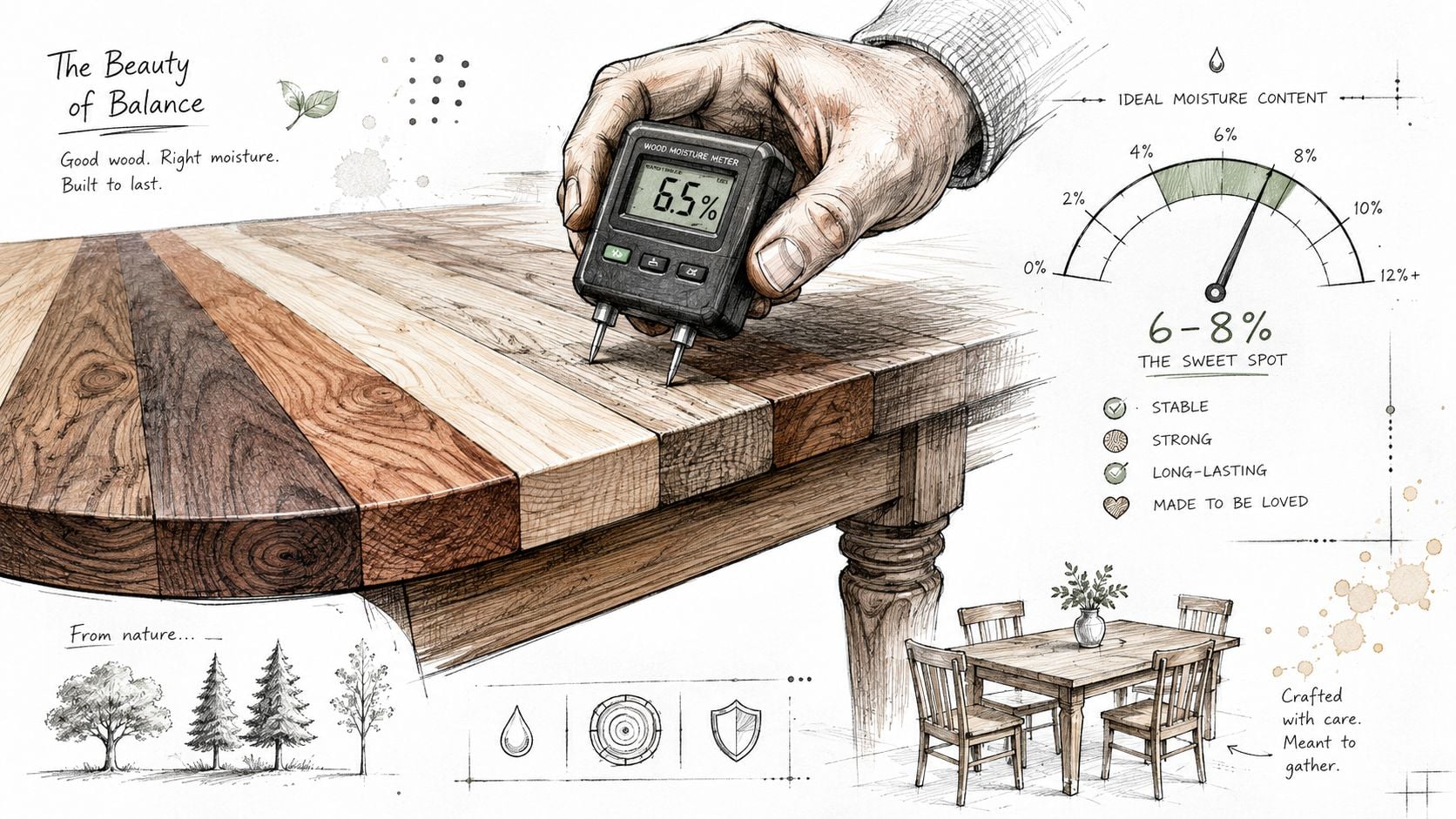
For interior furniture, USDA Forest Products Laboratory guidance points to a target of around 6 to 8% moisture content, with broader interior ranges commonly cited at 6 to 10% depending on climate and product type. USDA guidance on wood moisture content explains the underlying concern. Wood assembled too wet can continue shrinking inside a conditioned home, loosening joinery, opening panel seams, and distorting the top.
Compare wood by use, not just color
Oak, maple, and walnut each create a different visual and tactile result. Oak brings pronounced grain and a familiar, adaptable character. Maple presents a cleaner, more restrained surface and can suit lighter interiors. Walnut offers a deeper tone and expressive grain, often making the tabletop itself the room's focal point.
Hardness provides a concrete screening tool. One woodworking guide identifies a Janka hardness above 1,000 lbf as generally adequate for a dining surface that receives regular use. This practical guide to choosing table wood offers that benchmark, but hardness shouldn't be treated as a complete durability score. A hard surface can still stain, dent at vulnerable edges, or show scratches if the finish and household habits don't match.
The guide to selecting the best wood for tables can help buyers compare grain, tone, stability, and maintenance before committing to a species.
Treat modern surfaces as lifestyle choices
Sintered stone and matte ceramic surfaces create a contemporary look and can suit homes that prioritize a clean, architectural appearance. Warm stone, travertine, beige marble, and mixed-material designs are visually current, but their suitability depends on stain resistance, scratch tolerance, edge treatment, and repair options. A surface that requires careful protection may frustrate a family that wants to set down hot dishes and clean quickly after dinner.
Ask for the exact care instructions, not a general statement that a material is durable. Confirm whether the finish can be renewed, whether an edge can be repaired, and how the maker handles seams or replacement components. Reclaimed or certified timber may support a lower-waste purchasing philosophy, but provenance should be documented and the material should still be properly dried and prepared for its destination climate.
Practical rule: Choose the surface that matches the household's least careful regular use, not its most carefully styled dinner.
Navigating Trends vs. Everyday Usability
Organic shapes, oval tops, rounded corners, pedestal bases, sintered stone, and matte ceramic surfaces can give a dining room a distinctive identity. They can also introduce trade-offs that don't appear in a styled photograph. A rounded table may improve visual flow in a tight room, but it can complicate placement against a wall. A sculptural pedestal can create open legroom, yet its footprint may limit where chairs sit.
The question isn't whether a trend is attractive. The question is whether it solves a real problem for the people using the room. A practical guide to dining table styles can help compare silhouettes, but the final choice should come from the room's circulation and the household's habits.
When a rectangle wins
A rectangular table remains a strong long-term option because it uses wall-adjacent space efficiently, provides clear seating positions, and works well with extension leaves. It also makes place settings easier to organize and offers a predictable edge for homework, serving dishes, or a temporary home office. In a narrow room, that predictability often matters more than an unusual outline.
An oval can soften a passage and reduce sharp corners. A round table can support conversation because every seat faces the center. Those benefits are real, but they need to be weighed against capacity, wall clearance, and the amount of usable edge available to each diner.
Spend on the feature that improves daily life
Mixed materials can be worthwhile when the combination improves performance. A resilient top paired with a stable base may reduce maintenance, while a contrasting wood base can add warmth without placing delicate material across the entire surface. The same combination becomes a poor value if it introduces seams that collect debris or finishes that require constant caution.
Expandable formats deserve similar scrutiny. They make sense for households that regularly shift between small daily meals and larger gatherings. They aren't automatically better for a household that rarely hosts, especially if the extension system adds cost, weight, or storage demands without solving a recurring need.
A durable design should still feel personal, but the most successful statement usually comes from proportion, grain, edge detail, or a carefully selected finish. Those choices create character without sacrificing the table's basic job.
The Custom Order Process Simplified
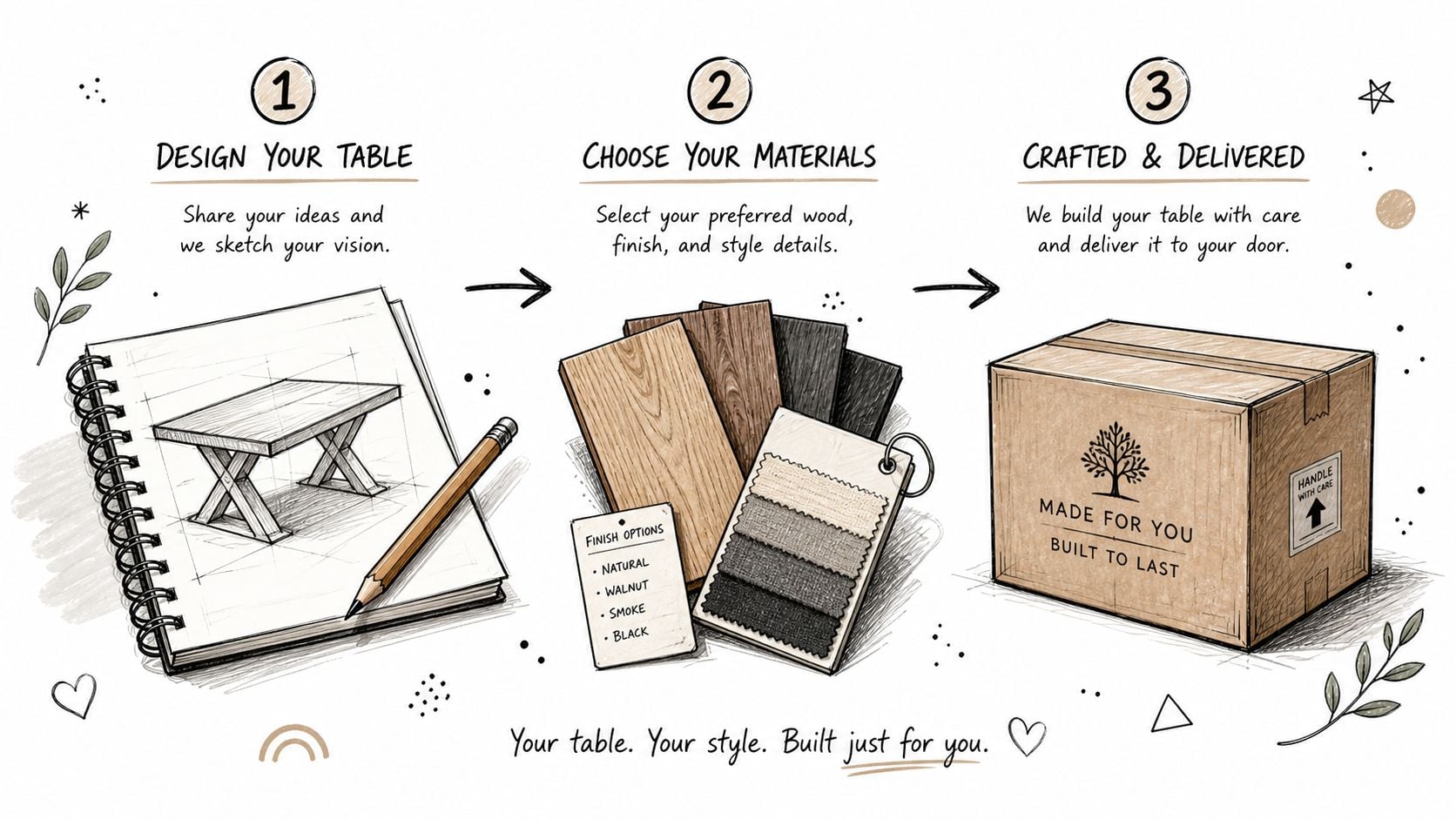
A custom order becomes easier when each decision follows the one before it. The buyer doesn't need to choose a finish before knowing the dimensions, and shouldn't approve a shape before testing the room's circulation. A clear sequence reduces expensive revisions and keeps aesthetic decisions tied to practical requirements.
1. Define the room and the routine
Begin with a measured floor plan and a short use brief. Record the intended guest count, the number of people who eat daily, chair dimensions, nearby furniture, walkway directions, and whether the table must support work or games. A sketch with dimensions gives a designer something more reliable than a verbal description.
The buyer should also identify the home's visual language. Warm and informal rooms may benefit from visible grain and softened edges, while a formal interior may call for a restrained top and a more deliberate base. The design should serve the architecture rather than compete with it.
2. Select construction before decoration
Next, evaluate the material and build details. Ask how the maker verifies moisture content, how the top accommodates seasonal movement, what joinery supports the base, and which finish is appropriate for the expected use. These questions matter because a finish can't correct unstable lumber or an unsuitable structure.
The choice between fixed and expandable construction should come from actual hosting patterns. Extension and leaf systems solve a genuine space problem when daily seating and entertaining capacity differ. A fixed top is simpler when the household uses the same arrangement most of the time.
3. Confirm the touchpoints
Before approving the order, review the top thickness, edge profile, leg placement, base clearance, finish sample, and delivery route. A color sample should be seen in the home's lighting, and a leg design should be checked against the chairs rather than viewed alone. A designer can help coordinate these elements so the table looks intentional from every seated position.
Miller Waldrop Furniture & Decor offers custom order options for fabrics, finishes, and configurations, giving shoppers a way to develop an individual dining piece with design guidance. The retailer's staff can also help coordinate furniture choices across dining and adjacent living spaces, which is useful in open-plan rooms where the table must relate to more than one area.
4. Plan delivery as part of the design
A table can be perfectly specified and still fail to enter the home. Measure doors, stair turns, elevators, gates, and tight hallways before the order is finalized. Confirm whether the top arrives assembled, whether the base separates, and what on-site assembly requires.
A custom order is finished only when the table works in the room, not when the drawing looks complete.
Creating Your Perfect Dining Space
The strongest custom dining tables connect three decisions that are often made separately. Size determines comfort and movement. Material determines how the piece responds to daily use. Form determines how the room feels and how easily the table adapts when the household changes.
A useful decision framework starts with the least flexible constraint. If the room has a narrow passage, solve circulation first. If children use the table every day, select a surface and edge treatment that can tolerate ordinary care. If hosting is central to the household, prioritize an expandable configuration only after confirming that open leaves and pulled-out chairs won't block the room.
Build around the non-negotiables
The buyer can separate requirements into three groups:
- Must fit: table footprint, chair clearance, door paths, and walkway space.
- Must endure: moisture stability, surface hardness, finish care, and repairability.
- Must express: wood tone, silhouette, edge detail, base style, and relationship to the wider home.
This approach prevents an appealing detail from overpowering a practical need. It also makes trade-offs clearer. A simpler rectangle may provide more usable seating, while an oval may improve movement around a sharp corner. A hard wood may suit active dining, while a delicate stone may work better in a more controlled setting.
For broader interiors, a dining table should reinforce the homeowner's overall intention. Resources such as design a home that reflects your style can help connect the dining room's materials, colors, and proportions to the rest of the home without forcing every piece to match.
The final selection should feel specific to the household, but it shouldn't require constant protection from that household. A table earns its place when guests can gather comfortably, children can use it naturally, and the finish develops character without turning every meal into a maintenance exercise.
Miller Waldrop Furniture & Decor offers custom order options for dining furniture, including guidance on size, shape, finishes, and configurations for a table that fits the room and the way it's used. Visit Miller Waldrop Furniture & Decor to explore dining solutions and connect with a design team that can help turn the plan into a confident purchase.