


Your Guide to the Perfect Drift Wood Table Lamp


A room can be well furnished, thoughtfully painted, and still feel unfinished. The sofa fits. The rug is right. The art is good. But the space still lacks that one object that gives it a pulse and makes guests ask where it came from.
That's where a drift wood table lamp earns its place. It doesn't just fill a dark corner. It adds shape, texture, and a sense that the room has a story. In homes across West Texas and Southeastern New Mexico, that matters. The strongest interiors in this region rarely feel overworked. They feel grounded, relaxed, and personal.
Natural materials are part of why this category keeps gaining attention. The global table lamp market is estimated at $2.5 billion in 2025 and is projected to grow at a 5% CAGR from 2025 to 2033, driven by demand for aesthetic lighting and by design preferences for organic materials and sustainable looks, according to Archive Market Research's traditional table lamp outlook. That broader shift shows up in real rooms, where homeowners are leaning toward pieces that soften hard lines and make a home feel collected rather than staged.
People who are focused on crafting a comfortable home environment often discover that texture matters as much as color. A drift wood lamp brings both. It adds visual warmth during the day and a gentler mood at night.
For homes that blend clean architecture with natural finishes, organic modern design ideas offer a useful lens. A drift wood table lamp works especially well in that mix because it introduces an irregular, sculptural form into rooms that can otherwise feel too polished.
Bringing Natural Artistry Into Your Home
A drift wood table lamp often solves a very specific design problem. A room needs contrast, but not clutter. It needs warmth, but not heaviness. It needs a focal point, but not something loud.
Unlike a basic ceramic or metal lamp, driftwood changes the energy of a surface. On an entry console, it turns a pass-through zone into a welcoming moment. On a nightstand, it keeps the bedroom from feeling too matched. On a side table, it can bridge upholstered seating, wood casegoods, and iron accents without fighting any of them.
Why this kind of lamp feels different
Driftwood carries visual movement. Its bends, knots, and weathered grain keep the eye engaged in a way machine-perfect forms don't. That's why it reads more like functional sculpture than accessory.
A good lamp doesn't just occupy space. It helps the room feel finished from every angle.
That matters in open-concept homes, where one piece often has to hold its own from multiple viewpoints. A drift wood table lamp can do that while still feeling relaxed.
Where it fits in regional homes
In West Texas and Southeastern New Mexico, homes often balance practical living with a strong sense of place. Many interiors pull from ranch influences, farmhouse comfort, adobe warmth, or cleaner modern lines. Driftwood works across all of them because it isn't locked into one theme.
A coastal lamp can feel out of place in a dry-land setting if it leans too literal. Driftwood, used thoughtfully, avoids that trap. It reads as natural, sun-worn, and honest. That makes it at home next to leather, plaster, linen, antique pine, black metal, or light oak.
The Art of Nature What Defines a Driftwood Lamp
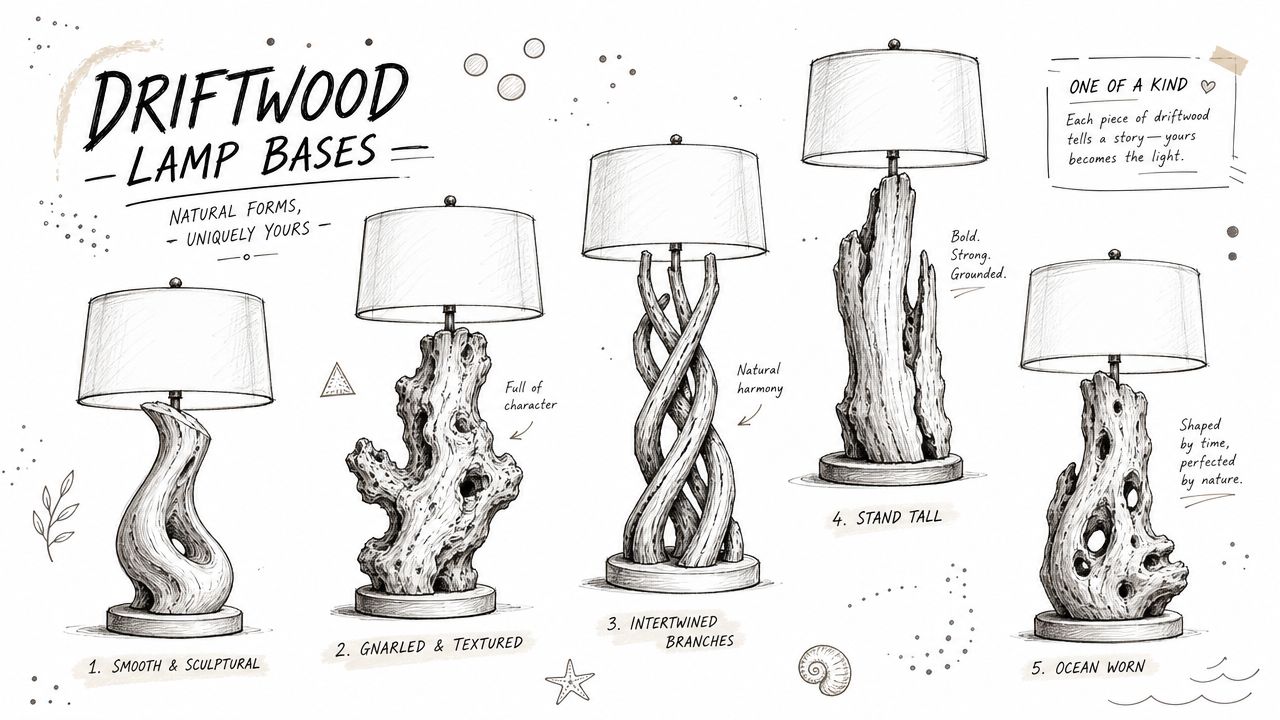
Some driftwood lamps look dramatic and architectural. Others feel quiet and handmade. Knowing the difference helps narrow the search quickly.
The broader appetite for natural wood forms isn't limited to lighting. The aquascaping driftwood market was valued at $0.3 billion in 2025 and is projected to reach $0.52 billion by 2034, according to Market Intelo's aquascaping driftwood report. That doesn't isolate table lamps, but it does reflect sustained interest in natural wood across décor categories.
Three forms that show up most often
The sculptural single-piece base
This style uses one striking branch or root-like form as the star. It tends to feel bold, gallery-like, and a little more refined. It works well in modern rustic rooms where the furniture lines are simple and the lamp needs to provide the personality.
The bundled or stacked branch look
This version gathers several narrower pieces into one base. It usually feels more casual and textural. In farmhouse and relaxed traditional homes, this is often the easiest style to layer because it has presence without feeling precious.
The minimally processed natural form
These lamps preserve irregular edges, twists, and imperfections. They feel earthy, collected, and less formal. They can be beautiful in adobe-inspired interiors or homes that rely on tactile materials more than ornament.
How to read the feeling of the piece
A quick visual test helps.
| Lamp form | What it communicates | Best fit |
|---|---|---|
| Single dramatic branch | Sculptural, edited, elevated | Modern rustic, organic modern |
| Clustered smaller pieces | Warm, approachable, layered | Farmhouse, casual traditional |
| Raw natural form | Earthy, grounded, collected | Rustic, adobe-inspired, eclectic |
The shape matters as much as the finish. A pale, sun-bleached look feels lighter and more coastal-adjacent. A deeper, richer tone can feel more substantial and often pairs better with leather, darker woods, and iron.
Practical rule: Choose the lamp base the same way a designer chooses art. Start with mood, not just color.
For readers who enjoy natural materials beyond wood, genuine rose quartz lighting offers another example of how raw elements can become statement lighting without feeling overly decorative. The lesson is the same. Natural material works best when the form feels intentional.
What works and what doesn't
A drift wood table lamp works when the base has enough visual interest to justify its footprint. It doesn't work when the wood looks generic, overly glossy, or arranged so tightly that it loses all character.
It also helps to avoid lamps that force a theme. If shells, rope, distressed paint, and driftwood all show up in one piece, the result often feels staged. The strongest lamps let the wood do the talking.
Understanding Quality Materials and Construction
Beauty gets attention first. Construction decides whether the lamp still looks and performs well after seasons of dry air, indoor heating, and daily use.
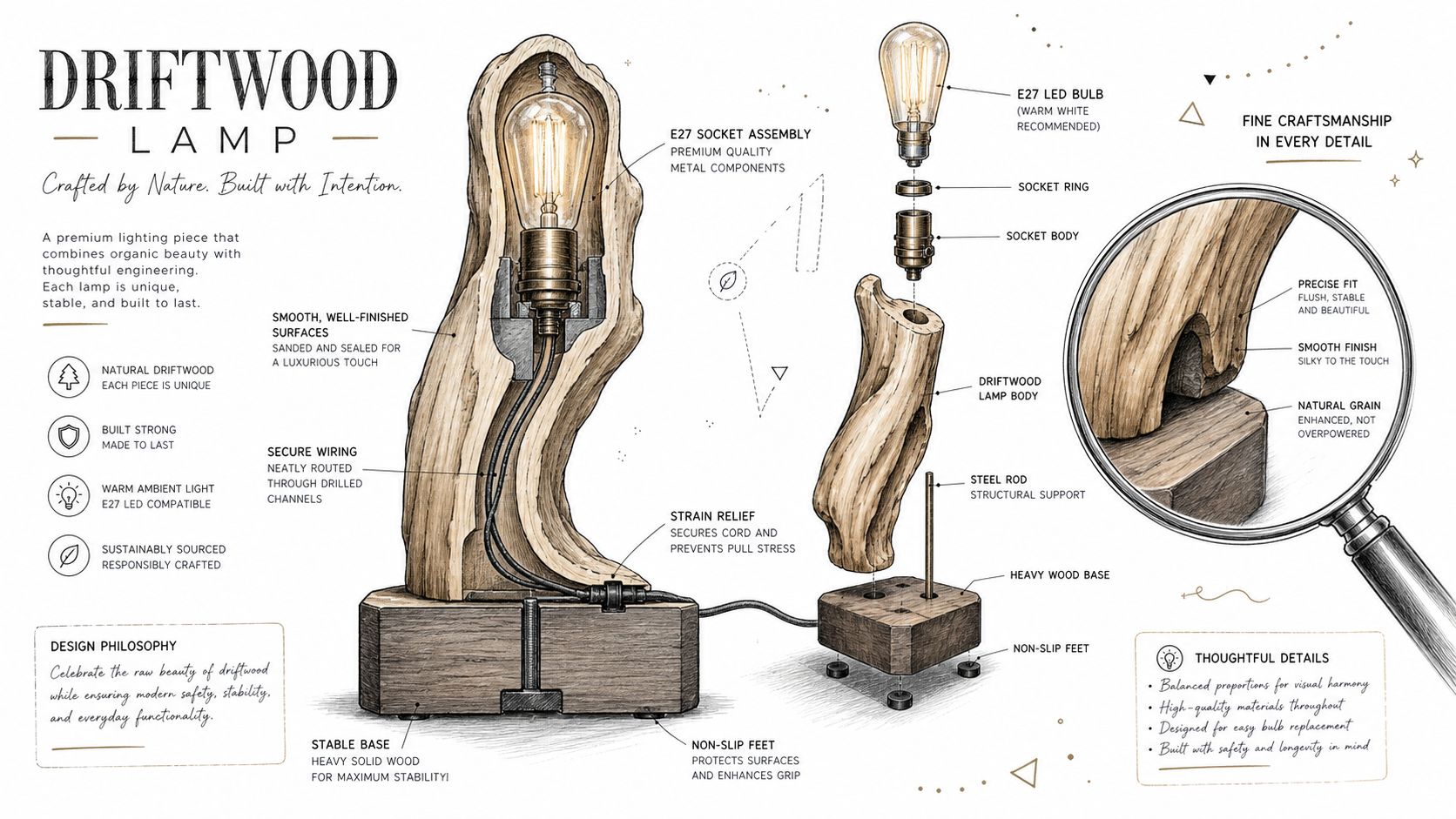
Start with the wood itself
A quality driftwood lamp begins long before wiring and shade selection. The wood has to be dry enough for indoor life. According to this driftwood lamp construction reference, natural, unprocessed driftwood should have a moisture content of 6 to 8%, because wood above 10% moisture content can expand and warp under indoor HVAC conditions.
That detail matters in this region. Dry climates expose weak preparation quickly. Wood that wasn't properly cured may crack, shift, or stress the joins after it's brought inside.
For anyone furnishing around natural materials, the same logic applies more broadly in choosing the right hardwood for longevity and style. Material performance always affects appearance.
What to inspect before buying
A well-made drift wood table lamp usually shows its quality in quiet ways.
- Stable joinery: The wood elements should feel integrated, not loosely gathered or overly dependent on visible glue.
- Clean transitions: Where the rod, socket assembly, or mounting hardware meets the wood, the connection should look intentional.
- Balanced base: The lamp should sit flat without rocking. If it wobbles in the showroom, it won't improve at home.
- Thoughtful finish: The surface should feel sealed enough for easy care without looking plasticky.
- Orderly wiring: The electrical path should look neat and secure, not improvised.
Signs of shortcut construction
Some flaws are easy to miss online but obvious in person.
| What to check | Better construction | Warning sign |
|---|---|---|
| Base contact | Sits flat and steady | Rocks or shifts |
| Wood surface | Preserves grain and texture | Heavy gloss or tacky finish |
| Hardware fit | Aligned and proportional | Crooked socket or awkward top assembly |
| Overall feel | Substantial and resolved | Fragile, top-heavy, or fussy |
If the lamp looks handcrafted but the hardware looks like an afterthought, it usually is.
Why craftsmanship isn't just cosmetic
Driftwood is irregular by nature. That's part of its charm, but it also makes construction harder. Straight rods, sockets, and shades must be integrated into a form that was never naturally symmetrical. Good makers solve that tension so the piece feels effortless. Poorly made examples look unresolved because no one reconciled the organic base with the practical demands of a working lamp.
That's why quality in this category should be treated as a necessity, not an upgrade.
Choosing the Right Size and Scale for Your Space
Most lamp mistakes come down to proportion. The base may be beautiful, but if the lamp is too short, too bulky, or too narrow for the surface beneath it, the room feels off.
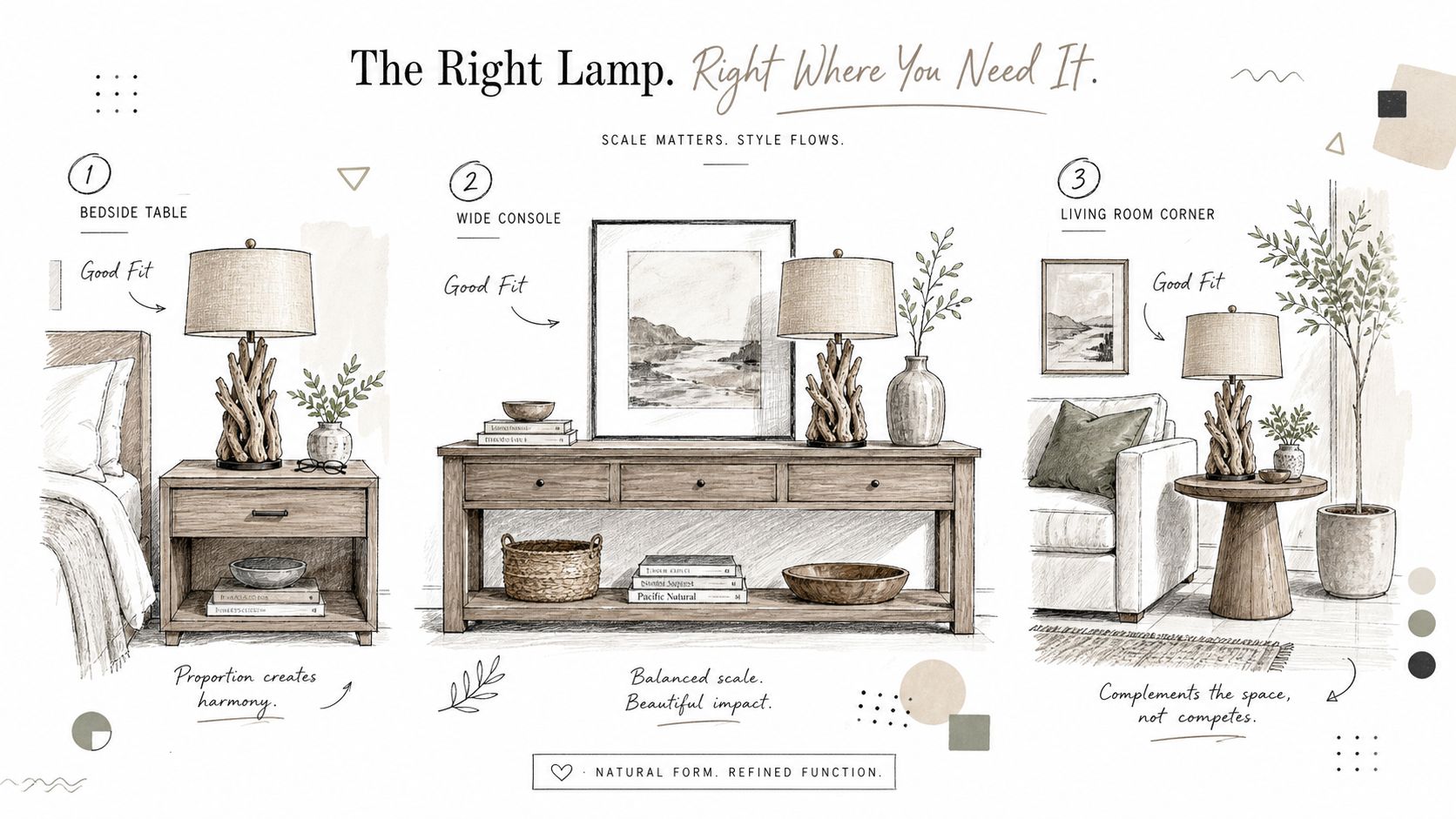
The eye-level rule that keeps lamps useful
For seating areas and bedside use, the bottom of the shade should land around eye level when someone is seated nearby. That keeps the bulb from glaring into the room and makes the light more comfortable for reading or winding down.
A drift wood table lamp can fool the eye because irregular bases often look larger than they measure. That's why shade proportion matters so much. A busy base paired with a tiny shade looks cramped. A delicate base under a giant shade looks accidental.
Match the lamp to the job
Different placements call for different visual weight.
- Beside an armchair: Choose a lamp with enough height to support reading light and enough presence to stand up to the chair's scale.
- On a console table: A more sculptural lamp can work well here because it's often viewed from a distance and doesn't need to serve task lighting first.
- On nightstands: The lamp should anchor the bedside but still leave room for practical items like a book, glasses, or a tray.
- On a living room end table: The lamp needs balance. It shouldn't crowd the tabletop or disappear next to the sofa arm.
A simple proportion check
Before buying, look at these three relationships:
Lamp to table
The base should feel comfortably planted on the surface, not as if it's perched at the edge.Shade to base
The shade should visually finish the lamp, not dominate or minimize it.Lamp to nearby furniture
The lamp should relate to the seat back, headboard, or console length around it.
When a lamp is the right scale, people notice the room feels settled. They usually can't explain why, but they can feel it.
One more point matters with driftwood specifically. Because the base already has visual movement, it often reads larger than a plain ceramic body. Many rooms do better with one strong driftwood lamp in a zone rather than several competing organic forms nearby.
Styling Your Driftwood Lamp in Any Home
The mistake most guides make is treating driftwood as coastal-only. In this region, that approach leaves a lot of good homes out of the conversation. A drift wood table lamp can work beautifully in modern rustic, farmhouse, traditional, or pared-back contemporary rooms when it's styled with intention.
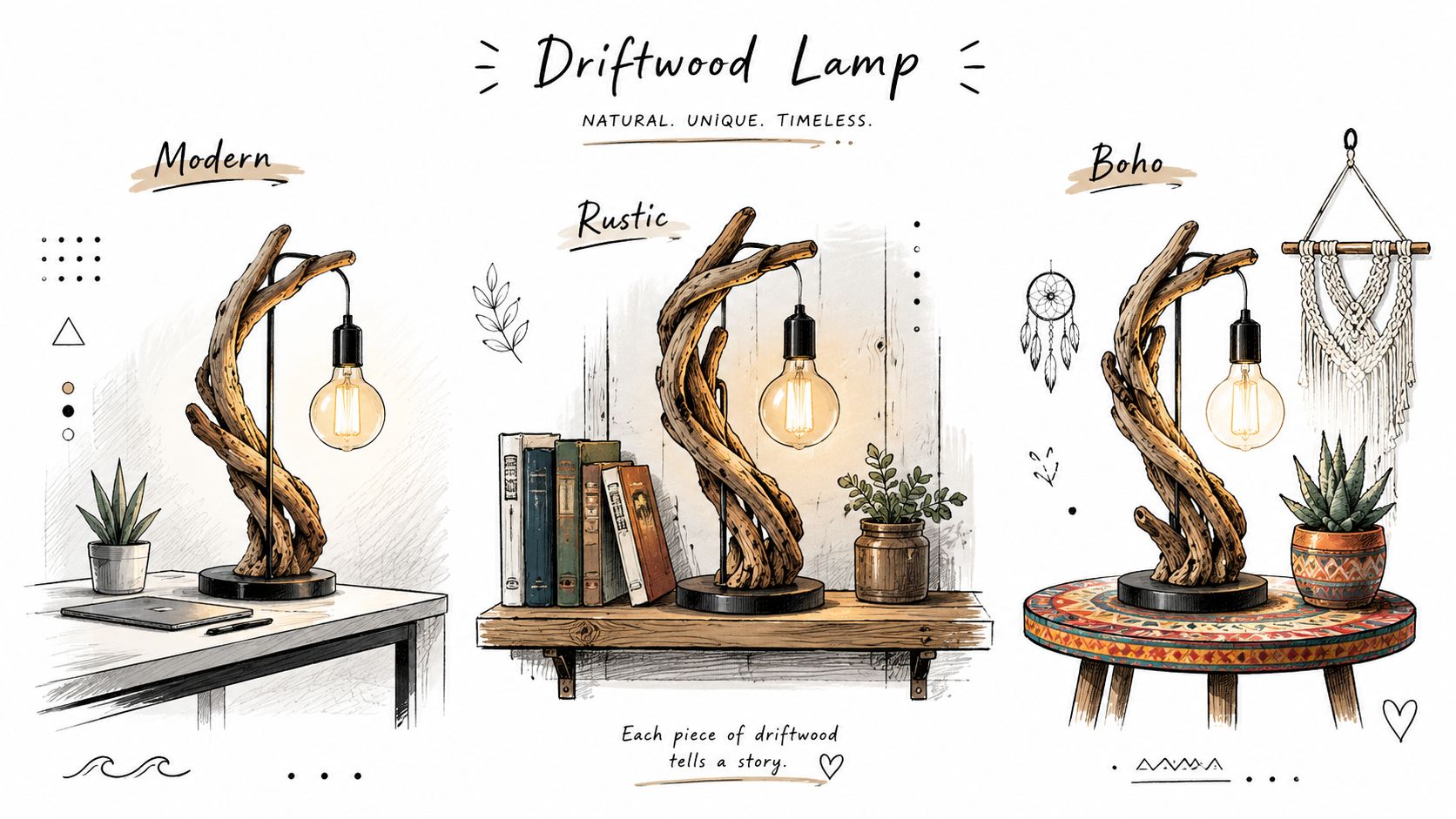
In a modern rustic room
This is one of the most natural pairings. A sculptural driftwood lamp brings softness to rooms with strong architecture, darker metals, or substantial seating.
Think of a leather chair, a clean-lined wood side table, and a lamp with a pale, weathered base and a simple linen shade. The contrast is what makes it work. The leather feels richer. The metal feels less cold. The room gains texture without piling on accessories.
Good companions in this look include:
- Leather upholstery: It adds depth and keeps the room from feeling too casual.
- Iron or black metal accents: These sharpen the silhouette of the lamp.
- Simple textiles: Solid or lightly textured fabrics let the lamp remain the focal point.
In a farmhouse setting
Farmhouse rooms do best when they feel edited rather than themed. A bundled-branch lamp can bring in the natural, collected element these spaces need, especially if the rest of the room has painted furniture, woven textures, or classic neutral upholstery.
Place one on a nightstand with crisp bedding and one vintage-inspired accessory. Or use a pair on a buffet with framed art above. The wood helps break up surfaces that might otherwise feel too flat or too coordinated.
What usually works best here is restraint. If the room already has shiplap, distressed finishes, and visible wood beams, the lamp should be simpler, not busier.
In a classic traditional home
Traditional rooms often benefit from one piece that loosens the formality. Driftwood can do that when the shape is elegant and the shade is well-suited.
A traditional living room with rolled-arm seating, warm wood tables, and patterned drapery can handle a driftwood lamp if the lamp has composure. The base should feel sculptural, not quirky. The shade should be refined. That mix keeps the room from feeling stuffy while still respecting its architecture.
The right natural accent doesn't fight a formal room. It gives it air.
In a more minimal space
Minimal homes need texture because they don't rely on ornament. A minimally processed driftwood lamp can be exactly the right interruption in a room of clean lines and quiet color.
Picture a soft neutral sofa, a plain side table, and a driftwood lamp with a restrained silhouette. The room stays calm, but it doesn't go flat. The lamp becomes the point of interest without requiring bright color or decorative excess.
How to style the surface around it
A drift wood table lamp rarely needs much company. In fact, overstyling around it usually weakens the effect.
A better formula is:
| Surface | Pair with | Avoid |
|---|---|---|
| Nightstand | Small tray, book, simple vase | Crowded stacks and multiple small objects |
| Console | One bowl or low object, framed art, maybe greenery | Several competing sculptural pieces |
| End table | Coaster, book, compact accent | Tall objects that fight the lamp's outline |
Shade choices matter more than people expect
The base may get all the attention, but the shade controls the tone. Linen shades tend to be the safest choice because they soften the irregularity of the wood and diffuse light in a flattering way. Very shiny shades can make the lamp feel disconnected from its organic base. Overly ornate shades usually push the piece into novelty.
Homes in West Texas and Southeastern New Mexico often look best when the lamp feels tied to its surroundings in a subtle way. Dusty neutrals, sun-washed woods, warm whites, and tactile fabrics all help driftwood feel rooted rather than imported from another design story.
Bulbs Wiring and Care for Lasting Beauty
A beautiful lamp still has to function safely. That's where many homeowners get into trouble with DIY-inspired pieces. The form may look appealing, but the unseen details are what determine whether the lamp is dependable in everyday use.
One safety concern deserves more attention. According to this DIY floor lamp guide discussing ballast, floor lamp builds often require 10 to 15 pounds of ballast in the base to prevent tipping, yet common tutorials don't provide equivalent ballast guidance for table lamps. That gap matters because driftwood bases can be irregular, top-weighted, and harder to stabilize. Professionally constructed lamps are the safer choice when stability isn't obvious.
What to look for in wiring and function
A well-made lamp should feel secure when touched, switched on, or moved slightly for cleaning. The socket shouldn't shift. The cord should feel solid and neatly integrated. The shade support should sit straight.
Bulb choice also affects the final look. Most driftwood lamps flatter a warm bulb because the light pulls forward the grain, ridges, and weathered undertones of the wood. Cooler light can make a natural base feel harsher and less inviting.
Buy the lamp for the base, then finish it with a bulb that supports the mood of the room.
Simple care that protects the finish
Driftwood doesn't need fussy maintenance, but it does need consistent, gentle care. Dust it with a soft dry cloth, especially in textured crevices where buildup can collect. Skip heavy spray polishes that leave residue in the grain.
If the lamp sits in a bright window, rotate the shade and keep an eye on how the surface is aging. Like any natural material, wood responds to its environment. Good care is less about making it look new and more about helping it age well. For related upkeep habits, wood furniture care guidance offers a helpful foundation.
Find Your Perfect Lamp at Miller Waldrop
Choosing the right drift wood table lamp comes down to three things. The shape should support the style of the room. The construction should feel solid and resolved. The scale should fit the table, the seating, and the way the lamp will be used.
When those three pieces line up, a lamp becomes more than an accessory. It becomes the item that gives the room its character. That's especially valuable in homes across Lubbock, Hobbs, and Ruidoso Downs, where many people want interiors that feel polished without losing warmth or regional personality.
The strongest design decisions come from seeing materials in person, comparing proportions side by side, and getting guidance from people who understand how real homes are lived in. That's where a curated showroom and a knowledgeable design team become useful tools, not extra noise. The right support helps narrow choices, avoid costly mistakes, and bring a room together with confidence.
A lamp may seem like a finishing touch. Often, it's the piece that makes everything else finally make sense.
Ready to find a drift wood table lamp that fits your style, scale, and everyday life? Explore Miller Waldrop Furniture & Decor for curated home furnishings, design guidance, and help creating a home that feels complete. Visit a showroom in Lubbock, Hobbs, or Ruidoso Downs to see distinctive pieces in person, compare finishes and proportions, and get expert support that makes the decision easier.