

How to Choose a Mattress for Your Best Sleep Ever


Picking out a new mattress is one of the most empowering investments you can make in your own health and well-being. Unlocking your best sleep comes down to a few key decisions. This guide will equip you to look honestly at your own sleep habits, discover which mattress materials will serve you best, and confidently test out your top contenders to ensure they feel just right.
Your Journey to Better Sleep Starts Here

Let's be honest, mattress shopping can feel like a real chore. But it doesn't have to. You can frame it as the first step toward reclaiming that deep, restorative sleep you've been missing.
The idea that there's one "perfect" mattress out there for everyone is a complete myth. The best one is the one that’s perfect for you. This guide will give you the knowledge and confidence to find that ideal match. Here’s how you can connect your personal sleep style to the right mattress technology, and a great starting point is understanding the basics of how to choose a new mattress and what really matters for your body.
Defining Your Path to Comfort
Finding your ideal sleep surface is about so much more than just picking a size or a firmness label. It's about listening to what your body is telling you. A few key insights make all the difference:
- Your go-to sleep position: Whether you’re a side, back, or stomach sleeper completely changes where your body needs support to keep your spine aligned.
- Your body type and weight: These factors dictate how much you sink into a mattress and what kind of support system you need underneath you.
- Your personal quirks: Do you wake up sweating? Is your partner a restless sleeper who jostles the whole bed? These little details are huge clues that point you toward the right materials and features.
A supportive mattress is the absolute foundation of good sleep. It should cradle your joints and keep your spine in a neutral position all night long. Think of it less as a purchase and more as a long-term investment in your well-being.
Your Allies in Finding the Perfect Mattress
Feeling a bit overwhelmed by all the options? You don't have to figure this out alone. You can leverage the expertise of our Sleep Experts at Miller Waldrop, who are here to be your guide. They’re trained to listen to your needs and connect them to the tools and solutions you need to win the day.
We even provide advanced bed-matching technology that maps your body’s unique pressure points, taking all the guesswork out of the process. This personalized approach means you walk away feeling confident, not confused.
By combining your self-knowledge with our expert tools, you can turn a stressful task into a genuinely rewarding experience. And remember, a great mattress is just one piece of the puzzle. To really complete your sleep sanctuary, check out our guide on how to get better sleep and build a routine that truly recharges you.
Know Thyself: Building Your Personal Sleep Profile
Before you step foot in a showroom or click on a single mattress, the most important work happens right at home. It’s about getting to know yourself as a sleeper. Honestly assessing your body, your habits, and your nighttime woes is the foundation for finding a mattress that truly works for you.
Think of it this way: when you know exactly what you need, you’re in control. You can walk past the flashy marketing and go straight to the options that will deliver real comfort and support.
What’s Your Go-To Sleep Position?
How you lie down for the night is probably the biggest piece of the puzzle. Your preferred sleep position determines which parts of your body press into the mattress and where you need the most support to keep your spine in a healthy, neutral line. The wrong mattress can twist your spine into an unnatural curve, and you’ll definitely feel it in the morning.
Here’s a quick rundown of what each position really needs:
- Side Sleepers: Most of us are side sleepers. The key here is pressure relief. You need a surface with enough give to let your shoulders and hips sink in just a bit, preventing that sharp, digging feeling. Too firm, and you’ll wake up with a sore shoulder; too soft, and your waist will sag, throwing your spine out of alignment.
- Back Sleepers: Sleeping on your back is great for natural spinal alignment, but you still need the right foundation. The goal is to support the natural ‘S’ curve of your spine. A mattress that’s too soft will let your hips sink too low, creating an uncomfortable arch. A medium-firm feel is often the Goldilocks zone for back sleepers.
- Stomach Sleepers: This can be a tricky position for your back and neck. Stomach sleepers absolutely need a firmer mattress. Without it, your midsection will sink deeply into the bed, arching your spine in a way that can lead to chronic lower back pain. Your goal is to stay as flat and level as possible.
How Your Body Type Changes Everything
Your weight and build have a huge impact on how a mattress feels. A mattress that feels perfectly firm for a 130-pound person might feel like a hammock to someone who weighs over 230 pounds. It all comes down to how much pressure you put on the foam and coils.
Lighter individuals (under 130 lbs) often find that firmer mattresses don't compress enough to contour to their bodies. They need something a little softer to get that "hugged" feeling and proper pressure relief.
On the other hand, heavier individuals (over 230 lbs) need a mattress with some serious backbone. Look for options with high-density foams and strong, durable coils that can provide consistent support without sagging over time. For a deeper look at this, our guide on choosing a mattress that is right for your body type is a great resource.
Tackling Your Specific Sleep Challenges
Beyond your position and weight, what other problems are keeping you from a great night's sleep? A good mattress isn’t just comfortable—it’s a problem-solver.
A great mattress doesn't just feel comfortable—it actively solves problems. It should cool you down, isolate your partner's movements, and provide targeted relief where you need it most.
Think about what you’re struggling with now. Do any of these sound familiar?
| Sleep Challenge | What to Look For in a Mattress |
|---|---|
| You sleep hot | Prioritize breathability. Look for gel-infused memory foams, natural latex, or hybrid models that let air flow freely through the coil system. |
| You suffer from back pain | A medium-firm mattress is often the sweet spot, providing enough contouring to relieve pressure points while still being supportive enough for spinal alignment. |
| Your partner is a restless sleeper | Excellent motion isolation is non-negotiable. Memory foam and mattresses with individually pocketed coils are fantastic at absorbing movement so you don’t feel every toss and turn. |
| You have allergies | Seek out hypoallergenic materials. Natural latex and mattresses with bamboo-infused covers are great for resisting dust mites, mold, and other allergens. |
By taking a few minutes to build this personal sleep profile, you’re no longer just shopping. You’re on a mission with a clear checklist, ready to find the mattress that’s truly built for you.
Navigating Mattress Types and Materials
Alright, you've done the self-assessment and have a clear picture of your sleep profile. Now comes the fun part: matching those needs to the right mattress. Stepping into the world of mattress materials can feel a little overwhelming at first, but it really just boils down to a few core types.
Think of each material as having its own personality, built to solve specific sleep problems. The goal is to find the one that speaks directly to your body's needs—whether that's something to cushion your shoulders as a side sleeper or something with serious support to keep your spine straight. This is where your personal insights turn into a real, tangible choice.
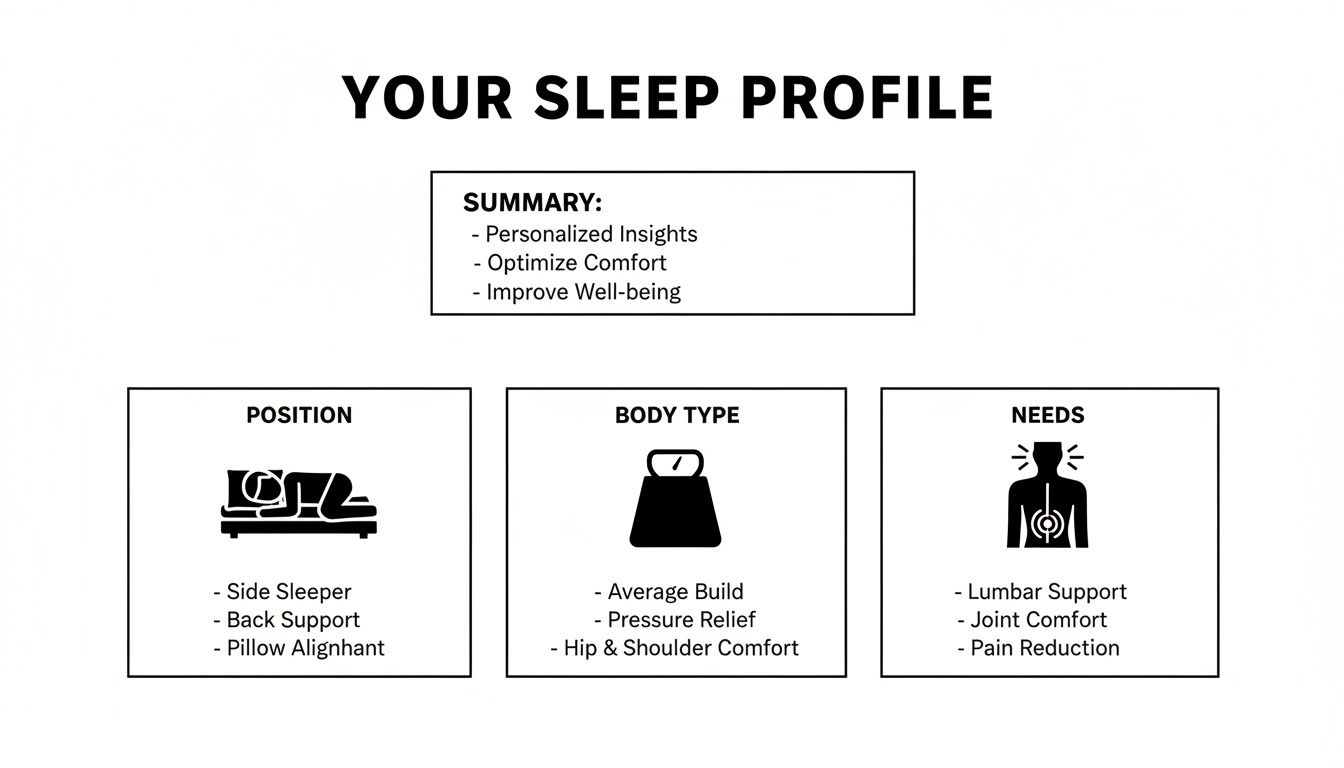
By keeping your sleep position, body type, and unique needs (like pain relief) top of mind, you can cut through the noise and zero in on the perfect material for you.
The Four Main Mattress Contenders
Most modern mattresses fall into one of four main categories. Each one offers a distinct feel and its own set of pros and cons, which is why one type might be a dream for you and a nightmare for someone else. Let’s break them down.
Here’s a quick overview to help you see how the different types stack up against each other.
Mattress Type Comparison at a Glance
| Mattress Type | Best For | Key Benefits | Potential Drawbacks |
|---|---|---|---|
| Innerspring | Stomach sleepers, hot sleepers, and those who prefer a traditional, bouncy feel. | Excellent airflow, strong edge support, and often more affordable. | Can transfer motion; may not offer enough pressure relief for side sleepers. |
| Memory Foam | Side sleepers, couples, and individuals with chronic pain. | Superior pressure relief, body-conforming comfort, and excellent motion isolation. | Can retain heat; some people dislike the “sinking” sensation. |
| Latex | Eco-conscious shoppers, allergy sufferers, and combination sleepers. | Responsive bounce, naturally cooling and hypoallergenic, and highly durable. | Can be heavy and is often a higher-end investment. |
| Hybrid | Nearly everyone—especially back sleepers and those wanting a balanced feel. | A blend of coil support and foam comfort, great airflow, and targeted pressure relief. | Can be more expensive; quality varies significantly between models. |
This table is just a starting point, of course. The real magic happens when you see how a specific mattress within these categories can address your personal sleep challenges.
Decoding Materials for Your Needs
Now, let's connect these materials back to that sleep profile you created. It's much easier to choose when you can see exactly how a mattress's construction is designed to solve your problems.
-
For the side sleeper with hip pain: You’ll want to look at a memory foam or plush hybrid mattress. The foam layers are designed to cradle your pressure points, while the pocketed coils in a good hybrid can offer zoned support to keep your spine perfectly aligned.
-
For the back sleeper needing solid support: A latex or medium-firm hybrid mattress is probably your best bet. These options are great at preventing your hips from sinking too far into the mattress, which is key for maintaining the natural curve of your spine.
-
For anyone who sleeps hot: An innerspring or latex mattress is a fantastic choice because of how breathable they are. Many modern hybrids also come packed with cooling tech like gel-infused foams and special fabrics that help regulate your temperature all night long. For a deep dive, our guide on what is a hybrid mattress explains how their construction boosts airflow.
It also helps to know what's popular and why. While innersprings have been the standard for generations, foam mattresses are a huge part of the market now, largely because quality memory foam can reduce pressure points by up to 55%. And hybrids are quickly becoming a favorite—with over 60% of users reporting better spinal alignment and cooler sleep compared to all-foam beds. If you're curious about the differences, you can compare spring vs foam mattresses to see how they truly stack up.
Your perfect mattress isn’t just about the material; it’s about how that material is engineered. A high-density foam will provide more durable support than a low-density one, and a lower-gauge (thicker) coil will offer a firmer foundation.
By understanding these fundamentals, you’re no longer just guessing. You're an informed shopper ready to make a confident investment in your sleep. When you're ready to feel the difference for yourself, our Sleep Experts at Miller Waldrop are here to guide you through these options in person.
How to Test a Mattress in the Showroom
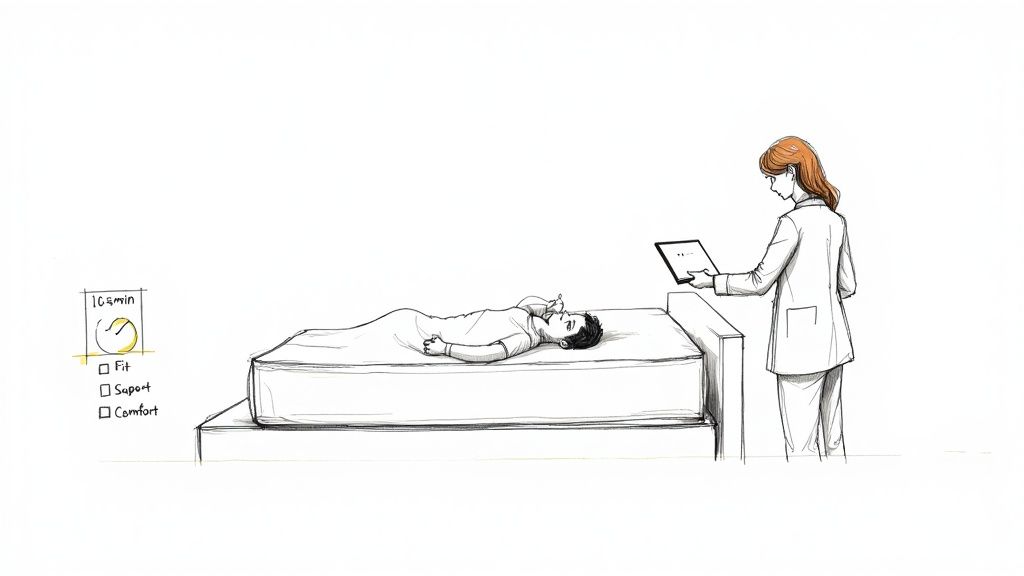
You’ve done your homework, built a sleep profile, and have a good idea of what materials you're looking for. While online research is fantastic for narrowing down your options, it can't tell you the whole story. At some point, you have to get off the screen and onto a mattress.
There’s simply no substitute for feeling it for yourself. Think of the Miller Waldrop showroom not just as a store, but as your personal sleep lab—a place to put all your research into practice and make a truly confident decision.
Your Game Plan for a Successful Test Drive
Walking into a showroom without a plan can feel overwhelming. To really get the most out of your visit, you need a strategy. This isn't about just sitting on the edge of a few beds; it's about simulating your actual sleep experience as closely as possible.
Here’s how to make your test a true success:
-
Dress for the occasion. Wear loose, comfortable clothes and shoes you can easily slip off. You need to be able to move around and lie down naturally without your outfit getting in the way.
-
Assume your go-to position. Don't just lie on your back for a few seconds if you're a die-hard side sleeper. Get into your primary sleeping position and see how it feels.
-
Give it some real time. Your body needs a chance to relax and truly register how the mattress responds. Plan to spend at least 10-15 minutes on each mattress you’re seriously considering. This is the only way to feel how it supports your pressure points over a longer period.
Leveraging Expert Guidance and Technology
The good news is you don’t have to do this alone. Our Miller Waldrop Sleep Experts are here to act as your guide, trained to translate your unique needs into the right mattress solutions. They're not just salespeople; they're here to help you solve your sleep problems.
Come armed with a few smart questions to get the conversation started:
- On Durability: "Can you tell me about the foam density or coil gauge in this mattress? How do you think that will hold up for someone with my body type over the next 8-10 years?"
- On the Warranty: "What, specifically, does the warranty cover when it to sagging? Is it prorated?"
- On Upkeep: "Does this mattress need to be rotated? If so, how often?"
The single most important part of testing a mattress is checking for proper spinal alignment. When you lie on your side, your spine should be in a straight line from your neck to your tailbone. Have a partner or one of our Sleep Experts take a look—even a small dip can lead to chronic pain down the road.
To take the guesswork out of the process, you can use advanced bed-matching technology right here in our showrooms. This system maps your body’s unique pressure points and generates data-driven recommendations that align perfectly with your sleep profile. It's an incredible tool for narrowing the field, saving you time and ensuring you're testing the mattresses most likely to be your perfect match.
Your showroom visit is the final, most important step. It’s your chance to confirm that the mattress you've been eyeing feels just as good in real life as it sounds on paper. Ready to find your perfect fit? Explore our mattress collection online, then visit us in Hobbs, Ruidoso Downs, or Lubbock to put your top choices to the test with one of our Sleep Experts.
Navigating Price, Sleep Trials, and Warranties
Let's talk about the practical side of buying a new mattress: the budget and the fine print. It's easy to get sticker shock, but thinking about a mattress as a long-term investment in your health really changes the perspective.
A well-made mattress might have a higher price tag upfront, but if it gives you a decade of incredible sleep without sagging, it's a much better value than a cheaper one you have to replace every few years. Your goal isn't just to find a cheap mattress; it's to find the best mattress you can comfortably afford.
At Miller Waldrop, we believe great sleep should be accessible. That’s why we offer several financing options available. You can get the right bed now without the financial stress.
Your Safety Net: The Sleep Trial
You can lie on a mattress for 15 minutes in a showroom, but the real test is how you feel after a full week of sleeping on it. Your body needs time to adapt to a new surface, which is why the sleep trial is one of the most important features to look for.
Most reputable brands offer a trial period, usually between 30 and 120 nights. Think of it as a test drive. If, after a few weeks, you're still tossing and turning or waking up sore, you haven’t made a costly mistake. You can simply exchange it. This takes all the pressure off, so you can buy with confidence.
Making Sense of the Warranty
A warranty is the manufacturer's promise that their product will hold up. But you have to know what you’re looking at, because they are definitely not all the same.
The single most important thing to check is the coverage for sagging. Over time, all mattresses develop body impressions, but a quality mattress shouldn't dip excessively. A solid warranty will typically cover sagging of 1.5 inches or more.
You'll also see two different kinds of coverage:
- Non-Prorated: This is what you want. If a defect pops up during this period, the company will repair or replace your mattress for free (you might just have to cover shipping).
- Prorated: Once the non-prorated period ends, a prorated warranty kicks in. This means if you need a replacement, you'll have to pay a portion of the original price, and that portion gets bigger the longer you've owned the bed.
A long non-prorated warranty is a huge green flag. It tells you the manufacturer is confident in their materials and craftsmanship. They expect it to last.
One final tip: protect your investment from day one. Using a proper bed frame and a waterproof mattress protector is non-negotiable. A simple coffee spill can void your entire warranty, so it’s a simple step that can save you a huge headache down the road.
If you’re looking for a bed known for its durability and solid warranty, the Serta Perfect Sleeper is a fantastic example of a mattress built to perform for years. When you visit us, our Sleep Experts will gladly go over all these details with you, making sure you feel completely comfortable with your choice.
Building Your Complete Sleep System
So, you’ve found the perfect mattress. That’s a huge step, but don't stop there. Think of your mattress as the foundation of a house; it’s crucial, but you still need the walls and roof to create a truly comfortable home. The right accessories aren’t just nice-to-haves—they're the tools that transform a good night's sleep into a truly restorative experience.
These final pieces work in harmony with your mattress to protect your investment, fine-tune your comfort, and build a sleep sanctuary designed just for you.
Finding the Perfect Pillow
A pillow has one critical job: to keep your head, neck, and shoulders perfectly aligned with your spine. Get it wrong, and you can undo all the good your new mattress is doing. The right choice is completely dependent on your new mattress and how you sleep.
- If you chose a firm mattress, you won't sink in very much. That means you’ll probably need a thicker, loftier pillow to fill that larger gap between your head and the mattress, especially if you’re a side sleeper.
- If you opted for a softer mattress, your body will sink deeper. A thinner pillow is often the right call here, preventing your head from being pushed up at an awkward, unnatural angle.
The goal is always a neutral spine—a straight line from your head all the way down. It's a surprisingly simple concept that makes a world of difference.
The Non-Negotiable Mattress Protector
If you take away just one piece of advice, let it be this: get a high-quality mattress protector. Forget those stiff, crinkly plastic sheets from the past. Today's protectors are breathable, silent, and completely waterproof without making you feel like you're sleeping on a tarp.
Think of a mattress protector as insurance for your bed. A single coffee spill or an accident with a pet doesn't just leave a stain—it can instantly void your mattress warranty. This simple, affordable accessory is the single best way to safeguard your investment.
Beyond spills, it also creates a barrier against dust mites, allergens, and dead skin cells, which keeps your mattress feeling fresh and hygienic for years. It's a non-negotiable part of any new mattress purchase.
Elevate Your Comfort with an Adjustable Base
Ready to take your comfort to the next level? An adjustable base is the ultimate upgrade. It lets you fine-tune your position for anything you do in bed, whether that's reading a book, watching a movie, or finding that perfect zero-gravity setting to relieve pressure on your lower back.
For anyone who deals with snoring or acid reflux, simply elevating your head can be a game-changer. An adjustable base like the Serta Motion Air Adjustable Base can turn your bedroom from just a place to sleep into a personalized wellness retreat.
Ready to put it all together? Our Miller Waldrop Sleep Experts can help you match the perfect pillow, protector, and base to your new mattress. Stop by our showrooms in Hobbs, Ruidoso Downs, or Lubbock, and let's complete your sleep sanctuary.
Still Have Questions? Let's Clear Them Up
It's completely normal to have a few last-minute questions before making a final decision on something as important as a mattress. Think of this as the final check-in before you commit. Here are some of the most common things people ask us right before they're ready to buy.
How Do I Know When It’s Really Time for a New Mattress?
Most good mattresses are built to last 7-10 years, but that's just a guideline. The real answer comes from how you feel and what you see.
Your body is the best indicator. Are you waking up stiff and sore for no apparent reason? That's a huge red flag. Also, take a good look at your mattress. If you see permanent body impressions, sagging in the middle, or lumps where there shouldn't be, its support system has broken down. For innerspring beds, creaks and groans are the mattress's way of telling you it's tired.
A simple tip to get the most life out of your mattress? A quality mattress protector. It's the single best thing you can do from day one to safeguard your investment against spills, sweat, and allergens.
I Have Back Pain. What’s the Best Firmness Level?
This is probably the number one question we get. For the majority of people with back pain, a medium-firm mattress hits that sweet spot between supportive and comfortable. It's got enough give to cushion your hips and shoulders, but it's also sturdy enough to keep your spine properly aligned.
But remember, "majority" doesn't mean "everyone." Your body weight and the position you sleep in can change the equation entirely. This is exactly where our expertise comes in handy. Our Sleep Experts use bed-matching technology to pinpoint the exact level of support your body needs to wake up feeling refreshed, not sore.
Is It Okay to Just Buy a Mattress Online Without Trying It?
While online research is fantastic for comparing brands and features, it can't tell you how a mattress feels. And that's everything.
You can't know if a mattress is right for your body until you've actually laid on it. We always recommend spending at least 10-15 minutes on a potential mattress in the store, relaxing in the position you actually sleep in. It’s the only way to truly understand how it contours to your curves and supports your spine. This one simple step can save you from a years-long mistake and ensures you're making a smart investment in your sleep.
You’re now armed with all the knowledge you need to walk into a showroom and make a smart, confident choice. The journey to better sleep is a big deal, and the team at Miller Waldrop is here to make sure you get it right.
Visit our showrooms in Lubbock, Hobbs, or Ruidoso Downs and let our experts guide you to the perfect mattress. It's time to start winning your days and your nights.