

Finding the Best Mattress Types for Back Pain Relief

Waking up with an aching back isn't something you just have to live with. More often than not, it's a clear signal from your body that your mattress is failing you. The right mattress isn't just a purchase; it's a powerful tool for your well-being. To conquer back pain, you'll want to find that sweet spot of medium-firm support. Here's how you can choose the perfect hybrid or memory foam mattress designed to give you both spinal support and cushioned comfort.
Your Path to Pain-Free Mornings Starts Tonight
That morning stiffness you feel? It’s not an inevitable part of getting older. Your mattress should be the most important tool you own for recovery, not the source of your pain. A high-quality mattress holds your spine in its natural alignment, letting your muscles finally relax and repair themselves overnight. The wrong one forces your body into awkward positions, night after night, leading to the chronic aches that ruin your mornings.
This guide will empower you with the confidence to find the relief you deserve. The secret is simply understanding what your body needs.
- Your Sleep Position: Where your body needs support and cushioning is completely different if you're a side, back, or stomach sleeper.
- Your Body Type: Your weight and build determine how deeply you sink into a mattress and whether it can properly support your spine's unique curve.
- Your Personal Preferences: At the end of the day, comfort is subjective. The right mattress has to feel good to you to deliver truly restorative sleep.
Charting Your Course to Better Sleep
Let's be honest, mattress shopping can feel like a maze of technical terms and endless choices. But you can cut through the noise by focusing on two core ideas: support and pressure relief. A supportive mattress keeps your spine straight, from your neck to your tailbone. Pressure relief cushions the heavier parts of your body, like your hips and shoulders. Finding a bed that masters this balancing act is the key to waking up feeling fantastic.
Your bed should be a haven, a place of rejuvenation to renew your body after the toils of the day. If you wake up experiencing more back pain than you went to bed with, it's a clear sign you have the power to fix the problem by switching up your mattress.
Of course, what you do during the day matters, too. A great mattress is a huge piece of the puzzle, but building healthier daily habits can make a world of difference. You can find helpful tips for relieving back and shoulder pain during the day to create a well-rounded approach to feeling your best.
Quick Guide to Mattress Types for Back Pain
To help you get started, here's a quick rundown of how different mattress types stack up when it comes to back pain. This table breaks down the essentials so you can quickly see which options might be a good fit for you.
| Mattress Type | Best For (Sleep Position) | Key Benefit for Back Pain | Firmness Feel |
|---|---|---|---|
| Memory Foam | Side & Back Sleepers | Contours to the body, relieving pressure points on hips and shoulders. | Medium to Medium-Firm |
| Latex | All Sleep Positions | Responsive support that "floats" the spine and prevents sinking. | Medium-Firm to Firm |
| Innerspring | Back & Stomach Sleepers | Firm, traditional support core that keeps the spine elevated. | Firm |
| Hybrid | All Sleep Positions | A balanced blend of coil support and foam pressure relief. | Medium to Medium-Firm |
This is just a starting point, of course. Personal comfort and body type will always play a role in the final decision.
Now, let's dive deeper into these main mattress types so you can pinpoint which one is built for your body and sleep style. Think of this guide as your toolkit, and our Sleep Experts as your partners on this journey. We are dedicated to helping you discover proven solutions, like the pressure-relieving Serta iComfortECO F20GL Hybrid Plush Mattress, so you can finally conquer back pain and get the deep, restorative sleep you’ve been missing.
How Mattress Materials Support Your Spine
Choosing the right mattress can feel like you're trying to solve a complex puzzle, but once you understand the core materials, everything starts to click into place. Don't think of a mattress as a single object. Instead, picture it as a system of layers, all working together to support your spine.
The materials inside—the foam, the springs, the latex—are what determine how that system performs. They dictate whether you sink in, feel lifted, or experience a little of both. Getting a handle on this is the first real step toward reclaiming your mornings from back pain. Let's break down the four main types so you can become an expert in your own comfort.
Memory Foam: The Contouring Cradler
Imagine slowly pressing your hand into a piece of dough. It gives way under the pressure, perfectly molding to the shape of your fingers. When you lift your hand, it slowly bounces back. That's the essence of viscoelastic foam, or what we all know as memory foam. It's engineered to react to your body’s heat and weight, creating a personalized cradle that hugs your unique curves.
This contouring "hug" is memory foam's biggest advantage for people with back pain, especially side sleepers. By allowing your shoulders and hips to sink in just the right amount, it helps maintain a straight, neutral spine instead of forcing it into an uncomfortable curve. This also takes the pressure off your most sensitive joints, which can seriously cut down on tossing and turning.
Of course, that deep hug isn't for everyone. Some people find the sinking feeling a bit restrictive, making it harder to roll over or get out of bed. Older memory foams also had a bad reputation for trapping heat, though today’s versions are much better, often infused with cooling gels or designed with open-cell structures to let air flow. If you love that conforming feel, exploring the best memory foam mattress options for back pain is a fantastic place to start.
Latex: The Buoyant Supporter
If memory foam is like dough, think of latex as a giant, resilient sponge. When you press down on it, it compresses but also pushes back with a gentle, uplifting force. This responsive buoyancy is what makes latex so unique. It contours to your body to relieve pressure, but you don't get that slow-sinking feeling you find with memory foam.
This makes latex a phenomenal choice for anyone who needs pressure relief but prefers to feel like they are sleeping on their mattress, not in it. Its natural elasticity provides a dynamic kind of support that adapts as you move, helping keep your spine aligned no matter which position you land in.
Here’s why latex is such a powerful ally against back pain:
- Durable Support: High-quality latex is one of the most durable materials out there, so it resists sagging and forming body indentations for years.
- Naturally Breathable: The open-cell structure of latex promotes excellent airflow, making it a much cooler sleep for those who tend to run hot.
- Responsive Feel: It makes changing positions effortless, a huge plus for combination sleepers or anyone who feels "stuck" in memory foam.
Innerspring: The Traditional Foundation
The innerspring mattress is the classic design most of us grew up with. At its core is a system of interconnected steel coils that provides that firm, bouncy, and familiar feel. This construction offers robust, edge-to-edge support and prevents the "quicksand" feeling some people dislike in all-foam beds.
For back and stomach sleepers, this firm support can be a game-changer. It does an excellent job of keeping the hips and torso elevated, preventing the lower back from dipping into a U-shape—a very common cause of next-day lumbar pain.
Think of an innerspring system as the foundation of a house. It's strong and unyielding, ensuring that everything built on top of it remains stable and level.
But the traditional innerspring isn't without its downsides. Because the coils are often interconnected, they can transfer motion easily, meaning you might feel every time your partner tosses and turns. And with only a thin comfort layer on top, some models can create pressure points on the hips and shoulders, which is often an issue for side sleepers.
Hybrid: The Best of Both Worlds
So, what if you could get the deep, pressure-relieving hug of memory foam and the sturdy, responsive support of a spring system? That's exactly what a hybrid mattress delivers. It’s a modern solution designed to give you the benefits of multiple materials all in one bed.
A true hybrid has a core of individually pocketed coils, which are a massive upgrade from old-school interconnected springs. Each coil is wrapped in its own fabric sleeve, allowing it to move independently. This design cuts down on motion transfer and lets the support system conform much more precisely to your body’s shape.
On top of this advanced coil system, you’ll find thick comfort layers made of memory foam, latex, or other high-end materials. This creates a beautifully balanced feel that offers both deep-down support and luxurious cushioning. Industry reports show that while foam mattresses make up about 45% of the global market, hybrids are the fastest-growing category, especially for people dealing with back pain. It’s because they master that delicate balance between support and pressure relief, making them a great fit for nearly every sleep position and body type.
Finding Your Ideal Firmness for Spinal Alignment
We’ve talked about what’s inside a mattress, but the firmness is what truly makes or breaks its ability to fight back pain. It’s not just about what feels "soft" or "hard" at first touch. The right firmness is the secret to keeping your spine in a healthy, neutral line all night.
Think of it this way: a good mattress works to distribute your body weight evenly, preventing your hips from sinking too low or your shoulders from being pushed too high. It’s all about finding that perfect balance. Getting this right is personal, and it’s where the science of human movement and biomechanics comes into play.
If a mattress is too soft, your torso can sag into it, creating a "hammock effect" that puts a ton of strain on your lower back. On the flip side, a mattress that’s rock-hard creates intense pressure points at your shoulders and hips, forcing your spine into an unnatural curve.
Matching Firmness to Your Sleep Position
The biggest clue to finding your perfect firmness? How you sleep. Each position creates different pressure points, and your mattress needs to accommodate them to keep your spine happy.
- Side Sleepers: You need a surface with enough give to cushion your hips and shoulders—the widest parts of your body. A medium-soft to medium feel (think a 4-6 on a 1-10 scale) is usually the sweet spot. This allows you to sink in just enough to keep your spine straight.
- Back Sleepers: Your main challenge is supporting the natural curve of your lower back without letting it sag. A medium-firm mattress (around a 6-7) typically provides that perfect lift while still feeling comfortable.
- Stomach Sleepers: This position can be tough on the spine, so a supportive mattress is non-negotiable. Look for a medium-firm to firm feel (a 7-8) to keep your hips from dipping, which prevents your back from arching painfully.
This simple guide can help you see which mattress types might deliver the feel you’re looking for.
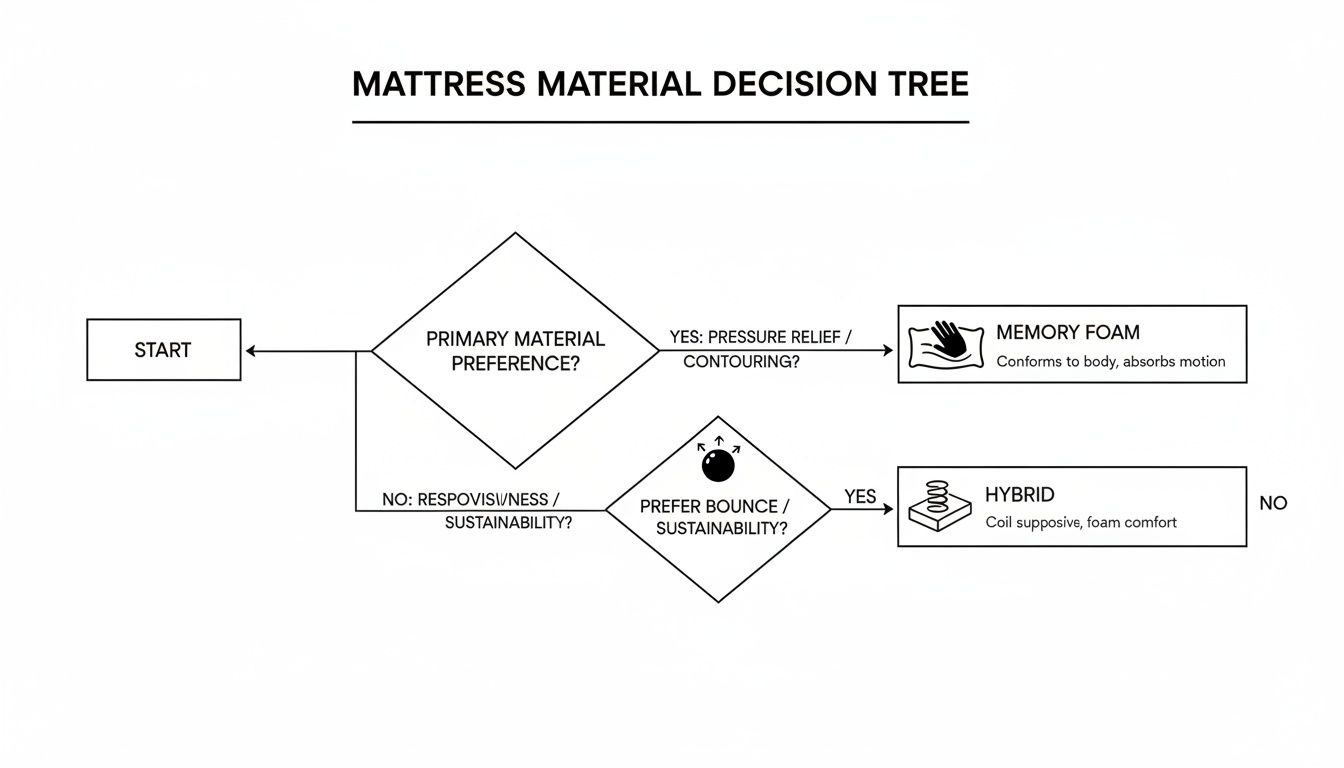
As the flowchart shows, whether you prefer a deep hug or a gentle lift can point you toward the right material to get the support you need.
How Your Body Weight Influences Firmness
The other half of this puzzle is your body weight. How firm a mattress feels isn't set in stone; it’s relative. A mattress that feels firm to a 120-pound person might feel soft to someone who weighs 250 pounds.
The Bottom Line: Firmness is a partnership. Lighter individuals (under 130 lbs) often need a softer mattress to get any contouring benefits. Heavier individuals (over 230 lbs) need a firmer, more robust construction to prevent sinking too deep and to ensure the mattress holds up over time.
For most people in the 130-230 lb range, the manufacturer's rating is a pretty good starting point. Year after year, we see that hybrid models with a medium-firm feel (rated 5–7 out of 10) are consistent winners for people with back pain. They nail that tricky balance of supportive lift and gentle contouring.
Want to dig a little deeper into this? Our complete guide on how to choose your ideal mattress firmness breaks it all down for you.
Ultimately, finding that perfect match between firmness, your sleep style, and your body is what leads to waking up refreshed and pain-free.
Advanced Features That Target Back Pain
Once you've got the basics of material and firmness down, it's time to look at the features that really take a mattress from "good" to "great" for back pain. These aren't just bells and whistles; they're specific design elements engineered to give your spine the targeted relief it desperately needs.
Think of it this way: a basic mattress supports your whole body, but these advanced features act like a physical therapist, providing extra attention right where you need it most. They can turn your bed into a true recovery tool.
Zoned Support: A Smarter Way to Align
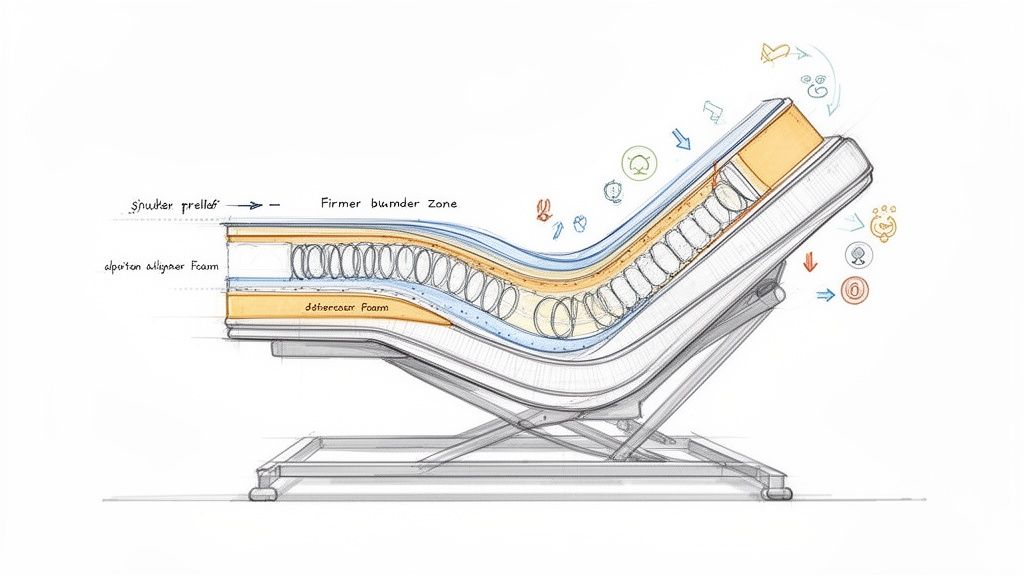
One of the best innovations for back pain sufferers is zoned support. Instead of being uniformly firm from head to toe, a zoned mattress is strategically engineered with different levels of support for different parts of your body. It’s a brilliant and intuitive approach.
Your body isn't a straight, evenly weighted plank. Your hips and torso are heavier and need more pushback to keep them from sinking too deep, which is a major cause of spinal misalignment. Meanwhile, your shoulders and knees need a softer touch to avoid painful pressure points.
Zoned support solves this problem by using firmer coils or denser foam in the center third of the mattress, directly under your lumbar region. The result?
- Reinforced Lower Back: The extra firmness under your hips prevents your spine from sagging into a "U" shape.
- Cushioning for Joints: Softer zones at the shoulders and feet let those areas sink in just enough for comfort.
- Proper Spinal Alignment: By supporting each body part individually, the mattress helps you maintain that straight, neutral spine all night long.
You'll often find this incredible feature in higher-end mattresses like the Serta iComfortECO F20GL Hybrid Plush Mattress, which is built specifically to provide this kind of intelligent, body-contouring support.
Adjustable Bases: The Ultimate Tool for Relief
For many people, the secret to ending back pain isn't just about the mattress itself, but the position they sleep in. This is where an adjustable base becomes an absolute game-changer. It gives you the power to elevate your head and feet, finding the perfect custom position that takes all the strain off your spine.
The "zero-gravity" position is famous for a reason. By slightly raising your head and knees, it mimics a feeling of weightlessness, distributing your body weight evenly and dramatically reducing pressure on your lower back.
Finding that perfect angle can feel like a miracle, especially if you deal with conditions like sciatica or spinal stenosis. Beyond back pain, you can discover more about how adjustable bases can help alleviate multiple health concerns in our dedicated guide. An adjustable base puts you in the driver's seat, allowing you to find the precise posture that brings immediate relief.
When you combine advanced features like zoned support with the personalized positioning of an adjustable base, you’re no longer just buying a bed. You’re equipping yourself with a sleep system designed to help you wake up without pain. Our Sleep Experts at Miller Waldrop can walk you through how these technologies feel in person, helping you find the perfect match for a better morning.
How to Test a Mattress Like an Expert
You’ve done your homework. You know the different types of mattresses, understand what features can help your back, and have a good idea of what you’re looking for. Now for the most critical part: the test drive.
Walking into a mattress showroom can feel like stepping onto a sales floor, but it doesn't have to be. With the right approach, you can take control and turn this final step into a confident decision that leads to pain-free mornings. This isn't just about bouncing on a few beds; it's about simulating how you'll actually sleep.
Your Showroom Game Plan
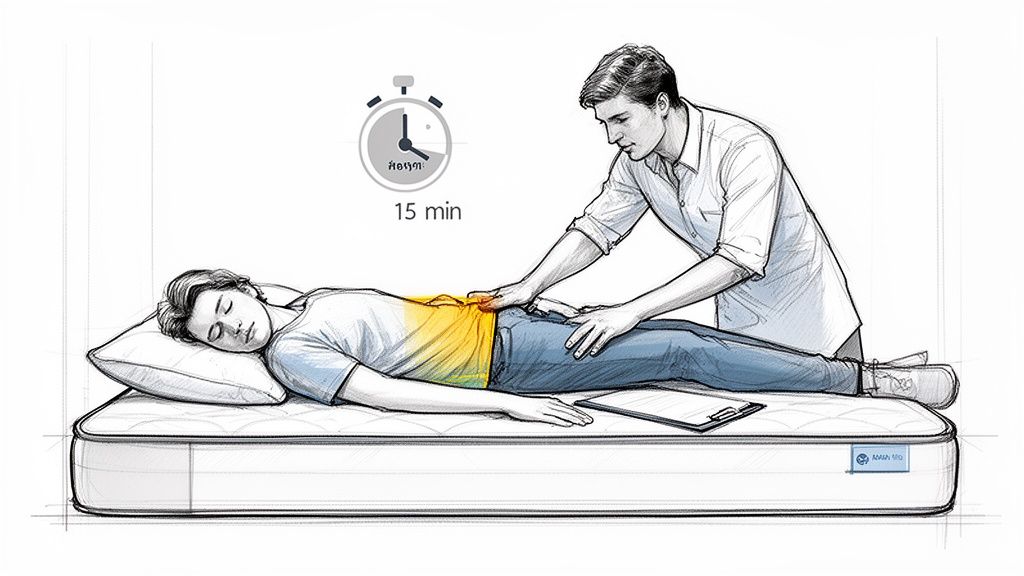
To make your visit count, you need a plan. Think of it less like shopping and more like an evaluation. Here’s a simple, step-by-step guide to testing a mattress like you’ve been doing it for years.
-
Dress Comfortably. Wear loose, non-restrictive clothes and shoes you can easily kick off. You need to be able to move and lie down naturally without your outfit getting in the way.
-
Lie Down for at Least 15 Minutes. This is the golden rule. Seriously. Your body needs time to relax and truly feel the mattress. A quick two-minute test won't tell you anything about how the support layers will interact with your spine and pressure points over a full night.
-
Get into Your Go-To Sleep Position. Don't just lie flat on your back if you're a dedicated side sleeper. Settle into the position you naturally fall asleep in and pay close attention. Does the mattress contour to your body's curves, or do you feel pressure building up anywhere?
-
Do the Hand-Slide Test. While on your back, try sliding your hand into the gap under your lower back. If it slides through with a lot of room to spare, the mattress is probably too firm. If you can barely get your hand in at all, it’s likely too soft. You're looking for a snug fit with just a little space—that's the sign of proper lumbar support.
Making a Confident Choice
As you try out different models, keep coming back to the two most important things for back pain: support and pressure relief. A good mattress has to nail both. The core needs to keep your spine straight, while the top layers cushion your hips and shoulders without letting you sink into a hammock.
The right mattress should make you feel almost weightless. It distributes your body weight so evenly that no single area feels strained or pressured.
This is exactly why testing a mattress in person, with an expert guide, makes all the difference. At Miller Waldrop, our showrooms are designed to be relaxed, educational spaces where you can find the tools you need. Our Sleep Experts are your partners in finding relief. We even use a high-tech bed matching system that maps your body’s unique pressure points to give you a scientific starting point.
From there, we can point you toward mattresses that are a great fit for your results, like the expertly engineered Serta iComfortECO F20GL Hybrid Plush Mattress. You've got the knowledge now. Let us provide the tools and expertise to help you find the perfect match and finally put that nagging back pain to rest.
Your Local Sleep Expert Is Your Greatest Ally
You've done the homework. You now understand what separates a great mattress from a mediocre one, and how different materials, firmness levels, and support systems can either soothe or worsen back pain. This knowledge is powerful—it’s the key to finding a bed that actually solves the problem, not just puts a band-aid on it.
The last step is to connect all that great research to the real world. And for that, you don't have to go it alone. Having the right guide can turn a potentially overwhelming shopping trip into a confident decision for your long-term health.
Why a Trusted Partner Matters
Reading reviews online is a fantastic starting point, but it can’t replace the feeling of lying on a mattress yourself. A true sleep expert isn’t just a salesperson pushing the latest model; they’re more like a consultant for your sleep health. Their job is to listen to your specific story—your pain points, your sleep style, your preferences—and use their in-depth knowledge to match you with the right solution.
Here at Miller Waldrop, that’s been our entire focus for over 70 years. As a family-owned business serving our communities in West Texas and Southeastern New Mexico, we've always seen ourselves as more than just a store. We're your neighbors, and our Sleep Experts are here to help you live better.
We see mattress shopping as a partnership. Our job is to give you the information, the space, and the expert guidance you need to make a choice you’ll be happy with for years to come.
Putting Your Knowledge to the Test
Think of our showroom as your personal sleep lab. With everything you’ve learned about mattress types for back pain, you can now truly appreciate the differences. Feel how a top-tier memory foam bed molds to your every curve, test the responsive "push-back" support of natural latex, and see why hybrids are often the best of both worlds.
We genuinely encourage you to come put your new expertise into practice. Visit one of our showrooms in Lubbock, Hobbs, or Ruidoso Downs and bring your questions. Take your time and lie down on beds from the best brands in the business, like the incredibly engineered Serta iComfortECO F20GL Hybrid Plush Mattress.
You can even see science in action as our bed-matching system maps your unique pressure points, confirming what you've learned. The journey to a pain-free morning is almost over. Let’s finish it together.
A Few Final Questions About Mattresses and Back Pain
Even with all this new information, you might still have a few nagging questions before you're ready to make a choice. It's completely normal. You’ve learned a ton about the best mattress types for back pain, but let's tackle those last few uncertainties.
Think of this as the final once-over, clearing up the common questions that pop up right before you commit. Getting these answers will help you walk into the showroom feeling sure of your decision.
Can a Mattress Topper Really Help My Back Pain?
A mattress topper can definitely help, but it's more of a band-aid than a cure. If your current mattress is just a bit too firm, a quality topper can add a welcome layer of cushioning and take some pressure off your joints.
But it can't perform miracles.
A topper can't fix a sagging, unsupportive mattress. If the core of your bed is shot, the topper will just sink into the same dips and craters. It won't do a thing to improve your spinal alignment.
It's a great short-term fix, but it's not a substitute for a mattress that gives you the foundational support you truly need.
How Long Does It Take to Adjust to a New Mattress?
Be patient with yourself and your new bed! Your body has likely spent years compensating for a lack of support. Your muscles have been working overtime all night trying to hold your spine in place. When you finally get on a mattress that does the work for them, it can feel a little strange at first.
Give it anywhere from 30 to 90 days. During this break-in period, two things are happening: the mattress materials are softening and conforming to your body, and your muscles are learning to relax into a healthier, more natural alignment. It’s like retraining your sleep posture.
A Quick Q&A to Wrap Things Up
To round things out, here are a few more common questions we hear all the time:
- What exactly is an orthopedic mattress? Honestly, it’s mostly a marketing term. There's no official medical standard for it. Typically, it refers to an extra-firm mattress designed to provide robust support, often with zoned layers that target specific areas like your lower back and shoulders.
- How do I know when it's time to replace my mattress? Your body will tell you. Are you waking up stiff and sore? Can you see visible sagging, dips, or lumps? If your mattress is pushing 7-10 years old, its best days are almost certainly behind it, and it could be the hidden cause of your back pain.
Answering these last few questions should give you the confidence to move forward. You now know what to look for and how to find a bed that will be a true partner in your health for years to come.
You’re now equipped to make a decision that will lead to deeper sleep and pain-free mornings. At Miller Waldrop, our Sleep Experts are here to help you put all this knowledge to good use. Stop by one of our showrooms, and let’s find the perfect mattress to help you win back your rest.