


Bench Seat with Storage: Organize Your Home in Style

You walk through the door, and the first thing you see is a pile. Shoes by the wall. A backpack slumped over. Mail on the nearest surface. Maybe a throw blanket from last night is still draped over the arm of the sofa because there was nowhere better to put it.
That kind of clutter is not just visual. It interrupts your routine. It asks you to step around it, move it, or ignore it.
A bench seat with storage solves that problem in a simple, practical way. It gives you a place to sit, and it gives everyday items a hidden home. In one piece, you can create a calmer entry, a neater bedroom, or a living room that feels more settled.
The trick is choosing the right one. Not every bench is built the same, and not every style works for every room. If you know what to look for, the decision gets much easier.
Reclaim Your Space from Clutter
A lot of homes do not need more square footage. They need better function.
Take a typical front entry. Someone comes home from work, someone else drops sports gear by the door, and the shoes multiply faster than anyone wants to admit. The space becomes a holding zone for unfinished decisions. Keep this? Move that? Deal with it later?
A bench seat with storage changes the rhythm of the room. You sit down to take off your shoes. You lift the top or open the storage below. The mess disappears into a spot that was designed for it.
That one habit can make a room feel calmer.
Where clutter usually starts
Certain areas attract clutter because they serve multiple jobs at once.
- Entryways collect shoes, bags, keys, and jackets.
- Bedrooms gather extra pillows, blankets, and off-season items.
- Living rooms become storage for throws, toys, and game-night basics.
If your room feels too small, it may be asking for furniture that works harder. Good ideas for transforming small spaces often start with that exact principle.
Why this piece works so well
A storage bench handles two needs at once without asking for much floor space. It creates order without making the room feel crowded.
For smaller homes, apartments, and multipurpose rooms, that matters. If you are planning around a tighter footprint, this guide to https://www.millerwaldrop.com/furniture-design-for-small-spaces/ can help you think through layout and scale before you buy.
Tip: If clutter returns to the same spot every day, that is usually the best place for a storage solution. Your habits are showing you where the furniture needs to work.
The Ultimate Dual-Purpose Furniture
Some furniture does one job. A storage bench does two, and that is why it earns its keep.
It gives you a place to sit. It also hides the things that make a room feel untidy. That combination is why I often think of it as the Swiss Army knife of furniture.

The popularity of this category is not random. The global storage bench market reached USD 2.04 billion in 2024, and the same report notes that over 55% of the world’s population now lives in cities, where space-saving furniture matters more in daily life (Dataintelo).
What you are really buying
You are not just buying a bench.
You are buying a better routine.
In an entryway, it becomes the place where people land when they come home. In a bedroom, it can hold extra bedding while giving the foot of the bed a finished look. In a living room, it can act as extra seating that also keeps blankets out of sight.
Three ways it solves common problems
- It reduces visible clutter
Closed storage makes a room feel quieter because not every item has to stay out in the open. - It adds useful seating
This matters in small entries, bedrooms, and even dining-adjacent spaces where you want one more perch without adding bulk. - It uses one footprint for two functions
That makes it especially appealing in homes where every piece needs to justify the space it takes.
Best uses around the home
- By the front door for shoes, bags, and seasonal grab-and-go items
- At the foot of the bed for pillows, quilts, and extra linens
- In the living room for throws, toys, or media accessories
- In a hallway where you want both seating and storage without a large cabinet
If you like the idea of furniture doing double duty, this example of a https://www.millerwaldrop.com/coffee-table-with-storage-drawers/ shows the same smart approach in another room.
Key takeaway: The best storage bench does not just fit the room. It smooths out the daily routine that happens in that room.
Decoding Materials and Construction Quality
Style gets attention first. Construction determines whether you still like the piece a few years from now.
Many shoppers get tripped up at this point. Two benches can look similar online, yet perform very differently in a busy home. The difference often comes down to the frame, the hardware, and the way the piece handles daily use.
Why frame material matters most
The frame does the heavy lifting. It supports the seat, the storage compartment, and the people using it.
According to this storage bench buying guide from Garvee, solid wood frames can support over 300 lbs and often up to 500 lbs, while metal frames typically support 250 to 275 lbs and engineered wood usually falls around 200 to 225 lbs.
That same source notes that engineered wood can delaminate under sustained pressure. In plain language, that means the material can start to separate over time.
Storage Bench Material Comparison
| Material | Durability | Cost | Best For |
|---|---|---|---|
| Solid wood | Highest. Handles daily use well and offers strong long-term value | Higher | Busy households, high-traffic entries, family homes |
| Metal | Good structural support, often with a lighter visual profile | Moderate | Modern styles, lighter-use areas |
| Engineered wood | More budget-friendly, but less forgiving over time | Lower | Occasional use, lower-traffic rooms |
What to inspect in person
A pretty bench is easy to find. A well-built one asks you to look closer.
Lift-top benches
If the seat lifts, open and close it more than once.
Check for a smooth motion. The lid should not feel jerky or flimsy. It should stay aligned as it moves. If it slams shut or shifts to one side, the hardware may be underbuilt for regular use.
Drawer and cubby benches
Pull drawers all the way out. See if they glide evenly.
Look at the drawer sides and the interior base. Thin panels and rough action can signal a piece that may not age well in a busy home.
Upholstered benches
Press on the seat cushion and the fabric around the edges.
You want upholstery that feels well-fitted, not loose. Seams should look straight. If the bench will live in a family room or entry, ask yourself a practical question first. Will this fabric be easy to live with when shoes, pets, dust, or spilled drinks enter the picture?
Construction details people often miss
- Joinery: Tight corners and stable connections matter more than decorative trim.
- Finish quality: A good finish should feel even, not sticky or rough.
- Interior storage surface: Splinters, raw edges, and flimsy bottoms are warning signs.
- Hinges and supports: These parts get used repeatedly, so they need to feel dependable.
Tip: If the bench will go in a high-use area, start with construction first and style second. The room will forgive a simpler silhouette more easily than it will forgive a wobbly bench.
A strong frame is not glamorous, but it is what lets a piece stay useful year after year.
Finding Your Perfect Bench Style
Once you know how to spot quality, style becomes much easier to enjoy.
A bench seat with storage can lean crisp and modern, warm and rustic, formal and classic, or distinctly mid-century. The right choice depends on what the rest of your room is already saying.
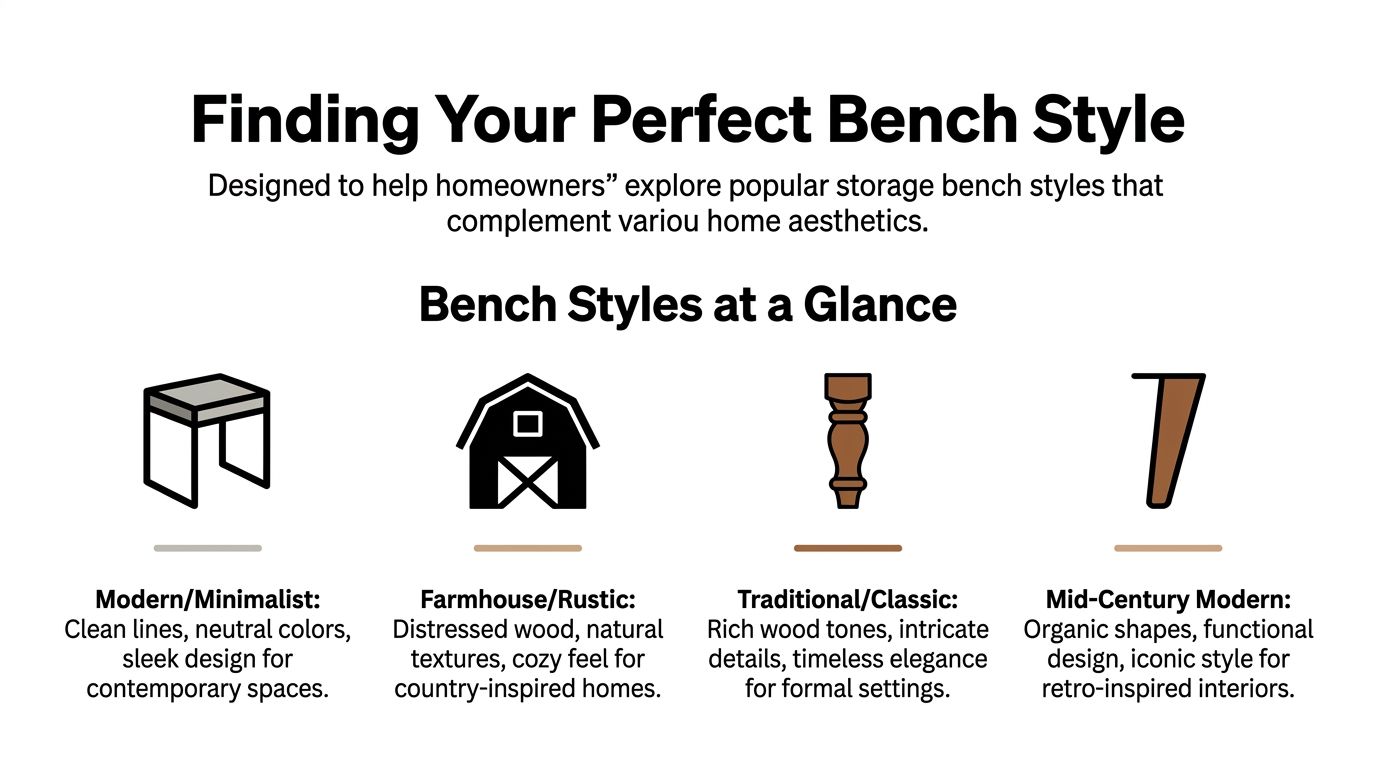
Bench styles at a glance
Modern and minimalist
This look favors clean lines, simple shapes, and low visual noise.
If your home has clean-lined lighting, fewer accessories, and a calmer palette, a bench with a neat profile and understated hardware will usually fit best. These benches often work well in condos, newer homes, and rooms that already have a tidy architectural feel.
Farmhouse and rustic
This style feels warmer and more relaxed.
You will often see wood grain, textured finishes, and a slightly more grounded silhouette. If you are gathering ideas for that broader look, a visual reference like a Farmhouse Kitchen can help you spot the same common themes in tone, texture, and materials.
Traditional and classic
Traditional benches usually bring more detail. Think shaped legs, richer wood tones, or upholstered tops with a more formal look.
These work well in homes with layered furnishings, framed art, and a more timeless mix of pieces.
Mid-century modern
This style has a strong design history. An important milestone in storage bench design came from Scandinavian functionalism in the 1950s, which influenced over 40% of global mid-century modern furniture exports by the 1960s and helped set the standard for “form follows function” (Accio).
That heritage still shows up today in tapered legs, lighter visual weight, and practical design with little excess.
Choose the right storage type
Style matters. Access matters too.
Lift-top benches
Best for larger, softer items.
These are great for blankets, extra pillows, and things you want to store in one open compartment. They are simple to use and usually give you the most flexible interior space.
Drawers
Best for separation and order.
If you want to keep items sorted, drawers make that easier. Shoes in one section, pet gear in another, scarves in a third. They create structure for people who dislike digging through one large compartment.
Open cubbies
Best for quick access.
These fit homes where convenience matters more than concealment. If the bench sits in a mudroom-style area, cubbies can help family members grab what they need without opening anything.
A simple style test
Ask these three questions:
- Does this bench echo the shapes already in my room?
- Do I want the storage hidden or divided?
- Will I still like this finish when the room evolves?
A good bench should look at home on day one and still make sense after you swap rugs, paint, or bedding later on.
Sizing and Placing Your Storage Bench
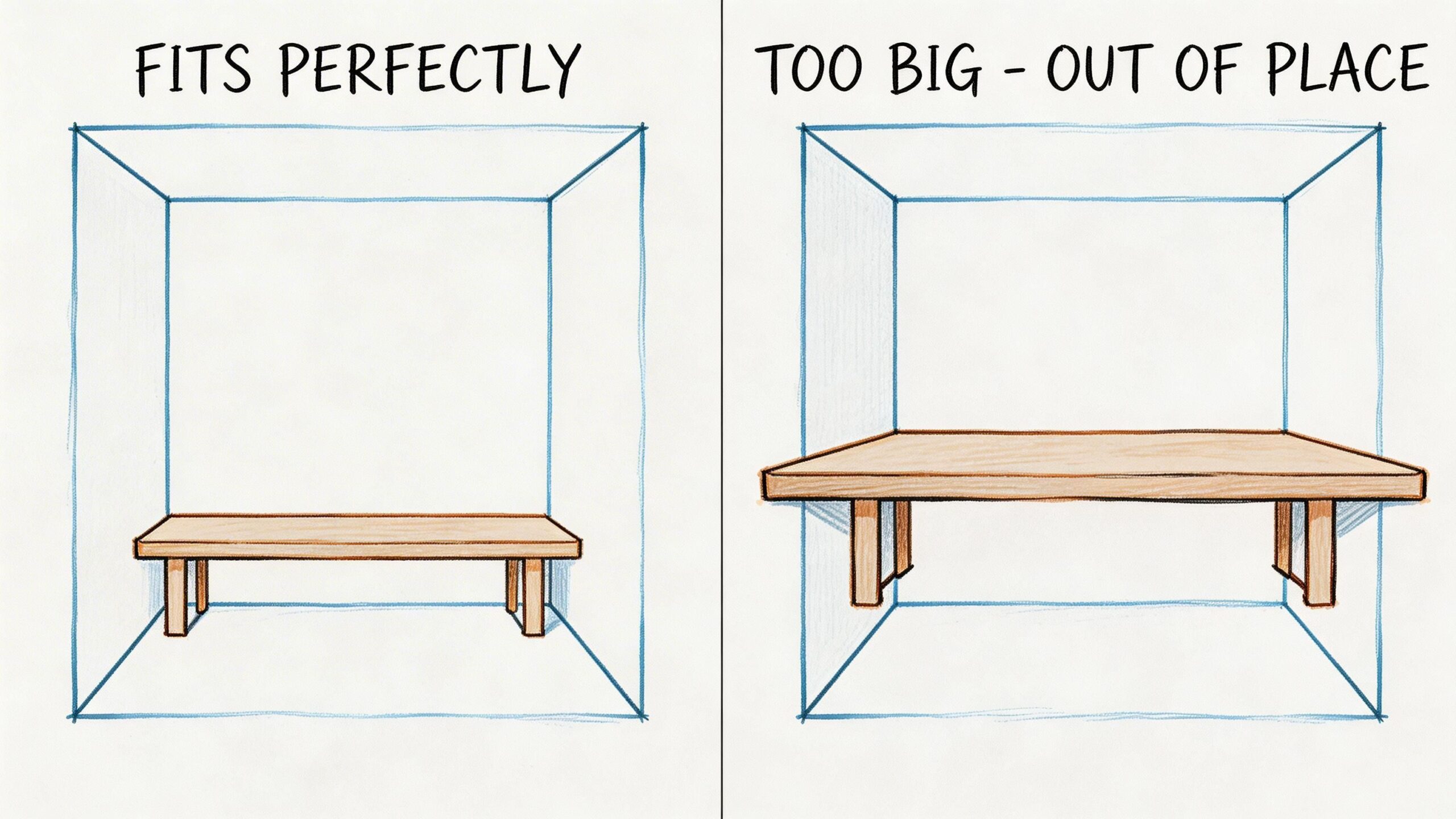
A beautiful bench can still feel wrong if it is too deep, too long, or placed where it interrupts the room.
Most sizing mistakes happen because people focus only on the bench itself. The better approach is to think about the space around it. Can you walk past it easily? Can the lid open without hitting the wall? Does it feel balanced with the furniture nearby?
A smart reminder comes from custom bench conversations. There is a real advice gap around awkward spaces. One source notes that Etsy lists over 500 “corner storage bench” options, yet there are still few detailed guides on fitting unusual angles or matching local architectural styles (MyCornerBench).
Start with these three measurements
Write them down before you shop.
- Width available
Measure wall to wall, or the zone where the bench will sit. - Depth available
People often go wrong at this stage. You need room for the bench and enough space to move around it comfortably. - Height in context
Think about nearby windowsills, bed height, wall art, and whether the piece should feel low-profile or more substantial.
If bench depth is the part that trips you up, this guide to https://www.millerwaldrop.com/bench-seat-depth/ gives helpful context.
Best placement by room
Entryway
Keep the bench close enough to the door to be useful, but not so close that it blocks the swing of the door or narrows the path into the home.
If people stop there to remove shoes, the area needs breathing room. You should not feel like you are squeezing around the bench every time you come in.
Bedroom
At the foot of the bed, the bench should feel related to the bed, not oversized compared to it.
Visually, the room should still read as open. Functionally, you should be able to walk around the bench without feeling cramped.
Living room
A storage bench in a living room often works best under a window, along a wall, or as a flexible accent piece.
In this setting, think of it as part storage, part extra seating. It should support the room without pretending to be the main piece.
Awkward spaces need a different mindset
Bay windows, angled walls, and corners can be excellent spots for a bench, but they require more careful measuring.
For bay windows
Measure each wall segment separately. Do not assume the angles are perfectly uniform.
Also think about the practical side. Will a lift-top open cleanly under the window trim? Will cushions get direct sun most of the day?
For corners
Corners sound simple until trim, outlets, and baseboards get involved.
Measure low and high. Walls that seem square can shift enough to affect fit, especially if you want a built-in or near-built-in look.
Tip: Painter’s tape on the floor is one of the easiest ways to test a bench footprint before you buy. It lets you feel the traffic flow, not just see the numbers.
Styling Your Bench to Elevate Your Space
A storage bench earns its keep through function. It earns its charm through styling.
At this stage, the piece stops feeling purely practical and starts feeling intentional. A plain bench can become the moment that makes an entry feel welcoming or a bedroom feel finished.
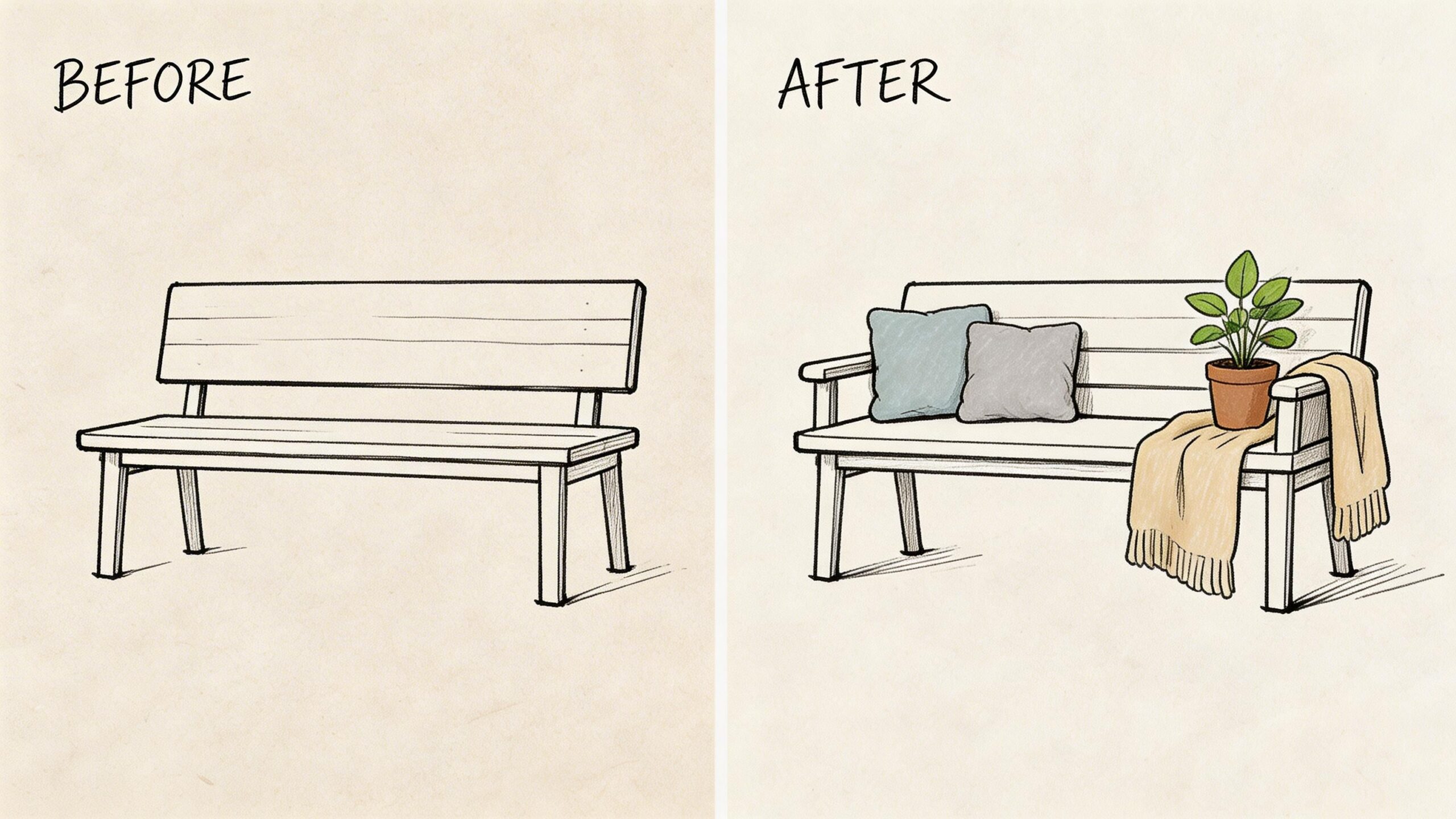
A simple wood bench in a hallway can look a little bare on its own. Add one lumbar pillow, a small basket nearby, and a mirror above it, and suddenly the same piece feels considered.
In a bedroom, the mood shifts again. An upholstered storage bench at the foot of the bed can carry the color story of the bedding. A folded throw on one corner softens the look and makes the room feel lived in rather than staged.
Three easy styling moves
Add one soft layer
A pillow or folded throw helps a bench feel more inviting.
Do not overload it. One or two pieces usually look better than a pile, especially if the bench is in an entry where people need to sit down.
Style the wall above it
A bench often looks best when it has something anchoring it visually.
Try one larger mirror, one substantial piece of art, or a small grouped arrangement if the wall is wide. This helps the bench feel connected to the room rather than floating on its own.
Balance the sides
A plant, basket, or small accent nearby can complete the scene.
The key is scale. If the bench is simple and low, a taller plant or framed mirror can provide height. If the bench already has a tall back or bold upholstery, keep the accessories quieter.
Matching style to use
There is a practical side to styling too.
- Busy entry: Keep decor minimal so seating and storage stay easy to use.
- Bedroom: Lean softer with textiles and a calmer palette.
- Living room: Tie the bench into nearby upholstery, wood tones, or accent colors.
Key takeaway: The best-styled bench still looks easy to live with. If the accessories get in the way of sitting, opening, or storing, pull back.
Good styling should support the piece, not complicate it.
Your Design Partner for the Perfect Home
A bench seat with storage looks simple. Choosing the right one takes more judgment than anticipated.
You are balancing size, style, storage type, construction quality, and how the piece will behave in your specific home. That gets even more important in West Texas and Southeastern New Mexico, where dust, dryness, and day-to-day family use can be hard on furniture.
One often-missed issue is climate durability. In environments like Southeastern New Mexico, solid hardwoods outperform MDF by 50% in warp tests, which matters when shoppers are trying to balance appearance with long-term value (Walmart category overview).
That kind of detail changes a purchase from “looks good today” to “still works well years from now.”
Why local guidance matters
A local furniture team sees patterns that online filters cannot.
They know which finishes hold up better in regional conditions. They know when an upholstered bench needs a more forgiving fabric. They know that a ranch-style home, a compact townhouse, and a mountain retreat may all need very different proportions, even if the customer starts with the same idea.
What helps most when you shop in person
Touch the materials
Online descriptions flatten the difference between solid, sturdy construction and something that only looks substantial in a photo.
When you open a bench, sit on it, and inspect the finish, the quality gap becomes easier to read.
Compare styles side by side
A bench that seemed perfect online may feel too formal, too deep, or too visually heavy once you see it near other pieces.
That is not a setback. It is useful information.
Ask about custom options
Awkward spaces, specific finishes, and fabric concerns are common reasons people delay a purchase.
A custom order can solve those problems cleanly, especially when the room needs a certain scale or a more durable material choice.
For shoppers who want to browse options in one place, the accent bench collection at https://www.millerwaldrop.com/c/accent-benches is a practical starting point.
Miller Waldrop Furniture & Decor has served families in Lubbock, Hobbs, and Ruidoso Downs for over 70 years, with curated showrooms, design help, and a selection that includes trusted brands such as Flexsteel, Hooker, Ashley, and La-Z-Boy. That kind of support matters when you want a piece that fits your room, your routine, and your climate.
The right bench is not just another accent. It is one of those pieces that makes home life easier every single day.
If you are ready to find a bench seat with storage that fits your room and your routine, Miller Waldrop Furniture & Decor can help. Visit the showrooms in Lubbock, Hobbs, or Ruidoso Downs to compare styles in person, explore quality brands, and get design guidance for tricky spaces, family-friendly materials, and long-term furniture choices.